
GRAY WHALES
GIANTS IN MOTIONby Laura Marx, Spring 2023

Gray whale off the Oregon coast. photo by Dan Meyers on Unsplash
GRAY WHALES
GIANTS IN MOTIONby Laura Marx, Spring 2023
Gray whales and their amazing migrations up and down the west coast of the U.S. have made an impact in my life ever since I was a child. In the 1990’s I remember following the story and being in awe of JJ, the young gray whale who was rescued and rehabilitated by Sea World San Diego. In later years, whale watching season off the coast of San Diego was an event to look forward to every year from December to April. Depending on what month it was, tourists and locals would be on the lookout for gray whales traveling south to their overwintering grounds, or in the late spring sometimes we would be lucky enough to see mother and calf pairs, who were often the last to start their journey north.
Years later, now residents of Seattle, my partner and I recently witnessed a gray whale in mid-summer near the northern half of Whidbey Island. Our whale watching tour guides explained that it was a whale who stayed as a temporary resident to feed in the Puget Sound. I love that, despite the fact that I now live over 1,000 miles away from my hometown in southern California, I can still observe these gentle giants on a different part of their migratory journey and life stage. Their set route makes it somewhat predictable where they can be seen at different times of the year.
While I refer to them as gentle giants, compared to other whale species, gray whales are actually medium sized. And in terms of appearance, gray whales might not be judged as conventionally attractive to the average person’s eye. Their bodies are often mottled with scars from being covered in barnacles and whale lice, and they have a bumpy back in place of a dorsal fin. What I find most charming about them compared to other whales is that their two blowholes create a heart shaped spout, which makes them recognizable from afar. And, of course, they are most celebrated for their incredible ability to repeat the same epic movement patterns, every year of their lives.

Closer view of gray whale showing the heart-shaped spout. photo by Dan Meyers on Unsplash
As recently as 2017, three distinct migrating populations of gray whales were recognized: the North Pacific Migratory population, the Pacific Coast Feeding Group population, and the Western Pacific population. Gray whale migratory patterns are determined by several factors, involving their reproductive timelines as well as seasonal food availability. While individuals from all three of these populations have been identified using the same location for winter calving grounds in Baja California, Mexico, their behavior differs in where they spend their summers feeding. The North Pacific Migratory population will travel to feed in the arctic waters near Alaska, while the Pacific Coast Feeding Group population does not travel as far, and spends the summer feeding in the Pacific Northwest. The Western Pacific population feeds off the east coast of Russia. This third population is complex, because only some of the population joins the southern migration to Mexico, while other members of this population have been seen in the winter near Japan and China.

Blue indicates area of gray whale migration by the North Pacific Migratory population and the Pacific Coast Feeding Group population. by Pcb21 CC-BY-SA-3.0 via Wikimedia Commons

During their annual journey, gray whales can travel an average of 10,000 to 12,000 miles. From north to south and vice versa, it generally takes them two to three months to complete the journey one way, moving at a slow and steady pace of about five miles per hour. After feeding all summer in productive northern waters, whales will follow their prey’s migration south in the fall and then continue their journey to their wintering grounds in Mexico, where they will fast while breeding and calving. Throughout the spring, whale watchers along the west coast can spot gray whales on their way back to their northern destination, completing the round trip.
The warm and safe lagoons to which gray whales travel every winter are protected wildlife refuges, and for good reason, as they provide essential conditions for gray whale calf survival. Adult females have even been observed returning to their natal lagoons. After 13 months of gestation, female gray whales usually give birth in January and nurse their calves until they are strong enough to attempt to travel north. In preparation for their long journeys ahead, gray whale mothers and their calves need to conserve energy, and the warm waters of their lagoon shelters help with this. In warmer temperatures, mothers are able to devote all their energy to nursing, and calves can grow quickly. During this early stage, the few months of overwintering also help mothers and their babies avoid the gray whale’s main predator: orcas, which are not seen as frequently that far south.
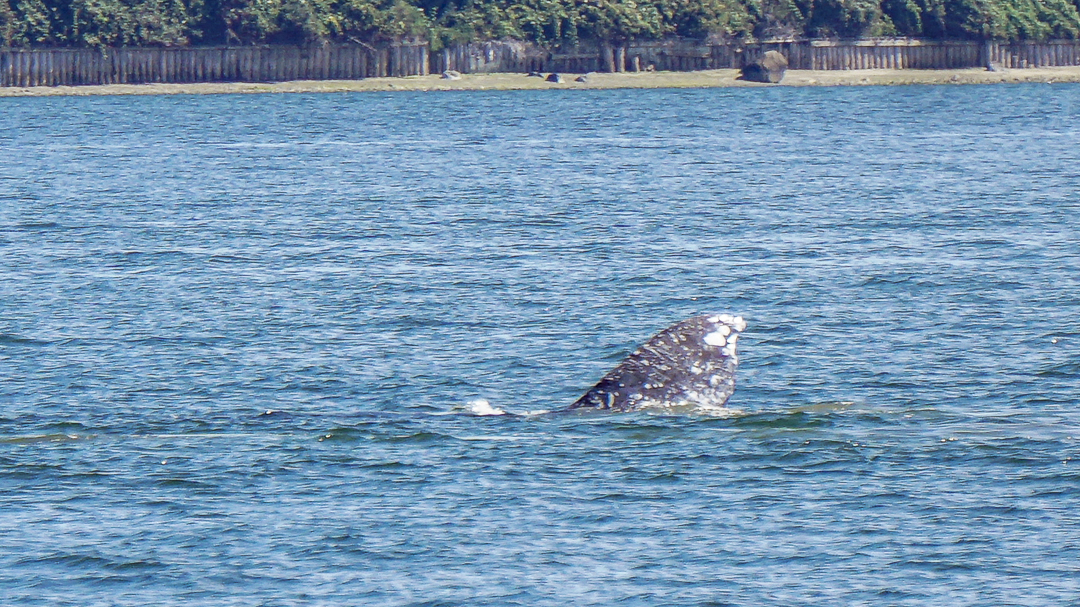
Graywhale fin not far from shore in the Salish Sea. photo by Laura Marx
Gray whales are unique in terms of feeding behaviors because, unlike other baleen whales, they generally don’t feed on plankton or fish in the water column. Instead, they consume mostly benthic crustaceans and filter feed by turning on their sides and sifting through the sediment on the ocean floor. During feeding season, they can consume up to 170 tons of food before months of fasting. In terms of conservation concern, climate change is affecting the food chain at all levels, including benthic organisms upon which the gray whales depend. Sea ice melting too early in the north will affect the timing of productive phytoplankton blooms, which in turn could affect the distribution and abundance of the bottom dwelling amphipods that are the main source of gray whales’ diets. Fortunately, gray whales have been observed to be opportunistic eaters and can switch to feeding off of zooplankton when it is more available, which could be good news for gray whales in the future as waters warm.

Gray whale spout. photo by Laura Marx
The best time to observe gray whales in Puget Sound is in the spring, as they pass by on their way to summer waters. A group of gray whales called the Sounders, which belong to the North Pacific Migratory population, makes a regular appearance and sometimes stays for longer periods of time feeding on locally common ghost shrimp. Recently the Sounders have been observed arriving earlier and earlier in the year, and sometimes staying through the winter. They were first seen doing this in 2019, a year of notable change of food availability in the Arctic, and a year of tragic mass gray whale mortality. If this trend continues, we may see more hungry whales each year in local waters. Eager eyes will be watching to see how the whales’ migration behaviors adapt to future changes.
While gray whale populations were once close to extinction due to overexploitation by the commercial whaling industry, protections in the 1900s helped them recover over several decades. Today the North Pacific Migratory population’s current numbers are considered stable. Unfortunately, since designating gray whales into three distinct populations, the Pacific Coast Feeding Group population and the Western Pacific population have been assessed as endangered. Within U.S. waters, all gray whales are protected by the Marine Mammal Protection Act (MMPA), and their long migrations do put them at risk for accidents with boats. Under the MMPA, boats are not allowed to approach whales closer than 300 feet. Gray whales are known for their friendly and curious demeanor and have been known to approach boats full of lucky passengers.
Someday, my dream is to travel to the lagoons in Mexico to watch gray whales on the winter rest stop leg of their journey, following these ocean giants on their amazing migration once more.

Laura Mariko Marx is a recent resident of Seattle but is loving everything about living in the majestic Pacific Northwest. She attributes her love for wildlife to having grown up in San Diego, a city that gave her exposure to animals, conservation issues, and the outdoors. Laura is currently a botany interpreter at The Spheres in Seattle and a volunteer at the Seattle Aquarium. In her spare time, she enjoys writing, reading, yoga, arts and crafts, hiking, SCUBA, and spending time with her partner and their house full of pets.
Table of Contents, Issue #19, Spring 2023
Underground Movement
by Amy Porter, Spring 2023 Wolf Haven mounded prairie. photo by Wolf Haven Internationalby Amy Porter, Spring 2023On Wolf Haven’s mounded prairie, there is an underground movement happening that largely goes unnoticed — bioturbation (the movement of soil) by Mazama...
A Window on Eelgrass
by Kylie Rench, Spring 2023 photos by John F. Williams by Kylie Rench, Spring 2023 photos by John F. WilliamsLow tide opens a window for the beach walker onto the vibrant world of eelgrass meadows. Submerged by salt water during most tidal cycles, these meadows are...
Poetry-19
Spring 2023 photo by Thomas NolandSpring 2023Sand and Water by Jeffrey Hummel Sand infinite amountsappearing all the sameBlowing, shifting, changingAbrasiveA handful you can’t holdSlides through your fingersGets into everythingevery part of youEvery nook, crack...
Lizard’s Locomotion
by Karin Kersteter, Spring 2023 illustrations by Karin Kersteter by Karin Kersteter, Spring 2023illustrations by Karin KersteterThere is an expression “leave the leaves,” which is designed to encourage people to let leaves lie in yards and gardens, rather than rake...
Turbulence
by Rebekah Boettcher, Spring 2023 photos by Rebekah Boettcher except as noted Seagull with clam. photo by John F. Williamsby Rebekah Boettcher, Spring 2023 photos by Rebekah Boettcher except as notedHow did I get here? I ponder, stunned once again as we walk down to...
Learning from a Snail’s Pace
by Michelle Ryder, Spring 2023 Photos by Michelle Ryder except as noted Mapfire peering over the side of the bathtub from inside of it.by Michelle Ryder, Spring 2023 Photos by Michelle Ryder except as notedIn 2022 a snail came into my life. And stayed. Late last...
Movement Imagery
Spring 2023 Cowling Creek, Suquamish. photo by John F. WilliamsSpring 2023Here is a collection of photos and art work depicting various kinds of movement. You may enjoy playing the audio file below as you view the photos. The music evokes the feeling of motion through...

Plant motion
text and photos by John Bolivar, Spring 2023 Ribes sanguineum floral bud encased in ice.text and photos by John Bolivar, Spring 2023At first look it would appear that plants do not have the luxury of movement to help them avoid bad weather — like our recent bout of...
2022 Photo Challenge
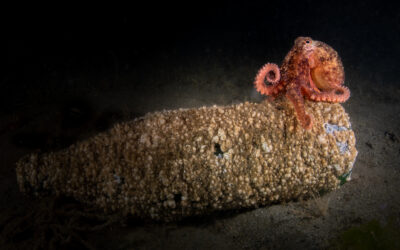
by MaST Center Aquarium, Spring 2023 Jurors' Favorite - On the Bottle, Veronika Nagy. Small octopus sitting on a bottle. by MaST Center Aquarium, Spring 2023The Underwater Photography Challenge focuses on bringing divers to Redondo Beach, Washington, to highlight the...
COPYRIGHT
Copyright SEA-Media
All rights reserved. Reproduction or distribution, in whole or in part. without consent of copyright owner is strictly prohibited — except for brief quotations in critical reviews and other noncommercial uses permitted by copyright laws.
SEA-Media is a 501(c)(3) nonprofit corporation
PLEASE HELP SUPPORT
SALISH MAGAZINE
DONATE
Salish Magazine contains no advertising and is free. Your donation is one big way you can help us inspire people with stories about things that they can see outdoors in our Salish Sea region.
We also don't advertise Salish Magazine, so please spread the word of this online resource to your friends and colleagues.
Thanks so much for your interest and your support.