
High-flying Lichen: Three Aerial Traits That Increase Its Likability
by Celeste Hankins, Winter 2024-25

Snow on fruticose lichen. photo by John F. Williams
High-flying Lichen: Three Aerial Traits That Increase Its Likability
by Celeste Hankins
Winter 2024-25
Audio Version
Look up! You can’t miss them. They drip from the trees, soft, pale gray-green, and a bit mysterious. These pendulous organisms are called fruticose lichens. Often mistaken for moss, they sway overhead like tangled tassels on the forest’s trunks and branches.
 Fruticose is one of three main lichen body types. An article from our Autumn 2019 issue tells about (and shows) all three.
It’s easiest to remember the lichens’ common names. The witch’s hair hangs lank and stringy. Old man’s beard sags overhead in scruffy tufts. And Methuselah’s beard, stretchy like elastic, grows up to 20 feet long and drapes the forest like faded ribbons.
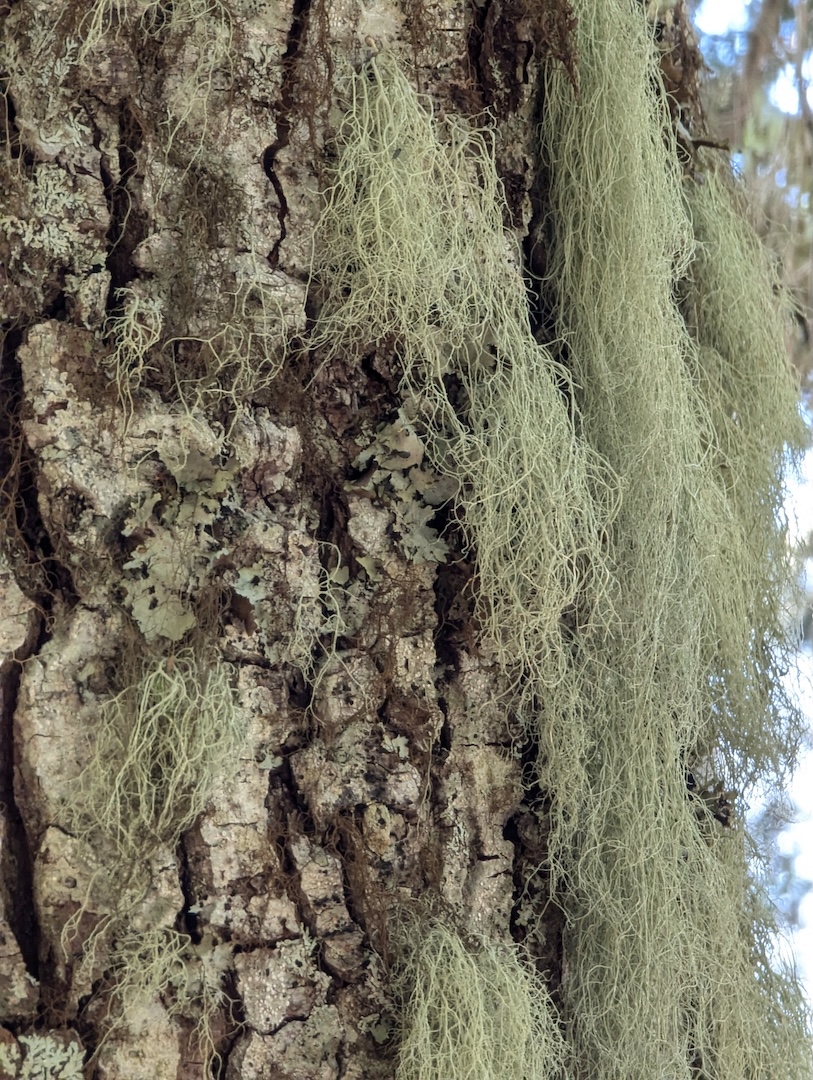
Witch’s hair lichen (Nodobryoria oregana) in Skagit County, WA. photo by Timothy McNitt via iNaturalist, some rights reserved (CC-BY)
These high-flying organisms are some of nature’s most creative concoctions. They’re a symbiotic mashup of fungi and algae, with three airborne properties that set them apart in the Salish woodland.
First, they turn air into life
Lichens do not have roots. They are epiphytic. That means they absorb nutrients and moisture directly from the air and rain, like a collection of mini mops.
Within the lichen, fungus and alga work in tandem to process what they collect. Fungal cells provide structure and protection, while the alga acts like a metabolic engine, using the nutrients absorbed from air to make food through photosynthesis.
Since the organisms absorb everything present in the air, they’re sensitive to pollution and can indicate air quality, like a canary in a coal mine. Scientists often analyze amounts of heavy metals, carbon, and sulfur within the organisms, and their results help monitor and predict atmospheric changes that affect the Salish ecosystems.

Old man’s beard lichen (Usnea barbata) near Darrington, WA. photo by halocline via iNaturalist, some rights reserved (CC-BY-NC)
Second, fruticose lichens live the single high life
While many lichens use tiny fruiting spores to reproduce sexually, fruticose lichens in the Salish canopy primarily reproduce with asexual, aerial propagation.
The process begins with fragmentation. A lichen, perhaps swinging in the breeze, gets blown a bit too hard, and a fragment breaks free.
This fragment is made up of a tiny bit of algal cells wrapped in a few strands of fungus, and it sails through the forest air. The wind or rain may transport it further. Or a bird or a squirrel may carry the snippet to another branch or a nearby conifer. When the fragment finally lands and settles, it forms a new lichen structure: baby lichen.
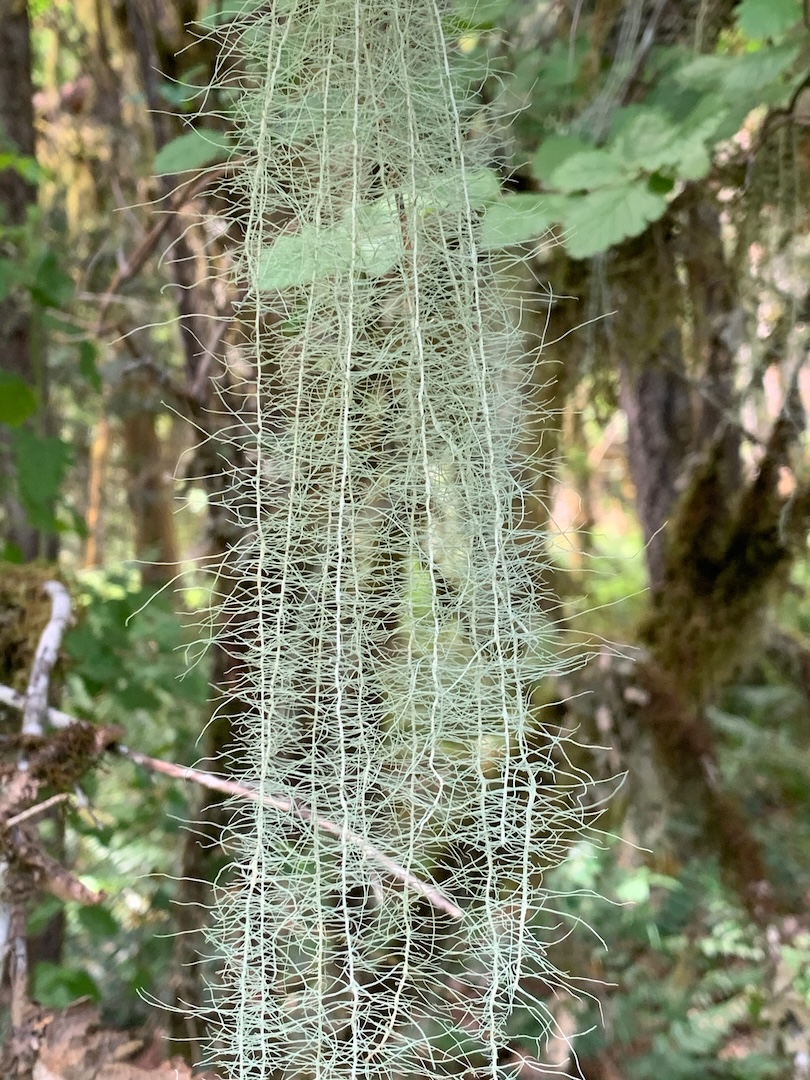
Methuselah’s beard lichen (Usnea longissima) in Cowichan Valley, BC, Canada. photo by John D Reynolds via iNaturalist, some rights reserved (CC-BY-NC)
Third, fruticose lichens support the forest’s airborne creatures
While lichens are sometimes considered their own ecosystem, many birds rely on them for raising their young. More than 50 species of North American birds, including hummingbirds near the Salish Sea, use lichen when building their nests. Flying squirrels also add lichen to their nests because of its insulating properties. Fruticose lichens, like witch’s hair and old man’s beard, are especially accessible to wildlife living amongst the trees and shrubs.
So, the next time you visit the Salish woods, don’t forget to look up, enjoy, and remember the likability of lichen.
FIND OUT MORE
See more about lichen as it grows In the Company of Alders, by Phoebe Goit in Issue #8, Summer 2020

Celeste Hankins is a freelance writer and nature guide living in the Pacific Northwest, just a short hike from the Salish Sea. She has an MA in Science Writing from Johns Hopkins University and is a certified marine naturalist from the San Juan Whale Museum. Celeste also volunteers as a habitat interpreter at the Seattle Aquarium and as a citizen scientist monitoring sea birds and harbor porpoises. Come rain or shine, you can find Celeste narrating scenic cruises on the fjord, swimming with seals, or leading family beach walks.
Issue Page
Table of Contents, Issue #26, Winter 2024-25

By the Wind Sailor
By-the-wind Sailor by Andy Lamb, Winter 2024-25A beach strewn with by-the-wind sailors that have been blown ashore. photo by Rick Harboby Andy Lamb Winter 2024-25When asked to contribute something about marine life for the "In the Air" issue of the Salish Magazine, it...

Aerial Relationships
Red alder strobiles and catkins. photo by Sarah Ottinoby Sara Ottino Winter 2024-25“If you reveal your secrets to the wind, you should not blame the wind for revealing them to the trees.” — Kahlil Gibran Plants and air have a complex relationship. Plants...

Eggs On a Journey
by Christina Jarvis Winter 2024-25 I heard about the theory that one way fish can spread to new bodies of water is when waterfowl eat fish eggs and then poop them out into new places. For example, this could be how a new alpine lake gets its fish. An ecology research...

Dance of the Fairy Moth
Dance of the Fairy Moth by Mary Johnson, Winter 2024-25Ocean spray fairy moth. photo by oxalismtp via iNaturalist, some rights reserved (CC BY-NC)by Mary Johnson Winter 2024-25the discovery One morning while exploring the yard deep into May, I spot an insect no longer...

Listen to Wandering
by Meiwei Winter 2024-25Barn swallow looking for insects in a grassy field in Hansville. photo by John F. Williamsby Meiwei Winter 2024-25 Here's a song — you can read the words as you listen.WANDERING by Meiwei Where there’s a way there’s an aimless wandererWhere...

Poetry 26
by multiple poets Winter 2024-25Cormorants in Rich Passage. photo by John F. Williamsby multiple poets Winter 2024-25Along Rich Passage by Sue Hylen Along Rich Passage Cormorants guard pier pilings sea lions honk their songs seven geese...

Windblown trees
by Paul Brians, Winter 2024-25Paul Brians is an active member of the Bainbridge Island Photo club. His daily walks usually take him into nearby Battle Point Park, where he recently shot numerous images of autumn color, including this brief video of trees near the duck...
COPYRIGHT
Copyright SEA-Media
All rights reserved. Reproduction or distribution, in whole or in part. without consent of copyright owner is strictly prohibited — except for brief quotations in critical reviews and other noncommercial uses permitted by copyright laws.
SEA-Media is a 501(c)(3) nonprofit corporation
PLEASE HELP SUPPORT
SALISH MAGAZINE
DONATE
Salish Magazine contains no advertising and is free. Your donation is one big way you can help us inspire people with stories about things that they can see outdoors in our Salish Sea region.
We also don't advertise Salish Magazine, so please spread the word of this online resource to your friends and colleagues.
Thanks so much for your interest and your support.