
Eggs on a Journey
by Christina Jarvis
Winter 2024-25
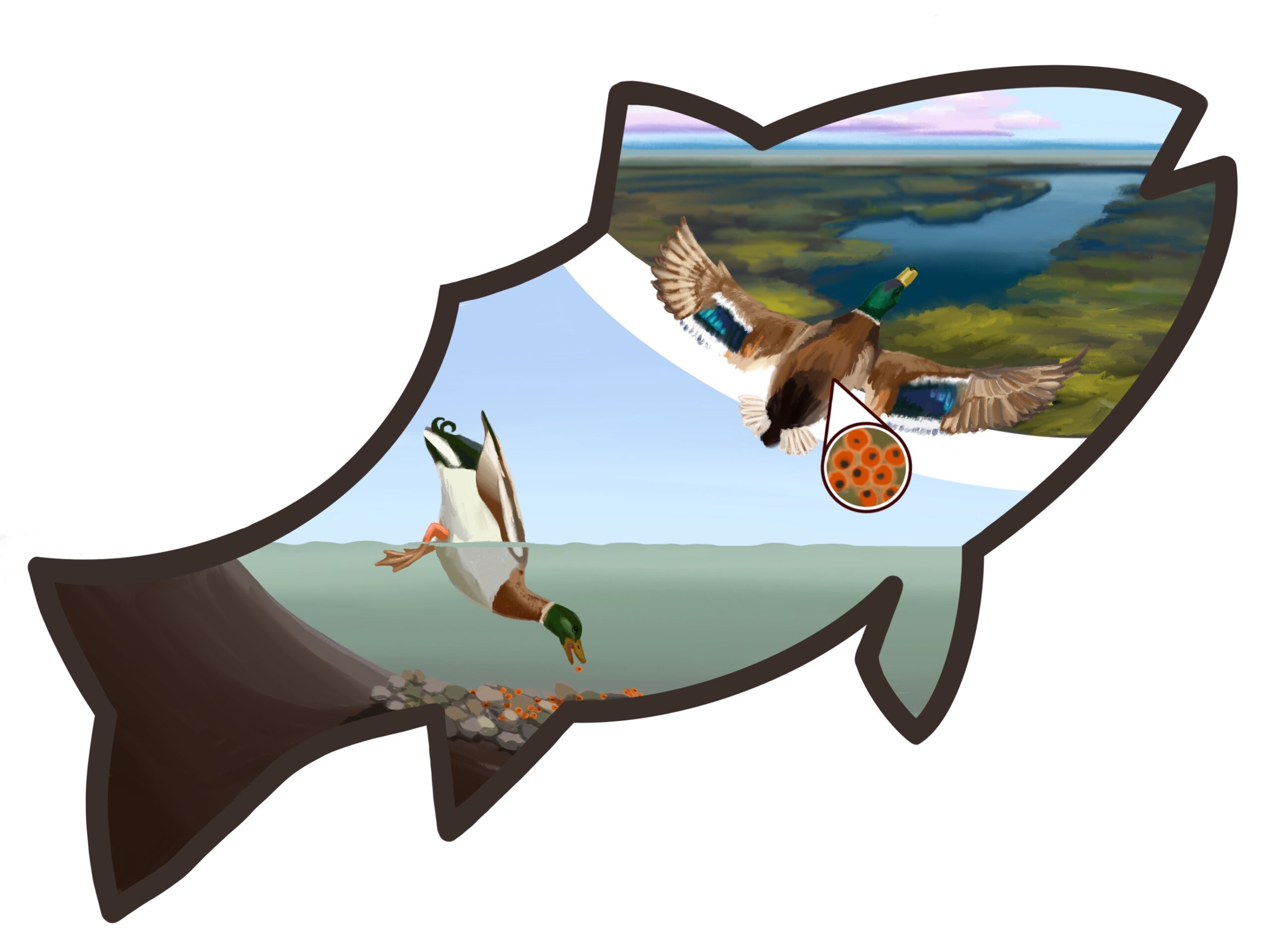
I heard about the theory that one way fish can spread to new bodies of water is when waterfowl eat fish eggs and then poop them out into new places. For example, this could be how a new alpine lake gets its fish. An ecology research group published a study (see links below) showing that the eggs of at least one fish species can survive transport through a bird’s digestive system.
When the “In the Air” call for submissions came out, I wanted to see if I could depict this idea in a single image. The fish deposits its eggs in the gravel bed, and the duck eats them and then flies to a new place with those eggs in his stomach, as shown by the zoom circle.
FIND OUT MORE
Fish Eggs Survive Journey through a Duck by Rachel Nuwer, Scientific American
Experimental evidence of dispersal of invasive cyprinid eggs inside migratory waterfowl by Ádám Lovas-Kiss, Orsolya Vincze, Viktor Löki, Felícia Pallér-Kapusi, Béla Halasi-Kovács, Gyula Kovács, Andy J Green, Balázs András Lukács in PubMed Central, National Library of Medicine.

Christina Jarvis is a Seattle-based artist focusing on animal and nature painting. She works with both traditional media like watercolor and gouache, and digitally. You can see more of her work on Instagram @skertina.
Issue Page
Table of Contents, Issue #26, Winter 2024-25

By the Wind Sailor
By-the-wind Sailor by Andy Lamb, Winter 2024-25A beach strewn with by-the-wind sailors that have been blown ashore. photo by Rick Harboby Andy Lamb Winter 2024-25When asked to contribute something about marine life for the "In the Air" issue of the Salish Magazine, it...

Aerial Relationships
Red alder strobiles and catkins. photo by Sarah Ottinoby Sara Ottino Winter 2024-25“If you reveal your secrets to the wind, you should not blame the wind for revealing them to the trees.” — Kahlil Gibran Plants and air have a complex relationship. Plants...

Dance of the Fairy Moth
Dance of the Fairy Moth by Mary Johnson, Winter 2024-25Ocean spray fairy moth. photo by oxalismtp via iNaturalist, some rights reserved (CC BY-NC)by Mary Johnson Winter 2024-25the discovery One morning while exploring the yard deep into May, I spot an insect no longer...

High-flying Lichens
High-flying Lichen: Three Aerial Traits That Increase Its Likability by Celeste Hankins, Winter 2024-25Snow on fruticose lichen. photo by John F. Williams by Celeste Hankins Winter 2024-25Look up! You can’t miss them. They drip from the trees, soft, pale gray-green,...

Listen to Wandering
by Meiwei Winter 2024-25Barn swallow looking for insects in a grassy field in Hansville. photo by John F. Williamsby Meiwei Winter 2024-25 Here's a song — you can read the words as you listen.WANDERING by Meiwei Where there’s a way there’s an aimless wandererWhere...

Poetry 26
by multiple poets Winter 2024-25Cormorants in Rich Passage. photo by John F. Williamsby multiple poets Winter 2024-25Along Rich Passage by Sue Hylen Along Rich Passage Cormorants guard pier pilings sea lions honk their songs seven geese...

Windblown trees
by Paul Brians, Winter 2024-25Paul Brians is an active member of the Bainbridge Island Photo club. His daily walks usually take him into nearby Battle Point Park, where he recently shot numerous images of autumn color, including this brief video of trees near the duck...
COPYRIGHT
Copyright SEA-Media
All rights reserved. Reproduction or distribution, in whole or in part. without consent of copyright owner is strictly prohibited — except for brief quotations in critical reviews and other noncommercial uses permitted by copyright laws.
SEA-Media is a 501(c)(3) nonprofit corporation
PLEASE HELP SUPPORT
SALISH MAGAZINE
DONATE
Salish Magazine contains no advertising and is free. Your donation is one big way you can help us inspire people with stories about things that they can see outdoors in our Salish Sea region.
We also don't advertise Salish Magazine, so please spread the word of this online resource to your friends and colleagues.
Thanks so much for your interest and your support.