
Aerial Relationships
by Sara Ottino, Winter 2024
Red alder strobiles and catkins. photo by Sarah Ottino
Aerial Relationships
by Sara Ottino
Winter 2024-25
“If you reveal your secrets to the wind, you should not blame the wind for revealing them to the trees.” — Kahlil Gibran
Plants and air have a complex relationship. Plants exchange carbon dioxide and oxygen with the atmosphere, and strong winds can uproot trees, but the relationship some plants have with air is rooted even deeper.
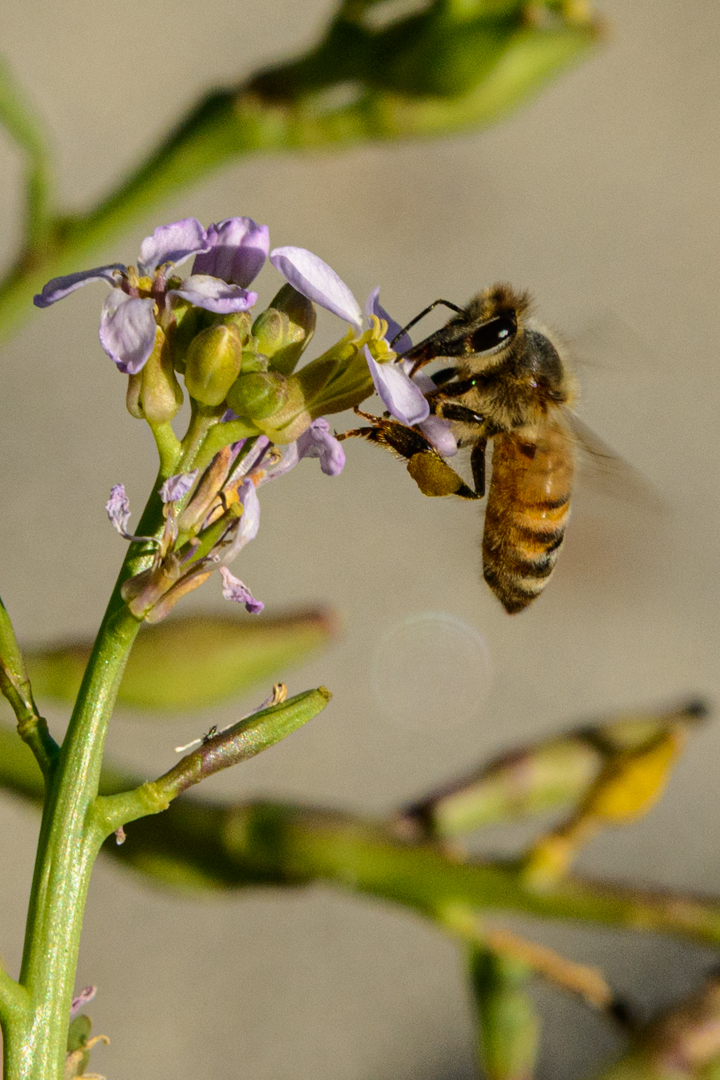
Bee pollinating a flower. photo by John F. Williams
airborne affairs: the wind’s role in plant reproduction
Pollination happens when pollen is transferred from the male part of a plant to the female part of the same or different plant. This leads to fertilization and the development of a seed. The word “pollination” rouses images of bees, butterflies, and hummingbirds, and while these animals are important pollinators for many plants, other plants rely on air for pollen transport.
Seed-producing plants are sorted into two categories: gymnosperms (naked seeds) or angiosperms (flowers and fruits). Around 98% of gymnosperm species are wind-pollinated while only 10% of angiosperms are pollinated by wind. Plants that rely on living creatures for pollination often have showy or fragrant flowers that attract insects, birds, or mammals. In contrast, the flowers of wind-pollinated plants are usually small and neutral-colored.
Some wind-pollinated trees produce catkins. A catkin is a cluster of flowers, either male or female. They frequently hang onto their parent tree or shrub longer than other flowers, so you can spot them dangling from branches even in the fall and winter. Other wind-pollinated plants do not produce flowers at all; they instead develop cones.
While flowering plants reliant on animal pollination put a lot of energy into developing attractive flowers, wind-pollinated plants use their energy to create large quantities of pollen. Since the wind is less precise at transferring pollen than animals are, much of the pollen a wind-pollinated plant produces may never reach its intended target. The more pollen a plant produces, the more likely it is that some pollen will successfully land on a female flower or cone. Unfortunately, large amounts of pollen drifting through the air is a nightmare for people and animals with pollen allergies.

Seed cones of Western red cedar
photo by Walter Siegmund, some rights reserved (CC-BY-SA 3.0)

Catkins of Sitka willow
photo by Eli S. Harris, some rights reserved (CC-BY-NC)

Seed cone of Douglas fir
photo by John F. Williams

Catkins of hazelnut
photo by John F. Williams
wind-pollinated species of the pnw
The Puget Sound region is home to many native plant species that rely on the wind for pollination, including grasses, Douglas fir (Pseudotsuga menziesii), Western red cedar (Thuja plicata), Garry oak (Quercus garryana), red alder (Alnus rubra), and beaked hazelnut (Corylus cornuta). Some plants, such as Sitka willow (Salix sitchensis), are pollinated by both wind and insects. English lavender (Lavandula angustifolia) is not native to the Salish Sea region, but it is loved by many local gardeners and bees, making it an excellent choice for pollinator gardens. Despite its allure to animal pollinators, English lavender can also be wind-pollinated.
 You can learn more about the red alders in this article from a 2020 issue of Salish Magazine: RED ALDER, by Thomas & Sara Noland
what’s in the wind?
Air’s role in plant reproduction is not limited to pollination. Air movement is also important for seed dispersal (anemochory) for many plants, regardless of whether the plant was pollinated by wind (anemophily) or by animals (zoophily). Big-leaf maple (Acer macrophyllum) produces inconspicuous clusters of greenish-yellow flowers that are pollinated by insects. Each flower in the cluster, when pollinated, will develop into a winged seed called a samara.
While many plants develop winged seeds, big-leaf maple is one of the few species that produces winged seeds in pairs. As the seeds dry on the tree, the pair will split apart, and each seed will fall on its own. The shape of the wing allows the seed to spin like a helicopter rotor as it falls. This enables the seed to fall more slowly and to be moved by air currents. Without any wind, the seed would spin straight down to the ground, but even the slightest movement in the air will carry the seed away from its parent tree, and, hopefully, to an ideal spot for germination.
Video: How Maple Seeds Spin by Jon Farrow
Video: How a Vortex Helps Dandelions Fly, from ScienceTake, New York Times

Dew on dandelion pappi. photo by John F. Williams
Flowers that produce seed fluff, such as dandelions and thistles, are pollinated by insects but take advantage of the wind for seed dispersal. Each white dandelion fluff consists of a seed attached to a pappus, a cluster of fine hairs. The pappus is like a parachute that catches the breeze and drifts off. The pappi (plural of pappus) on a dandelion respond to levels of moisture in the air by opening or closing their hairs. On wet days the pappi close and wait for better dispersal conditions. When the air is dry, the pappi spread open so that they can catch the breeze.
Other plants have seed pods that burst open and shoot their seeds through the air. Often, these types of plants are considered weeds because they spread so easily. Gorse (Ulex europaeus) and Scotch broom (Cytisus scoparius) are noxious weeds in Washington state. These yellow-flowering shrubs are often seen along the side of highways. Their seeds develop in a dehiscence pod, which means that the pod has a weak seam that will split open, allowing the seeds to be released. When the pod bursts open, the seeds can be ejected through the air up to 16 feet away from the mother plant.
Video: Exploding seed pods, Biodiversity shorts.
Hairy bittercress (Cardamine hirsuta), more commonly known as shotweed, is a non-native nuisance for many gardeners around the Salish Sea. Each seed inside a shotweed seed pod has a coil structure. As the seeds develop, the seed pod begins to swell and eventually splits along the line of weakness. As the pod splits open, the coils release and shoot the seeds away from the pod, and occasionally into the eye of an unlucky gardener. (Editor’s note: If you spot the invasive shotweed in your yard or garden, please contact the Noxious Weed Control Board who will help you eliminate it.)
there’s a fungus amungus
Like plants, some fungi species utilize the wind for reproduction. However, fungal reproduction is not the same as plant pollination. Spores may seem similar to pollen, but pollen is made up of male gametes (cells) which must fuse with a female gamete to cause fertilization. A fungal spore is a single cell that can germinate on its own. While pollen must transfer from the male structure to the female structure, fungal spores simply need to land in a suitable location.
Many species of fungi rely on air to disperse their spores; the most iconic may be the puffballs. Puffballs are a group of fungi that emit clouds of spores into the air. As the fruiting body, called the peridium, emerges from the ground, the structure is solid, but as it matures, the inside hollows out and is filled with powdery spores. Each spore is connected to the peridium by a tube under tension. When rain, an animal, or the wind disturbs the peridium, the tension is released, and the spores are ejected through an opening in the top of the structure in what looks like a puff of smoke.
Video: Spore release from a puffball by Merlin Sheldrake

Puffball mushroom full of spores. photo by John F. Williams

Puffball mushroom releasing spores. photo by John F. Williams
While puffballs keep their spores inside their fruiting body, gilled mushrooms develop their spores externally. These external spores can be released passively by wind or actively catapulted off the gills. Once in the air, the spores are left to the whim of the wind.
Studies on fungi have shown that because of the microscopic size of the spores, air drag quickly slows them down and they do not travel far. To increase their travel distances, some species of fungi have adapted by changing the shape of their spores to be more aerodynamic. Another adaption is to release a large quantity of spores at once. When a mass of spores is released at the same time, it generates air flow that helps carry more spores farther away from the fruiting body. One study found that spores that were released together traveled up to 20 times farther than spores that were ejected individually.
Researchers at UC Berkeley showed How fungal spores travel farther by surfing their own wind.
blowing in the winds of climate change
The relationship air has with plants and fungi is ancient, and the development path of anemophily (wind pollination) and anemochory (seed dispersal) is not the same for all species. Some plants, predominantly gymnosperms, relied on the wind from the start. Others, such as the majority of angiosperms, adapted over time to wind pollination as a response to low numbers of pollinators.
The earth is not static and changes in climate have impacts on the species that live here. It can be easy to notice how climate change affects pollinators and their plant pals, but increases in temperature also affect plant fertility. For example, higher temperatures can reduce the amount of pollen plants produce, can kill pollen, or prevent pollen from being released. Changes in rain and air moisture can also reduce how far airborne pollen, seeds, and spores will travel.
As the climate changes, some animals can migrate to suitable conditions. Plants and fungi, however, especially those reliant on the wind for seed and spore dispersal, are only able to travel where the air allows. If the wind blows a seed into inhospitable territory, that seed will not grow. If too many seeds or spores are unable to grow, species will die out.
For Species That Rely on Wind, Climate Change Won’t Be a Breeze, by Tara Lohan, The Revelator
Humans can choose to become stewards of the earth and help wind-reliant species to travel to new suitable locations. Gardeners can opt to plant a diverse mix of species in their gardens. This allows native plants access to areas they may not have been able to reach on their own. When planting trees, consider how the climate may be different once the tree is mature and choose a tree that will be better suited for future conditions.
Although climate change may cause some plant, fungi, and animal species to go extinct, others have the potential to adapt. In the past, when animal pollinators were not abundant, some plants evolved to be pollinated by the wind. While not all will survive, there is hope that some resilient plants will take advantage of the ever-present air and find a way to live on in a new climate.

Sarah Ottino — Freelance Writer & Photographer
Sarah loves to write, create, and explore nature. She travels full-time in a 20 ft. Airstream with her husband and her border collie, Nimbus. She uses life’s adventures as inspiration for healthy living, outdoor recreation, and environmental content. She often uses her photography or design graphics to complement her writing. Her website is: www.naturewritten.com
Issue Page
Table of Contents, Issue #26, Winter 2024-25

By the Wind Sailor
By-the-wind Sailor by Andy Lamb, Winter 2024-25A beach strewn with by-the-wind sailors that have been blown ashore. photo by Rick Harboby Andy Lamb Winter 2024-25When asked to contribute something about marine life for the "In the Air" issue of the Salish Magazine, it...

Eggs On a Journey
by Christina Jarvis Winter 2024-25 I heard about the theory that one way fish can spread to new bodies of water is when waterfowl eat fish eggs and then poop them out into new places. For example, this could be how a new alpine lake gets its fish. An ecology research...

Dance of the Fairy Moth
Dance of the Fairy Moth by Mary Johnson, Winter 2024-25Ocean spray fairy moth. photo by oxalismtp via iNaturalist, some rights reserved (CC BY-NC)by Mary Johnson Winter 2024-25the discovery One morning while exploring the yard deep into May, I spot an insect no longer...

High-flying Lichens
High-flying Lichen: Three Aerial Traits That Increase Its Likability by Celeste Hankins, Winter 2024-25Snow on fruticose lichen. photo by John F. Williams by Celeste Hankins Winter 2024-25Look up! You can’t miss them. They drip from the trees, soft, pale gray-green,...

Listen to Wandering
by Meiwei Winter 2024-25Barn swallow looking for insects in a grassy field in Hansville. photo by John F. Williamsby Meiwei Winter 2024-25 Here's a song — you can read the words as you listen.WANDERING by Meiwei Where there’s a way there’s an aimless wandererWhere...

Poetry 26
by multiple poets Winter 2024-25Cormorants in Rich Passage. photo by John F. Williamsby multiple poets Winter 2024-25Along Rich Passage by Sue Hylen Along Rich Passage Cormorants guard pier pilings sea lions honk their songs seven geese...

Windblown trees
by Paul Brians, Winter 2024-25Paul Brians is an active member of the Bainbridge Island Photo club. His daily walks usually take him into nearby Battle Point Park, where he recently shot numerous images of autumn color, including this brief video of trees near the duck...
COPYRIGHT
Copyright SEA-Media
All rights reserved. Reproduction or distribution, in whole or in part. without consent of copyright owner is strictly prohibited — except for brief quotations in critical reviews and other noncommercial uses permitted by copyright laws.
SEA-Media is a 501(c)(3) nonprofit corporation
PLEASE HELP SUPPORT
SALISH MAGAZINE
DONATE
Salish Magazine contains no advertising and is free. Your donation is one big way you can help us inspire people with stories about things that they can see outdoors in our Salish Sea region.
We also don't advertise Salish Magazine, so please spread the word of this online resource to your friends and colleagues.
Thanks so much for your interest and your support.