
Sticky Subjects
in the Intertidal Zoneby Celeste Hankins, Autumn 2024
Images by Celeste Hankins except as noted
Sticky Subjects
in the Intertidal Zoneby Celeste Hankins, Autumn 2024
Images by Celeste Hankins except as noted
Audio version
You can listen to the text of this article using the Audio version above. narrated by Celeste Hankins
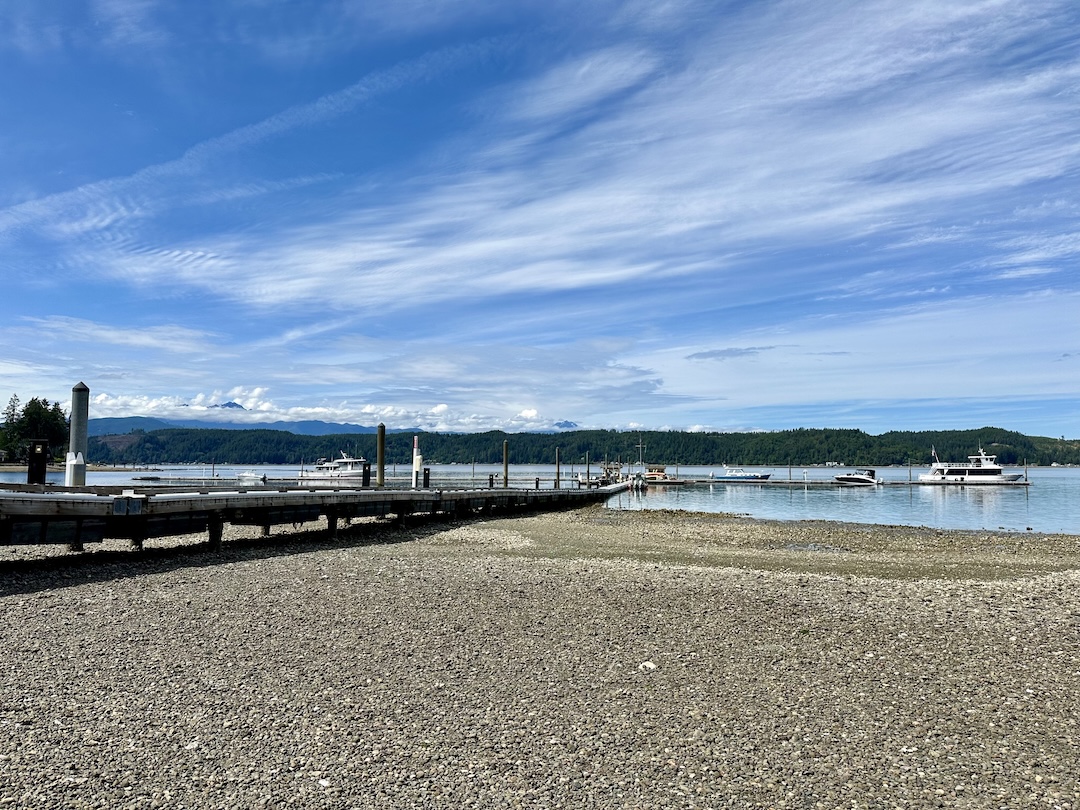
I kneel in the mud and scoop up a knot of sea life. The tangle of bivalves and barnacles feels heavy in my hands and sharp around its edges. My beach walking group on Hood Canal peers at the mismatched cluster. A boy tugs at one of the mussels hitched to an oyster shell, but the small animal holds tight, using threads stretched taut like bungee cords.
These intertidal creatures have sticky superpowers, I explain. Once a critter attaches to a hard surface, it rarely lets go.
Blue mussels, oysters, and barnacles often stick together in the Salish Sea. They typically form sprawling mono-colonies. Sometimes, however, the different animals affix to one another. The organisms I held had attached with a trifecta of natural superglue. Observing their connections helps unravel the mysteries of underwater adhesion.

A tangle of bivalves and barnacles.
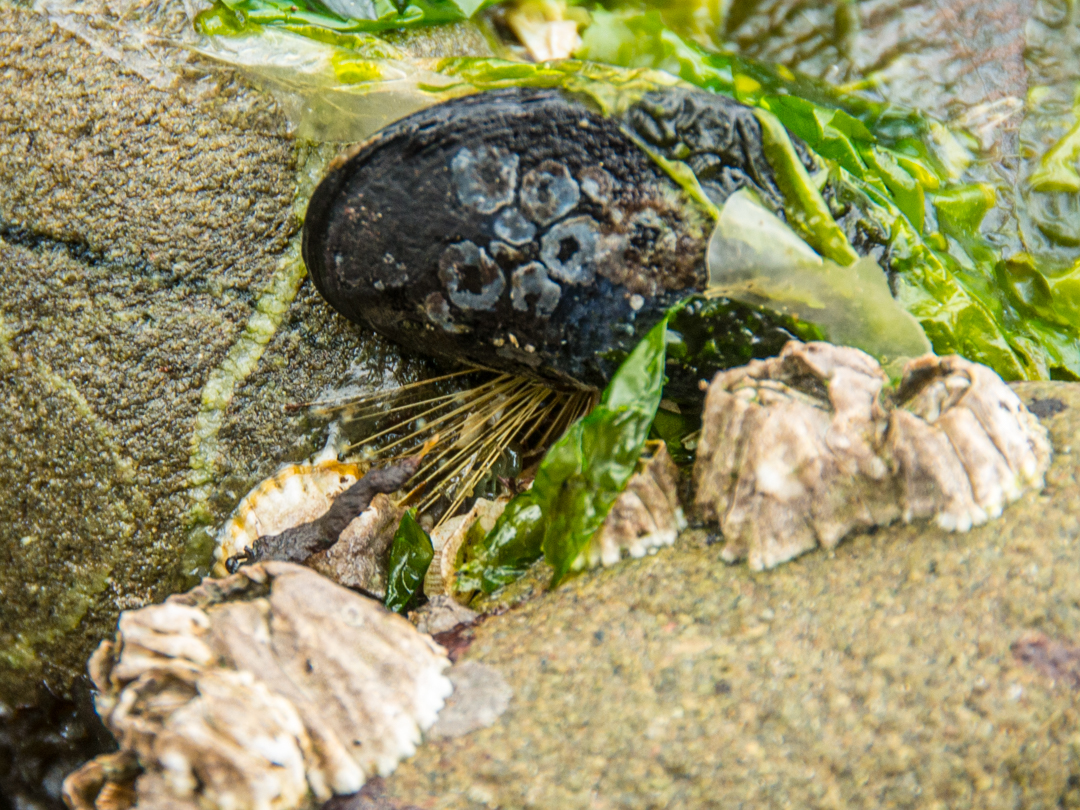
A mussel with its byssal threads holding it to a rock. photo by John F. Williams
My beach walkers first examine the mussels’ sticky threads. The fibers bind the animals to one another and to the rest of the mass. Construction takes some fancy footwork, I say.
A mussel’s muscular foot organ acts like a tiny thread-making laboratory. Glands in the foot pump a series of liquids through a long groove in the organ. The groove acts like a mold, turning the mix into strands of tenacious thread. As the mussel’s foot emerges from between its two shells, it releases up to 100 fibers. They quickly solidify in water, ready to anchor the animal to its new home.
It only takes a few minutes for a mussel to make a byssal thread. The ingredients are similar to what makes up a human tendon, except stronger. One strand from an adult mussel can hold the weight of a gallon of milk, just over 8 pounds.
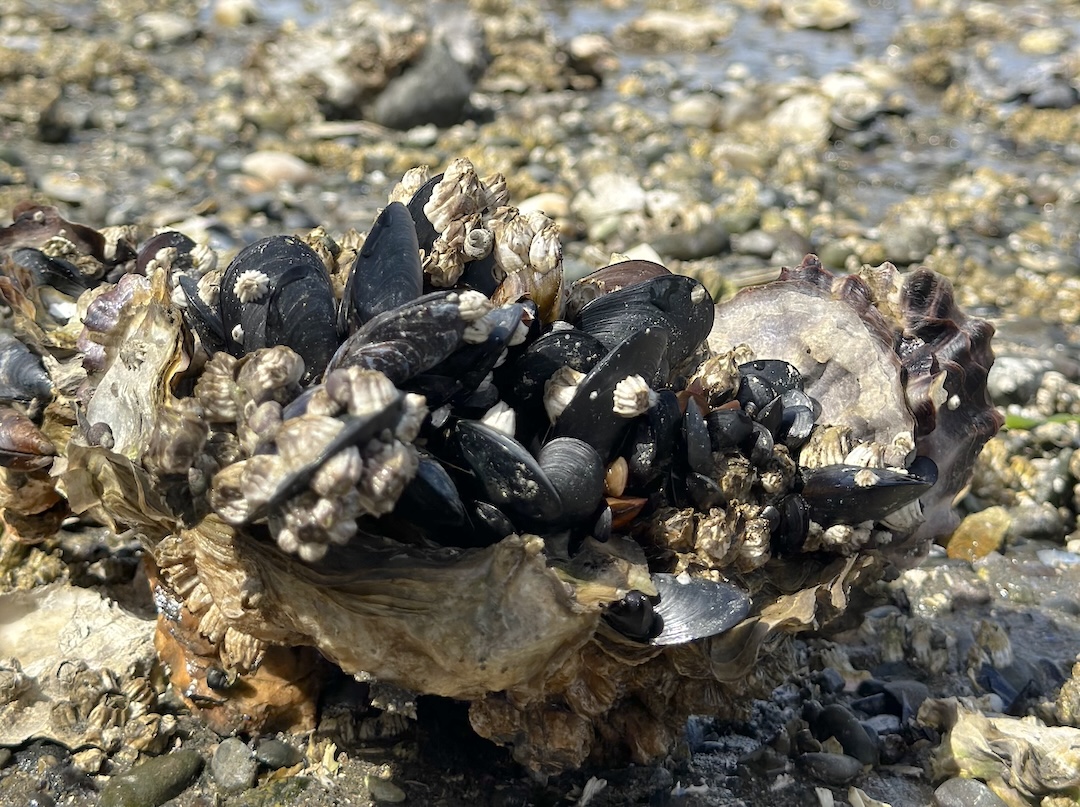
A cluster of mussels, oysters, and barnacles.
The main component is collagen, the same protein that makes our skin stretchy. Other proteins and ingredients, including iron, form a protective covering and a waterproof adhesive at the end of each string. The super-sticky fibers anchor mussels to docks, rocks, oysters, and one another, often holding tight for years.
The mussels we observe cling to a solid clump of ruffled Pacific oysters. The oysters bind to surfaces by building layers of hard, cement-like material. It’s about 90 percent calcium carbonate, or chalk, similar to the animal’s shell. The remaining ten percent, however, contains five times the amount of protein, as well as iron. More like mussel glue in composition, the substance gives an oyster its seaworthy sticking power.
A baby oyster will drift for weeks before it settles, or attaches, to a solid surface. At that point, the larva gets a new name. It’s called spat, and it will spend the rest of its life stuck to its neighbors. There’s safety in numbers for bivalves like oysters and mussels. Cleaving together protects them from wave action and makes it harder for predators, like seagulls, to remove individuals. Dense colonies also help the creatures reproduce more efficiently.
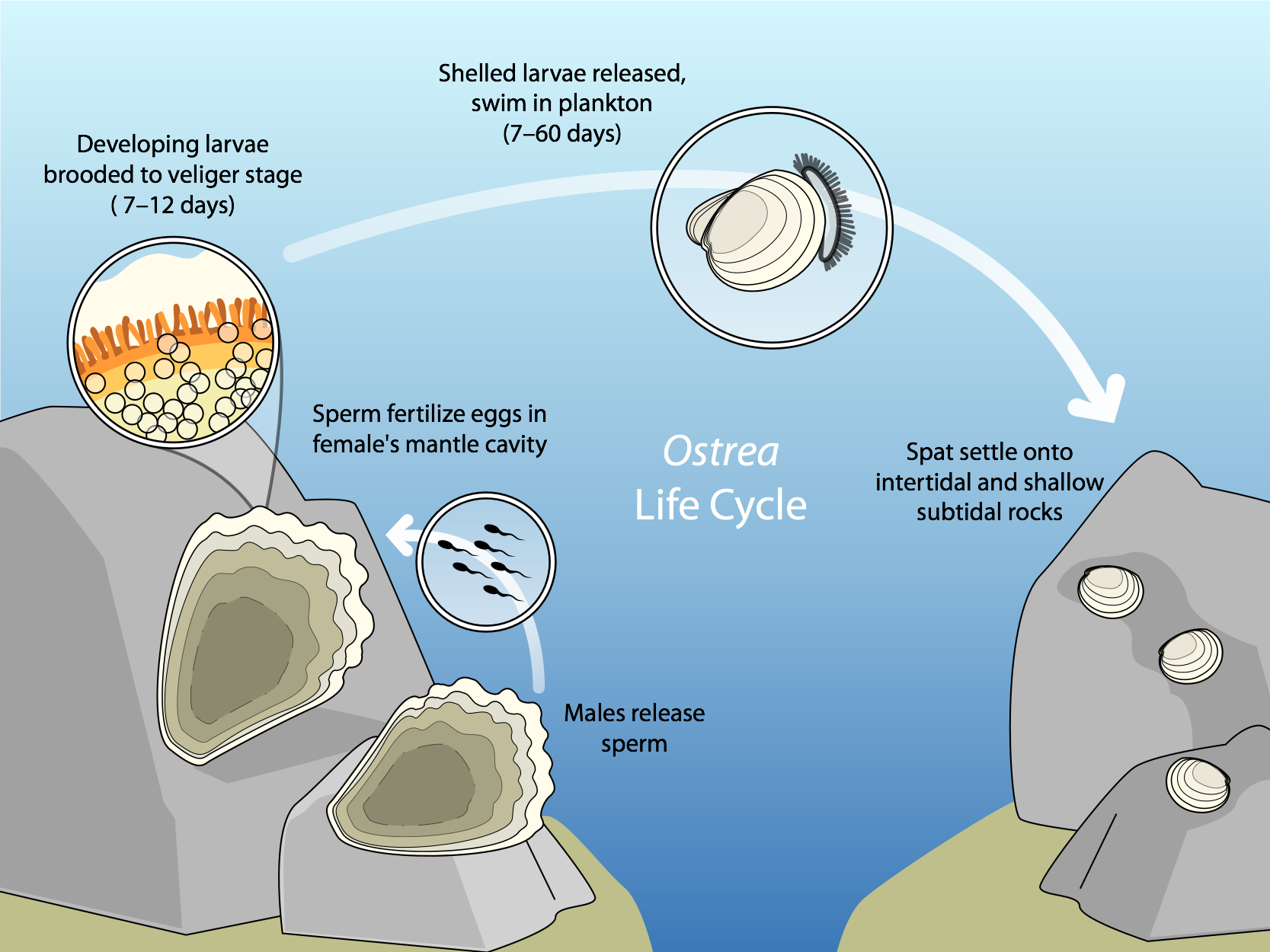
Life cycle of the Olympia oyster, Ostrea lurida. May be re-used under the CC BY-NC 4.0 license. illustration by Julia C. Blum

Barnacles on mussel shells.
On the Hood Canal beach, I point to a group of small volcano-shaped animals stuck to the top of the largest clustered oyster. “Are those alive?” one walker asks.
“Very much so,” I answer, “and they’re standing on their heads.”
The cone-shape crustaceans are called acorn barnacles. They’ll spend their lives upside down, heads glued permanently to their home. In this case, an oyster shell.
The young barnacle uses glands in its antennae to make a protein-rich adhesive. One of the ingredients is an enzyme similar to a clotting agent that’s found in human blood. The animal’s superpower, however, is in the application. Before settling, the barnacle secretes a tiny drop of oil where it wants to attach. Because oil repels water, the animal can apply its adhesive directly to the surface. This fast-curing cement is one of nature’s strongest glues.
Humans have yet to create a comparable synthetic glue that will set and hold in wet environments. Research about barnacle, oyster, and mussel attachment has increased in recent years. Unraveling the animals’ chemical secrets may help scientists produce new adhesives, like a surgical glue that works inside living bodies.
But back on the beach, my group ponders the knot of sea life. The mismatched creatures crowd together with a mysterious mix of glue, thread, and chalk. Bound in their tight-knit community, they will stick together for the long haul.
FIND OUT MORE
There are some other articles in Salish Magazine with more info about mussels and barnacles. You can see them (or listen to them) using the links below.
 Mussel Strength. Mussels have adapted a novel way of rooting themselves in place where they feed on free floating plankton and other microscopic sea creatures that pass by. September 2018
The Barnacle. From hard, circular pyramid-shaped shells, six pairs of feathery, olive green legs, swept through the salt water around them, feeling for a meal. September 2018

Celeste Hankins is a freelance writer and nature guide living in the Pacific Northwest, just a short hike from the Salish Sea. She has an MA in Science Writing from Johns Hopkins University and is a certified marine naturalist from the San Juan Whale Museum. Celeste also volunteers as a habitat interpreter at the Seattle Aquarium and as a citizen scientist monitoring sea birds and harbor porpoises. Come rain or shine, you can find Celeste narrating scenic cruises on the fjord, swimming with seals, or leading family beach walks.
Table of Contents, Issue #25, Autumn 2024
Nurse Stump Clan
by John F. Williams, Autumn 2024 images by John F. WilliamsStumps in foreground and background with new trees growing from them.by John F. Williams, Autumn 2024Images by John F. WilliamsA mushroom growing out of a tree.Taking a stroll through a forested city park the...
Shaping the Salish Sea
by Michael Melton, Autumn 2024Beavers and salmon have co-existed and co-evolved over seven million years, and they have a mutually beneficial relationship: beavers provide habitat for salmon and the salmon return nutrients to the rivers and streams. This film explores...
Poetry 25
by multiple poets Autumn 2024Starflowers. photo by Barb Ericksonby multiple poets Autumn 2024Desolation, first by Deborah Poe 1.a buck approaches the campsite (velvet antlers)fireweed spreads like its namethe first plant to grow in forestsafter fires burn back...
Nurturing Life
by Sarah Ottino, Autumn 2024images by Sarah Ottino except as notedLarge woody debris (LWD) is an important part of a healthy river ecosystem.by Sarah Ottino, Autumn 2024images by Sarah Ottino except as notedWhen we die, our bodies become the grass, and the antelope...
COPYRIGHT
Copyright SEA-Media
All rights reserved. Reproduction or distribution, in whole or in part. without consent of copyright owner is strictly prohibited — except for brief quotations in critical reviews and other noncommercial uses permitted by copyright laws.
SEA-Media is a 501(c)(3) nonprofit corporation
PLEASE HELP SUPPORT
SALISH MAGAZINE
DONATE
Salish Magazine contains no advertising and is free. Your donation is one big way you can help us inspire people with stories about things that they can see outdoors in our Salish Sea region.
We also don't advertise Salish Magazine, so please spread the word of this online resource to your friends and colleagues.
Thanks so much for your interest and your support.