
Nurse stump clan
by John F. Williams, Autumn 2024
images by John F. Williams
Stumps in foreground and background with new trees growing from them.
Nurse stump clan
by John F. Williams, Autumn 2024
Images by John F. Williams

A mushroom growing out of a tree.
Taking a stroll through a forested city park the other day, I was planning to experiment with photographing relationships in nature.
Ferns were growing out of trees, and there’s certainly a relationship there. Mushrooms were growing on trees, snags, and logs — another relationship to be explored.
I also saw some nurse stumps: old stumps with younger trees growing from them.
As a matter of fact, I saw so many nurse stumps in just a few acres that I shifted my focus and decided to create this photo essay about the nurse stumps in this single, small park.
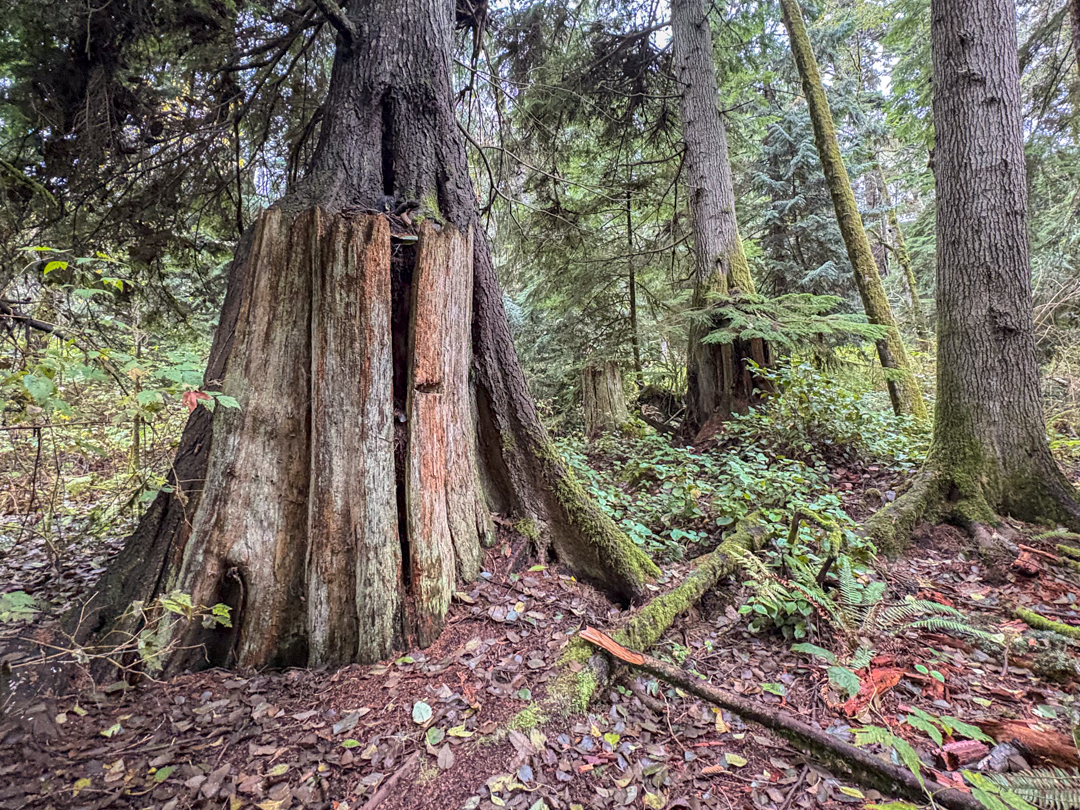
A springboard cut can be seen as a dark slash in the foreground stump in the header photo at top as well as in the stumps in the three photos below. These indicate that the stumps are quite old.
You can learn more about nurse logs and springboard cuts via the link below.
 Stump Stories from our Winter 2018 issue.

Here is an old stump with springboard cuts visible and a small tree growing from it.
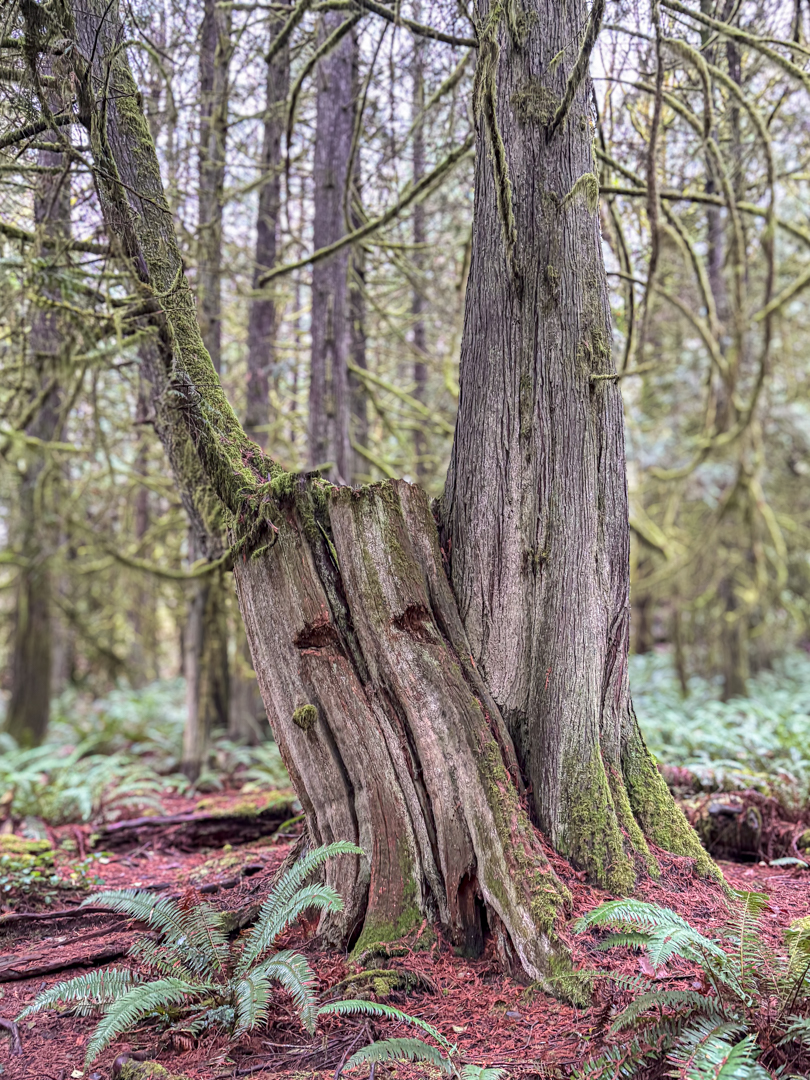

Another old stump containing springboard cuts. This one has two trees growing out of it. It’s a little confusing visually, so the two photos above are front and rear views showing how the two new trees have split the old stump.


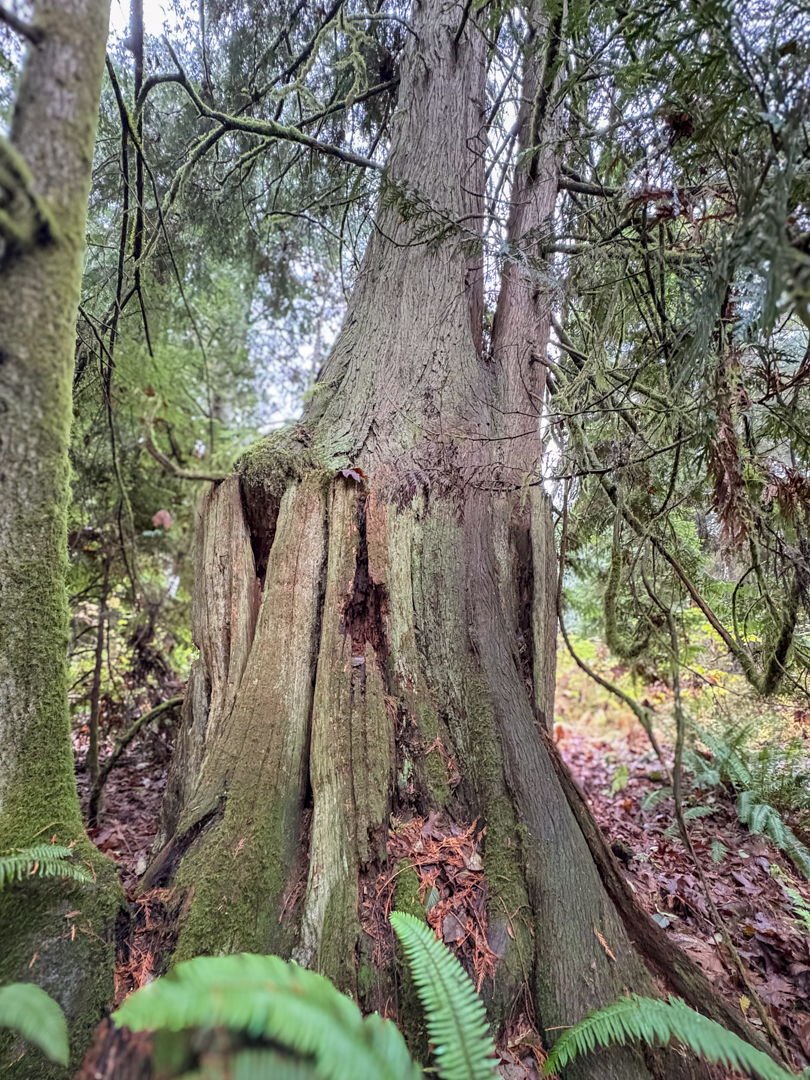
Above are three nurse stumps with fairly mature trees growing from them. In the first photo, the new tree is surrounding the old stump. In the second photo, the new tree has large root segments growing down through the clearly rotting stump. In the third photo, it looks like there are actually two trees growing from the stump, one much larger than the other.


And some of the trees growing from old stumps look quite young. Why were some stumps colonized much earlier than others?

This tree growing from a stump apparently met its demise. Now just the bottom part of its trunk is left: a stump on a stump!

Here’s an interesting one: it looks like the tree growing from the nurse stump started tipping, probably because part of the stump rotted away and no longer held that side of the tree up. But with roots firmly in the ground around the stump, the tree straightened out again.
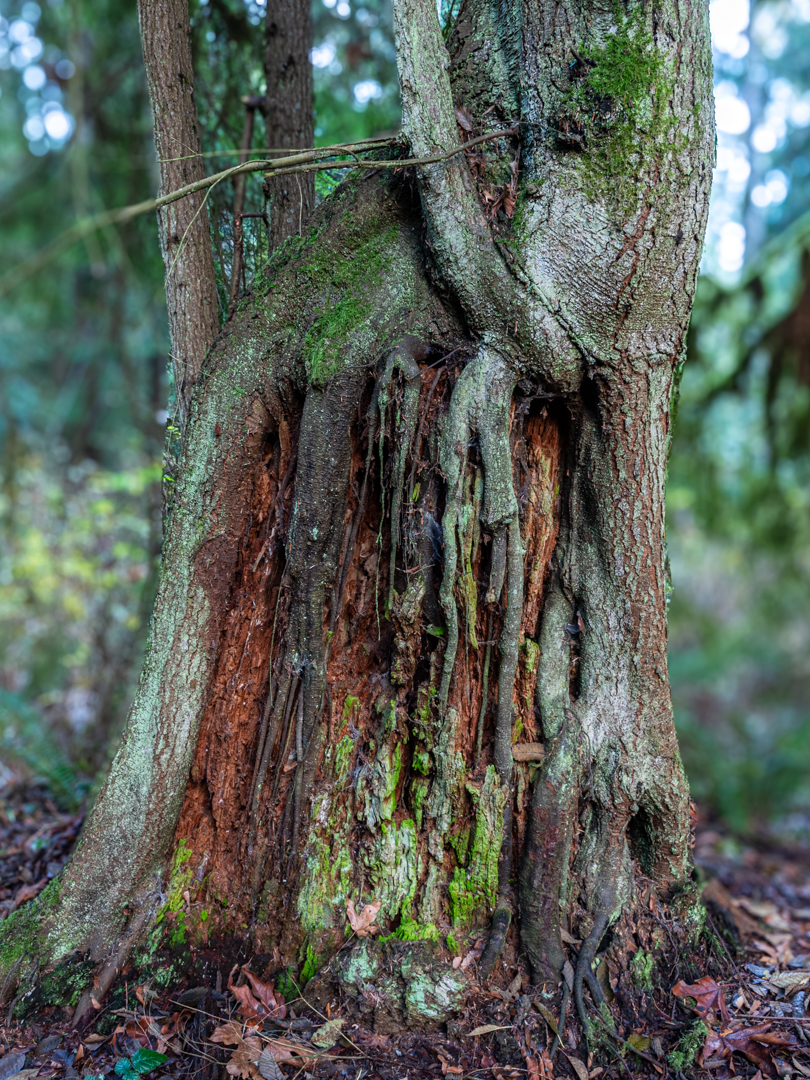
And speaking of old stumps rotting away, here is another view of that same tree. It is tilting toward the camera, so we’re seeing the rotten part of the stump. But also visible are strong roots growing around the rotten part, and they are holding the tree up.

Here is a close-up of the rotting area, and some of the smaller roots are visible, looking healthy in contrast to the stump rot.

This tree found a way to stay straight as the stump it was growing on began to decay. Now, it’s a confusing combination of pieces.

And it’s not just stumps which nurse young trees: this rotted-away nurse log hosts quite a large tree.
Moral of the story? We didn’t invent reuse/recycle — we hopefully are learning that from the nature around us.

John F. Williams, publisher of Salish Magazine: over decades of exploring underwater and in our forests and beaches, his experiences have been enriched by the insights of knowledgeable people.
For years, he shared those insights by making educational films and through lecture tours. Now, he publishes Salish Magazine to extend that notion of sharing insights by offering a wealth of articles that are keyed to the observable, but pull back the curtains to reveal the invisible.
Table of Contents, Issue #25, Autumn 2024

Sticky Subjects in the Intertidal
by Celeste Hankins, Autumn 2024Images by Celeste Hankins except as notedby Celeste Hankins, Autumn 2024Images by Celeste Hankins except as notedYou can listen to the text of this article using the Audio version above. narrated by Celeste HankinsI kneel in the mud and...

Shaping the Salish Sea
by Michael Melton, Autumn 2024Beavers and salmon have co-existed and co-evolved over seven million years, and they have a mutually beneficial relationship: beavers provide habitat for salmon and the salmon return nutrients to the rivers and streams. This film explores...
Poetry 25
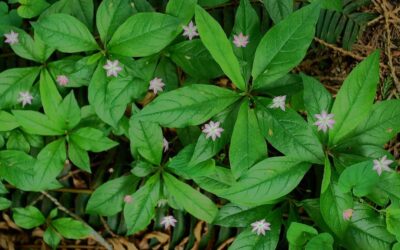
by multiple poets Autumn 2024Starflowers. photo by Barb Ericksonby multiple poets Autumn 2024Desolation, first by Deborah Poe 1.a buck approaches the campsite (velvet antlers)fireweed spreads like its namethe first plant to grow in forestsafter fires burn back...
Nurturing Life
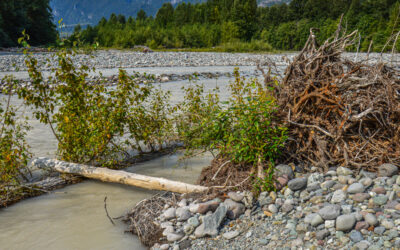
by Sarah Ottino, Autumn 2024images by Sarah Ottino except as notedLarge woody debris (LWD) is an important part of a healthy river ecosystem.by Sarah Ottino, Autumn 2024images by Sarah Ottino except as notedWhen we die, our bodies become the grass, and the antelope...
COPYRIGHT
Copyright SEA-Media
All rights reserved. Reproduction or distribution, in whole or in part. without consent of copyright owner is strictly prohibited — except for brief quotations in critical reviews and other noncommercial uses permitted by copyright laws.
SEA-Media is a 501(c)(3) nonprofit corporation
PLEASE HELP SUPPORT
SALISH MAGAZINE
DONATE
Salish Magazine contains no advertising and is free. Your donation is one big way you can help us inspire people with stories about things that they can see outdoors in our Salish Sea region.
We also don't advertise Salish Magazine, so please spread the word of this online resource to your friends and colleagues.
Thanks so much for your interest and your support.