
MAPPING RED-WINGED BLACKBIRD TERRITORIES
by Mica Sage Roberts, Spring 2026
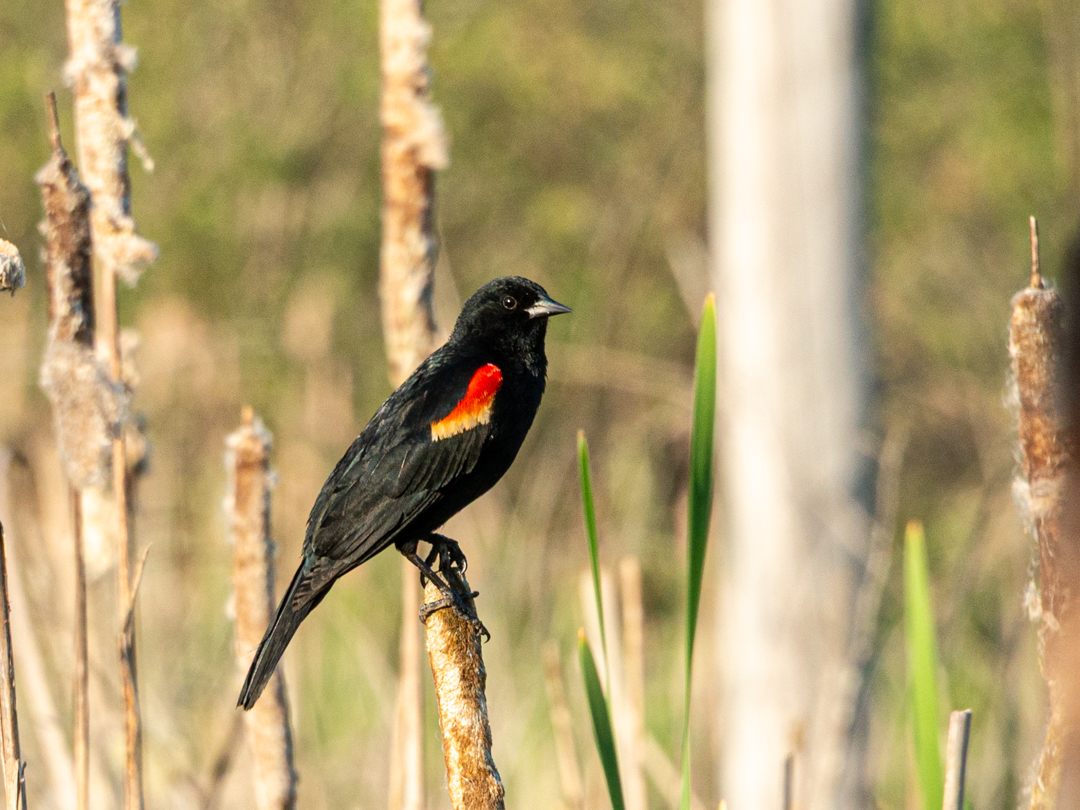
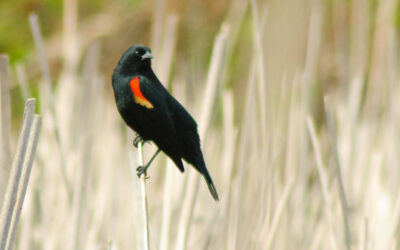
Male red-winged blackbird on cattail. photo by John F. Williams
MAPPING RED-WINGED BLACKBIRD TERRITORIES
by Mica Sage Roberts
Spring 2026
Conk-la-ree! A moment later from the east: conk-la-ree-o! I flipped over the soggy graph paper map and marked the location, praying the page wouldn’t tear under the pencil. Conk-la-ree! Ah, there was Mister Song again. Of the four birds I had heard that afternoon, his call was distinctly clear, lacking that nasally rasp that most red-wing blackbird males have.
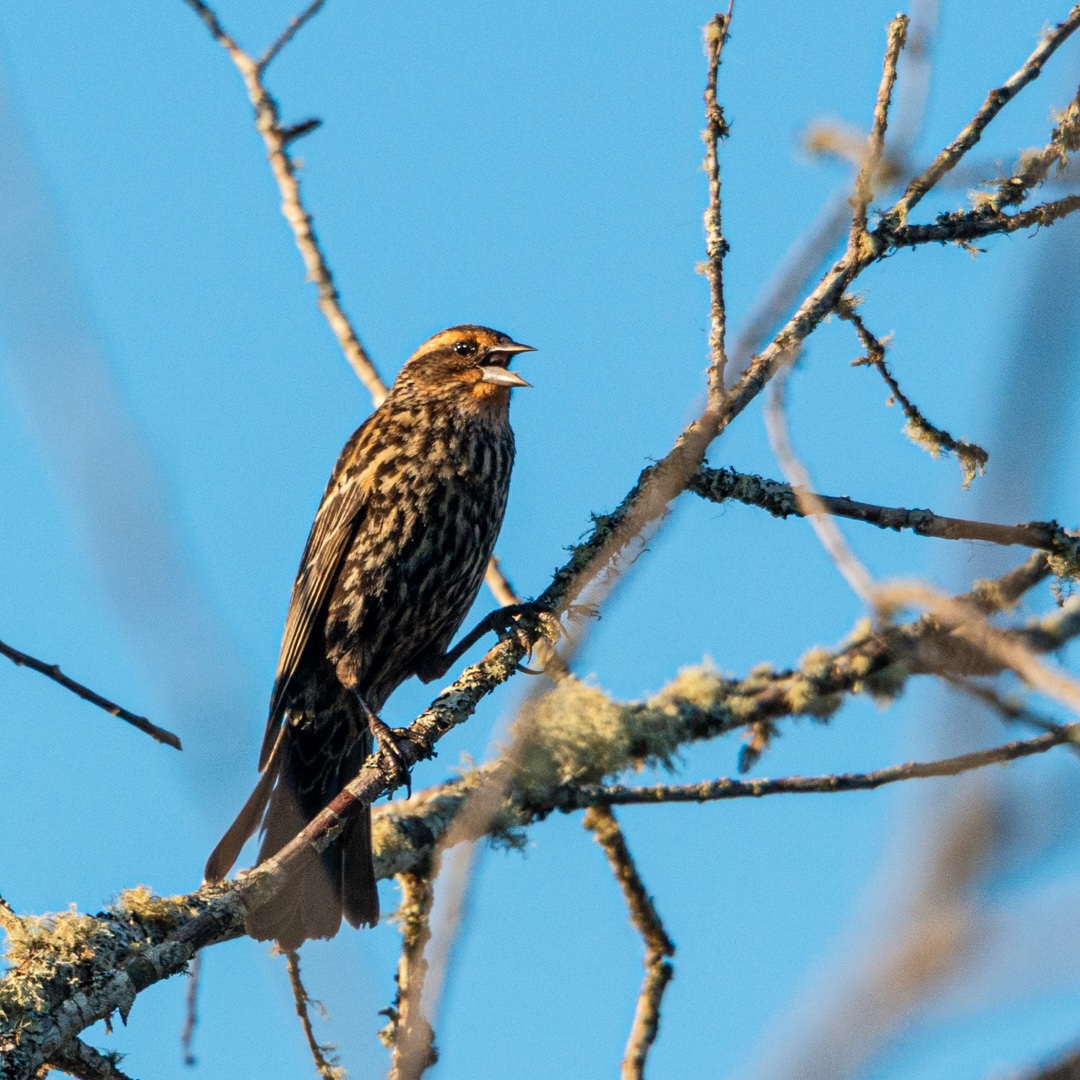
Female red-winged blackbird in a tree. photo by John F. Williams
It was the first day of my field project for a bioacoustics class and I wondered if I had bitten off more than I could chew. I had elected to map out the territories of the male red-wing blackbirds at Black Lake Meadows Reserve, a 46-acre runoff wetland park in Thurston County, Olympia, Wash. The idea of a territory map intrigued me, and with the guidance of my ornithologist professor, I had put together a plan for surveying the territories.
It’s no secret that male red-wing blackbirds (Agelaius phoeniceus) are fiercely territorial during breeding season. Each spring, the males must establish and defend their territory in the hopes of attracting as many females as possible. The females, for their part, are loyal to the best territory. Once fledglings have left the nest, the territory no longer needs defending and the birds live in a large mixed-species flock. However, the males will return to the area and attempt to defend the same territory they had the previous year.
The location for this project was chosen solely because it was within walking distance of my front door. My professor had assured me that, should the need arise, I could go to any other wetland and perform the same observations. The males would be perched at the tops of cattails, willow reeds, and small trees, singing their conk-la-ree songs to establish their territories. Defense of the territory takes the form of posturing (flashing their red epaulets), louder singing, and occasional combat. The birds will go right to the edges of their territories to sing and display. A patient observer can discern the boundaries simply by watching the birds interact.
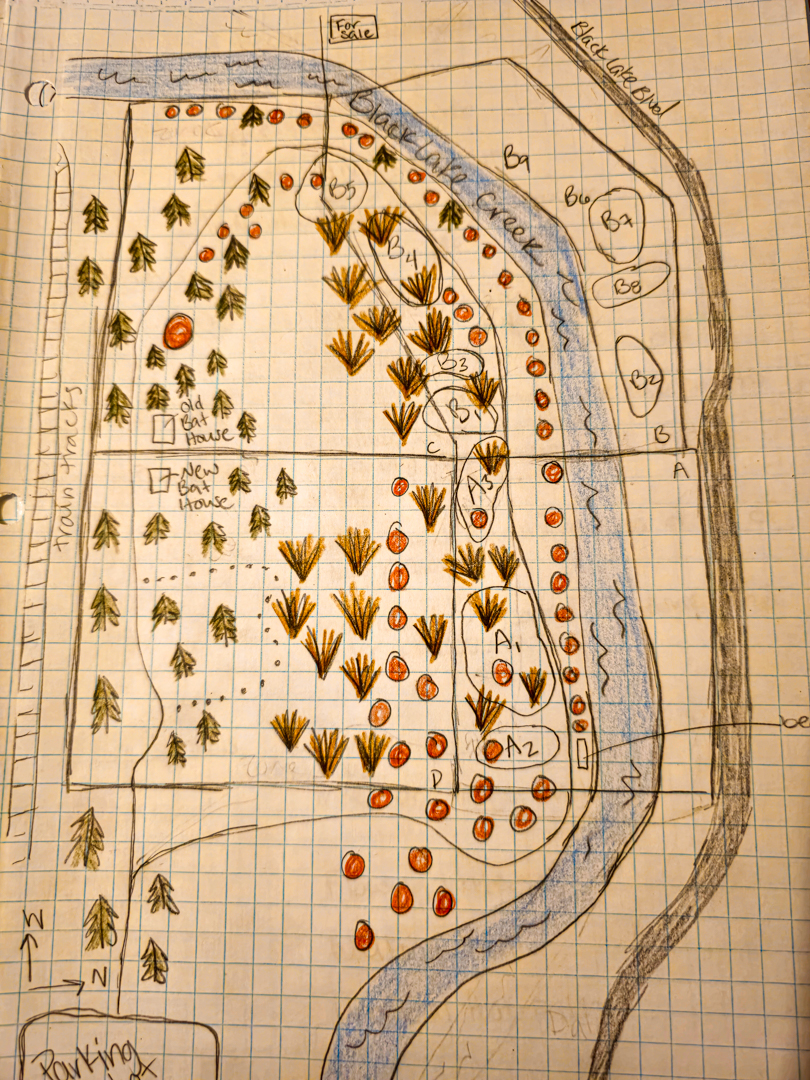
Author’s working map of the park.
I had divided the park into quarters, ingeniously labeled Zones A, B, C, and D; each one accessible by the wide gravel path. The path circled a seasonal wetland and meadow, and was bordered to the west and north by Black Lake Creek. In early March, the red-wing blackbirds would be establishing their territories, and my plan was to spend an hour in each zone recording my observations.
In Zone A, I pulled the binoculars up to my rain-spattered glasses and immediately put them back down. The misting rain and my fogging glasses severely limited my visibility, as did my location: though barren, the crisscrossing brambles and shrubs created dense thickets that stretched above my head. The binoculars refused to operate their x-ray vision no matter how politely I asked. Relying on my ears alone for this project was a challenge I hadn’t anticipated.
However, birds’ voices are as unique as humans’ voices, even if they are singing the same song. Mr. Song (A1), as previously stated, had a particularly clear voice. The bird creatively dubbed A2 was especially nasally, as if he were singing through a kazoo. A3 lopped off the end of his song: conkle-re! A4, at a slightly lower pitch than the others, sang from the eastern reaches of the park. My observation plan wasn’t as fool-proof as I had hoped, but it would have to do for now.
After another twenty minutes of standing in the rain, I trudged home to dry off and revise the plan.
The next morning glittered with frost. My breath hung in the air as I stood next to a burnt bigleaf maple tree, the demarcation between Zones A and B. Part of my issue yesterday, I had decided, was that I had been surveying close to dusk. I had a much better chance of catching their activity during the dawn chorus, when the cold air aided their high voices to travel farther.
I couldn’t afford to spend another day in Zone A, but I could pass through slowly and try to detect newcomers. Listening closely, I heard the same four voices as I had yesterday. Perfect.
The residents of Zone B were in full swing by the time I arrived, my cheeks burning from the chilliness of the morning. Conk-la-ree! I stopped and cocked my head toward the song. Conk-la-ree! I could just see the B1 singer through the branches, perched atop willow reeds. Then, much closer: conk-la-ree! A different songster (B2) issued a challenge from the low branches of a tree in front of me. The first singer replied, and the two called back and forth for another minute before the male in the tree flew off. B1 had successfully defended his territory!
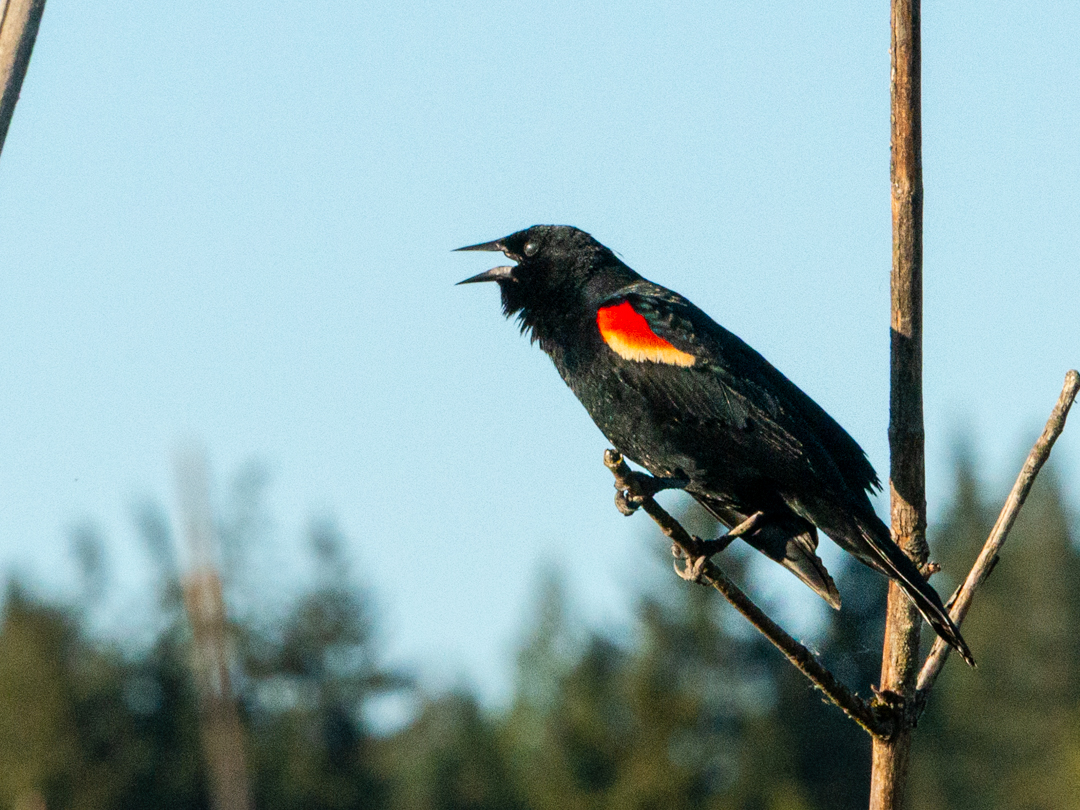
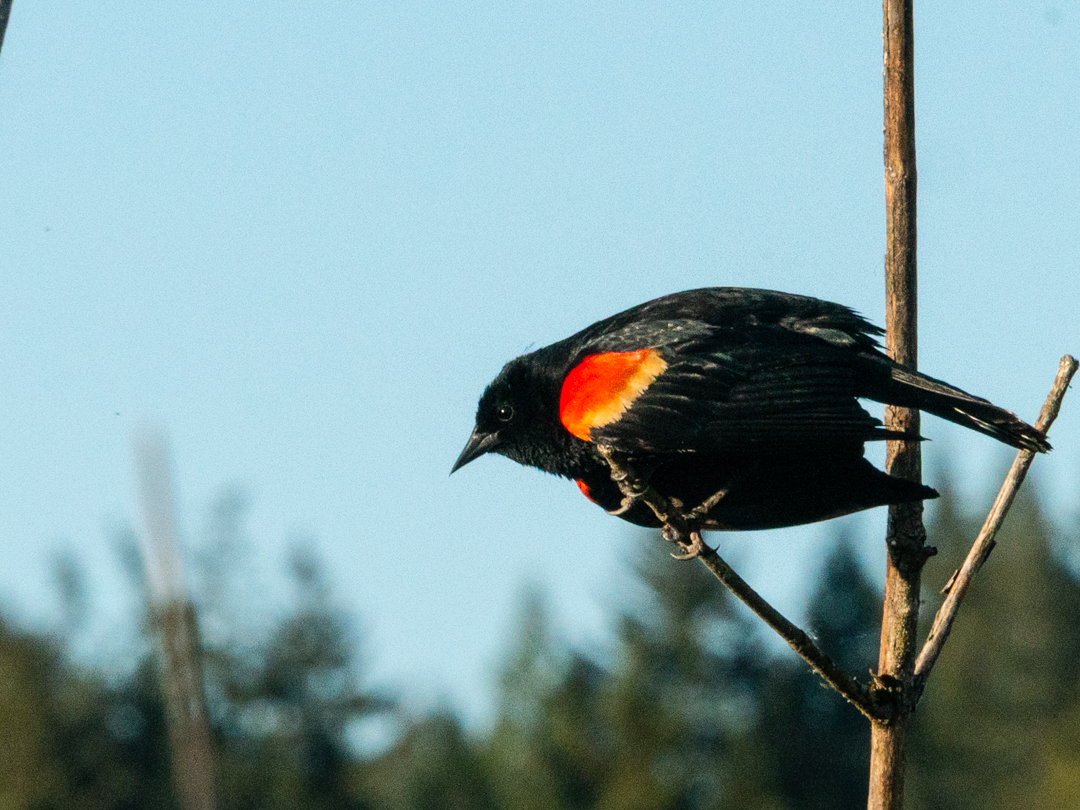
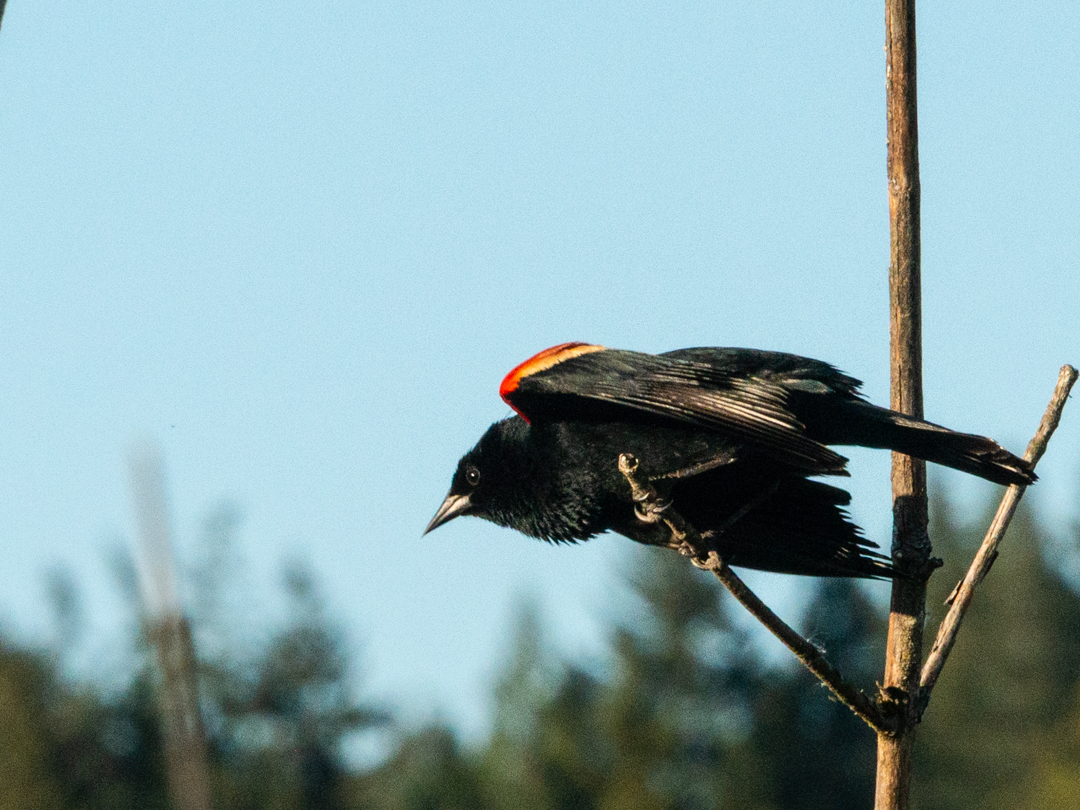
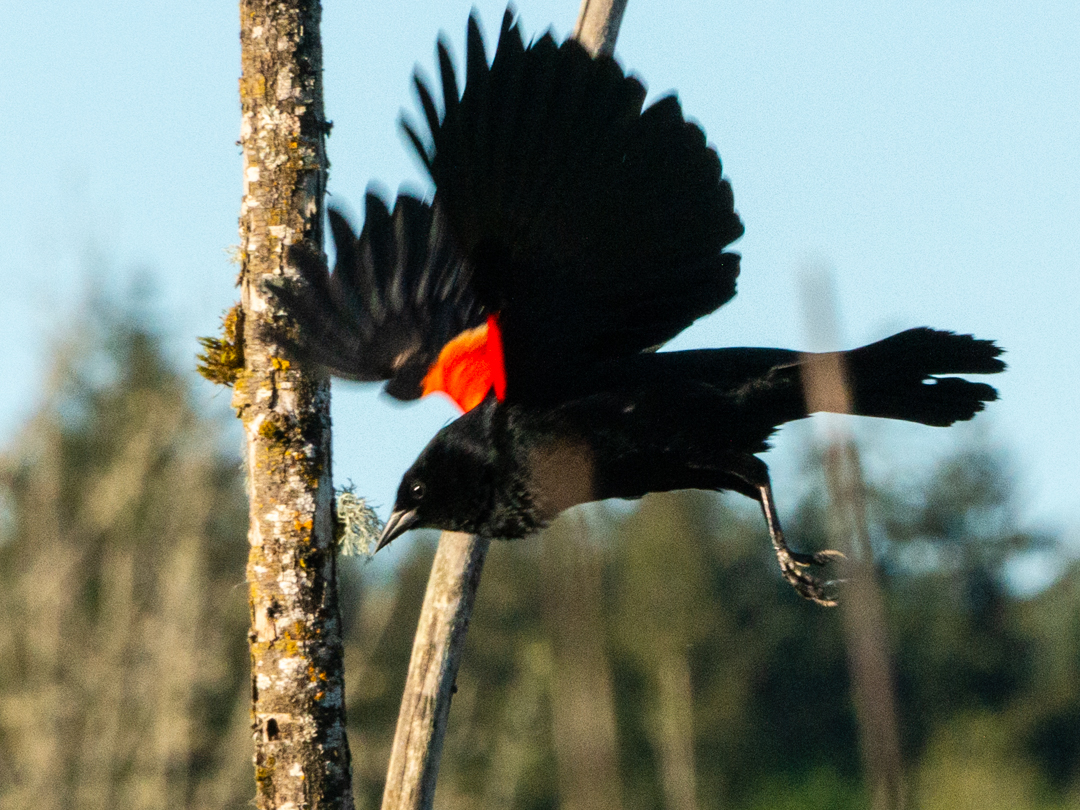
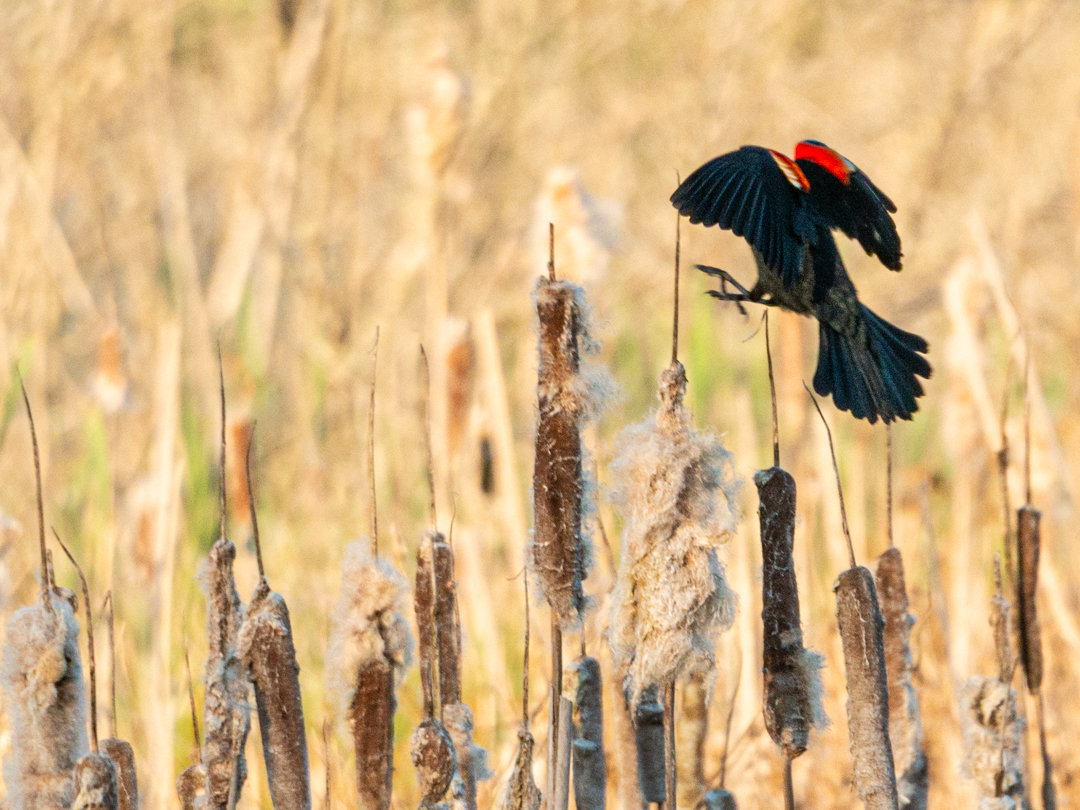
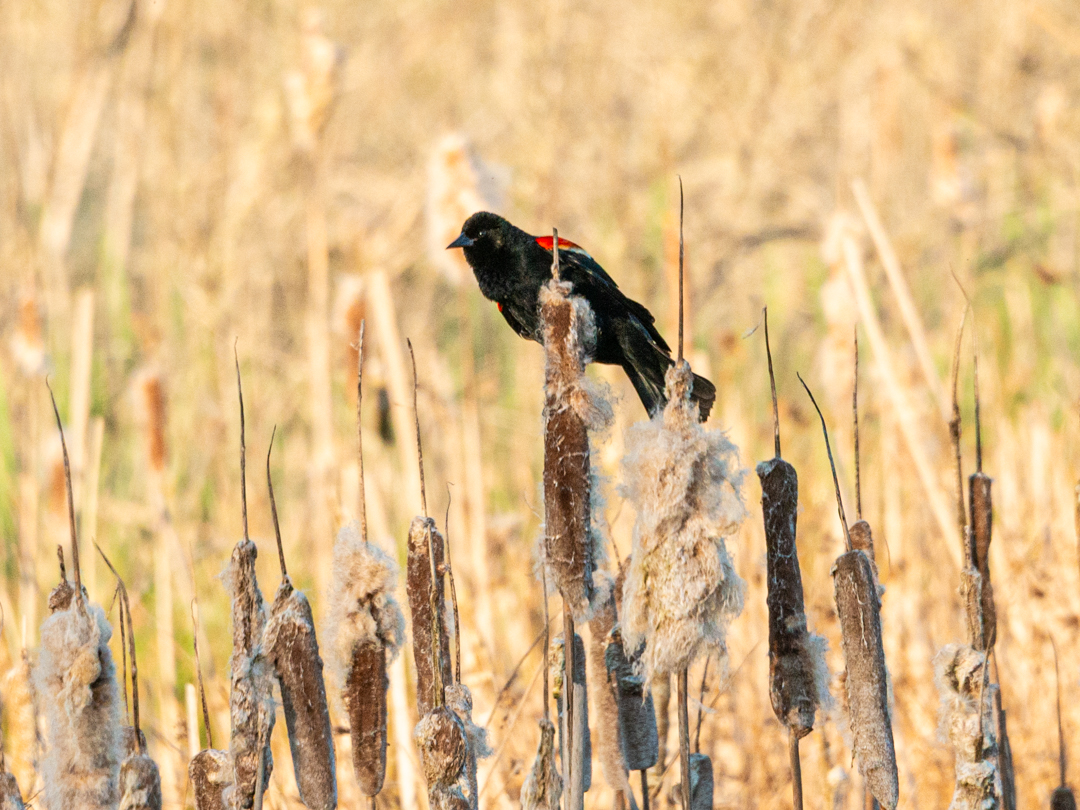
Red-winged blackbird taking off from a tree and landing on a cattail. photo by John F. Williams
That morning, I counted nine male red-wing blackbirds vying for territory. The prime real estate, it seemed, was in the marshy wetland encircled by the walking path. More voices rang from that area, but I would frequently hear the same bird across a relatively large patch of land. Comparatively, the wetland between the trail and 21st Ave. SE was crowded with overgrown reed canary grass and humming with the rumble of passing traffic. I noted three males in that area, perched on the few available willow reeds. I watched them (B6, B7, and B8) intently as they sang, hopped to a different reed adjacent to a contender, and sang again. A squabble broke out between B6 and B7, and those two males tussled briefly before B6 broke away. B7 resumed his post and sang at B8, who hadn’t moved. I scribbled a note: juveniles?
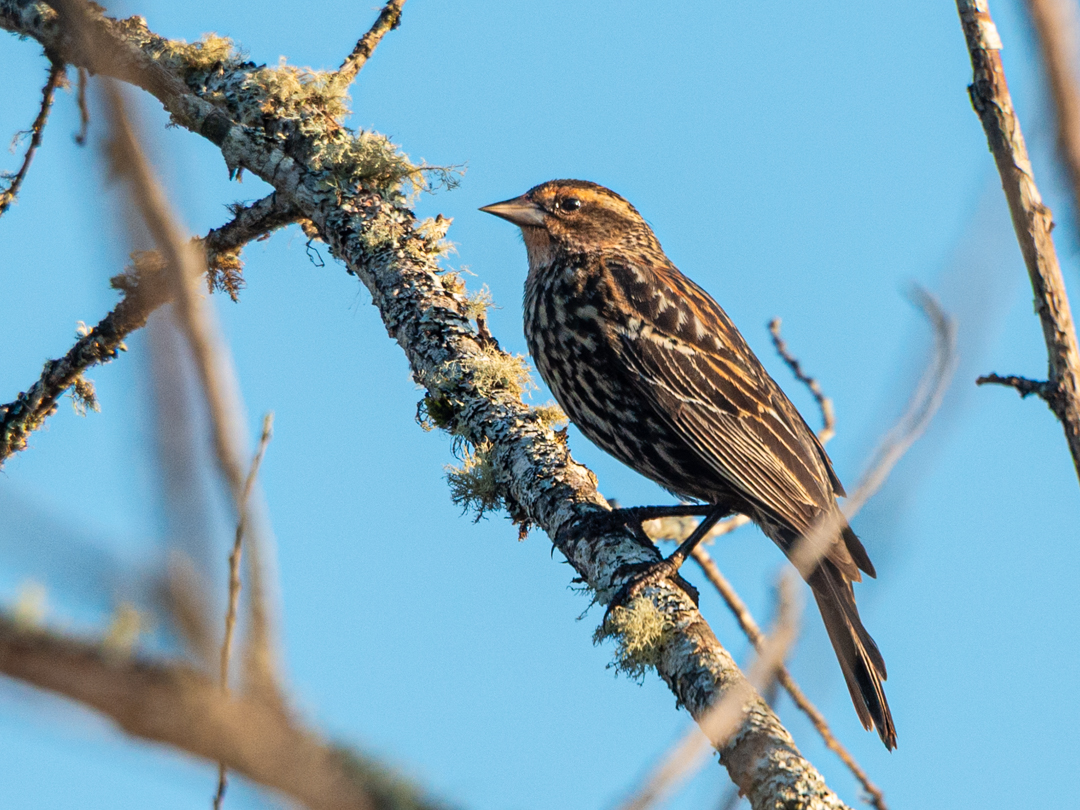
Female red-winged blackbird in a tree. photo by John F. Williams
I repeated my methods for Zones C and D. Near the border between Zones B and C, the wetland gives way to solid ground, and the tall reeds shift to stumpy snowberry shrubs. I noted only one songster that morning: B5, whom I had recorded the previous day near the B/C border. He was likely a younger or less aggressive male, given the location of his territory.
Zone D was home to chickadees, song sparrows, pine siskins, and spotted towhees, but no red-wing blackbirds. I pushed as far into the meadow as I could, hoping to catch the southern boundaries of the birds in Zones A and B, but the vegetation proved impassable and the tall alders blocked my view. The data I had collected would have to suffice. I returned home to finalize the territory map, which I would present in class the following week.
Prior to that project, I had believed science to be something that only happens in sterile laboratories with those awful fluorescent lights and measurements taken in micrometers. Being outside first thing in the morning, pencil and ears at the ready, was an activity that caused me fall in love with the natural sciences. Moreover, learning to distinguish between avian individuals made me fall more in love with the world around me. Like getting to know a friendly neighbor, knowing the birds made the park feel like a more welcoming home.

Issue Page
Table of Contents, Issue #31, Spring 2026
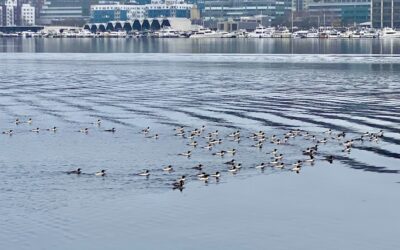
Birds on an Urban Lake
BIRDS ON AN URBAN LAKE by Dave Galvin Spring 2026Mergansers on Lake Union. photo by Dave Galvin by David Galvin Spring 2026The Salish Sea is defined by water: the sea itself, the freshwater lakes and rivers, and the rain that is the hallmark of the region. It is no...
Poetry 31
by multiple poets Spring 2026Red-winged blackbird on cattail reed. photo by John F. Williams by multiple poets Spring 2026Red-winged Blackbird Marcia Claire Millican Conspicuous commander, comfortable atop the cattails. Displaying proud patches,resilient red and...
COPYRIGHT
Copyright SEA-Media
All rights reserved. Reproduction or distribution, in whole or in part. without consent of copyright owner is strictly prohibited — except for brief quotations in critical reviews and other noncommercial uses permitted by copyright laws.
SEA-Media is a 501(c)(3) nonprofit corporation
PLEASE HELP SUPPORT
SALISH MAGAZINE
DONATE
Salish Magazine contains no advertising and is free. Your donation is one big way you can help us inspire people with stories about things that they can see outdoors in our Salish Sea region.
We also don't advertise Salish Magazine, so please spread the word of this online resource to your friends and colleagues.
Thanks so much for your interest and your support.