
BIRDS ON AN URBAN LAKE
by Dave Galvin
Spring 2026
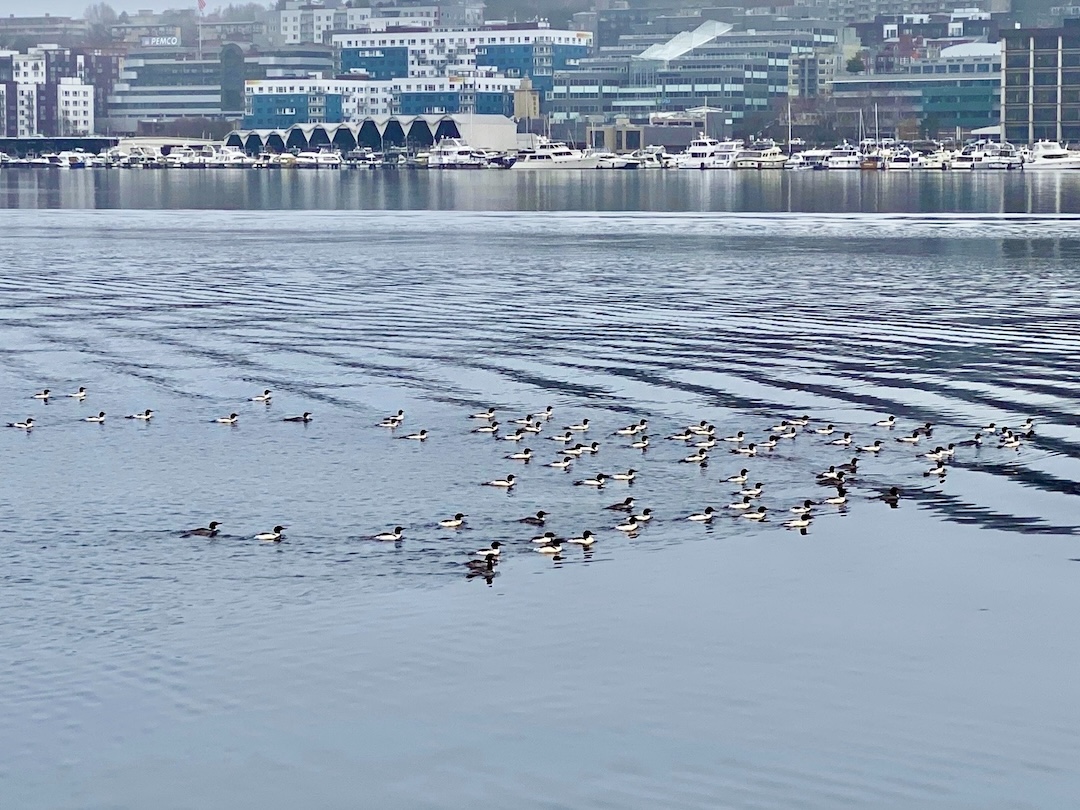
Mergansers on Lake Union. photo by Dave Galvin
BIRDS ON AN URBAN LAKE
by David Galvin
Spring 2026
The Salish Sea is defined by water: the sea itself, the freshwater lakes and rivers, and the rain that is the hallmark of the region. It is no surprise, then, that we enjoy a number of waterbirds. This ode to our waterfowl results from living in a floating home on Lake Union in Seattle for more than 40 years.
Lake Union is a quintessentially urban lake, close to downtown Seattle and full of a wide variety of uses and users, from old shipyard dry-docks and fishing piers to modern marinas packed with sail and motor moorages, summer sailing races called “Duck Dodge,” and more recently, a plethora of stand-up paddleboards. There are funky houseboats dating from the early 1900s, many such as mine still on old log rafts, as well as more upscale, modern replacements on concrete floats. (It seems odd to couple “concrete” with “floats”, but I digress.)
The lake formed as a glacial kettle hole; it has steep sides and is roughly 40 feet (13 meters) deep across the main part of the lake. Due to 19th-century engineering, 580-acre Lake Union is now a link between ~22,000-acre Lake Washington to the east and the Puget Sound/Salish Sea to the west. Fresh water flows constantly east to west through Lake Union and the Ballard Locks, which separate fresh from salt water.
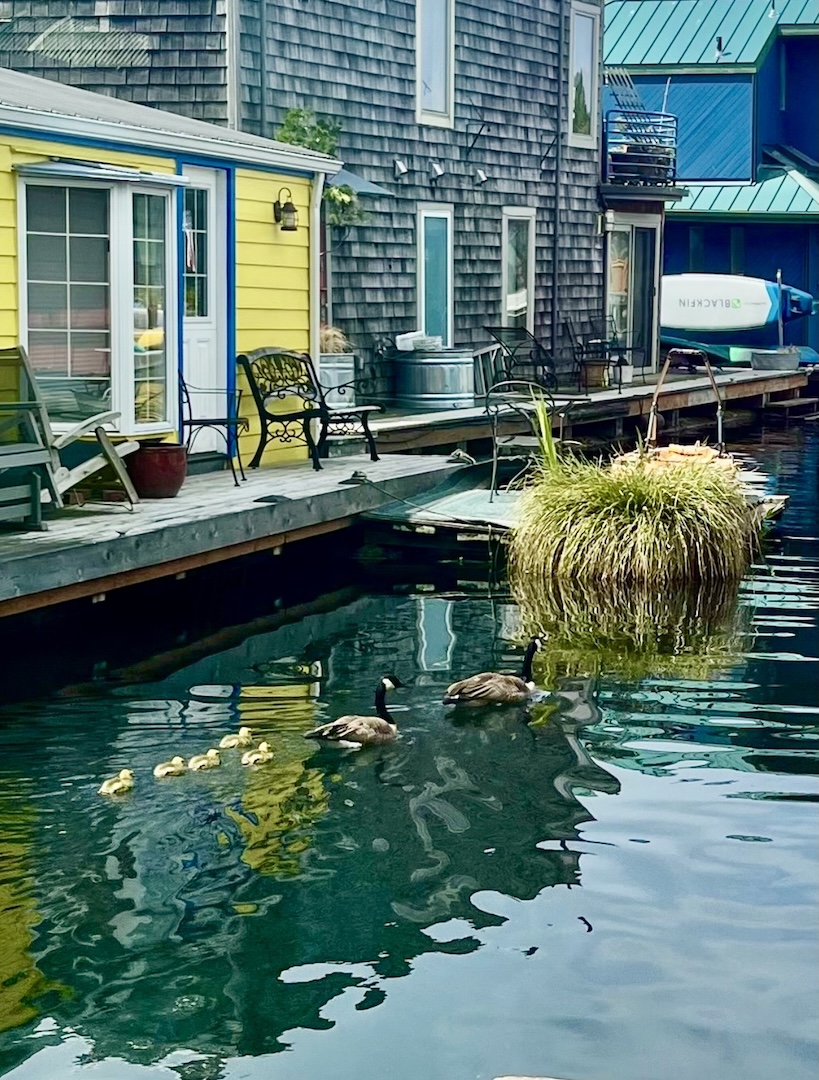
A Canada goose family on Lake Union. photo by Dave Galvin
The lake went through a rough century after the influx of non-native settlers. Saw mills, sewage, and gasification residues created quite a mess. But, in the late 1960s, sewers were finally completed for the floating communities and upgraded regionally. Industry started to wane on the shoreline, and the water quality improved dramatically. Today this little urban lake is remarkably clean by water quality standards, at least for such an urban space, and thus full of fish.
I give this background to talk about fish, since small fishes are the base of the food web for most of our visiting waterfowl. We still have barely viable populations of anadromous salmon, including Chinook, coho, and sockeye, as well as cutthroat trout, although they face challenging odds: from habitat destruction to, more recently, high summer water temperatures. Meanwhile, we have a thriving population of some small native fish, such as sticklebacks, as well as introduced species such as bass, perch, and bluegill sunfish. All of these, it turns out, are food for our fish-eating waterfowl.
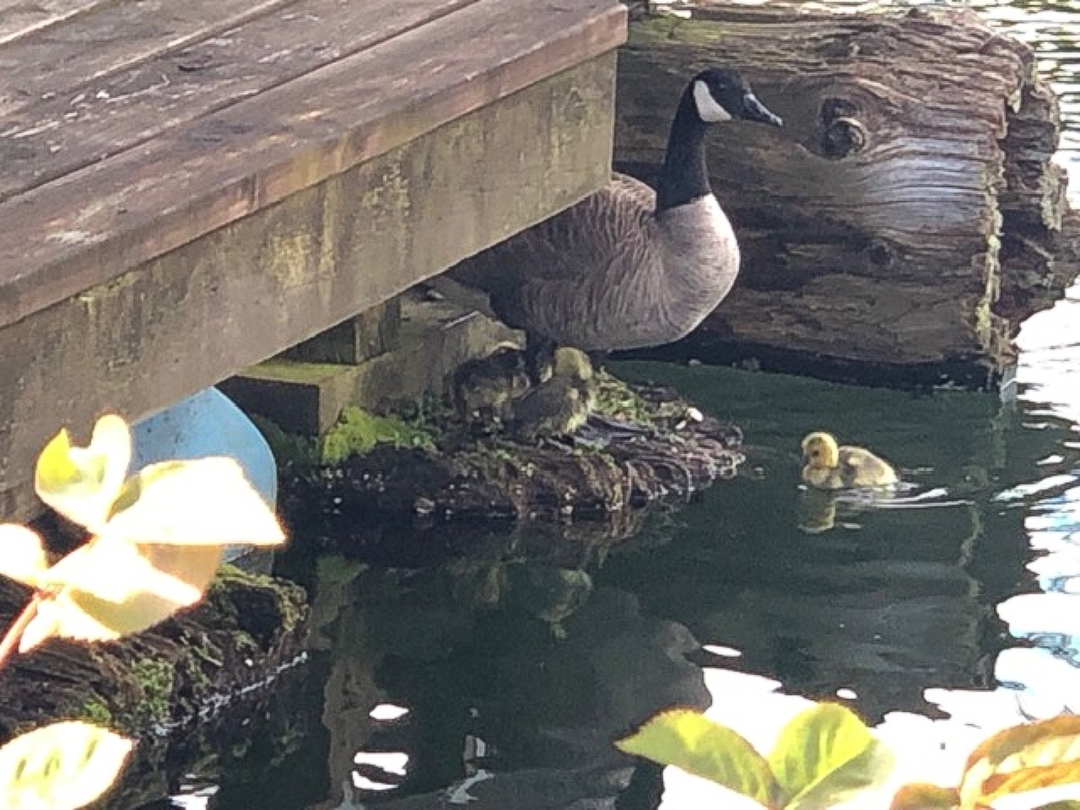
Canada goose with nest and chicks. photo by Dave Galvin
One of the features of our lake is the change in waterfowl with the seasons. Come fall, a whole host of mostly fish-eating “divers” show up: double-crested cormorants, common mergansers, greater and lesser scaups, common goldeneyes, buffleheads, pied-billed grebes, and more. Most of these divers nest away from the Salish Sea, up river valleys and in freshwater lakes in the mountains to the east or north into interior British Columbia. But, when their nesting sites start to freeze in late fall, they all migrate to the lower elevations of the Salish Sea, where the fresh waters stay open and the salt waters never freeze.
We thus have two distinct avian seasons on Lake Union and likely more generally across the Salish: summers with only dabblers such as Canada geese and mallards, plus a few gadwalls, and then thriving winters with a dozen or more divers. We often have hundreds of these wintering waterfowl on the lake, all eating fish every day. I’ve read that goldeneyes and buffleheads might prefer the small Asian freshwater clams that have invaded. Whatever their preference, it seems that my urban lake keeps producing enough fish or other food to support an enormous influx of hungry visitors each winter.
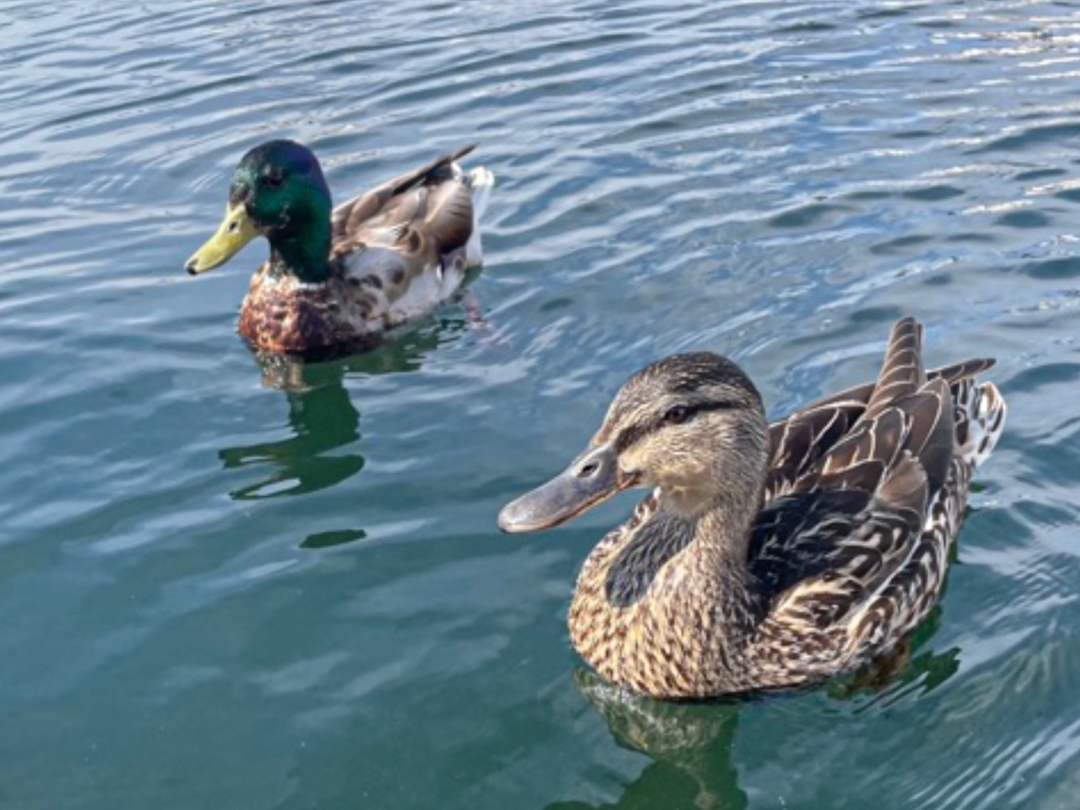
Two ducks on the lake. photo by Dave Galvin
Thus, I find that living on a low-elevation lake in the Salish Sea area offers many opportunities to watch nature unfold by the seasons. I hope that readers might agree across the region, given that we all share that connection to water.
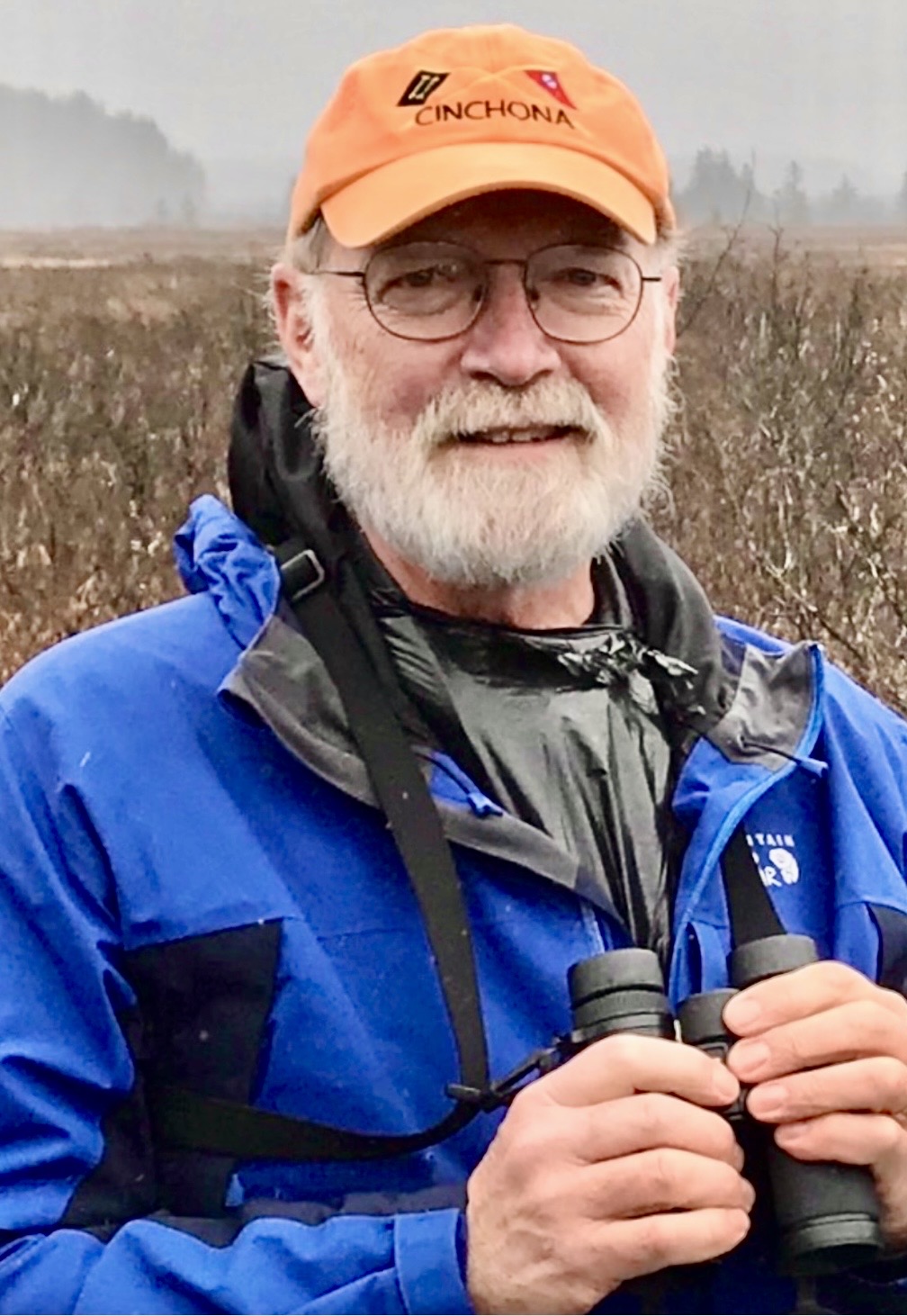
Dave Galvin, a life-long bird-watcher, has lived on a floating home in Seattle for more than 40 years. He was president of Seattle Audubon Society — now known as Birds Connect Seattle — in 1980, and dedicated his professional career as well as his volunteer work in retirement to protecting the local environment, especially in urban areas. His two houseboat-raised kids knew the difference between a Mallard and a Gadwall from about age three. Dave leads local bird walks monthly in Seattle, and writes a column on birds for the local neighborhood rag, the Eastlake News, which is still distributed in paper copy.
Issue Page
Table of Contents, Issue #31, Spring 2026
One Bird Birding
ONE-BIRD BIRDING IN THE SALISH SEA by Maria Ruth, Spring 2026Pigeon Guillemots on a bluff. photo by Govinda Holtby by Maria Ruth Spring 2026Over the past decade, I’ve added just one bird to my life list of birds I’ve seen in my backyard. This bird wasn’t at my bird...
Serious, Playful, Mischievous, Nurturing
SERIOUS, PLAYFUL, MISCHIEVOUS, NURTURING by Gunnison Langley, Spring 2026Crow perched on a tree. photo by Gunnison Langley by Gunnison Langley Spring 2026Last year I joined a Birds Connect Seattle “Neighborhood Bird Outing” at Magnuson Park in North Seattle. About an...
Bald Eagles, A Visual Story
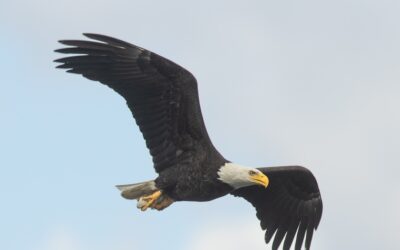
Only mature adult bald eagles have the classic white heads and tails. As they recover from the egg-thinning effects of DDT, they are once again becoming common around the Salish Sea. However, because their lives primarily play out above our heads, we often miss some...
Mapping Red-Winged Blackbird Territories
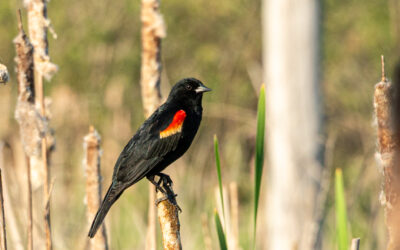
MAPPING RED-WINGED BLACKBIRD TERRITORIES by Mica Sage Roberts, Spring 2026Male red-winged blackbird on cattail. photo by John F. Williams by Mica Sage Roberts Spring 2026Conk-la-ree! A moment later from the east: conk-la-ree-o! I flipped over the soggy graph paper map...
Poetry 31
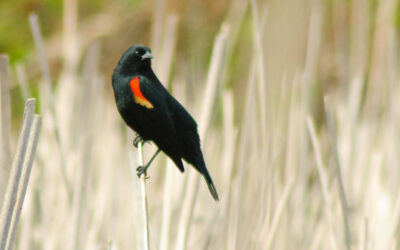
by multiple poets Spring 2026Red-winged blackbird on cattail reed. photo by John F. Williams by multiple poets Spring 2026Red-winged Blackbird Marcia Claire Millican Conspicuous commander, comfortable atop the cattails. Displaying proud patches,resilient red and...
COPYRIGHT
Copyright SEA-Media
All rights reserved. Reproduction or distribution, in whole or in part. without consent of copyright owner is strictly prohibited — except for brief quotations in critical reviews and other noncommercial uses permitted by copyright laws.
SEA-Media is a 501(c)(3) nonprofit corporation
PLEASE HELP SUPPORT
SALISH MAGAZINE
DONATE
Salish Magazine contains no advertising and is free. Your donation is one big way you can help us inspire people with stories about things that they can see outdoors in our Salish Sea region.
We also don't advertise Salish Magazine, so please spread the word of this online resource to your friends and colleagues.
Thanks so much for your interest and your support.