
Spring Aliens
in the woods
by Thomas and Sara Noland
photos by Thomas Noland
Spring 2025

Spring Aliens in the Woods
by Thomas and Sara Noland
photos by Thomas Noland
Spring 2025
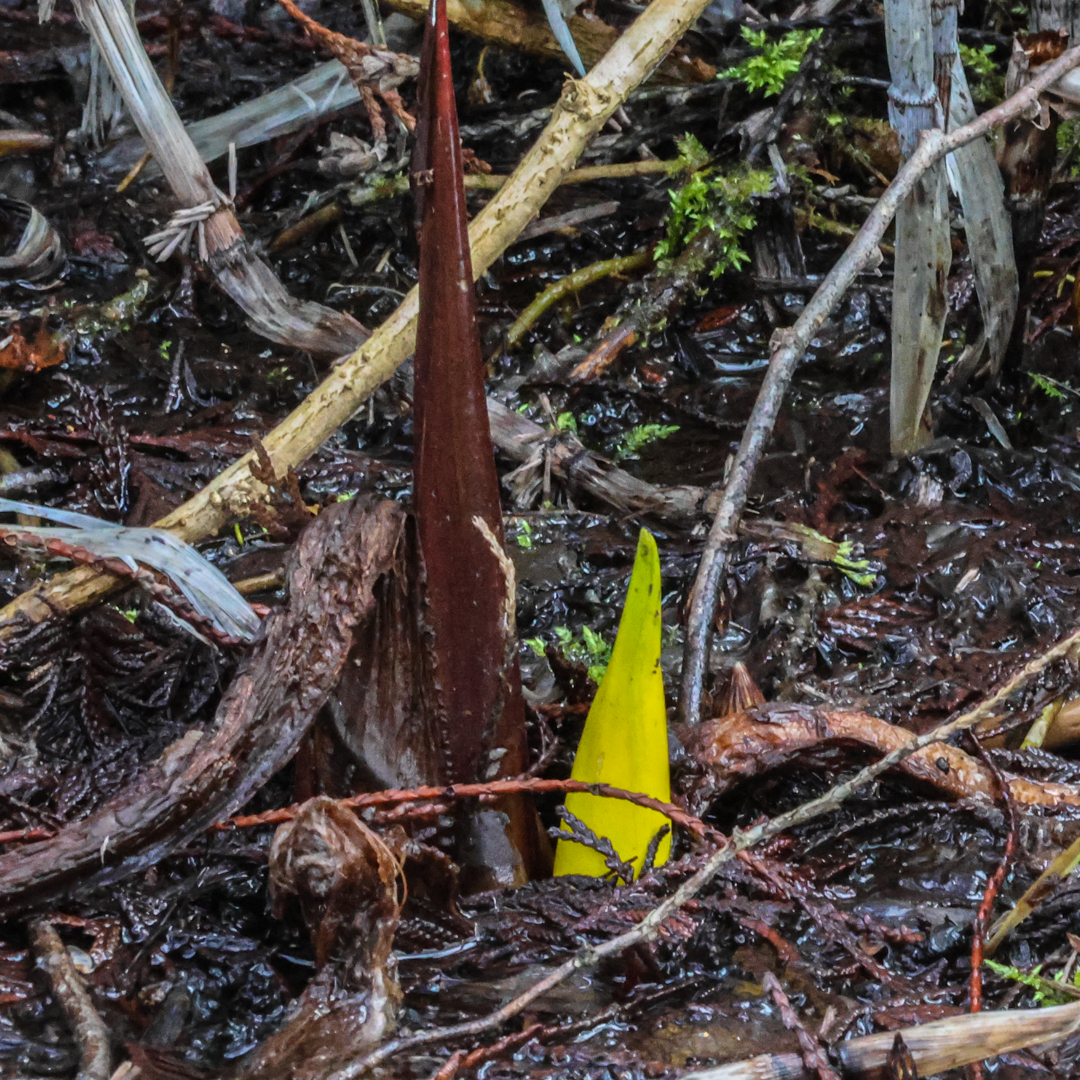
It’s spring in the woods, and botanical aliens are awakening. They aren’t really aliens — they’re native inhabitants of the Salish Sea region — but when they start emerging in early spring, they might make you imagine extraterrestrial creatures from a science fiction movie, hiding under the ground all winter, then poking green beaks up through mud and last year’s fallen leaves to test the spring air.
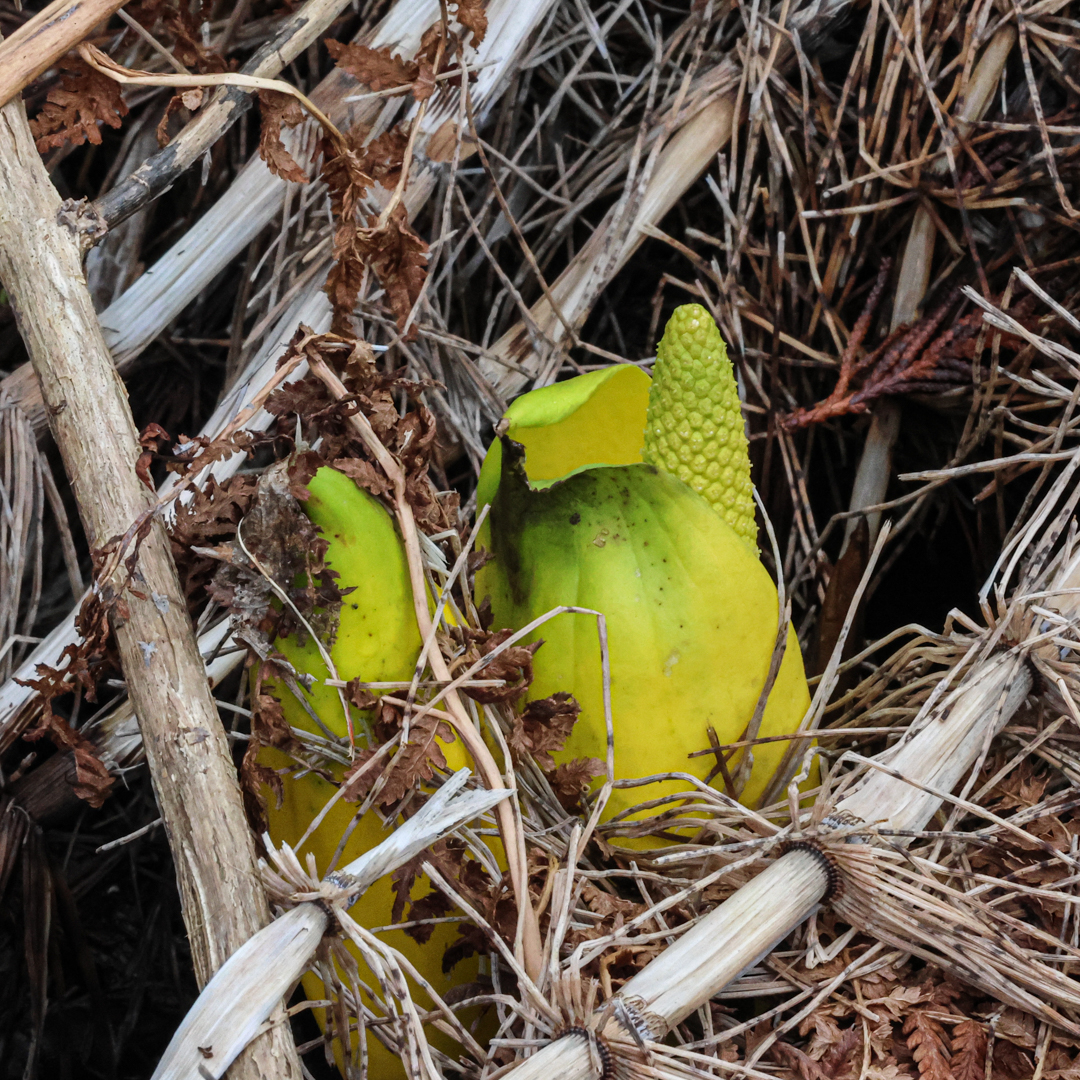
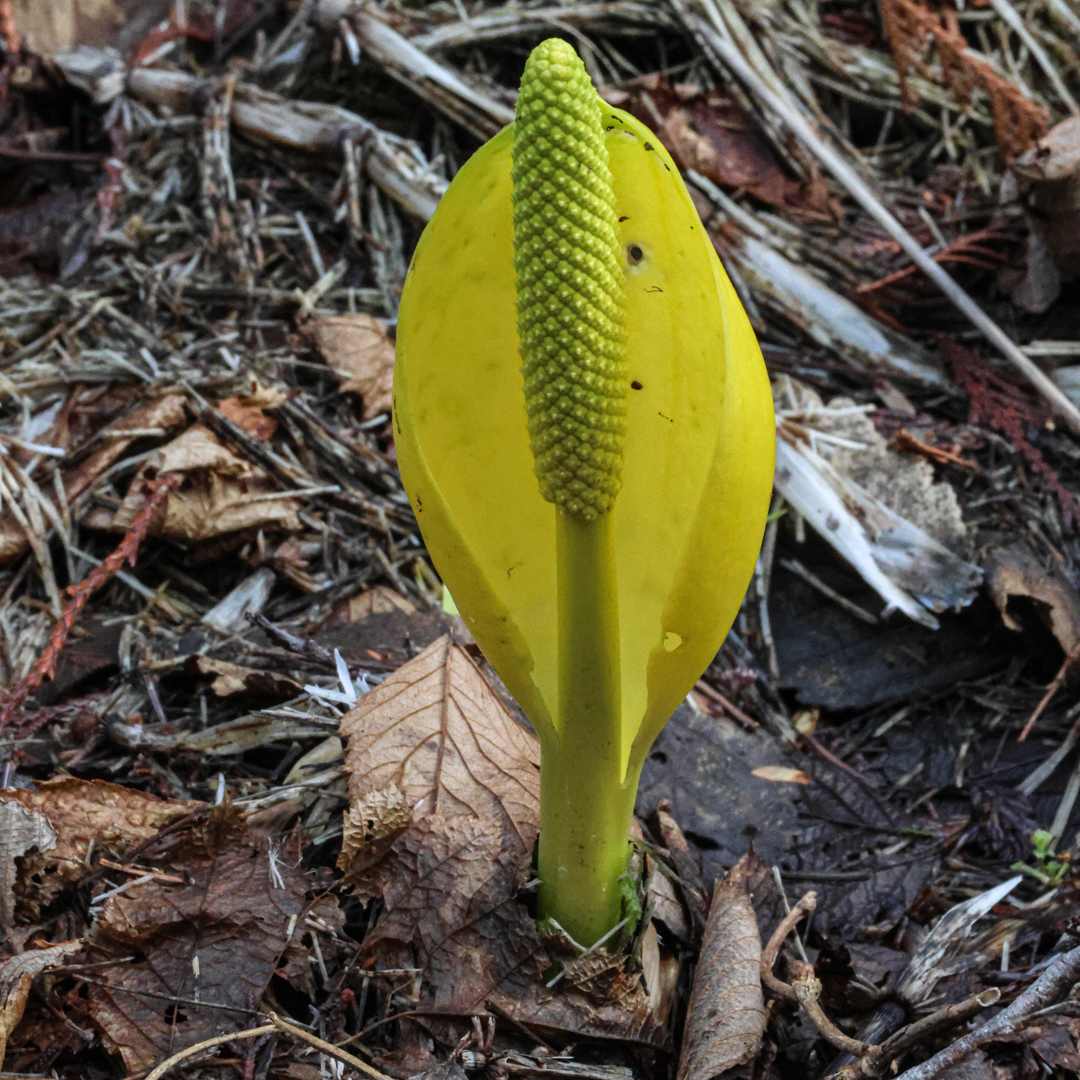
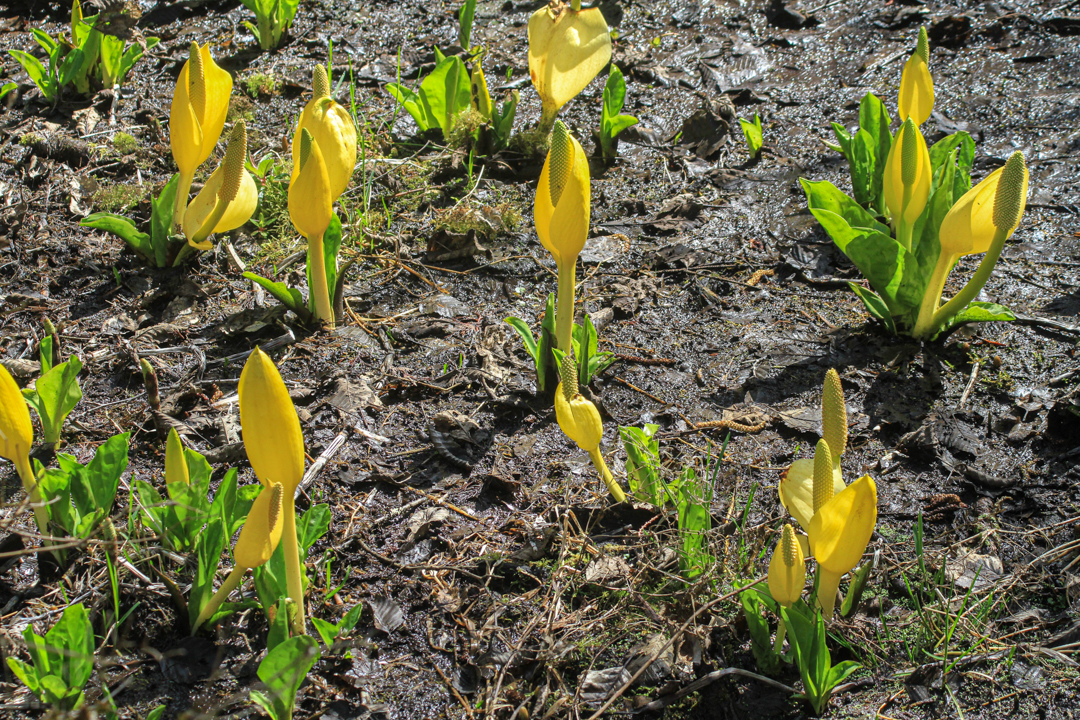
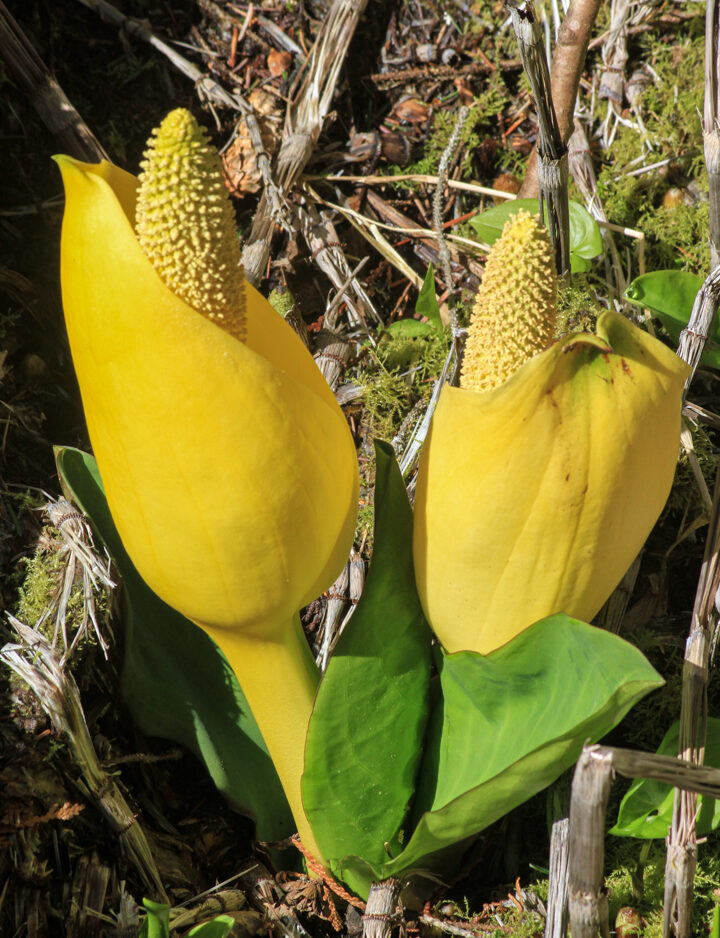
Bright yellow spikes start to unfold, revealing a nubby cylinder inside. Is it alien, plant, or plastic? If there’s a doubt about the organic nature of this being, the smell confirms it is indeed alive and doing something chemical. Particularly on a warm spring day, with a big patch of the yellow spikes on full display, that aroma wafting across a forest trail makes it easy to understand why people named them skunk cabbage.
smell of success
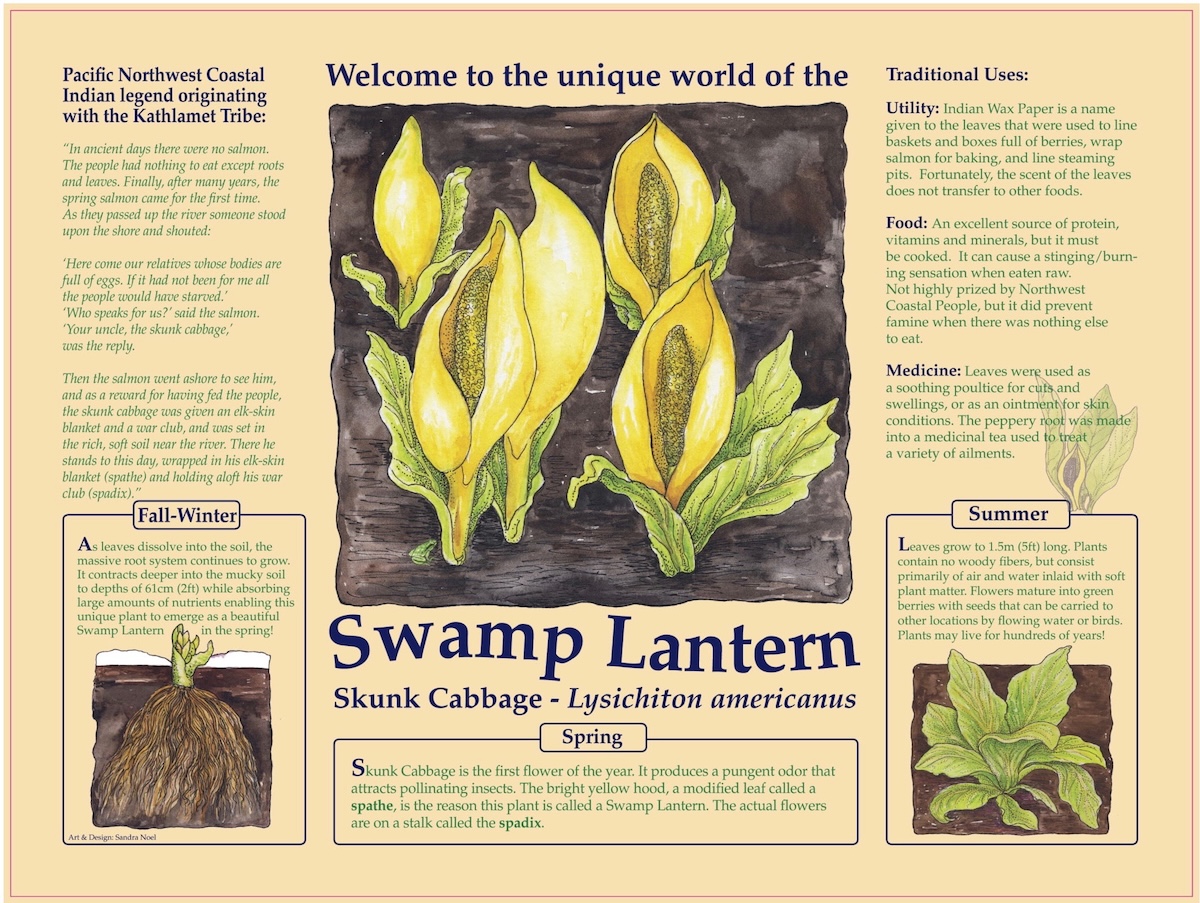
American skunk cabbage (Lysichiton americanus) is more poetically known as swamp lantern. A true wetland plant, its roots must be saturated year-round. It’s ideal habitat is a pocket of deep, mucky soils in a low spot in the forest, or in a groundwater seep on a shady hillside. The roots often grow to a depth of a foot or more and form a large rootball. The leaves of skunk cabbage continue to grow through the summer and become quite large before dying back in the fall.
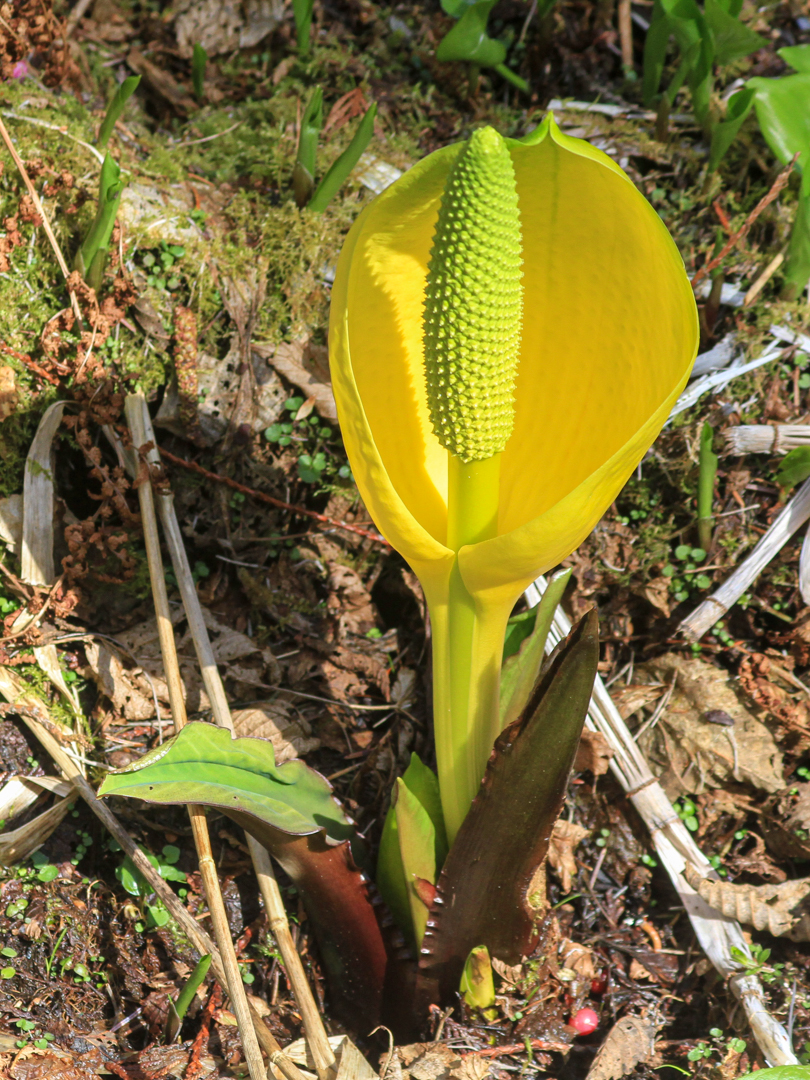
Roots survive the winter underground, sending up a bright yellow spathe in early spring. The spathe is like a hood that partially encloses a spadix where the plant’s reproductive parts are located. Skunk cabbage is pollinated mainly by rove beetles (Staphylinidae) and flies, attracted by the carrion-like odor of the plant. Spiders take advantage of this situation, weaving their webs around the bright yellow spathes to trap the flies for a meal. Green fruit forms along the spadix, where seeds ripen to be dispersed primarily by animals and running water. If left undisturbed, skunk cabbage plants can live for decades.
 Skunk cabbage (swamp lantern) – Lysichiton americanus. Identification and characteristics
University of Washington Botanic Gardens: March Plant Profile: Lysichiton americanus
breakfast for bears
For black bears, early spring skunk cabbage is an important food source. After emerging from hibernation, black bears have been observed feasting on the roots and leaves (resulting in another nickname, bear weed).
However, skunk cabbage is toxic if consumed by humans, particularly in its raw form. It contains calcium oxalate crystals, which can cause irritation of the mouth, throat, and digestive tract, or even death if consumed in large quantities. Indigenous people have used skunk cabbage for medicinal purposes and in food preparation. The large leaves were used to line baskets and as wrappers for salmon and other foods cooked in a fire. Obviously these practices require knowledge of how to carefully process each part of the plant to avoid its toxic effects.
hot cabbage
Eastern skunk cabbage (Symplocarpus foetidus) grows in wetlands of eastern North America. When damaged, the leaves of the eastern species emit a strong pungent odor (sound familiar?). It is a thermogenic species, having evolved special chemical processes inside the plant that allow it to heat up as it emerges from the ground in early spring, even melting through snow. Our Salish Sea species, Lysichiton americanus, is not known to be thermogenic, however.
Skunk Cabbage melts snow and ice! Five Fascinating Facts you should know including Thermogenesis!
invading across the sea
American skunk cabbage was introduced as a garden plant in Europe in the early 1900s. As with too many introduced garden species, it escaped into natural landscapes where it thrives in forested wetlands. Its large leaves shade out and block native plants from growing. Laws to prevent importing or spreading this species are in place in European countries, and volunteers are working to remove it. Anyone who has spent time digging out invasive English ivy or Himalayan blackberry from a forest in the Salish Sea region can understand the hard work required to control an alien plant once it’s loosed on a native ecosystem.
Skunk Cabbage (invasive species) – #BlairvadachBytes
a festival for swamp lanterns
Skunk cabbage is found at low elevations from Alaska to California, so chances are you can find it in a local park where there’s deep, wet soil and adequate shade.
For a more curated view, the Adopt-A-Stream Foundation in Everett, Washington, hosts a Swamp Lantern Festival in April each year. Visitors can see (and smell) swathes of skunk cabbages in bloom along a quarter-mile of boardwalk meandering through a forested wetland at the Northwest Stream Center. It’s a great place to view skunk cabbage and other native wetland species without venturing into boot-sucking mud. (Reservations are recommended and there is a small fee.)
The Swamp Lantern Festival described in the Everett Post
Discover | Adopt A Stream Foundation
Reproduced with permission from the Adopt-A-Stream Foundation, all rights reserved.

Thomas Noland is a naturalist and photographer living in Everett. In addition to his interests in paleobiology, he is a dedicated entomologist and caretaker of numerous rescued cats.
Sara Noland grew up in the wilds outside Renton, attended UW and Western, and has lived in Everett for the past quarter century. She was fortunate to spend a quarter of her undergraduate life at UW Friday Harbor Laboratories. She shares a tiny house with her husband and a herd of cats and dogs. Sara works and volunteers as a biologist and writer; her favorite topics are Washington beaches and lowland forests.
Issue Page
Table of Contents, Issue #27, Spring 2025
Images of New Life
Images of New Life text and photos by John F. Williams, Spring 2025Salal flowerstext and photos by John F. Williams Spring 2025Here are some Pacific ninebark flowers in their bud stage, in their showy stage, and in their later withering and seed-forming stage....
Springtime Bees
Springtime Bees by Sarah Ottino Spring 2025A ground-nesting bee on some blades of grass. photo by Rich Hatfieldby Sarah Ottino Spring 2025The longer, warming days of spring rouse native bees from their winter slumber. While domesticated European honeybees produce a...
Salish Sea Salamanders
Salish Sea Salamandersin Urban Spaces by Dominick Leskiw and Julianna Hallza, Spring 2025Closeup of the face of a long-toed salamander. photo by Julianna Hallzaby Dominick Leskiw and Julianna Hallza Spring 2025How do long-toed salamander populations (and by extension,...
Herald of Spring
Red-Winged Blackbird: Herald of Spring by Lucienne Miodonski Spring 2025Red-winged blackbird among the cattails in a wetland. photo by John F. Williamsby Lucienne Miodonski Spring 2025In the Skagit Valley of the Pacific Northwest, where the northern arm of the Salish...
Artwork 27
by Linda Hanlon Spring 2025This northern alligator lizard lives near me. I am always happy to see them when I find them in my yard. For more about alligator lizards, you might look here: https://wdfw.wa.gov/species-habitats/species/elgaria-coeruleaTrillium can be...
Poetry 27
Poetry 27 by multiple poets Spring 2025Herring eggs on kelp at low tide in Agate Passage. photo by John F. Williamsby multiple poets Spring 2025THE KISS OF SPRING by Diane Moser Blazing pink-whitecotton candy treesdance over sidewalksand roadside. They throw...
COPYRIGHT
Copyright SEA-Media
All rights reserved. Reproduction or distribution, in whole or in part. without consent of copyright owner is strictly prohibited — except for brief quotations in critical reviews and other noncommercial uses permitted by copyright laws.
SEA-Media is a 501(c)(3) nonprofit corporation
PLEASE HELP SUPPORT
SALISH MAGAZINE
DONATE
Salish Magazine contains no advertising and is free. Your donation is one big way you can help us inspire people with stories about things that they can see outdoors in our Salish Sea region.
We also don't advertise Salish Magazine, so please spread the word of this online resource to your friends and colleagues.
Thanks so much for your interest and your support.