
Red-Winged Blackbird:
Herald of Spring
by Lucienne Miodonski
Spring 2025
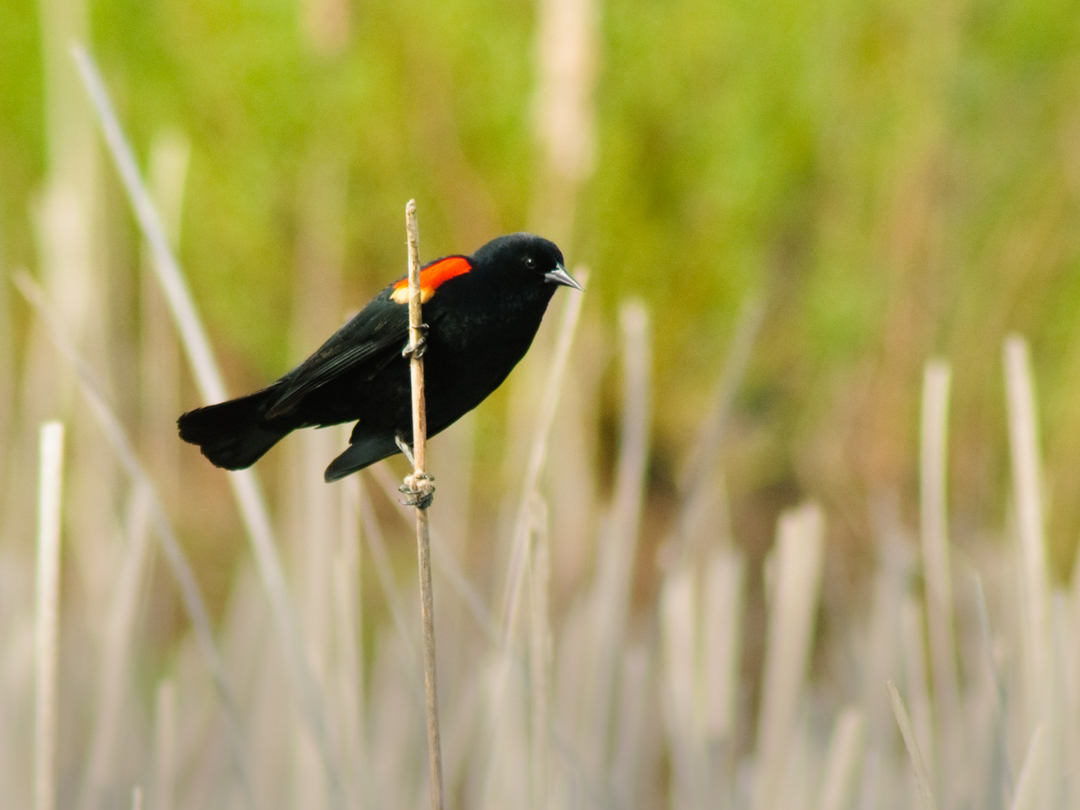
Red-winged blackbird among the cattails in a wetland. photo by John F. Williams
Red-Winged Blackbird: Herald of Spring
by Lucienne Miodonski
Spring 2025
In the Skagit Valley of the Pacific Northwest, where the northern arm of the Salish Sea braces against the wide shoulders of the Cascade Mountains, the winters are long and soggy, and the forests and fields seem to hunker down under the weight of rain clouds. Spring here emerges slowly, like a grand unraveling. Snowlines slowly retreat up mountain slopes, and the sun lingers a little longer over the horizon.
As days lengthen and temperatures rise, the arrival of spring marks a transformation in ecosystems, with various species emerging to take advantage of warming temperatures and abundant resources. Among the first avian harbingers of spring to return to their breeding grounds in the marshes, wetlands, and open fields are male red-winged blackbirds (Agelaius phoeniceus). The species lives year-round throughout much of the United States including the Salish Sea region, while breeding populations in the northern Midwest states and Canada are migratory. When the males emerge from their winter retreats, they arrive at their breeding sites several weeks before the females, a behavior driven by the need to establish and defend territories.
opening notes to a tempest
Upon arrival at the breeding habitat, males engage in vigorous competition to secure the most desirable breeding areas and thereby attract females. The males perch high on cattails and reeds, puffing up their jet-black plumage and spreading their wings, accentuating their vivid red and yellow shoulder epaulettes, and singing loudly to assert dominance and mark territory. Their call is liquid and metallic, a triumphant “conk-la-ree!” — the opening note of a vast, symphonic return. Though these birds are small, their voices carry far and wide over the marshes. In addition to their iconic “conk-la-ree!” song they produce a variety of calls, including alarm calls, contact calls, and aggressive chatter. The visual and vocal displays signal an invitation to potential mates and warnings to rivals.
 Recordings of red-winged blackbird from the Audubon Society
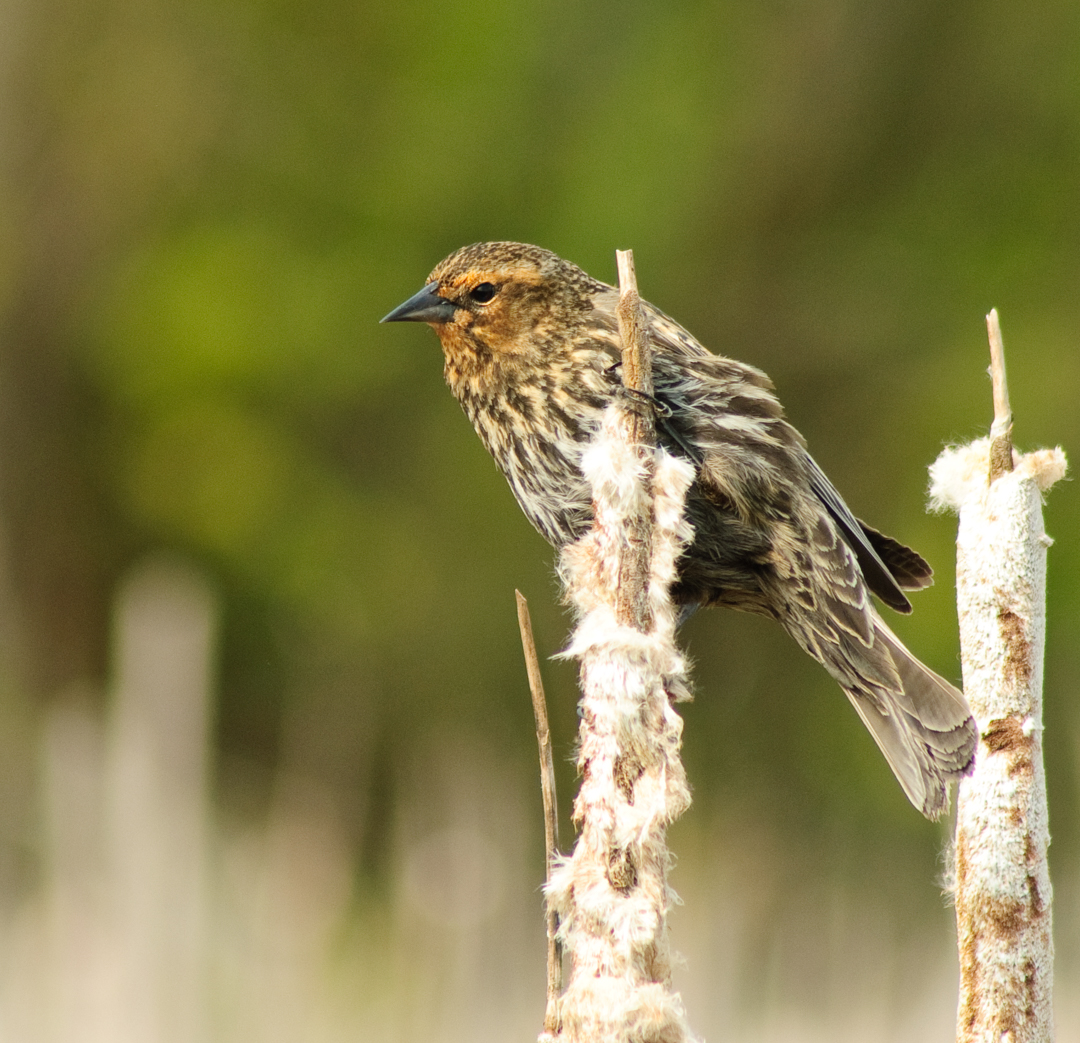
Female red-winged blackbird among cattails. photo by John F. Williams
Territorial battles can escalate into physical confrontations, with males chasing and grappling with intruders. The conflicts, usually harmless, are often resolved through posturing and vocal exchanges. By the time females arrive, the males have typically established territories, ranging from a few square yards to over an acre, depending on the quality of the habitat.
The arrival of females marks the beginning of courtship, a complex dance of attraction and selection. Female red-winged blackbirds are far less flashy; their plain brownish plumage blends in nicely for nesting. With the arrival of the females, males intensify their displays by spreading wings and flaring epaulettes, singing their songs, showcasing their physical prowess, and advertising the qualities of their territory: availability of food, suitable nesting sites, and protection from predators.
Interestingly, red-winged blackbirds exhibit a polygynous mating system, meaning that a single male may mate with multiple females within his territory. Polygyny can be advantageous in resource-rich environments by allowing dominant males to pass on their genes more broadly. In turn, females may mate with multiple males to maximize genetic diversity among their offspring.
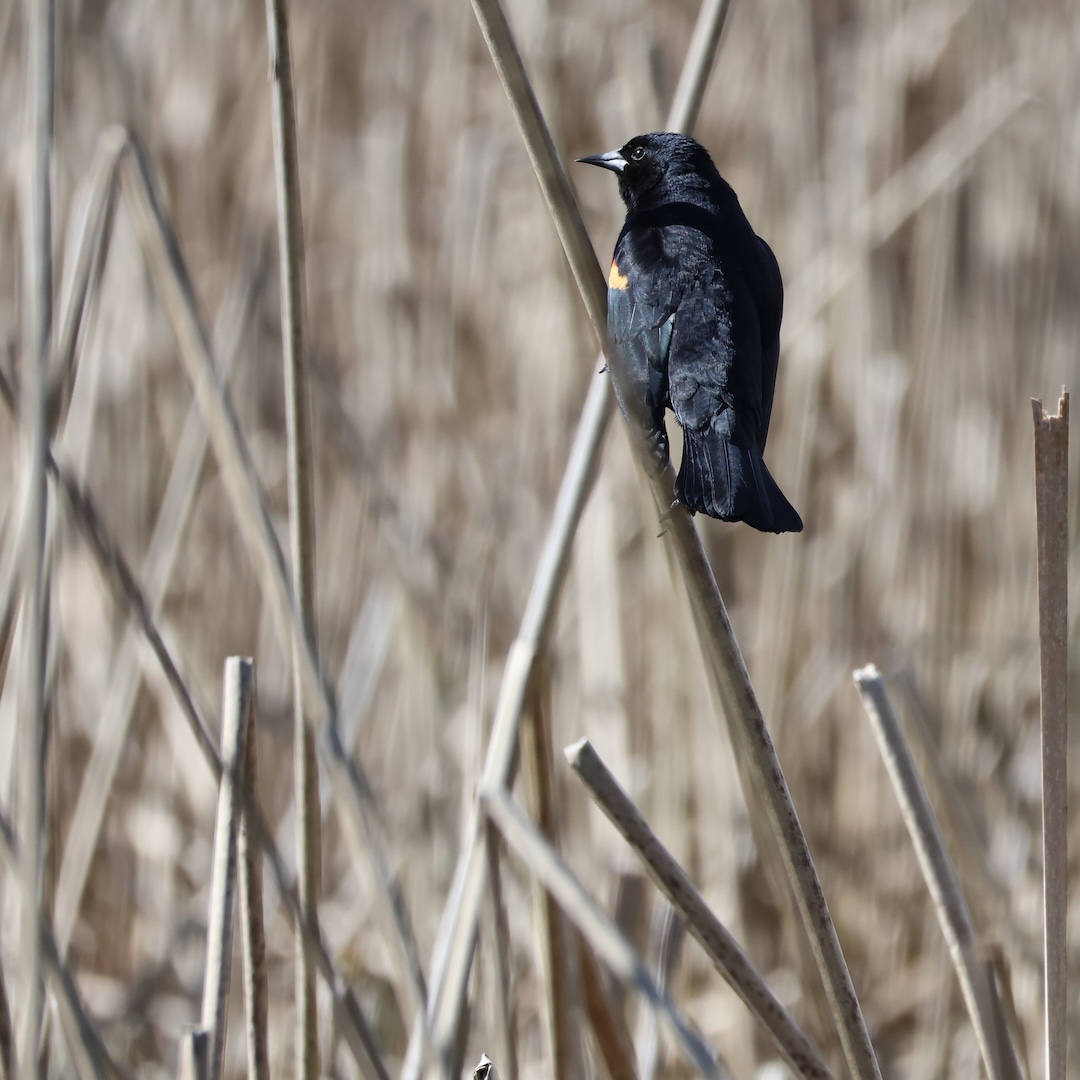
Red-winged blackbird in reeds. photo by Tom Noland
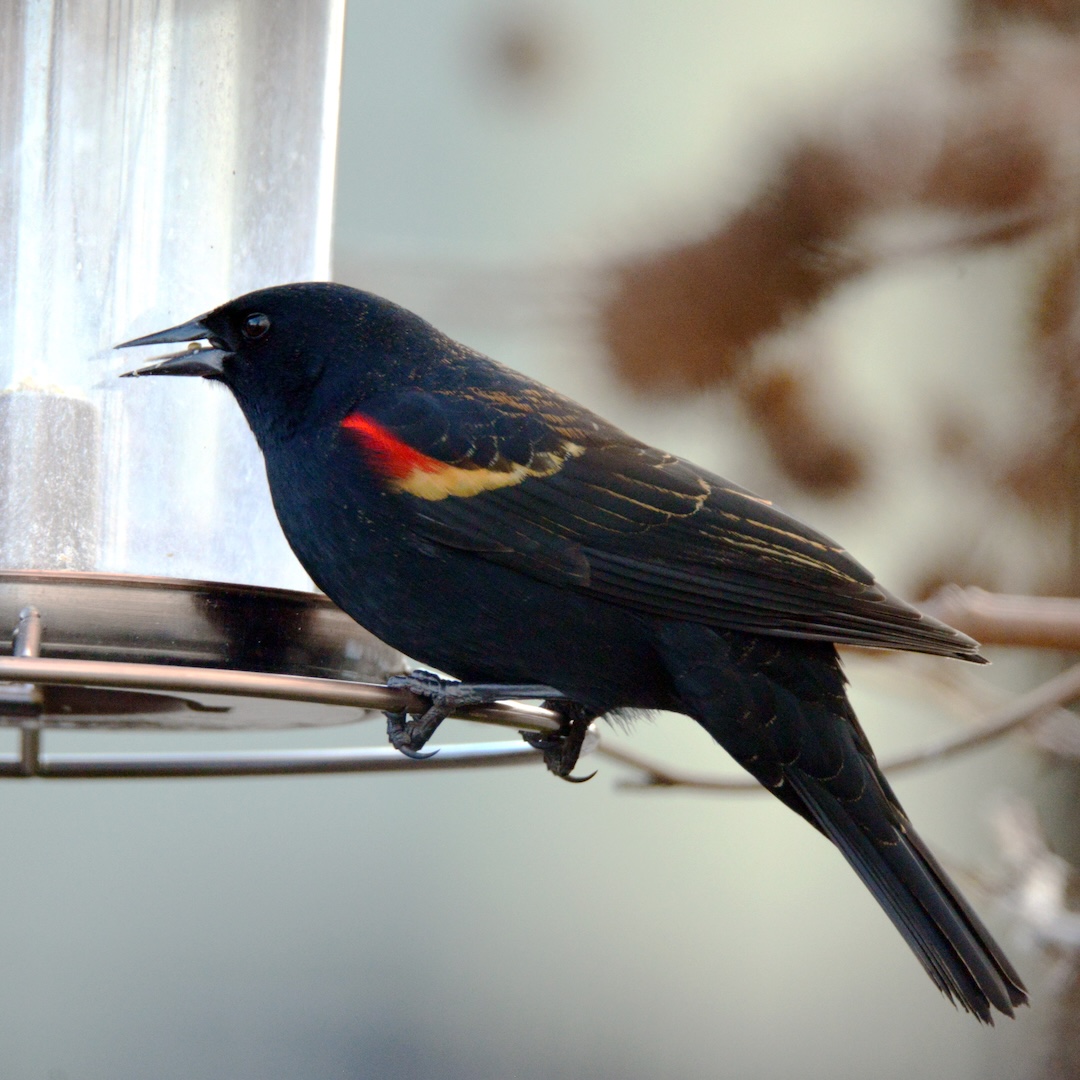
Red-winged blackbird at feeder. photo by Lucienne Miodonski
a secret nest
Once a female selects a mate and nesting site, she begins constructing a nest, usually among dense vegetation that provides cover and protection from predators. The nest is a cup-shaped structure intricately woven from grasses, reeds, and other plant materials, with a soft lining to cushion the eggs.
Females typically lay three to five eggs, which are pale blue-green with dark streaks and speckles. The incubation period is about 11 to 14 days, during which the female remains vigilant, blending into her surroundings to avoid detection by predators. The male’s role during this period includes patrolling the territory and defending it from intruders, ranging from rival males to predators (such as snakes, raccoons, and larger birds) to humans.
While the males are busily protecting their territories, the females are the primary food providers for their chicks. Their diet is rich in insects and other invertebrates, ensuring the necessary protein for rapid growth. Nestlings grow quickly, developing feathers within 10 to 14 days. After leaving the nest, fledglings continue to depend on their parents for food and protection for several more weeks. By late spring or early summer, most juveniles are ready to fend for themselves, allowing the adults to focus on potential second broods.
See more information about red-winged blackbird life history by CornellLab.
See more information about red-winged blackbird feeding and nesting habits from the American Bird Conservancy.
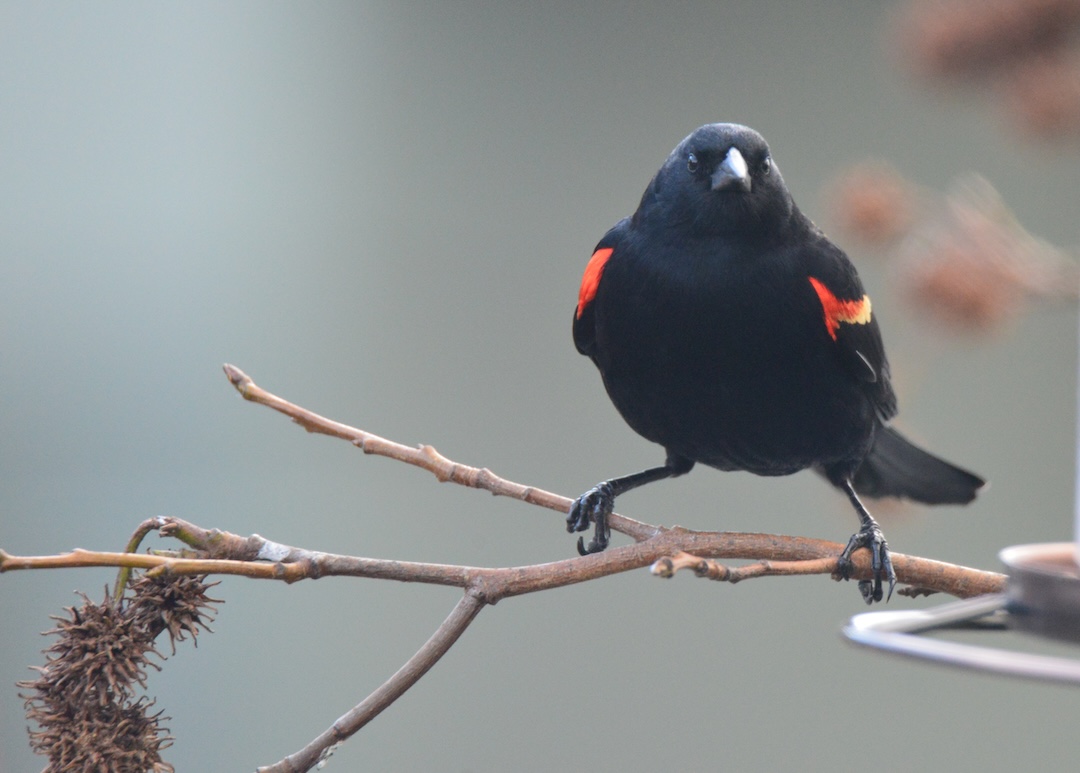
Red-winged blackbird next to birdfeeder. photo by Lucienne Miodonski
making the most of a changing world
Outside of the breeding season, red-winged blackbirds are highly social and often form large flocks, easily mixing with other birds, such as starlings. This seasonal adaptability underscores their resilience and ability to thrive in diverse environments. Red-winged blackbirds can use human-altered landscapes, such as roadside ditches and agricultural fields. This flexibility has allowed red-winged blackbirds to persist in large numbers despite widespread habitat modification by humans. These birds are still one of the most common species you will likely see and hear around the Salish Sea region.
The song of the red-winged blackbird is the sound of spring, a pulse of the Skagit Valley, and the echo of something timeless and enduring. On a spring morning in the Skagit Valley, it is easy to feel dwarfed by the scale of the world. Snow-capped mountains loom in the distance, the tides ebb and flow through estuaries, and overhead, the skies teem with life. In the midst of it all, there is a single reed, bending under the weight of a small blackbird singing a song that has been sung for millennia: “conk-la-ree!”
editor’s notes
Contributors to eBird have submitted nearly 17 million observations of red-winged blackbirds across the United States and Canada: https://ebird.org/species/rewbla
Despite these large numbers, overall populations of red-winged blackbirds are declining. The Cornell Lab of Ornithology estimated that since 1970, red-winged blackbird populations in North American have declined by 36% or 92 million birds. Learn more about bird population declines and what each person can do to help birds here: https://www.birds.cornell.edu/home/bring-birds-back/
Scientists have found that wetlands constructed to retain stormwater can provide habitat for red-winged blackbirds. See Sparling, D.W., Eisemann, J. & Kuenzel, W. “Nesting and foraging behavior of red-winged blackbirds in stormwater wetlands.” Urban Ecosystems 10, 1–15 (2007). https://doi.org/10.1007/s11252-006-0009-0
Urban areas are not without challenges for red-winged blackbirds, however. Traffic noise has a documented effect on their song patterns. See Cartwright, L.A., Taylor, D.R., Wilson, D.R. et al. “Urban noise affects song structure and daily patterns of song production in Red-winged Blackbirds (Agelaius phoeniceus).” Urban Ecosystems 17, 561–572 (2014). https://doi.org/10.1007/s11252-013-0318-z
For a less technical perspective, the audio series BirdNote has featured this species several times over the years:
- Blackbird expert Dr. Gordon Orians, who studied red-winged blackbirds in eastern Washington for many years, talks about how blackbirds use a unique “gape” to get at prey: https://www.birdnote.org/podcasts/birdnote-daily/gaping-blackbirds
- Writer Christian Cooper discusses how his “spark” bird lifts his spirits at the end of winter: https://www.birdnote.org/podcasts/birdnote-daily/spark-bird-christian-coopers-red-winged-blackbird
- Musician and writer Ray Young Bear explains how he took vocal lessons from red-winged blackbirds: https://www.birdnote.org/podcasts/birdnote-daily/learning-sing-blackbird
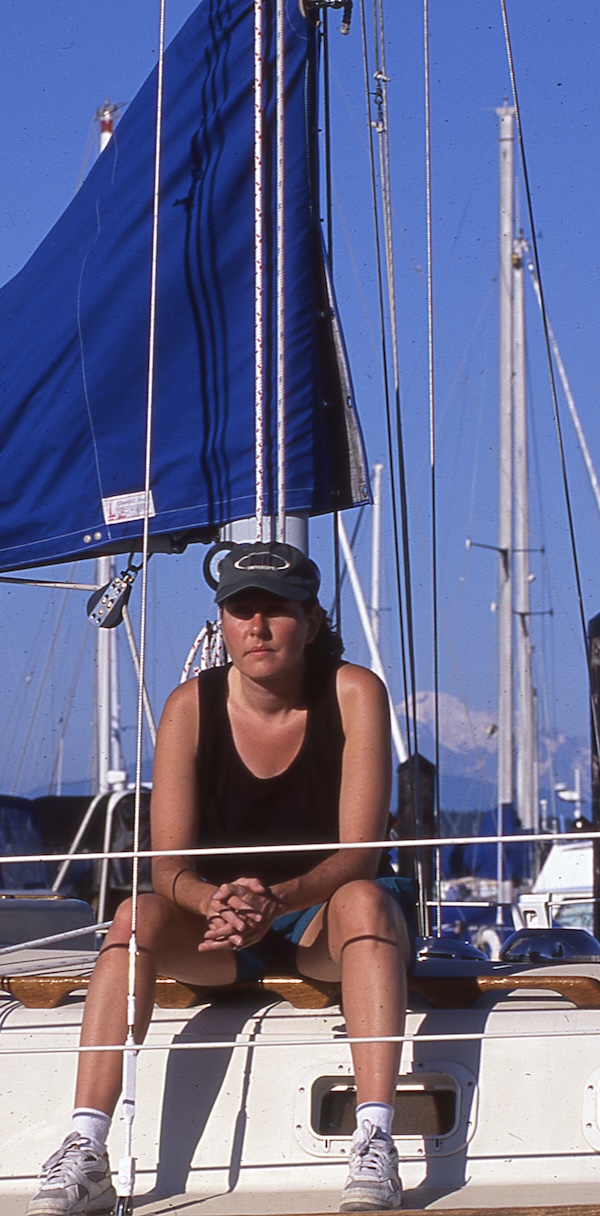
Lucienne Miodonski is a writer, poet, photographer, and active in dog sports. She has a passion for animals and the outdoors and is deeply curious about the natural world. Lucienne seeks to capture the beauty and complexity of nature and draws inspiration from the world around her. Whether crafting poetry, prose, or images, she strives to create work that is engaging and resonates with authenticity and a sense of wonder. She lives on Camano Island, overlooking the Salish Sea and the Olympic Mountains, with her husband and two dogs.
Issue Page
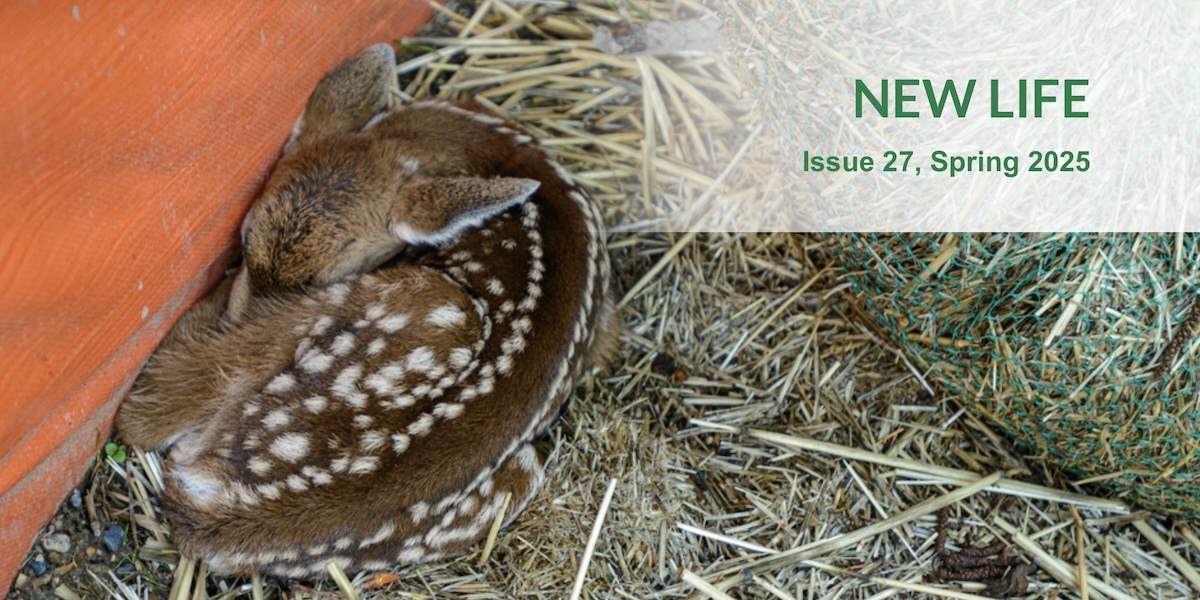
Table of Contents, Issue #27, Spring 2025
Images of New Life
Images of New Life text and photos by John F. Williams, Spring 2025Salal flowerstext and photos by John F. Williams Spring 2025Here are some Pacific ninebark flowers in their bud stage, in their showy stage, and in their later withering and seed-forming stage....
Springtime Bees
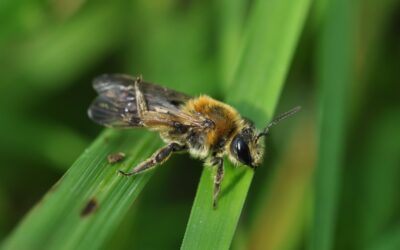
Springtime Bees by Sarah Ottino Spring 2025A ground-nesting bee on some blades of grass. photo by Rich Hatfieldby Sarah Ottino Spring 2025The longer, warming days of spring rouse native bees from their winter slumber. While domesticated European honeybees produce a...
Salish Sea Salamanders
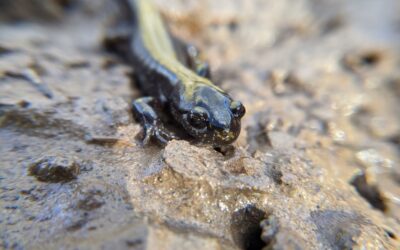
Salish Sea Salamandersin Urban Spaces by Dominick Leskiw and Julianna Hallza, Spring 2025Closeup of the face of a long-toed salamander. photo by Julianna Hallzaby Dominick Leskiw and Julianna Hallza Spring 2025How do long-toed salamander populations (and by extension,...
Spring Aliens
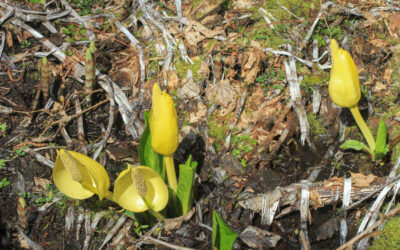
Spring Aliens in the woods by Thomas and Sara Noland photos by Thomas Noland Spring 2025by Thomas and Sara Noland photos by Thomas Noland Spring 2025It’s spring in the woods, and botanical aliens are awakening. They aren’t really aliens — they’re native inhabitants of...
Artwork 27
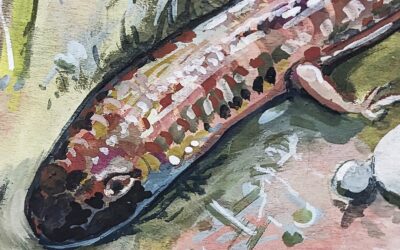
by Linda Hanlon Spring 2025This northern alligator lizard lives near me. I am always happy to see them when I find them in my yard. For more about alligator lizards, you might look here: https://wdfw.wa.gov/species-habitats/species/elgaria-coeruleaTrillium can be...
Poetry 27
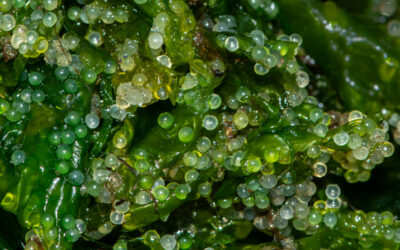
Poetry 27 by multiple poets Spring 2025Herring eggs on kelp at low tide in Agate Passage. photo by John F. Williamsby multiple poets Spring 2025THE KISS OF SPRING by Diane Moser Blazing pink-whitecotton candy treesdance over sidewalksand roadside. They throw...
COPYRIGHT
Copyright SEA-Media
All rights reserved. Reproduction or distribution, in whole or in part. without consent of copyright owner is strictly prohibited — except for brief quotations in critical reviews and other noncommercial uses permitted by copyright laws.
SEA-Media is a 501(c)(3) nonprofit corporation
PLEASE HELP SUPPORT
SALISH MAGAZINE
DONATE
Salish Magazine contains no advertising and is free. Your donation is one big way you can help us inspire people with stories about things that they can see outdoors in our Salish Sea region.
We also don't advertise Salish Magazine, so please spread the word of this online resource to your friends and colleagues.
Thanks so much for your interest and your support.