
Salish Sea Salamanders
in Urban Spaces
by Dominick Leskiw and Julianna Hallza, Spring 2025

Closeup of the face of a long-toed salamander. photo by Julianna Hallza
Salish Sea Salamanders in urban spaces
by Dominick Leskiw and Julianna Hallza
Spring 2025
How do long-toed salamander populations (and by extension, other amphibian species) persist in the middle of urban spaces in the Salish Sea region?
While most of Seattle prepares for bed, listening passively to the drizzle upon their roofs, Julianna Hallza embraces the crunch of gravel underfoot as she walks a dark pathway through the Union Bay Natural Area in Seattle. It is February 2021; the sky is a sheet of heavy clouds, punctuated by the tops of cottonwoods outlining a nearby pond and a row of willows delineating a small sliver of forest.
Ruler, camera, and notebook in hand, Hallza turns toward the willows. Her gaze is not aimed up at their crowns — rather, her headlamp concentrates a bright circle upon the ground. A few steps off the path, downed branches and trunks appear among the tall grasses and blackberries. Hallza kneels down, grabs a log with both hands, and rolls it gently toward her. Underneath, it is warm enough that a faint wisp of steam emerges into the cold air. Nestled in the black soil is the animal she came here for: a long-toed salamander (Ambystoma macrodactylum).

The hand holding this long-toed salamander illustrates the size of the salamander. photo by Julianna Hallza
Finding a long-toed salamander curled up under a fallen log is a special experience. They are beautiful animals. Their bodies are the color of suburban night, of headlights on wet asphalt. Upon their backs, some sport broken ochre stripes, reminiscent of sunlight dappling the dark ponds where they breed. Others look as if plated with a delicate layer of gold foil. Their sides and appendages are speckled with pale blue, like the few crisp stars one can see while searching for salamanders under clear skies. Their undersides have an astral quality, too — dusky and dotted by hundreds of tiny yellow flecks.
That winter, Hallza was conducting research exploring the impact of a restoration project on long-toed salamanders in the Union Bay Natural Area, an urban greenspace in the heart of the Salish Sea region. Specifically, she was hoping to understand how these salamanders utilize a specially designed corridor linking the ponds to the forests they rely upon.
Many people are unaware that salamanders live scattered throughout Seattle and the wider Salish Sea region. Even fewer know what it takes for these sensitive, yet resilient, creatures to persist in pockets of the urban landscape.
The answer lies in connection — between life stages, between habitats, and ultimately, between species.
a tale of two habitats
Long-toed salamanders are “biphasic,” meaning that their life cycle requires two distinct habitats: one for eggs to mature, and one for adults to persist. As adults, the salamanders spend the non-breeding season burrowed underground in forests to avoid cold temperatures in winter and drought in late summer. Long-toed salamanders are considered “fossorial,” or burrowing, because of their tendency to spend time underground, but they don’t typically dig the burrows themselves. Instead, they use existing dens created by mice, moles, or other animals, and they occasionally dig along tree roots where the soil is easier to move.
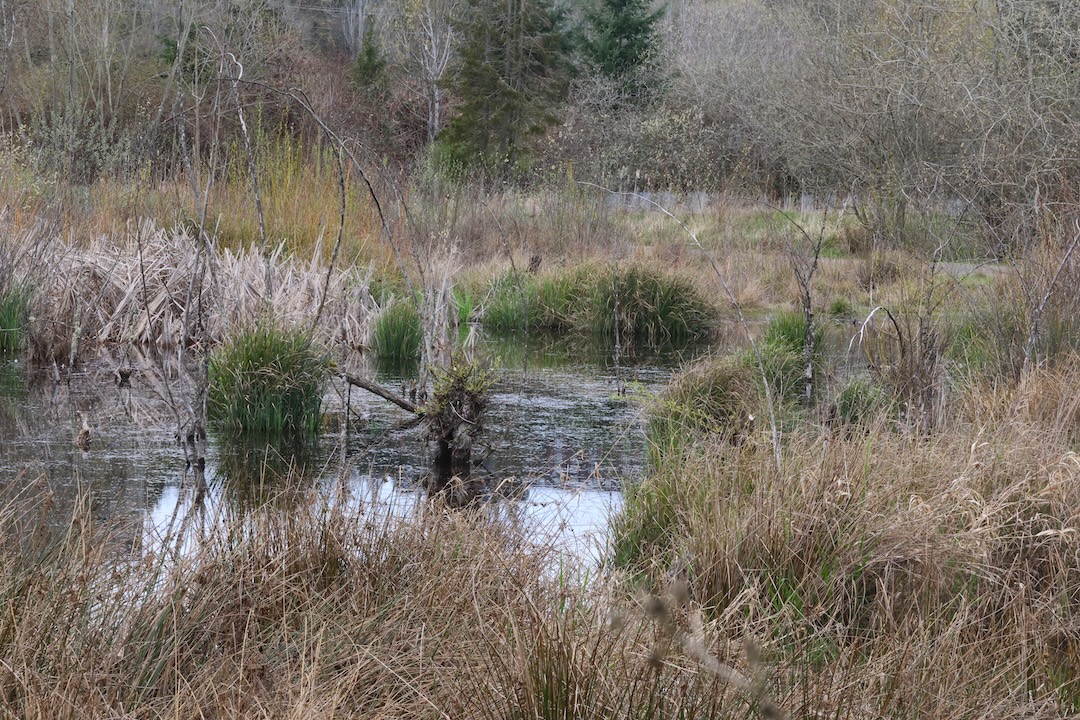
Wetland at the Union Bay Natural Area. photo by Thomas Noland
When temperatures are above freezing and moisture levels are high in the late winter and spring, the salamanders stay above ground but often remain beneath the cover of downed, decaying wood.
Come the rains of late winter (typically January or February in the Salish lowlands), the salamanders emerge from their subterranean habitat and migrate toward still-water ponds to breed and lay eggs. To travel between their wetland breeding habitat and upland non-breeding habitat, salamanders sometimes need to migrate about 200 meters (650 feet). For salamanders to thrive, the pond water must be uncontaminated and free of non-native predators such as introduced fish and bullfrogs.
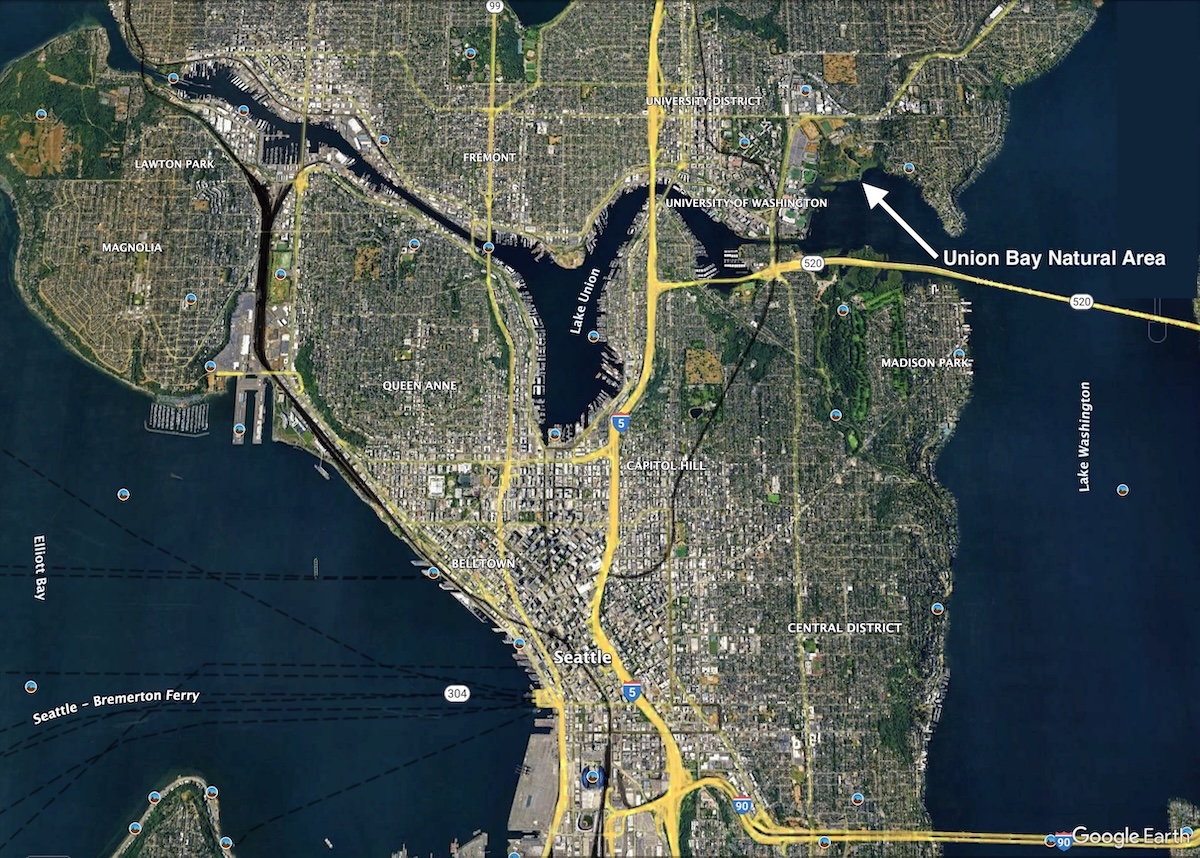
Screenshot of Google Earth showing a region around Seattle.
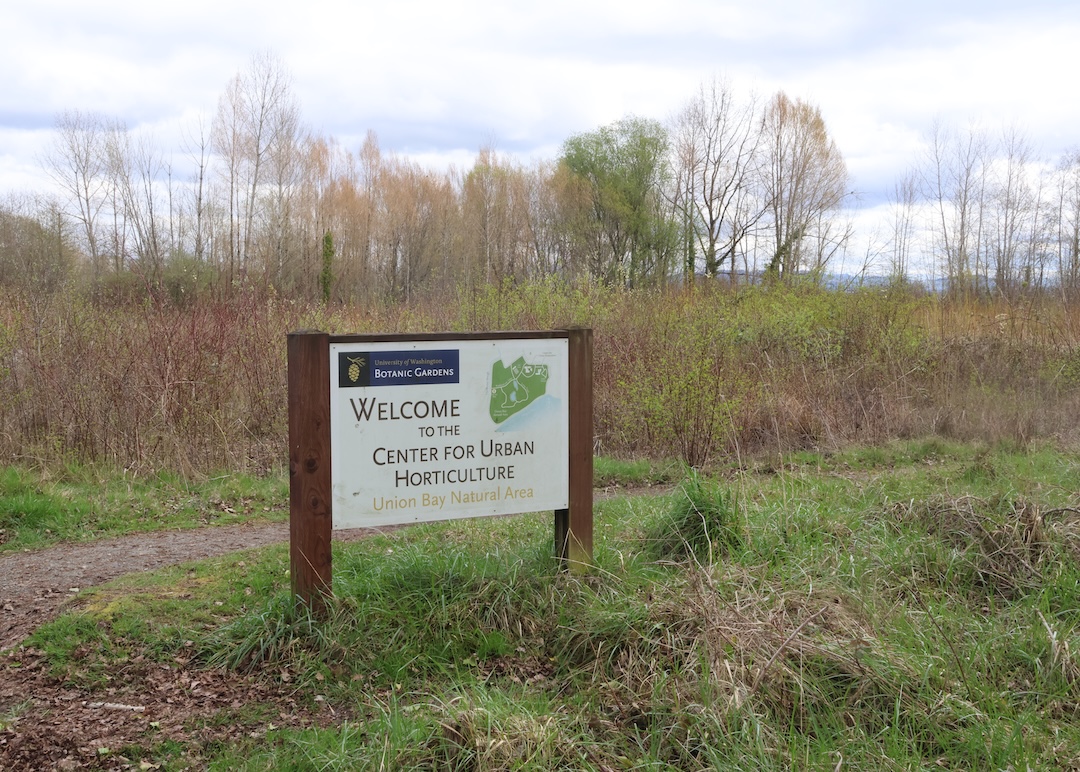
Welcome sign at Union Bay Natural Area. photo by Thomas Noland
Long-toed salamanders lay eggs singly or in small clusters enveloped in a jelly-like protective layer. This layer allows the eggs to absorb oxygen from the water. Eggs develop over the course of a few weeks, and tiny embryos are visible wiggling their tails before the eggs even hatch. Initially, hatchling salamanders are very small, about a centimeter (half-inch) or less, and only have tiny “balancers” extending from where their front legs will eventually grow. The tadpole-like larvae are distinguishable from frogs and toads because of their external gills, which allow them to breathe underwater.
Over the next weeks or even months, the larvae develop front and then back legs, and their tails become more defined. As water levels drop in late summer, their gills reabsorb into their bodies, and they metamorphose into their terrestrial adult form. From there, the salamanders migrate to upland forests, and the cycle begins again.
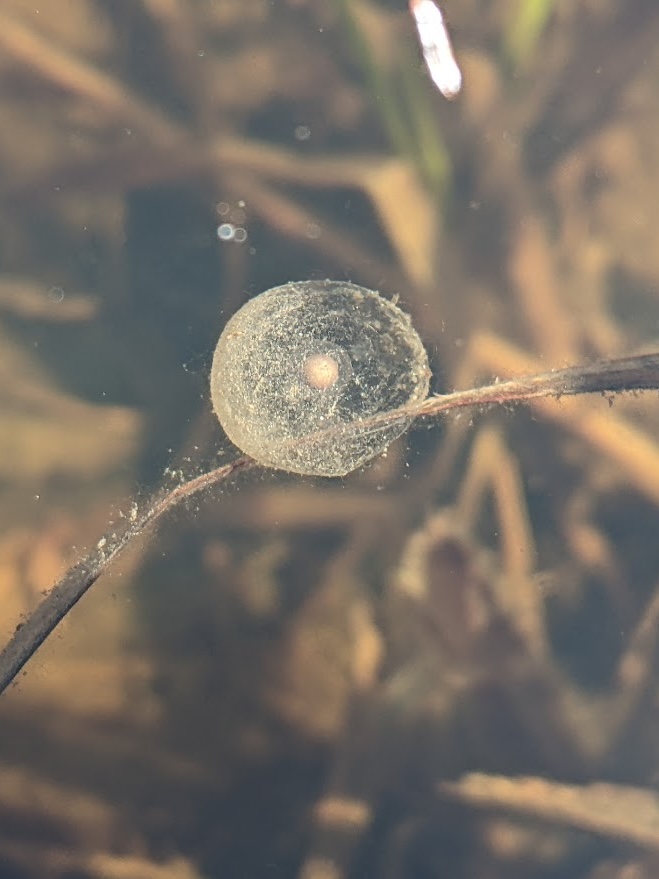
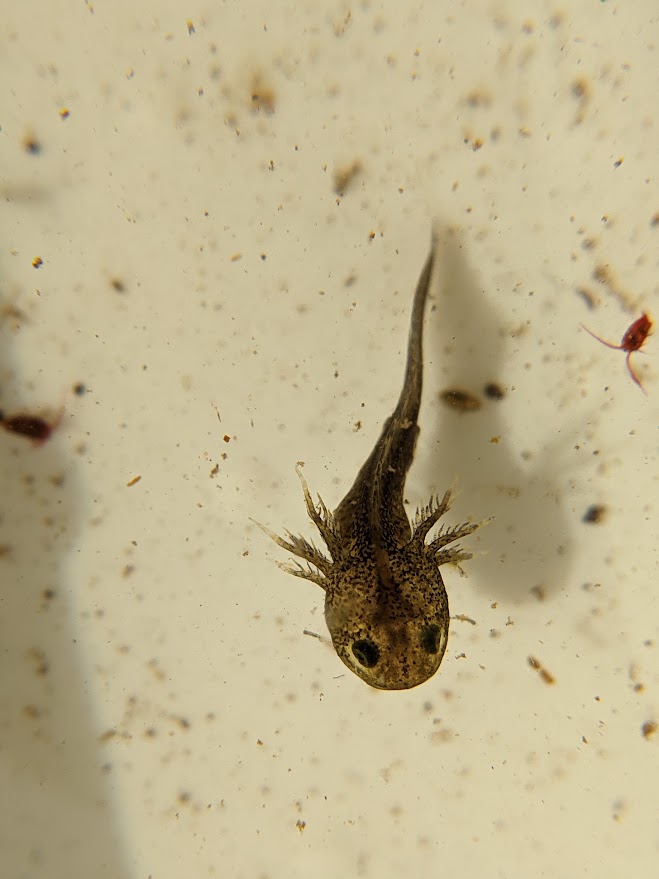
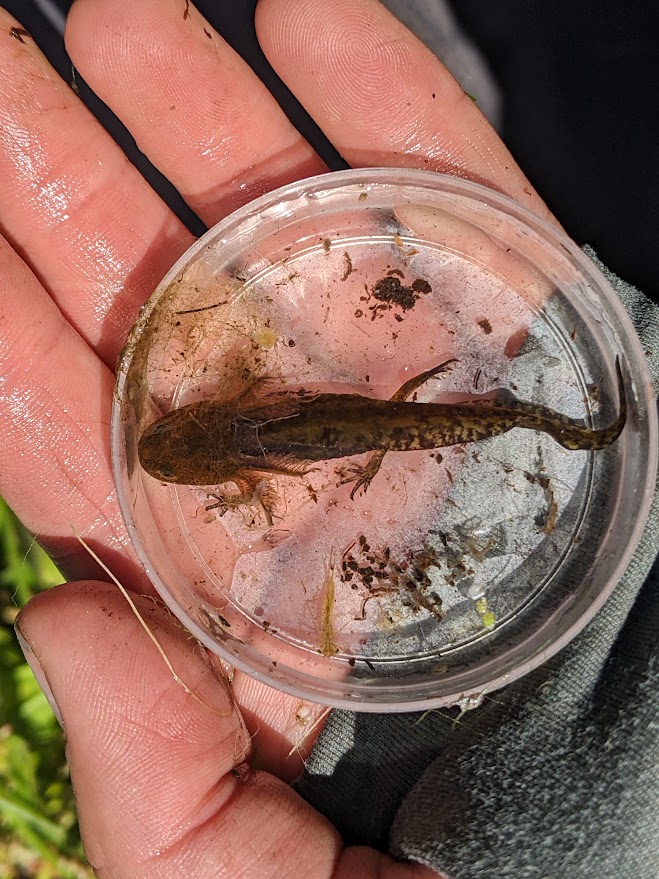
Long-toed salamander egg, hatchling before its legs have grown, and larva with legs. photos by Julianna Hallza
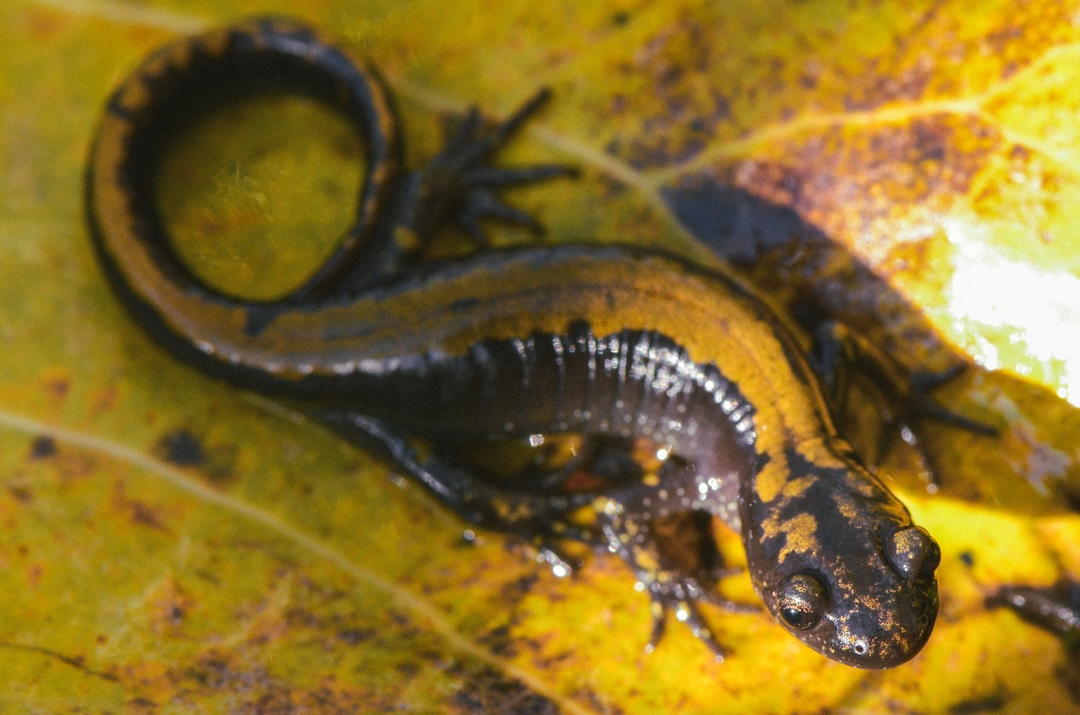
A long-toed salamander poses on a leaf showing its namesake appendages and characteristic golden stripe. Every individual’s stripe is different, like a fingerprint. photo by Dominick Leskiw
making connections
Most amphibians have relatively small home ranges, so an urban park can easily encompass a salamander’s entire home range of habitats. The process of creating and maintaining those habitats is up to a host of other life forms — including us.
In a perfect world, connections between forests and breeding ponds would be abundant and free from any sort of hindrance. Unfortunately, in many urban settings, this is not the case. Yet, while human society has created many of the problems amphibians now face, we can also help them.
As urban amphibians attempt to migrate between habitats, they are sometimes forced to cross busy roads. Salamanders in particular (but frogs, too) move very slowly on land. Roads are exposed surfaces with nowhere to hide from traffic. Drivers are unlikely to see amphibians because they are so small, and many people don’t even notice when they run one over.
To help amphibians cross roads, restoration practitioners sometimes install underpasses or overpasses encouraging safe travel. These structures allow amphibians to escape traffic by crawling through tunnels specially designed to facilitate movement, or over bridges with natural habitat. Fences funnel amphibians toward these structures and away from exposed sections of road. In places where these structures have not been built, volunteer groups may gather at popular crossing sites on rainy spring evenings to carry amphibians across the road. This kind of support reduces amphibian mortality and contributes to increased habitat connectivity, even in highly urbanized spaces.
help from a furry friend
Humans aren’t the only ones who create and connect amphibian habitat, though. Another ecosystem engineer, the beaver, also modifies landscapes in ways that benefit amphibians. Beavers dam streams to create ponds, and they dig canals that connect these ponds to forests. These spaces between ponds and forests are where beavers harvest additional wood and where salamanders spend the non-breeding season.
Beaver canals link wetlands to upland habitat by creating pathways with plenty of woody debris as cover along the way. Some amphibians follow beaver trails away from their natal (birth) ponds as they disperse because of the increased moisture and easier movement these trails allow. While the use of beaver canals has not been studied in long-toed salamanders, other amphibians such as the endangered Oregon spotted frog are known to use them.
Beaver ponds are also critical for many amphibians because they retain water late into the summer months when other ponds are dry, provide habitat for multiple species to coexist, and increase wetland connectivity at the landscape scale by creating a patchwork of stream and pond habitats across a watershed.
The trees that beavers harvest play a role, too. Holding another downed log in her hands, Hallza notices a riot of animacy — bugs, fungi, mice, salamanders, and more — below its decaying bark. Here on the ground, and even after death, a part of this tree has found new life.
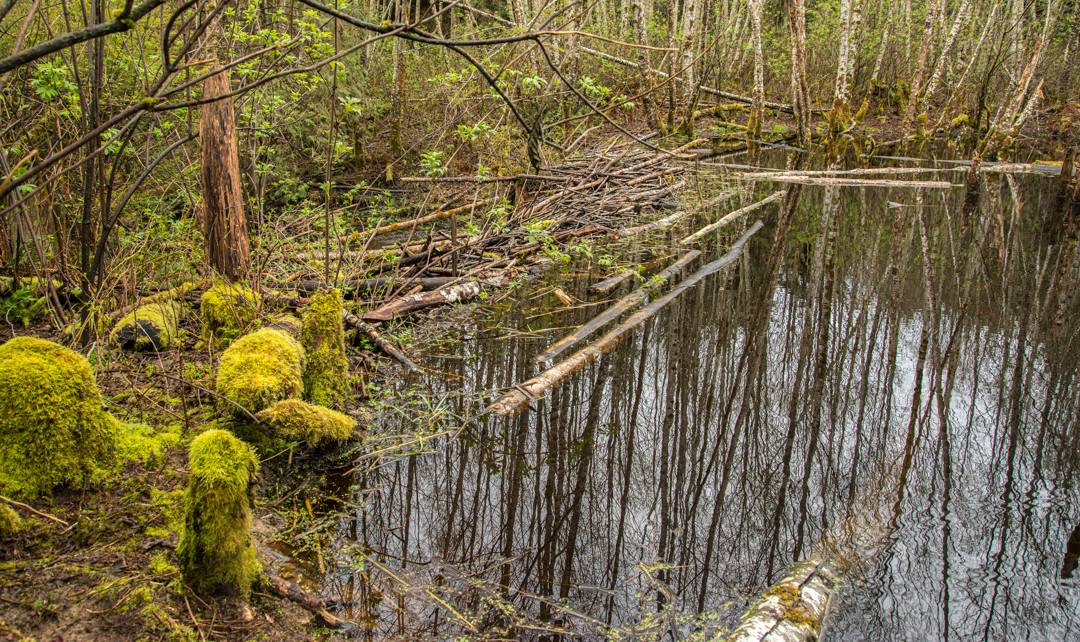
A beaver pond. photo by John F. Williams
the amphibian corridor
Urban amphibian habitats are not always separated by roads, but amphibians can still face other challenges to migration and breeding in urban greenspaces that are fragmented by pollution, non-native species, or poor habitat quality. Within the Union Bay Natural Area, there are no cars to threaten amphibian populations, but some parts of the park may be more hospitable for salamanders than others.
The park is plagued with invasive Himalayan blackberries and other non-native species. To control the blackberries, some parts of the space are mowed into grassy fields, but these spaces do not provide optimal cover for salamanders, which prefer moist, shady habitat with shrub or tree cover. To make matters worse, one of these large, grassy spaces cuts between a pond that long-toed salamanders use to breed and a forested stretch that could act as an overwintering site. A gravel path also separates the pond from the forest.
With these impediments in mind, in 2015, master’s student Kathleen Walter created a restoration site to provide a connection between the pond and forested area. This restoration site, named the Amphibian Corridor, was constructed by digging a trench between the pond and the forested area to increase soil moisture, planting native vegetation to provide shade and leaf litter, and placing large woody debris down for shelter. Additionally, Walter installed a culvert under the gravel path that separates the pond and forest, hoping that amphibians could crawl through the tunnel to complete their migration.
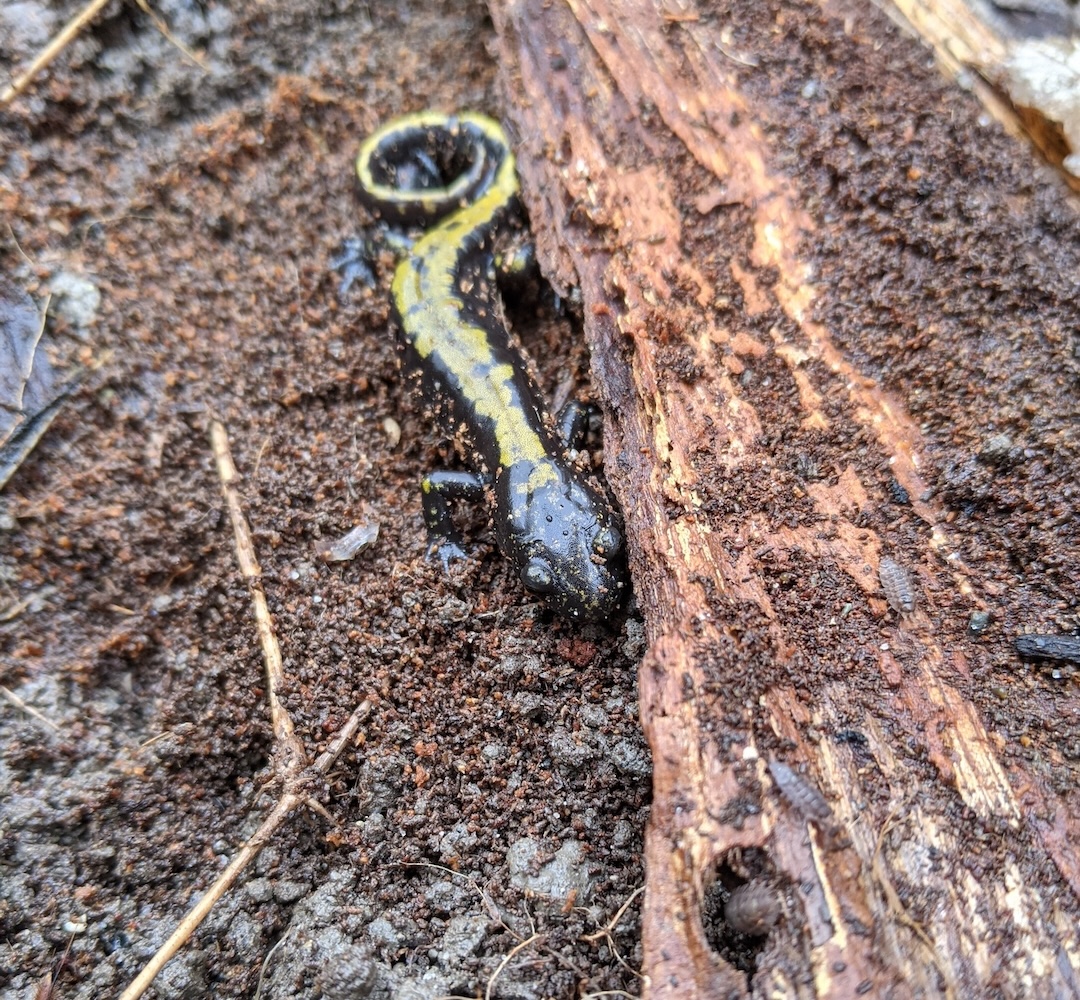
Salamander under woody debris. photo by Julianna Hallza
a surprising find
Hallza’s research was aimed at tracking salamander movement through the Amphibian Corridor. Yet, to her initial chagrin, almost all of the salamanders she captured and recaptured over the course of several months had not moved at all!
Instead, she discovered something equally important: These salamanders have high site fidelity at the Union Bay Natural Area within a breeding season. In other words, a single piece of woody debris can provide a home for a salamander (or two or three!) for several months. This is useful to know because restoration often focuses on increasing native plant cover. However the most critical component of restoration for amphibians could turn out to be the woody debris — especially larger logs, which the salamanders preferred — added to a site.
Through her study, Hallza also got to know several of the salamanders, in a way. Another beautiful facet of these animals is that the bright yellow spots and blotches running along their heads, backs, and tails are unique to each individual, like a fingerprint. Hallza recalls finding one salamander twelve times over the course of twelve weeks — under the same log every time, no less! This salamander was completely missing a foot the first time she found it. Yet, as the weeks progressed, Hallza noticed that it slowly regained use of its leg and eventually began to regrow toes, too. She sees this salamander’s story as a testament to the resilience of the species, and a reminder that even seemingly small things, like a single piece of wood, can make a big impact.
FIND OUT MORE
Amphibians & Reptiles of Washington | Burke Museum
Long-toed Salamander | Washington Department of Fish & Wildlife
Assessing the efficacy of wildlife underpasses in mitigating amphibian road mortality: A case study from the northeastern United States | Marcelino, M., S. Parren, B. Mosher. 2025 in Journal for Nature Conservation 86:126901.
Use of Restored Urban Habitat by Long-toed Salamanders (Ambystoma macrodactylum) in Seattle, Washington, USA | Hoza, J. and J. Bakker. 2023 in Herpetological Conservation and Biology 18(1):84-93.
Occupancy of Stream-Associated Amphibians within the Interstate 90 Snoqualmie Pass Corridor | Gustafson, A. 2018 in All Master’s Theses. 884.
Long-toed Salamanders: Microhabitat Preference and Movement in the Union Bay Natural Area | Hoza, J. 2021.
Late-Season Movement and Habitat Use by Oregon Spotted Frog (Rana pretiosa) in Oregon, USA | Christopher A. Pearl, Brome McCreary, Jennifer C. Rowe, Michael J. Adams, 2018

Dominick Leskiw is a freelance witer, illustrator, and photographer based in Seattle. He is passionate about marine life, birds, trees, and of course, amphibians & reptiles. He also monitors lake and stream health as a Water Quality Analyst in Snohomish County, WA. More of his work can be viewed at: www.dominickleskiwphotographyandart.com
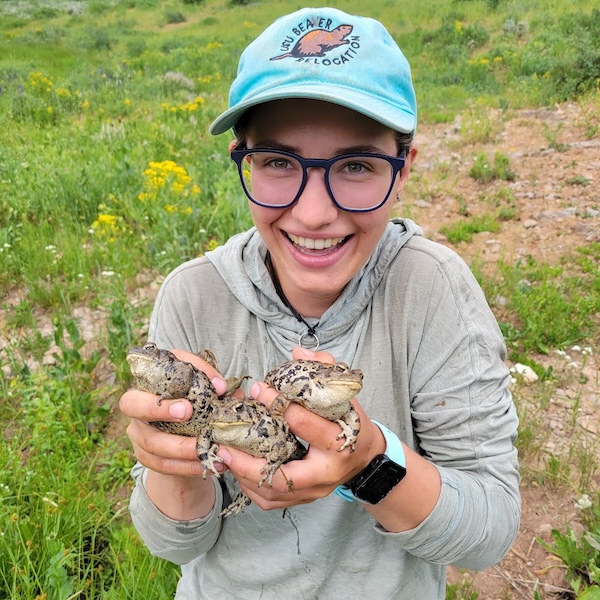
Julianna Hallza surveying boreal toads (Anaxyrus boreas boreas) for a monitoring project. photo by Stephen Bunnell
Julianna Hallza (née Hoza) is a PhD candidate at Washington State University, where her research focuses on restoration ecology and harnessing species interactions to promote biodiversity and build climate refugia for wildlife. This research was inspired by working several seasons as a wildlife technician for the U.S. Forest Service, where she gained experience doing wildlife surveys and working on beaver-related restoration projects. She earned her BS from the University of Washington, where she conducted research on horned lizard population genetics and long-toed salamander ecology (highlighted here). Julianna was born and raised in the Salish region, and she feels a strong connection to the people and ecology of the region, as well as the greater Pacific Northwest. She would like to acknowledge the support of University of Washington faculty advisor Dr. Jonathan Bakker for the amphibian corridors research project.
Issue Page
Table of Contents, Issue #27, Spring 2025
Images of New Life
Images of New Life text and photos by John F. Williams, Spring 2025Salal flowerstext and photos by John F. Williams Spring 2025Here are some Pacific ninebark flowers in their bud stage, in their showy stage, and in their later withering and seed-forming stage....
Springtime Bees
Springtime Bees by Sarah Ottino Spring 2025A ground-nesting bee on some blades of grass. photo by Rich Hatfieldby Sarah Ottino Spring 2025The longer, warming days of spring rouse native bees from their winter slumber. While domesticated European honeybees produce a...
Spring Aliens
Spring Aliens in the woods by Thomas and Sara Noland photos by Thomas Noland Spring 2025by Thomas and Sara Noland photos by Thomas Noland Spring 2025It’s spring in the woods, and botanical aliens are awakening. They aren’t really aliens — they’re native inhabitants of...
Herald of Spring
Red-Winged Blackbird: Herald of Spring by Lucienne Miodonski Spring 2025Red-winged blackbird among the cattails in a wetland. photo by John F. Williamsby Lucienne Miodonski Spring 2025In the Skagit Valley of the Pacific Northwest, where the northern arm of the Salish...
Artwork 27
by Linda Hanlon Spring 2025This northern alligator lizard lives near me. I am always happy to see them when I find them in my yard. For more about alligator lizards, you might look here: https://wdfw.wa.gov/species-habitats/species/elgaria-coeruleaTrillium can be...
Poetry 27
Poetry 27 by multiple poets Spring 2025Herring eggs on kelp at low tide in Agate Passage. photo by John F. Williamsby multiple poets Spring 2025THE KISS OF SPRING by Diane Moser Blazing pink-whitecotton candy treesdance over sidewalksand roadside. They throw...
COPYRIGHT
Copyright SEA-Media
All rights reserved. Reproduction or distribution, in whole or in part. without consent of copyright owner is strictly prohibited — except for brief quotations in critical reviews and other noncommercial uses permitted by copyright laws.
SEA-Media is a 501(c)(3) nonprofit corporation
PLEASE HELP SUPPORT
SALISH MAGAZINE
DONATE
Salish Magazine contains no advertising and is free. Your donation is one big way you can help us inspire people with stories about things that they can see outdoors in our Salish Sea region.
We also don't advertise Salish Magazine, so please spread the word of this online resource to your friends and colleagues.
Thanks so much for your interest and your support.