
Springtime
Bees
by Sarah Ottino
Spring 2025

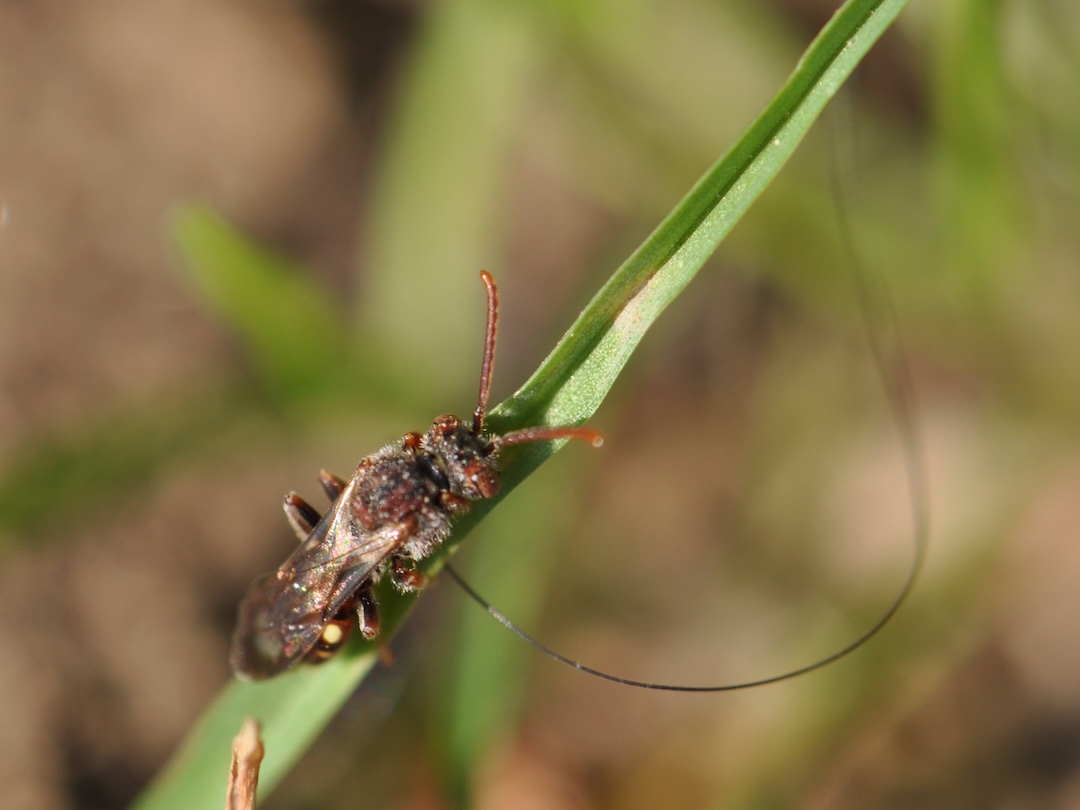
A ground-nesting bee on some blades of grass. photo by Rich Hatfield
Springtime bees
by Sarah Ottino
Spring 2025
The longer, warming days of spring rouse native bees from their winter slumber. While domesticated European honeybees produce a sweet treat, native bees are the star pollinators of the Salish Sea region. Food production as well as local ecosystems are dependent on them. As humans, we can help native bees by understanding their needs and taking action to support them.
Most native bees live for only a year, and only a few weeks of the spring and summer are spent as adults — the stage when we can observe them in flight. The rest of their lives are spent growing, developing, or hibernating in hidden chambers located underground, in rock or tree crevices, within brush piles, or even inside plant stems.
 The Washington Native Bee Society says: Give credit where credit is due: Honey bees aren’t the only bees in the garden.
early risers
Bees emerge from hibernation when several days in a row reach the right temperature. Early rising bee species prefer a wake-up temperature of around 50°F, although some species are more tolerant of colder temperatures and others prefer it to be warmer.
Although many native bee species wait until late spring to emerge, there are a few early risers around the Salish Sea region that take wing as soon as February, with more species joining in March. Early emerging species include the Pacific digger bee (Anthophora pacifica), blue orchard mason bee (Osmia lignaria), and some bumblebee species. Like humans, bumblebees shiver to raise their body temperature, allowing them to handle cooler weather. Other species such as the red-footed cuckoo leaf-cutter bee (Coelioxys rufitaris) prefer warmer temperatures and don’t emerge until later in the spring.
common bees by month
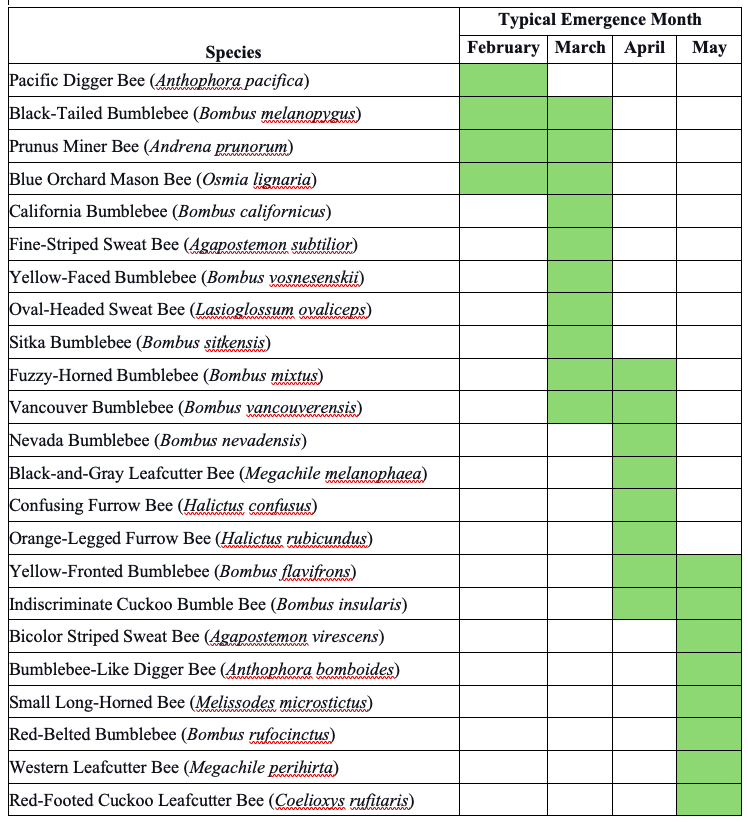
Typical emergence months are based on information provided by Saff Killingsworth (Xerces Society) and seasonality data from iNaturalist. Emergence dates are heavily influenced by temperature and may vary from year to year.
This chart lists a few of the many native bee species that emerge between February and May in the Salish Sea region. The species on this list include some of the most commonly observed bees noted in iNaturalist citizen observations for the region, as well as the most common bumblebees documented by participants in the Bumble Bee Atlas. Therefore, this chart is by no means an exhaustive species list, nor does it represent a scientific survey. Instead it’s intended to introduce people to native bee species they may observe locally.
The typical emergence month listed for each species indicates when the winged adult bees usually start coming out of their winter nests or hibernation chambers and can be observed on the wing. The adults may be observed in flight for weeks or a few months after they emerge. As a starting place for more information about these and other bee species, see https://www.inaturalist.org/ and the additional resources listed at the end of this article.
-Editor
For close-up photos and notes about emerging Pacific digger bees, follow this link to The first native bees of spring on the Washington Native Bees Society site.

European honeybee. photo by Thomas Noland
bee lifestyles
Bees are an iconic insect but most common knowledge about them is limited to a few species. In Washington State, 565 bee species have been recorded, and around 100 unrecorded species are thought to also live here. Of those recorded, around 213 live in the Puget Lowlands. Some species are native, while others have been introduced from elsewhere, such as the European honeybee (Apis mellifera).
Scientists are working to better understand the diversity of bees in the region. See An Annotated Checklist of the Bees of Washington State for a recent example of this effort.
Bees can be grouped based on their social structure and nesting behavior. Social bees include the European honeybee and bumblebee species. Social bees have a single queen and many workers that support the colony. While social bees are what most people think of, they only make up around 10% of bee species both locally and globally.
Most bees are solitary, which means each female forages for her own food and makes her own nest where she lays eggs. While solitary bees do not work together, females may create independent nests alongside others in ideal locations. A group of independent nests is called an aggregation.



Assorted bees on different kinds of plants. first photo by Thomas Noland, the others by Rich Hatfield
Other solitary bees have communal nests. Each female independently builds nest cells and lays eggs but shares a nest entrance with other females, like a bee apartment complex. Each apartment is occupied by a different female and her eggs, but they share the building’s front door.
Some solitary bee species, including sweat bees, are considered semi-social. Semi-social bees work together to build a nest but there is no single queen. Some bees build the cells, some collect pollen and nectar, and others lay eggs.
Social parasite bees target the nests of social bees. The parasitic queen takes over the nest and workers care for her offspring. Cleptoparasitic bees, often called cuckoo bees, steal resources from the nest where they hatch. A female cleptoparasitic bee enters the nest of a solitary bee and lays her own eggs. Her offspring then kill the host eggs and eat their food stores.
Bee Lifestyles in Washington State

Most bee species in Washington state are solitary (75%), with around 18% of species being cleptoparasites, 7% social species, and less than 1% social parasite species. Pie chart drawing by Sara Noland
Information source: An Annotated Checklist of the Bees of Washington State
solitary bees
Male solitary bees are typically the first to emerge in the spring, preceding the females. The males spend their time foraging for food and hanging around the nest site waiting for females to appear. After the females emerge, they forage for food and then begin mating and making nests for their offspring.
When a female first leaves the nest, her reproductive system is not fully mature, but this does not prevent her from mating. Each female bee has a special organ called a spermatheca that stores the male’s sperm until she is ready to fertilize an egg. Many female bees will only mate once; male bees tend to avoid females that have already mated. As each egg passes the spermatheca, the female determines whether the egg will develop into a male bee (unfertilized egg) or a female bee (fertilized egg).
The preferred location for a solitary bee’s nest varies depending on the species, but ground nests are the most common, with around 70% of bee species building them. Ground-nesting bees tend to favor well-drained sandy, loamy soil, but each species has its own preference. Each female excavates a tunnel into the earth, leaving a mound of loose soil at the entrance.

Antennae and an eye of a bee peeking out from its nest in the ground. photo by Rich Hatfield

More of the bee becomes visible as it emerges from its nest. photo by Rich Hatfield
Other bees are cavity nesters. They select empty insect tunnels, hollow plant stems, or rock crevices for building their nests. Carpenter bees are cavity nesters that favor raspberry plants. The female carpenter bee builds her nest in dead raspberry canes, and her offspring pollinate the raspberry blossoms the next spring.
Once a female bee has a suitable nest location, she builds nest cells and lays eggs. Solitary bee mothers build nurseries that are made up of nesting cells. The mother supplies each cell with a store of pollen and nectar that will provide food for the newly hatched larva. Like butterflies and moths, bees undergo complete metamorphosis. The grub-like larva eats, grows, and enters a pupal stage in its nest cell. The following spring the bee emerges from the nest as a winged adult.
There are many species of solitary bees, and their life cycles may vary from this general pattern.
For more information and photos of solitary bee nests, see: Wild Bee Conservation | Xerces Society
Bumblebee on a salmonberry flower. photo by Thomas Noland

Bumblebee on a salmonberry flower. photo by Thomas Noland
social bees
Bumblebees are social bees whose lifecycle differs from solitary bee species. Following mating in the summer or fall, female bumblebees (queens) seek a sheltered spot to hibernate through the winter, typically burrowing a few inches into the soil or leaf litter.
When the queen emerges in the spring, she forages for nectar and scouts out a new nest location. Because she mated months earlier and stored the sperm in her spermatheca through the winter, she is ready to lay eggs. Bumblebee nest sites can include brush piles, old rodent burrows, rock piles, or even human structures. Inside the nest, the queen builds wax cells, fills them with pollen, and lays her eggs on top.
After the first round of eggs hatches and the offspring metamorphose into adults, they begin taking over nest maintenance and foraging duties while the queen lays more eggs. After the colony has an established female worker force, the queen begins laying the future reproducers, which include male bees and gynes (future queens). When the males and gynes are mature, they leave the nest to mate with bees from other colonies. The old queen, female workers, and the males die. Future queens feed and build up their fat reserves before finding a cozy spot to sleep away the winter. They will continue the cycle when they emerge the following spring.
Most European honeybees are managed by a beekeeper and live in hive boxes. Those that escape from their keepers do not build free-hanging hives like those sought by Winnie the Pooh, instead building nests in sheltered locations like bumblebees. While a single honeybee hive may contain tens of thousands of bees, a native bumblebee nest usually supports only a few dozen to a few hundred bees.
See a poster illustrating the life cycle of bumblebees…
helping native bees
The Salish Sea region is home to several native bee species that are in decline. Threats to bee populations include pesticides, viruses and parasites transferred from domesticated honeybees, loss of habitat, and climate change.
Scientists have developed a strategy and mapping tool to protect bumblebee species of concern in Washington: State-wide bee conservation strategy blooms in Washington | US Forest Service
Everyone can take action to support the Salish Sea’s native bees. Property owners can avoid using chemical pesticides. Gardeners can choose to leave (or add) sticks, leaf litter, and dead stems to provide bees with nesting material and winter refuges for bumblebee queens. Planting diverse native plants that flower throughout the year is also an excellent way to provide food for the bees.
Shopping locally and organically helps ensure that bee-harming chemicals are not being used to grow the food we eat. Volunteering and participating in community science projects are also ways to support the survival of native bees.
FIND OUT MORE
Guidance for garden features and landscaping practices that help native bees:
• If You’re Thirsty, They’re Thirsty: Make a Simple Water Source To Support Pollinators by Deborah Seiler, Xerces Society
• Nesting & Overwintering Habitat: For Pollinators & Other Beneficial Insects by Sarah Foltz Jordan, Jennifer Hopwood, and Sara Morris, Xerces Society
• Attracting Native Pollinators by Eric Mader, Matthew Shepherd, Mace Vaughan, and Scott Black, Xerces Society (2011)
Native bee identification guides:
• Bumble Bee Field Guide – Bumble Bee Watch, Xerces Society
• Seven Native Bees to Know in Washington State by Joe Dlugo, Washington Native Bee Society
• Washington’s Native Bees, Washington State Department of Agriculture
• The Bees in Your Backyard: A Guide to North America’s Bees by Joseph S. Wilson and Olivia Messinger Carril (2015)
• Common Bees of Western North America by Olivia Messinger Carril and Joseph S. Wilson (2023)
Support an organization or get involved in a citizen science project:
o Washington Native Bee Society
o Bee Atlas, Washington State Department of Agriculture
o PNW Bumble Bee Atlas, Xerces Society
o Xerces Society
We thank The Xerces Society for Invertebrate Conservation for their support during preparation of this article.

Sarah Ottino — Freelance Writer & Photographer
Sarah loves to write, create, and explore nature. She travels full-time in a 20 ft. Airstream with her husband and her border collie, Nimbus. She uses life’s adventures as inspiration for healthy living, outdoor recreation, and environmental content. She often uses her photography or design graphics to complement her writing. Her website is: www.naturewritten.com
Issue Page
Table of Contents, Issue #27, Spring 2025
Images of New Life
Images of New Life text and photos by John F. Williams, Spring 2025Salal flowerstext and photos by John F. Williams Spring 2025Here are some Pacific ninebark flowers in their bud stage, in their showy stage, and in their later withering and seed-forming stage....
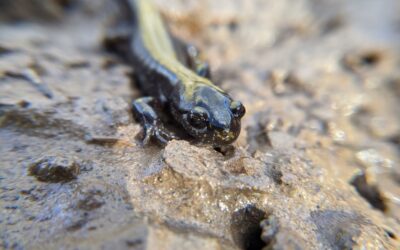
Salish Sea Salamanders
Salish Sea Salamandersin Urban Spaces by Dominick Leskiw and Julianna Hallza, Spring 2025Closeup of the face of a long-toed salamander. photo by Julianna Hallzaby Dominick Leskiw and Julianna Hallza Spring 2025How do long-toed salamander populations (and by extension,...
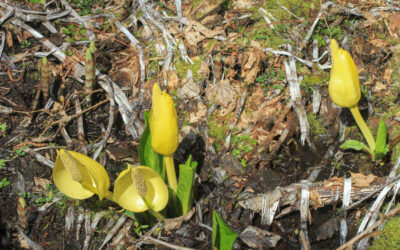
Spring Aliens
Spring Aliens in the woods by Thomas and Sara Noland photos by Thomas Noland Spring 2025by Thomas and Sara Noland photos by Thomas Noland Spring 2025It’s spring in the woods, and botanical aliens are awakening. They aren’t really aliens — they’re native inhabitants of...
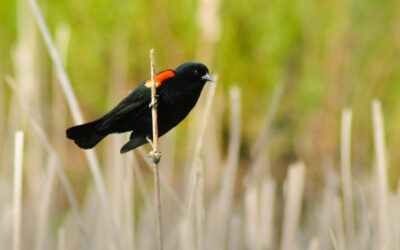
Herald of Spring
Red-Winged Blackbird: Herald of Spring by Lucienne Miodonski Spring 2025Red-winged blackbird among the cattails in a wetland. photo by John F. Williamsby Lucienne Miodonski Spring 2025In the Skagit Valley of the Pacific Northwest, where the northern arm of the Salish...
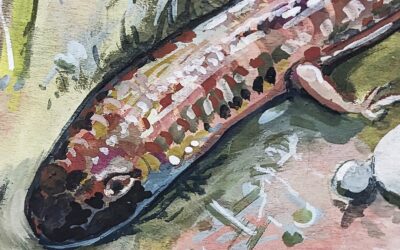
Artwork 27
by Linda Hanlon Spring 2025This northern alligator lizard lives near me. I am always happy to see them when I find them in my yard. For more about alligator lizards, you might look here: https://wdfw.wa.gov/species-habitats/species/elgaria-coeruleaTrillium can be...
Poetry 27
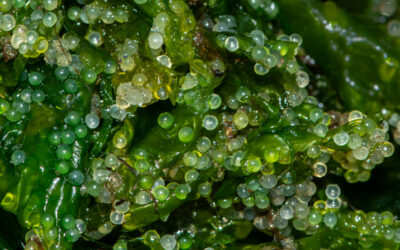
Poetry 27 by multiple poets Spring 2025Herring eggs on kelp at low tide in Agate Passage. photo by John F. Williamsby multiple poets Spring 2025THE KISS OF SPRING by Diane Moser Blazing pink-whitecotton candy treesdance over sidewalksand roadside. They throw...
COPYRIGHT
Copyright SEA-Media
All rights reserved. Reproduction or distribution, in whole or in part. without consent of copyright owner is strictly prohibited — except for brief quotations in critical reviews and other noncommercial uses permitted by copyright laws.
SEA-Media is a 501(c)(3) nonprofit corporation
PLEASE HELP SUPPORT
SALISH MAGAZINE
DONATE
Salish Magazine contains no advertising and is free. Your donation is one big way you can help us inspire people with stories about things that they can see outdoors in our Salish Sea region.
We also don't advertise Salish Magazine, so please spread the word of this online resource to your friends and colleagues.
Thanks so much for your interest and your support.