
ONE-BIRD BIRDING IN THE SALISH SEA
by Maria Ruth, Spring 2026
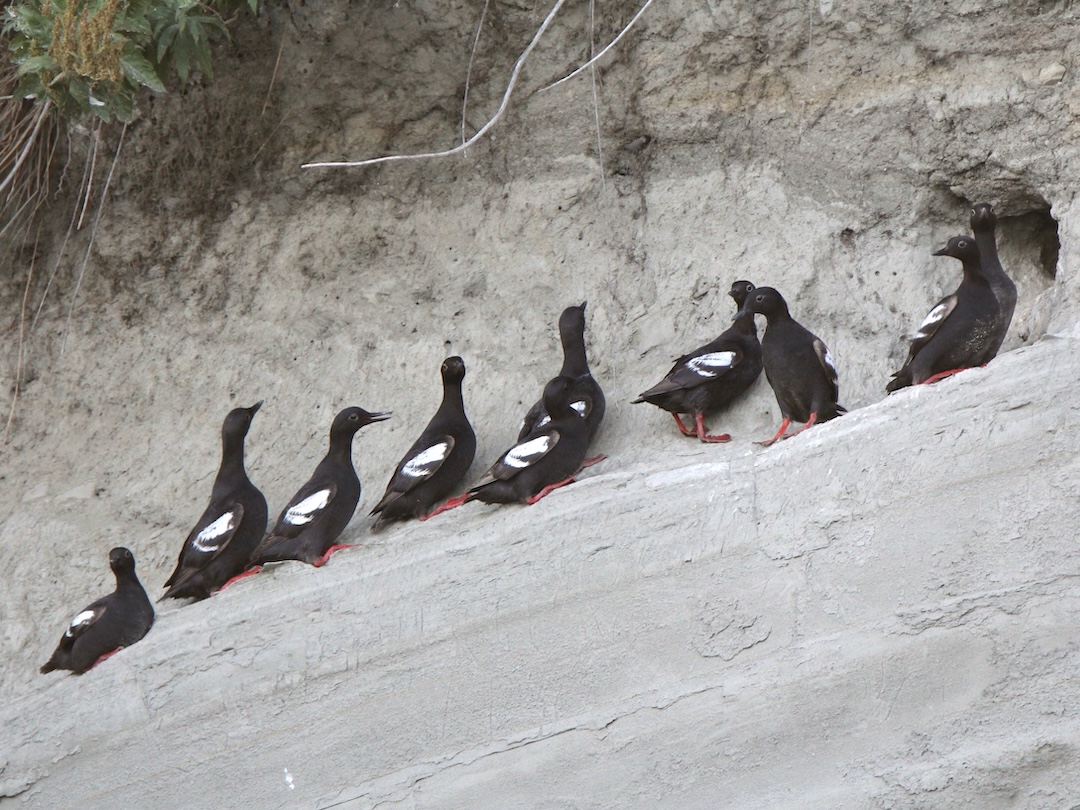
Pigeon Guillemots on a bluff. photo by Govinda Holtby
ONE-BIRD BIRDING IN THE SALISH SEA
by Maria Ruth
Spring 2026
Over the past decade, I’ve added just one bird to my life list of birds I’ve seen in my backyard. This bird wasn’t at my bird feeder, splashing in the birdbath, or waddling on its webbed feet through the garden. It was swimming and diving in an inlet on Puget Sound, a thirty-minute drive from my landlocked home in Olympia.
I first spotted this bird as I was sitting on a gravelly beach looking out over Eld Inlet, Washington’s Black Hills, the Olympia capitol dome, and the full glory of snow-covered Mount Rainier. This beach and nearshore water is the summer home for the Pigeon Guillemots and — thanks to this one plucky, wildly entertaining seabird — I have come to know this swath of the Salish Sea as intimately as my own backyard.
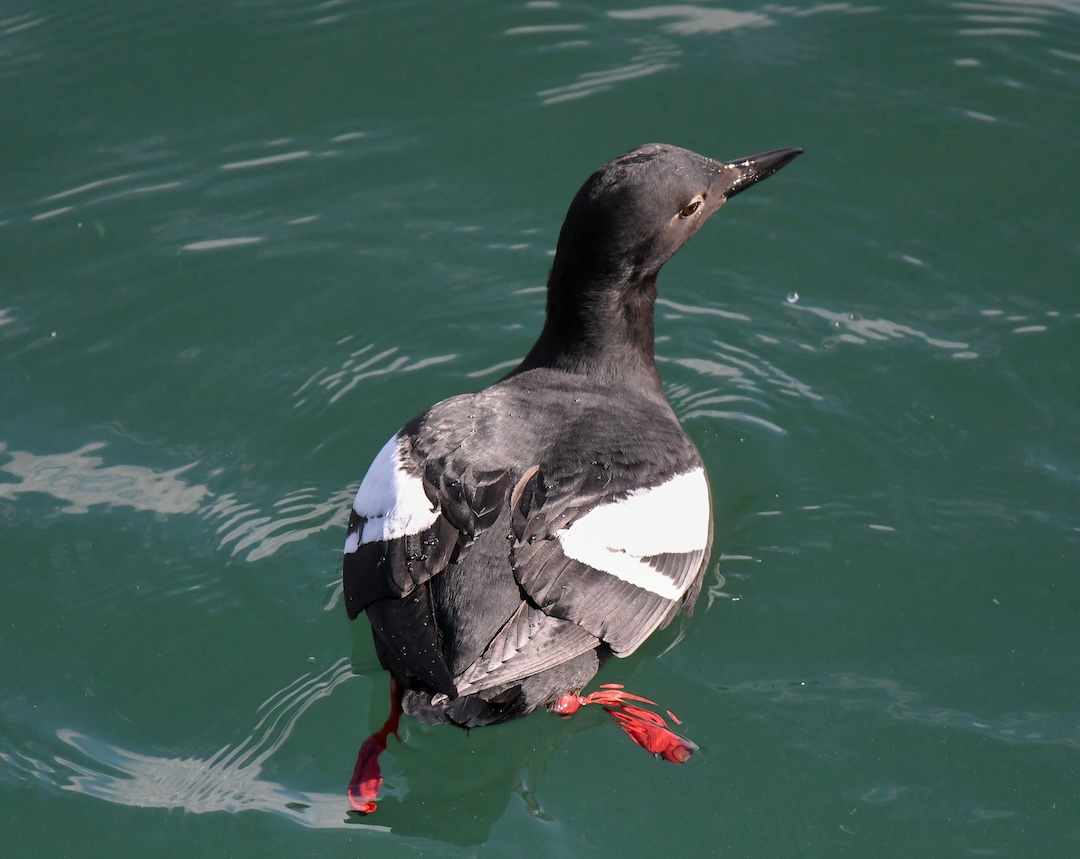
Left: Pigeon Guillemot paddling. photo by Hillary Smith
Right: Bright red from tongue to feet. photo by Lachlan Pope
Above: Pigeon Guillemot paddling. photo by Hillary Smith
Below: Bright red from tongue to feet. photo by Lachlan Pope
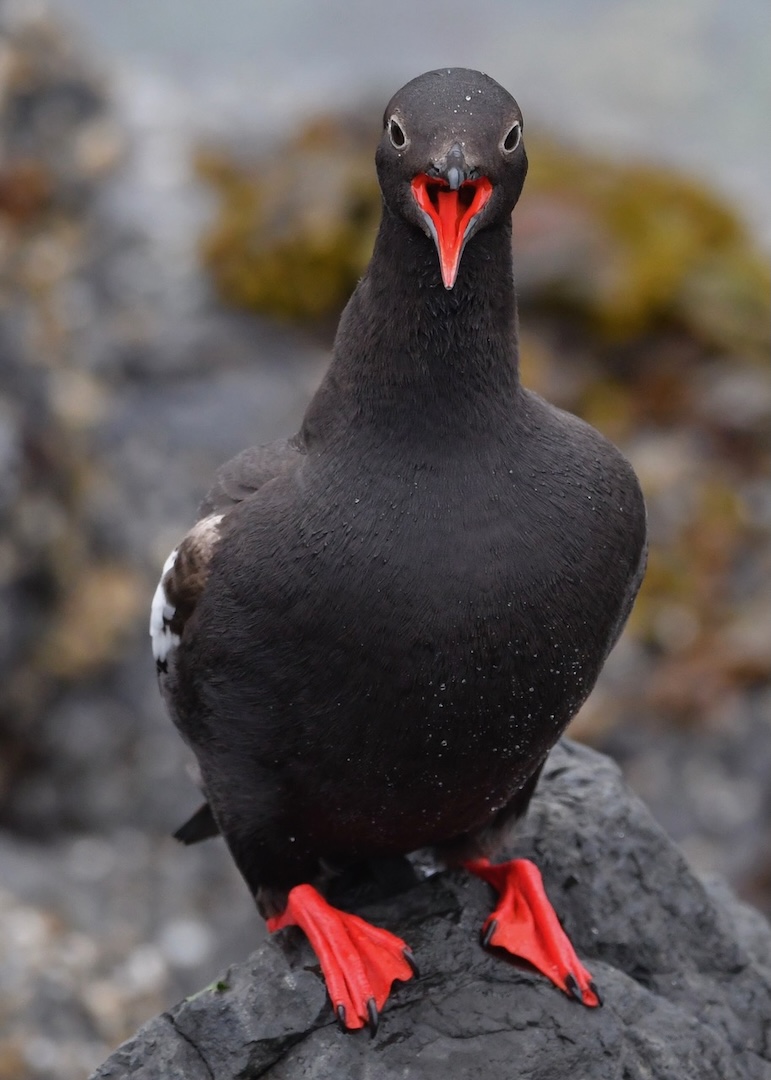
The Pigeon Guillemot is a relatively common seabird and easily observed in the nearshore waters of the Salish Sea. Guillemots are related to puffins, auklets, murres, and other birds in the alcid, or auk, family. Though its name isn’t easy to pronounce (gill-uh-mott), it’s an easy bird to spot in the nearshore waters of the Salish Sea. This guillemot is the only brownish-black seabird on the water with bright, white wing patches and flaming red feet and legs.
Pigeon Guillemots spend most of their lives at sea and come to land to nest in burrows in the earthen bluffs and in rocky crevices along our shorelines. Many of the guillemots’ nesting sites are literally in the backyards of waterfront property owners, but you’ll also find them in public waterfront parks throughout our region.
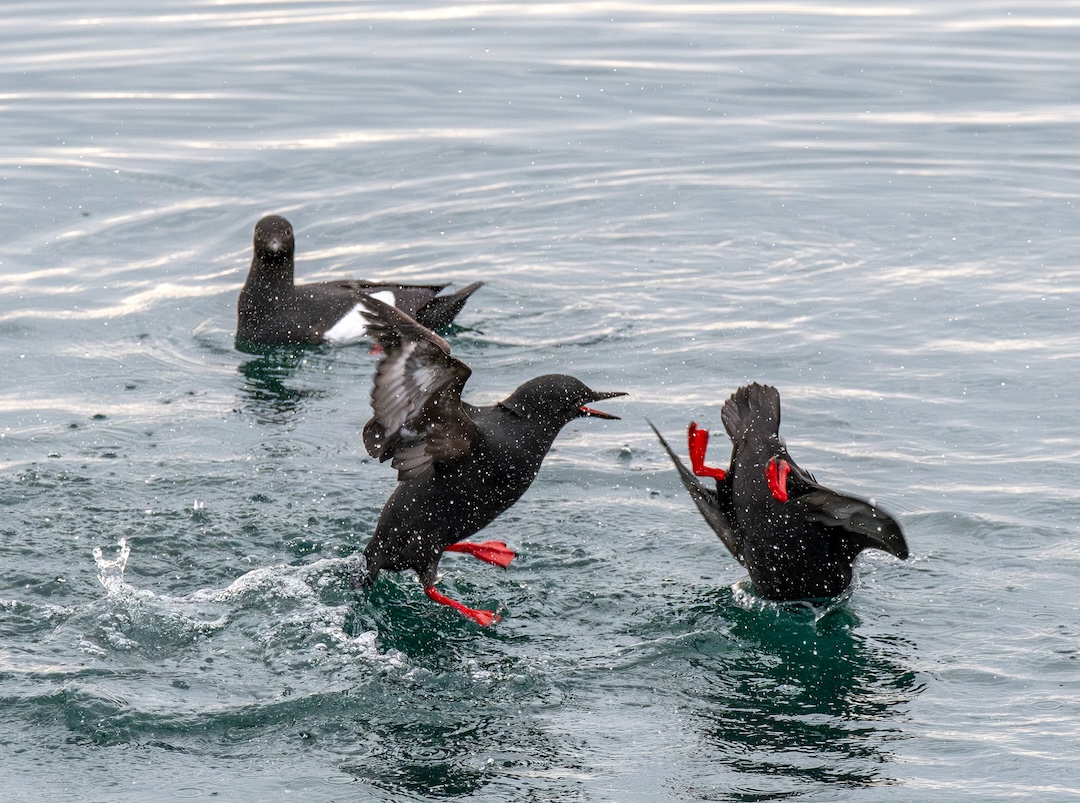
Pigeon Guillemots frolicking. photo by Hillary Smith
You could easily walk past the entrances to the hidden burrows and crevices and never know a guillemot was nesting in one. The only way to know for sure is to wait until late spring when the guillemots move inshore from their wintering grounds. You’ll see them in pairs or small groups diving, frolicking, and making large circling flights over the water and up toward the bluff. Watch closely and you might see one disappear into a roundish or irregularly shaped hole or crevice that leads to a hidden burrow. Here, over a period of two months, pairs of breeding guillemots will lay and incubate their two eggs and raise their chicks to fledging.
This was how I met my first Pigeon Guillemots in 2013. I had just signed up as a volunteer to collect data on the guillemots as part of a community science project run by the Salish Sea Guillemot Network. I was assigned to a beach on Eld Inlet where the bluff was topped by homes and rickety wooden staircases that zigzagged down from backyards to bulkheads. The bluff face was covered patchily with vines and small trees and naturally pocked with holes of many shapes and sizes. With my small team of volunteers, I hunkered down on the beach in my “birder’s drab” clothing and stared at the water. There, fifty feet offshore, was a group of guillemots. They were surprisingly easy to spot and identify. They are extremely social, vocal birds that leave the water ruffling with their raucous “water games.” How had I missed them all these years?
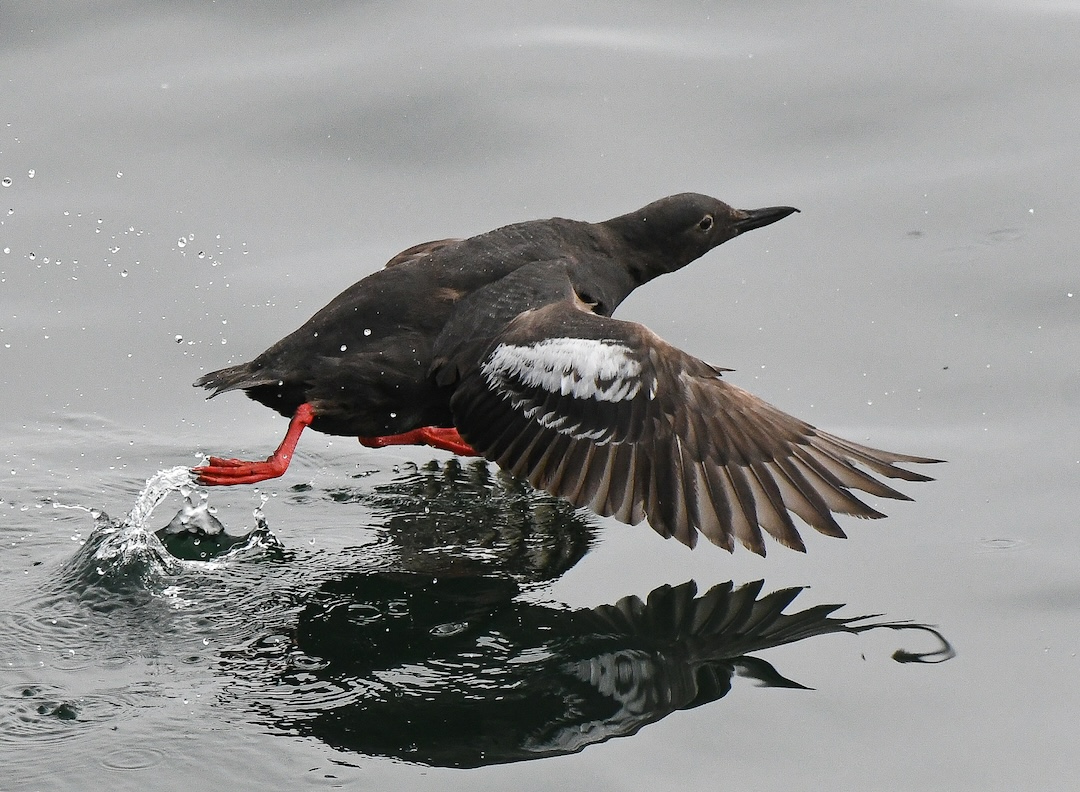
Pigeon Guillemot on the water. photo by Hillary Smith
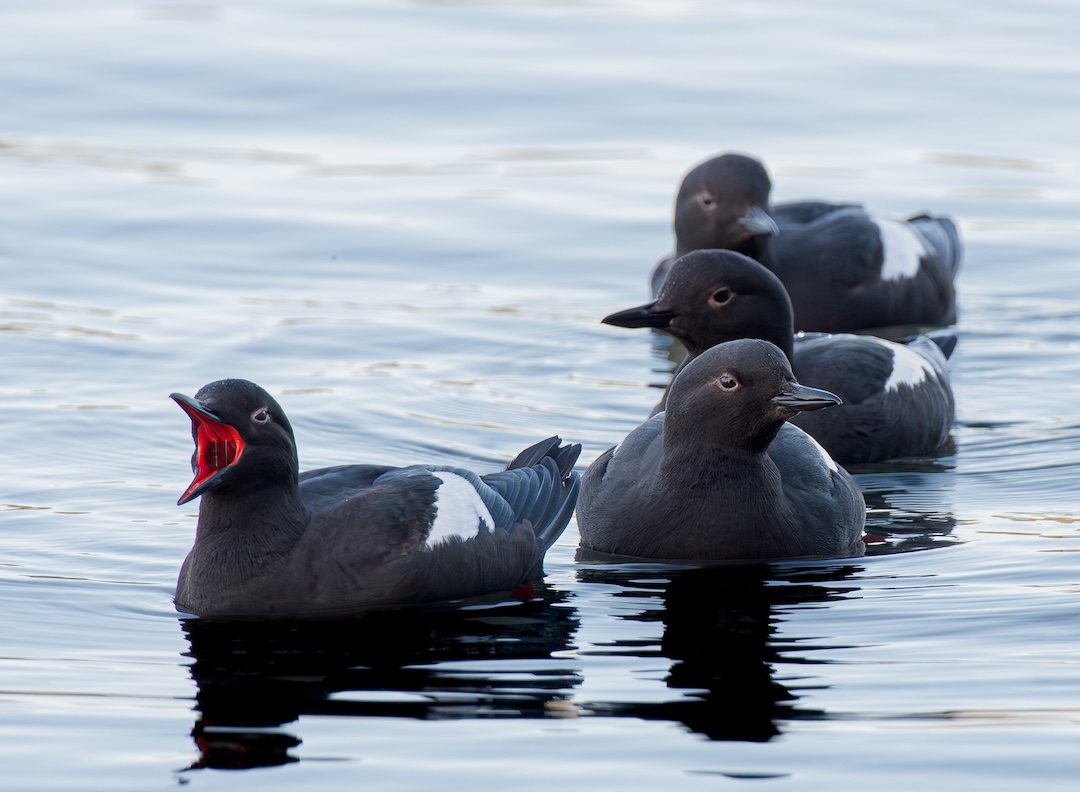
Group of Pigeon Guillemots on the water. photo by Hillary Smith
My fellow teammates and I sat in silence for an hour — as we would do weekly from June into early September — to count the Pigeon Guillemots and eventually track the breeding pairs to their nest sites. We’d note on our data sheets when the guillemots visited their burrows and when they delivered fish and other small prey to the burrow to feed their chicks. We identified the types of prey they delivered — mostly small fish such as sculpin and gunnel. We noted instances of disturbance — such as when beach walkers, boaters, and potential predators, such as eagles, caused the guillemots to flush or scream their high-pitched alarm call.
Along with 250 other volunteer surveyors from around the region, my team submitted our completed data sheets to the Salish Sea Guillemot Network. Other volunteers would compile the season’s data and provide a summary to several organizations, including the Washington Department of Fish and Wildlife and the University of Washington, where scientists use it for their research. Why the interest in Pigeon Guillemots?
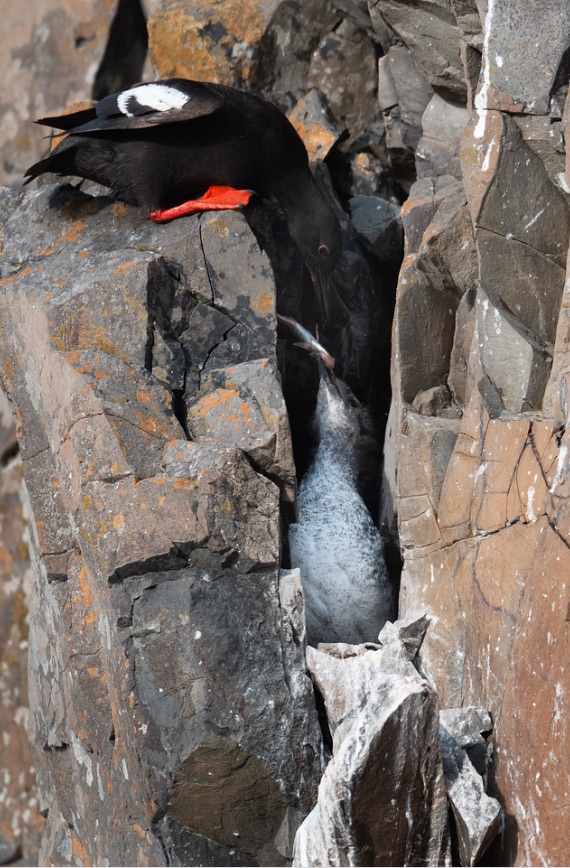
Adult feeding a youngster. photo by Tim Kuhn
In the early 2000s, the Pigeon Guillemot was selected as one of four seabirds to measure Washington State’s progress to clean up Puget Sound and restore the health of its ecosystems. After decades of rapid population growth, pollution, habitat damage, and changing climate, the quality of the Puget Sound water has deteriorated and, with it, the biodiversity of marine life and the ability for many species to survive or thrive. Pigeon Guillemots depend heavily on Puget Sound for breeding, foraging, and overwintering. They are sensitive to changes in their environment, and the health of their populations echoes the health of the larger Salish Sea ecosystem. While professional scientists conduct at-sea estimates of guillemot populations, they do not have the time or resources to gather vital breeding data from dozens of guillemot colonies across Puget Sound. That’s the value of community science: providing scientists with data they need but cannot acquire otherwise.
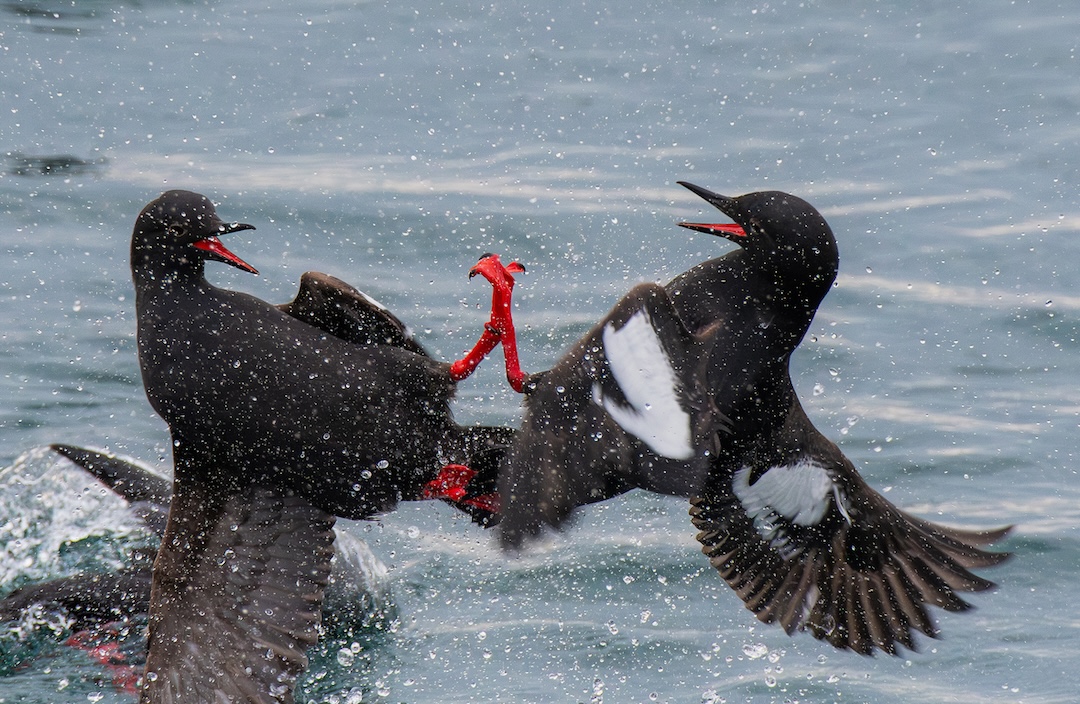
Frenzied activity of Pigeon Guillemots. photo by Hillary Smith
In my first year of collecting data, it was all I could do to track the often-frenzied activity of the guillemots and record the required data accurately. Eventually I got the hang of it and was able to track the guillemots and fill out my data sheet. You might think that “one-bird birding” would be limiting, but I found the opposite to be true. By sitting quietly and focusing exclusively on guillemots, you are perfectly positioned to take in everything else in their nearshore world.
Over the seasons, my “backyard” was visited by Belted Kingfishers, River Otters, Harbor Seals, Stellar’s Sea Lions, White-Sided Dolphins, White Pelicans, and Biggs’ Killer Whales. I watched a family of Red-breasted Mergansers slowly paddle through a group of guillemots. I saw salmon jumping, cormorants fishing, and clams squirting. I watched an American Robin teaching its young how to catch the tiny sand fleas jumping all over the beach. Documenting the presence of these creatures wasn’t part of the official guillemot survey, but it made me wonder if and how they were part of the Pigeon Guillemots’ life. During our hour-long surveys, the guillemots seemed so completely absorbed with each other that it was difficult to know what kinds of relationships, if any, they might have with the other creatures around them.
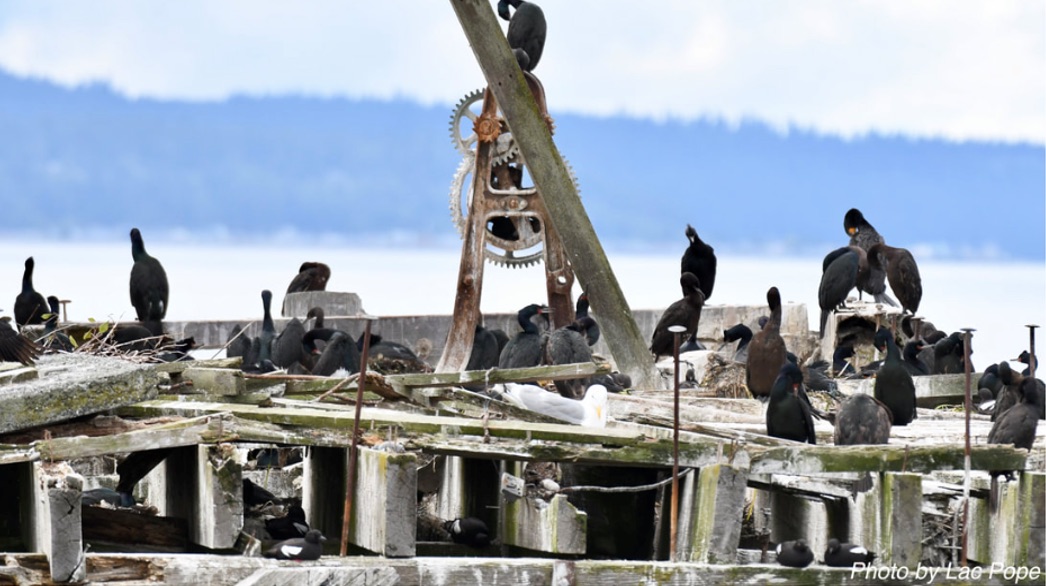
Pigeon Guillemots (below) and cormorants (above) sharing an abandoned dock for their nesting sites.
relationships
Typically, the relationships of living things in an ecosystem are described in terms of a food chain or food web, with the flow of nutrients from one organism to the next being shown by lines or arrows connecting predators and prey. A simple food web for the guillemot might connect eagles and hawks (predators) with the guillemots (prey) and the guillemots (predators this time) with small fish, invertebrates (prey). What is missing from these webs or chains is the network of the other more subtle and nuanced relationships that are not well documented but that play an important role in a species’ life.
One such relationship between guillemots and cormorants is on full display at an abandoned wharf, which is a jumble of old creosote-darkened planks set on pilings near a busy marine ferry terminal on Whidbey Island. In summer, the guillemots swarm with Double-crested Cormorants and Pelagic Cormorants around the derelict wharf. The guillemots nest in hidden crevices under the planks, and the two cormorant species nest on top of the planks. All three species rest and perch on the wharf together. They fly back and forth, between the wharf and their foraging grounds. They swim, loaf, and make their splashy landings all around pilings. And when the cormorants suddenly fly low or sound their alarm call, the guillemots follow suit, with adult guillemots often flying to the water in response.
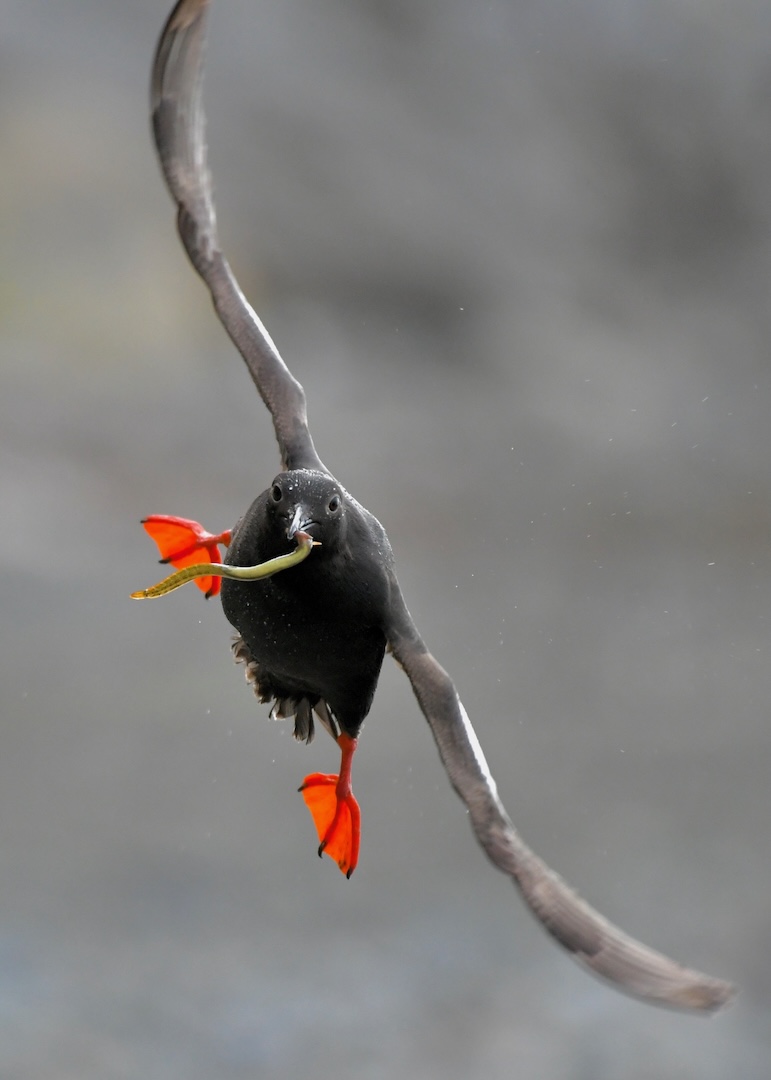
Pigeon Guillemot carrying a fish. photo by Hillary Smith
This behavior suggests there might be some interspecies alarm system in play to warn of a common predator, such as Bald Eagles. In scientific terms, this guillemot-cormorant “alliance” could be called a “symbiotic,” or mutually beneficial, relationship. The guillemot’s relationship with the Belted Kingfisher is not so easily categorized.
Feeding the young. video by Susan Morgan
Belted Kingfishers are a common bird along the shores of the Salish Sea. They excavate deep burrows in the bluffs and then often abandon them after a single nesting season. Pigeon Guillemots regularly take over these burrows, and it is likely that the guillemots depend on the kingfishers to excavate their burrows for them. The kingfisher doesn’t seem to derive any obvious benefit from the relationship, but the opportunistic guillemot certainly benefits from a ready-built summer home. This type of relationship, where one organism benefits and the other is not harmed is known as “commensalism.”
Neither symbiotic or commensal relationships appear in diagrams of food chains or food webs. Nor do the many undocumented interactions and alliances that fall shy of a “relationship.” For example, another team of guillemot surveyors observed a lone female Red-breasted Merganser entering four separate guillemot burrows in a low bluff near my survey site. The merganser even followed a few guillemots into their burrows and flushed them back out. The guillemots grouped together on the water below the burrow and sounded their alarm call, but when the merganser returned to the water after each visit, the guillemots calmed down and swam peacefully together with the merganser until it flew off.
What was going on here? Was this “normal” nest competition between these two cavity-nesting birds? Had the nesting site of this merganser been destroyed? Had the guillemots nested too close to an existing merganser nest? My “one-bird birding” kept opening new doors into the world of other lives in the Salish Sea.
new doors
Many mornings of listening to the birdsong at our colony on Eld Inlet makes me suspect the guillemots are cueing into the alarm calls of other birds too. When American Crows are present around the bluff, the American Robins nearby gather and call persistently in an attempt to deter the crows from finding their nests and preying on their eggs and chicks. The alarm call of the American Robins often elicit the alarm call of the guillemots, whose eggs and chicks are also preyed on by the crow. The guillemot’s alarm might serve to warn the guillemot in in the burrow to stay put or to warn the chicks inside not to venture toward the burrow opening.
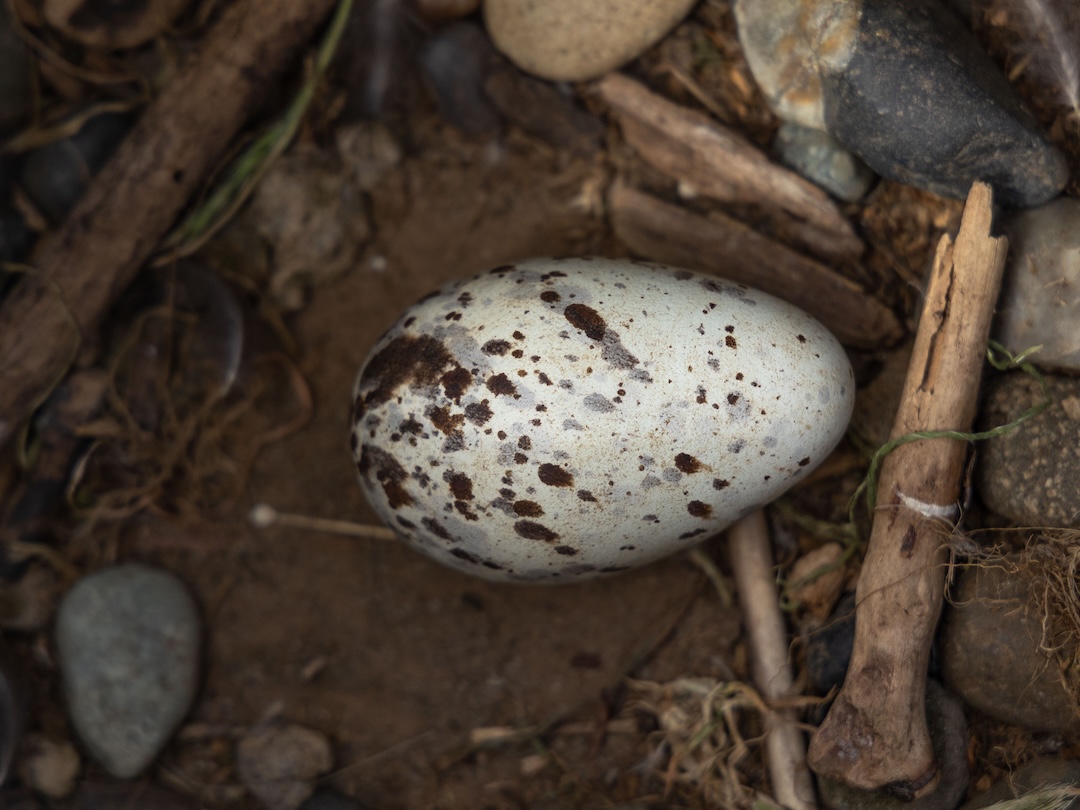
Pigeon Guillemot egg. photo by Scott Pearson
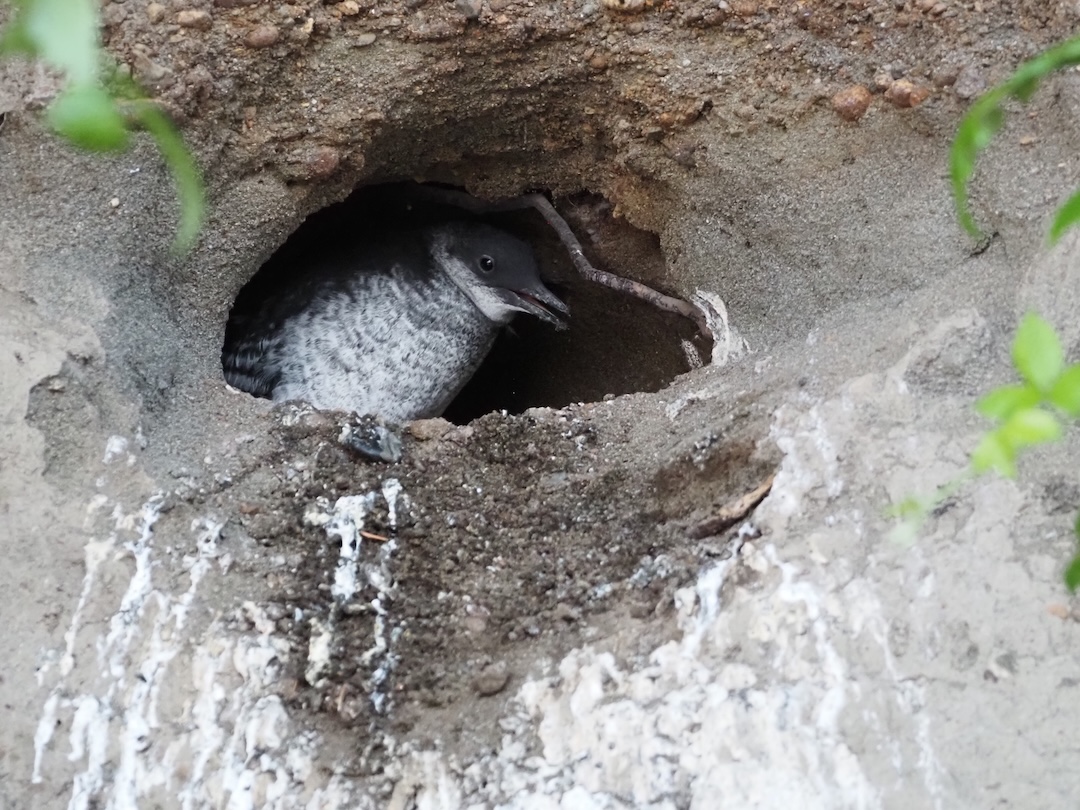
Pigeon Guillemot fledgeling. photo by Susan Morgan
It makes sense that avian alliances and mutual-aid societies would develop between similarly preyed-upon species. Is the guillemot-robin relationship a symbiotic one or did these two birds simply respond to the crows at the same time?
With the guillemot as my guide, I extended my backyard birding study to the central Oregon coast where I witnessed the most unorthodox of the guillemots’ relationships. The setting was Sea Lion Caves, a tourist spot featuring a 25-million-year-old natural basalt sea cave inhabited by as many as two hundred enormous Steller Sea Lions. The cave is also promoted as a home to nesting Pigeon Guillemots. Against the sounds of dozens of barking sea lions and the high-pitched trilling of the guillemots, I saw hundreds of guillemots. Some were resting on the rocks and ledges at the back of the cave. Some were flying in and out of the cave, bringing fish to their chicks who were tucked out of sight. Most peculiar of all were the guillemots waddling and hopping around on the rocks among the sea lions — as if being crushed by a 2,500-pound sea lion was nothing to worry about!
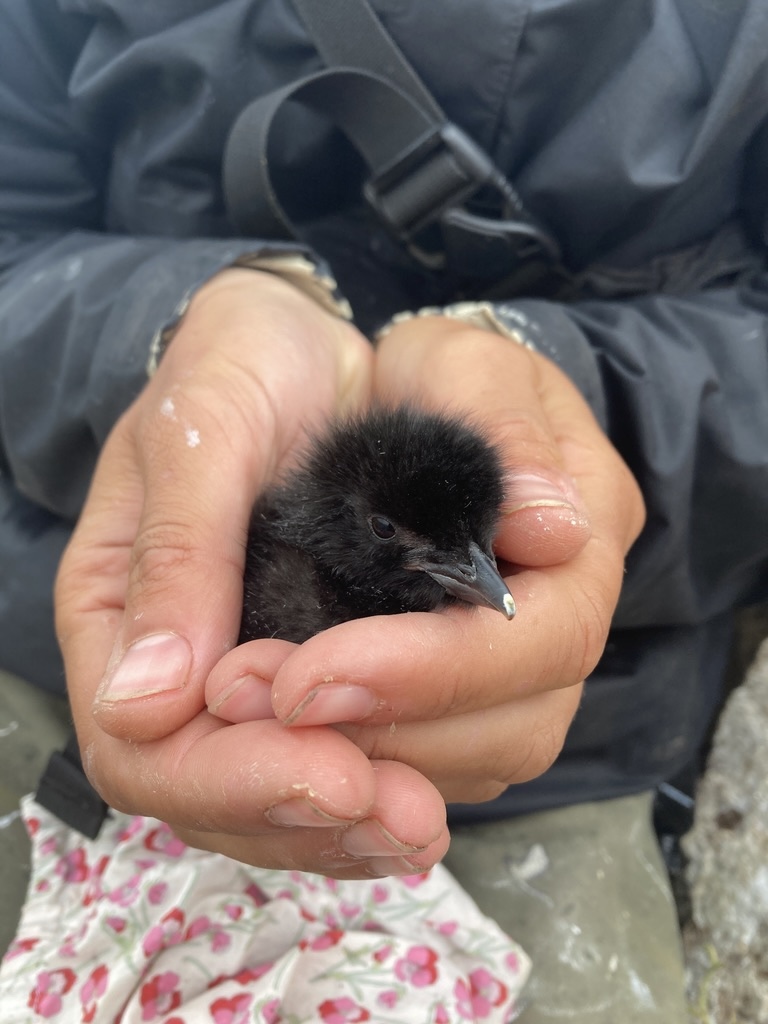
Pigeon Guillemot chick. photo by Stella Solasz
Were these two marine animals merely cohabiting a space that protected them from the weather and predators? Did these two species have some kind of commensal or symbiotic relationship? No matter how we might categorize this relationship, the guillemots had clearly worked out a successful breeding strategy among the sea lions as they had through their association with the kingfishers, cormorants, and robins. This was the surprising and encouraging conclusion of my Pigeon Guillemot breeding study.
And this brings us to our human relationship with the Pigeon Guillemots. What is our place in their lives and the lives of our other “backyard birds”? We can be appreciative observers. We can avoid activities that might disturb our birds. And, to honor our favorite birds in the Salish Sea and beyond — to advocate for their protection and conservation — we can slow down and witness the beautifully complex and fragile web of connections in their lives.
Adapted by the author from The Bird with Flaming Red Feet. Copyright © 2026 by Maria Mudd Ruth. Published by Skipstone, an imprint of Mountaineers Books. All rights reserved. Reprinted with permission.
A Song: The Bird with Flaming Red Feet
by Jonathan Mudd
(below the video are the lyrics)
The Bird with Flaming Red Feet
by Jonathan Mudd
Up before the sunrise, I try not to wake you
Down to the edge of the Salish Sea
There on the rocks in the shelter of the towering fir trees
Hiding on the beach with the bluffs at my back
Trying to make a count of things I cannot see
How to check a box when you discover what it means just to be?
Spin me off in a new direction
Let’s fall in and out of sync with time
I know you want to make this a perfect connection
You think you understand but the story’s incomplete
Hiding in plain sight like the bird with flaming red feet
Black as the night or tossed about in soft gray
Dressed up for seasons you’re only passing through
Floating like a white swan, like a stranger I never really knew
The water is a stage and a brilliant disguise
Underneath the surface vermillion true
If I look at you forever I’d never see through the mystery of you
Spin me off in a new direction
Let’s fall in and out of sync with time
I know you want to make this a perfect connection
Maybe the truth is part of the deceit
If you want to know the answer you don’t have to go too deep
Hiding in plain sight like the bird with flaming red feet
Spin me off in a new direction
Let’s fall in and out of sync with time
I know you want to make this a perfect connection
You think you understand but the story’s incomplete
Aren’t we all a little bit like the bird with flaming red feet?
Lyrics by Jonathan Mudd. Copyright 2026 by Jonathan Mudd. Published by Dad Rocks Music (ASCAP).
FIND OUT MORE
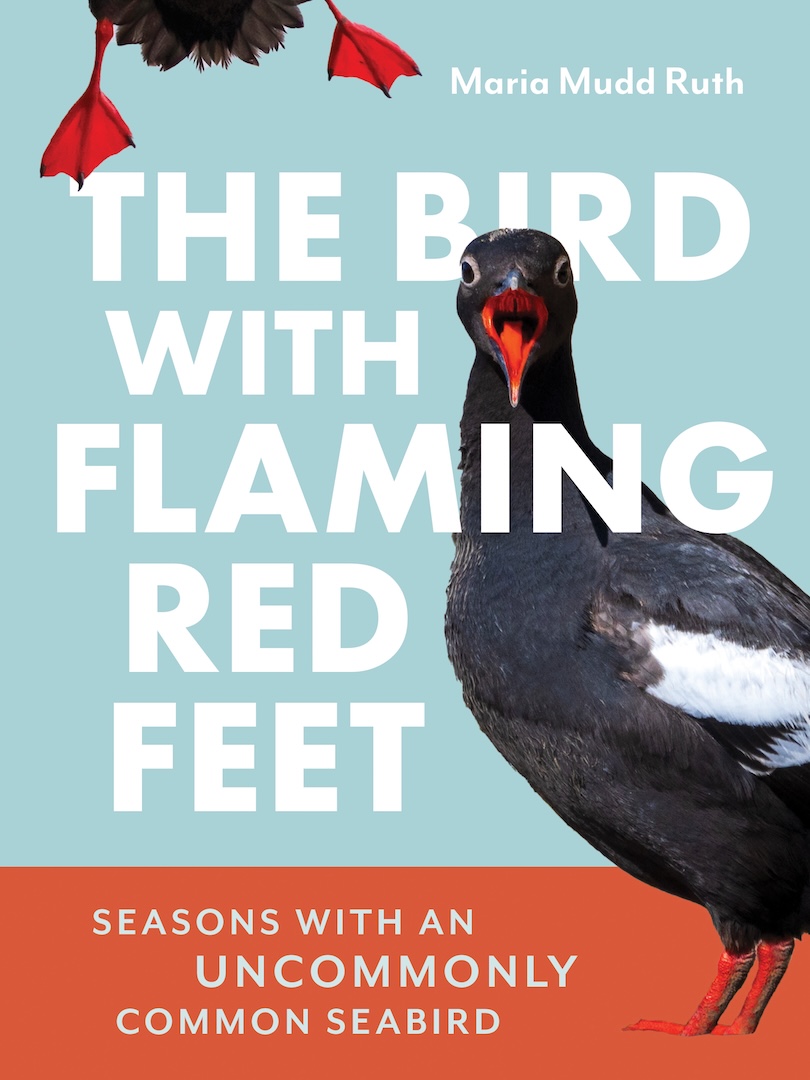
Review of the book The Bird with Flaming Red Feet by the Eastside Audubon Society.

Maria Mudd Ruth has written more than a dozen books on natural history topics, including Rare Bird: Pursuing the Mysteries of the Marbled Murrelet and A Sideways Look at Clouds (Mountaineers Books, 2020), and titles on butterflies, beetles, snakes, rain forests, deserts, and oceans. She has been a volunteer surveyor with the Salish Sea Guillemot Network since 2013.
Issue Page
Table of Contents, Issue #31, Spring 2026
Serious, Playful, Mischievous, Nurturing
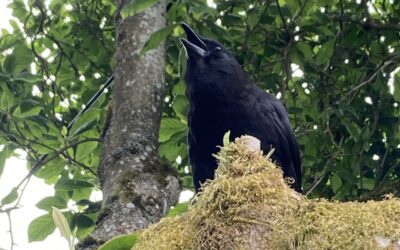
SERIOUS, PLAYFUL, MISCHIEVOUS, NURTURING by Gunnison Langley, Spring 2026Crow perched on a tree. photo by Gunnison Langley by Gunnison Langley Spring 2026Last year I joined a Birds Connect Seattle “Neighborhood Bird Outing” at Magnuson Park in North Seattle. About an...
Bald Eagles, A Visual Story
Only mature adult bald eagles have the classic white heads and tails. As they recover from the egg-thinning effects of DDT, they are once again becoming common around the Salish Sea. However, because their lives primarily play out above our heads, we often miss some...
Birds on an Urban Lake
BIRDS ON AN URBAN LAKE by Dave Galvin Spring 2026Mergansers on Lake Union. photo by Dave Galvin by David Galvin Spring 2026The Salish Sea is defined by water: the sea itself, the freshwater lakes and rivers, and the rain that is the hallmark of the region. It is no...
Mapping Red-Winged Blackbird Territories
MAPPING RED-WINGED BLACKBIRD TERRITORIES by Mica Sage Roberts, Spring 2026Male red-winged blackbird on cattail. photo by John F. Williams by Mica Sage Roberts Spring 2026Conk-la-ree! A moment later from the east: conk-la-ree-o! I flipped over the soggy graph paper map...
Poetry 31
by multiple poets Spring 2026Red-winged blackbird on cattail reed. photo by John F. Williams by multiple poets Spring 2026Red-winged Blackbird Marcia Claire Millican Conspicuous commander, comfortable atop the cattails. Displaying proud patches,resilient red and...
COPYRIGHT
Copyright SEA-Media
All rights reserved. Reproduction or distribution, in whole or in part. without consent of copyright owner is strictly prohibited — except for brief quotations in critical reviews and other noncommercial uses permitted by copyright laws.
SEA-Media is a 501(c)(3) nonprofit corporation
PLEASE HELP SUPPORT
SALISH MAGAZINE
DONATE
Salish Magazine contains no advertising and is free. Your donation is one big way you can help us inspire people with stories about things that they can see outdoors in our Salish Sea region.
We also don't advertise Salish Magazine, so please spread the word of this online resource to your friends and colleagues.
Thanks so much for your interest and your support.