
A Rainbow of Berries
by Gunnison Langley, Summer 2025

An artistic rainbow of berries. photos by Thomas Noland, composition by Susan Merrill
A Rainbow of Berries
by Gunnison Langley
Summer 2025
Often in the pursuit of filling our bellies with delectable berries, we overlook that berry plants gift us with color throughout the seasons. From when tender, verdant green shoots first emerge in the spring to when the plants blossom, continuing through the color change of leaves in the fall as the plant draws back for its winter retreat, berry plants bless us with a surprising diversity of color.
But how do berries get their colors? And why are they colorful in the first place? What kinds of berries can be observed locally throughout the year?
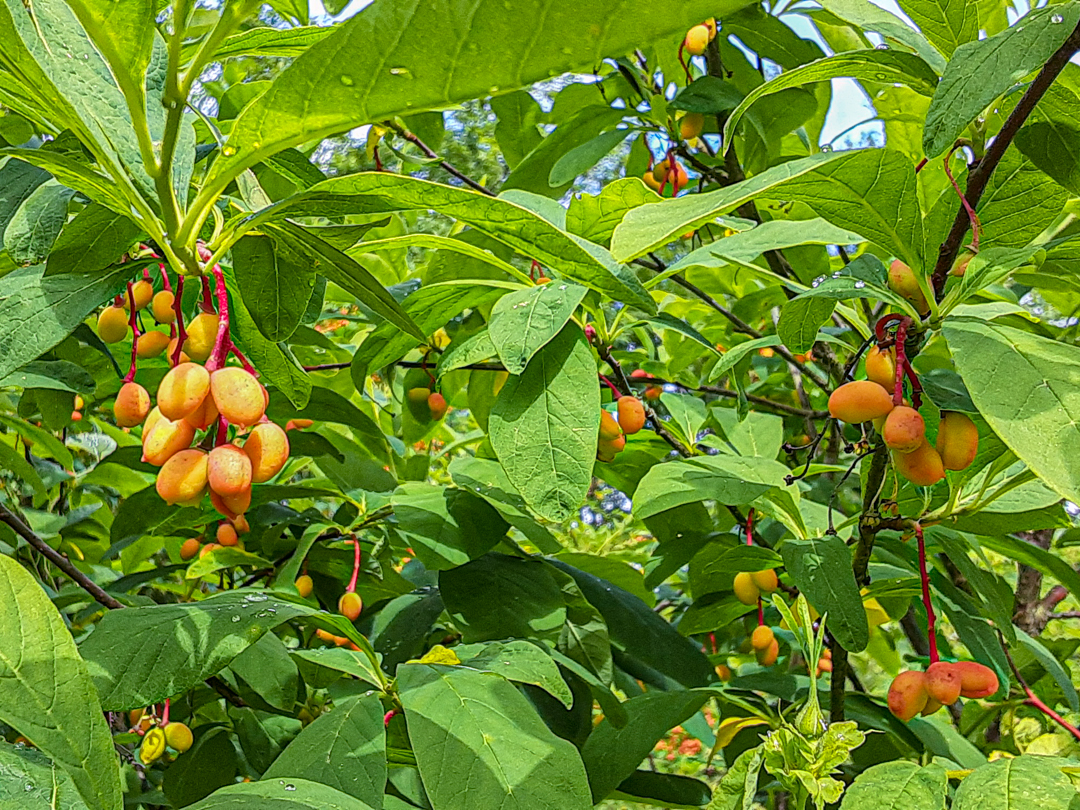
Unripe osoberries. photo by Thomas Noland
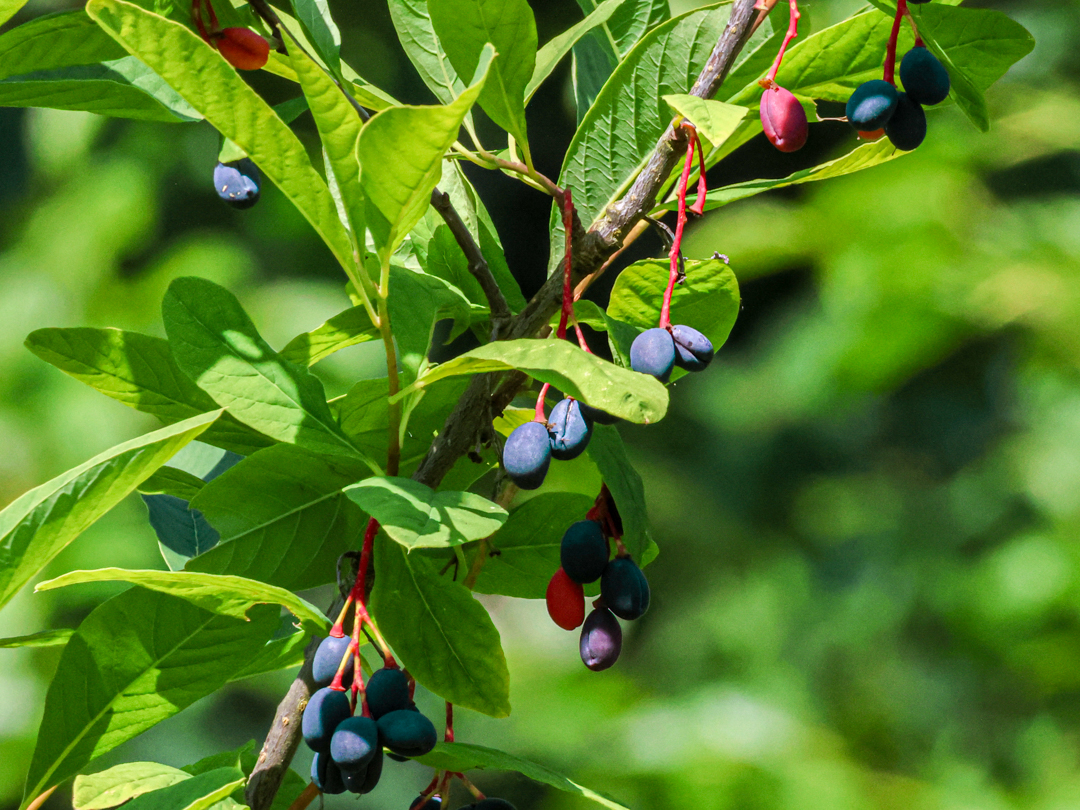
Ripe osoberries. photo by Thomas Noland
chemical magic
The process of how berries achieve their assortment of hues is all about chemistry.
The ripening process is genetically programmed into a plant and results from various metabolic and physiological alterations that are irreversible. (You cannot unripen a fruit.) As berries grow and ripen, they undergo complex processes that change not only their structure and color, but also their sugar, water, mineral, and vitamin contents.
Different pigments dictate what colors will appear in plants and their fruits. Chlorophyll causes the leaves to become green. Yellow or orange fruits contain carotenoids, and red, purple, and blue pigments in fruits (Hello berries!) are due to anthocyanin.
the ecology of berry colors
Why are berries bright and colorful in the first place? Species propagation is likely a major reason. Because plants cannot move to achieve this task, they rely on animals. Plants first produce enticingly colored flowers to draw the attention of hummingbirds, bees, and butterflies. These and other pollinators transport pollen to fertilize other flowers, starting the process of seed and berry formation.
Animals assist with the spreading of seeds by ingesting the berries and depositing the “leftovers” elsewhere after they have been digested. “Elsewhere” may be on your car windshield, in your yard, or in the forest, and it may be just a few feet to many miles away from the parent plant.
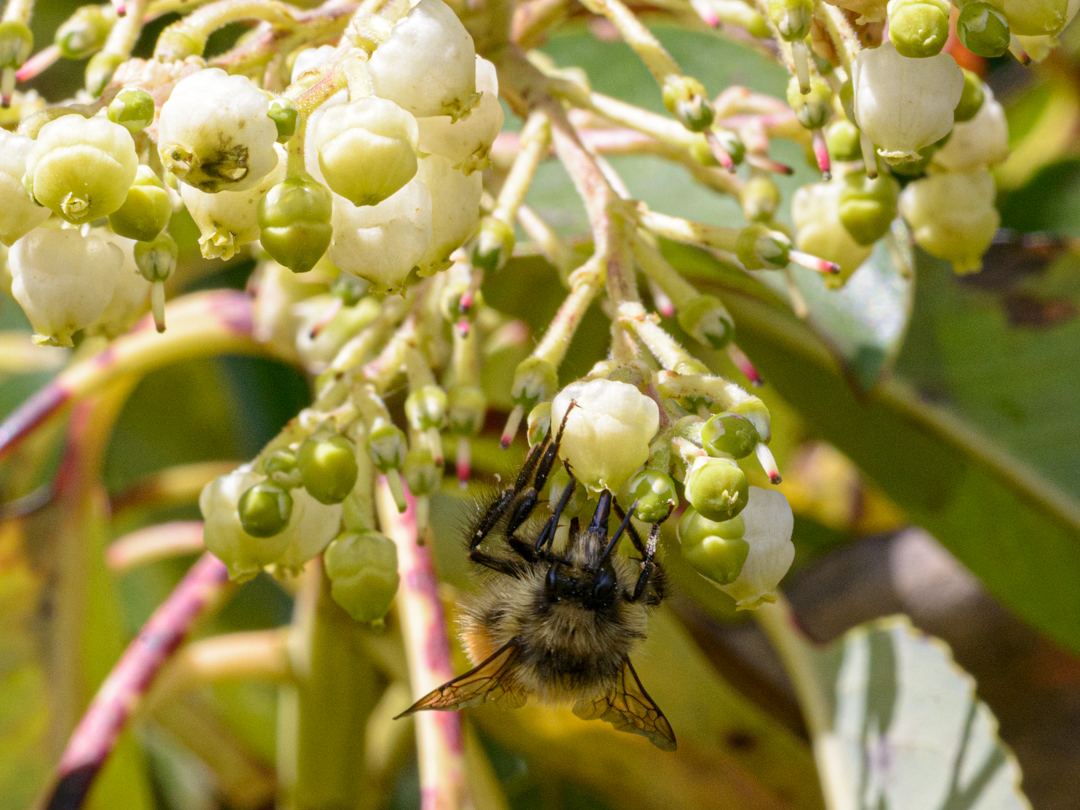
Many pollinators and berry-eaters see colors, but see them quite differently than we do. photo by John F. Williams
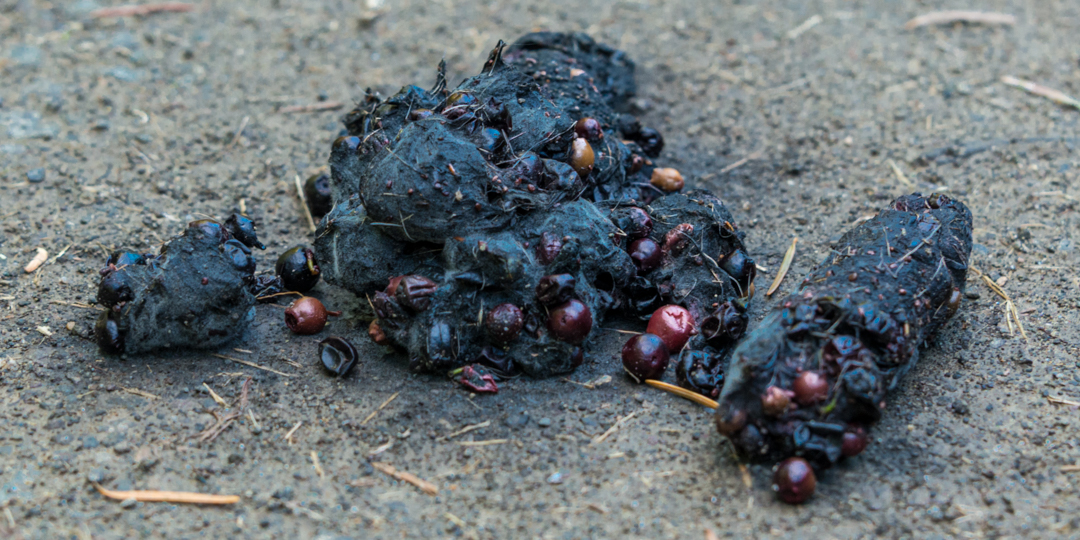
Huckleberries in scat. photo by John F. Williams
Colors play an important role in attracting animals to berry plants and are instrumental in plant reproduction, helping to ensure the plant species’ survival.
As berries ripen, their colors deepen and become more intense, as does their aroma. The increased fragrance may not be easily perceptible to humans, but animals with a stronger sense of smell (e.g., bears) can detect the odor, and when combined with berry color changes this signals when a berry is ripe and ready to eat.
rainbow through the seasons
The many berry-producing plant species in our region follow their own seasonal calendars for when they bloom, fruit, ripen, and die back.
The harbinger of berry season is the salmonberry plant with its five-petaled magenta blossoms. These might be the first berry blossoms that you encounter in the early spring and likely the first berries you’ll spot out in the woods. Salmonberries appear in an array of colors, from an almost banana yellow, to persimmon orange, light pink, and ruby red. Often all of these hues can be seen on a single plant!
 See a whole article about salmonberries, also in this issue.
Another early spring delight is the red-flowering currant with its floral color display ranging from light pinkish white to robust fuchsia. The blooms of the red currant hang down in bunches that drip color and are a welcome sight after our long, dark winters. Add the shiny green glimmer of an Anna’s hummingbird, or if so fortunate to witness, the lustrous rufus hummingbird visiting this beauty, it becomes a display of vibrant color from both flora and fauna.
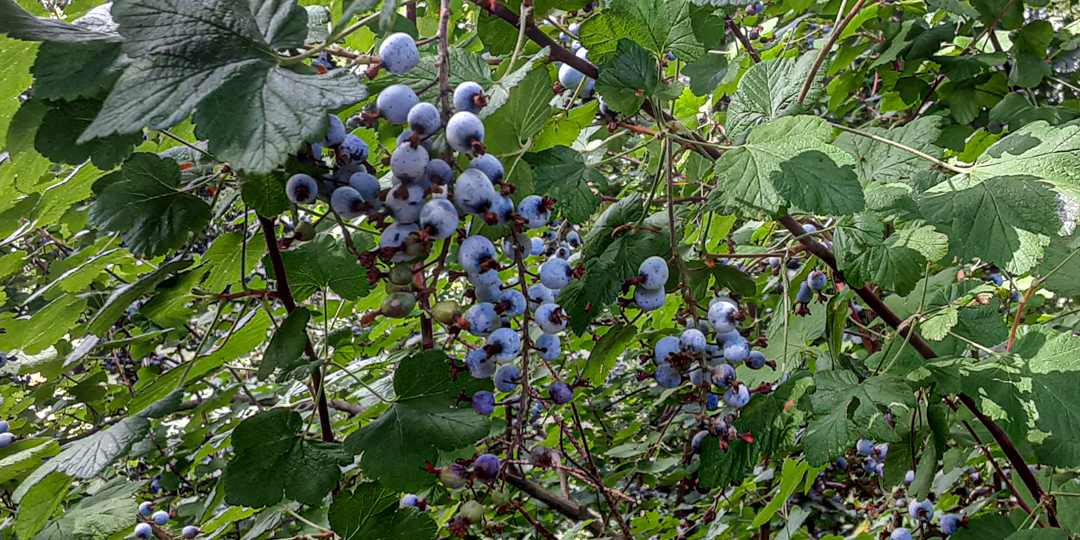
Redflower currant with berries. photo by Thomas Noland
Thimbleberries commence their season with white flowers adorned with yellow centers. If you come upon freshly blooming thimbleberries take a moment to stop, look, and listen. You may find yellow-faced bumblebees, their legs covered in pollen, busily feeding in the thimbleberry blossoms. Young thimbleberry leaves are bright green and their summer berries are like red gumdrops dotting the paths amidst our dark green forests.
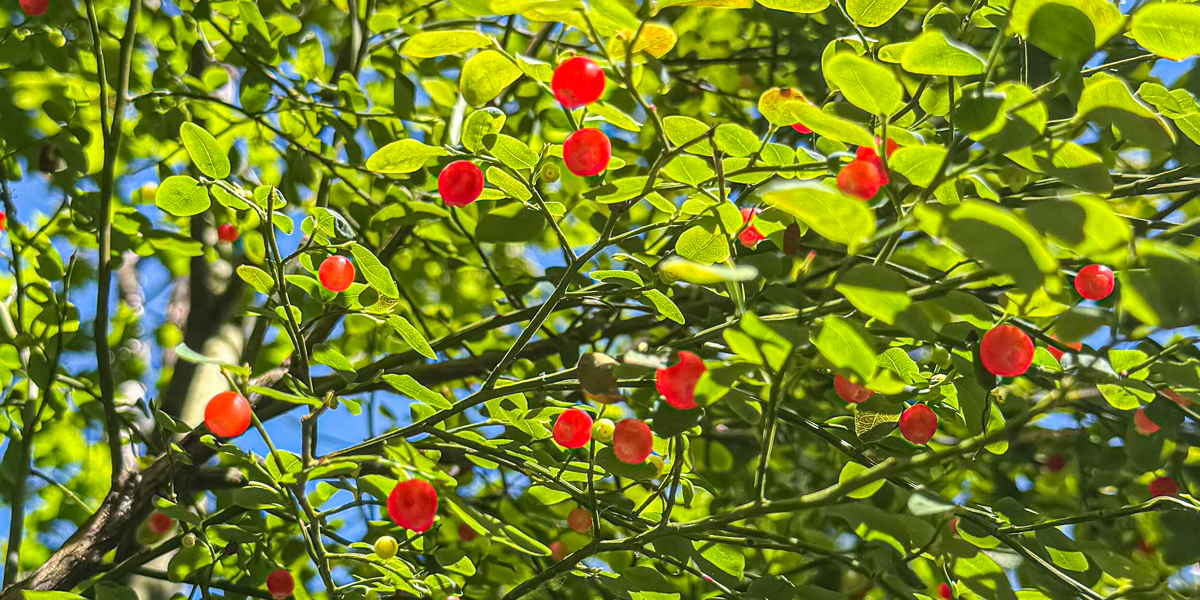
Ripe red huckleberries. photo by Thomas Noland
Late in the season, the tiny orbs of red huckleberry glow in dappled sunlight near the dark forest floor. Covered in rain droplets, they shimmer and glitter like precious gems.
One might argue that other ubiquitous berries such as those of Oregon grape, salal, kinnikinnick, and the simultaneously exalted and despised blackberries aren’t all that exciting or colorful. I would counter that they are both exciting AND colorful. Not only are their berries a crucial food source for birds, bears, and other creatures, but their flowers are important for pollinators and they beckon us to stop and admire them.
The flowers of Oregon grape appear in dense clusters of intense yellow, and then those flowers are replaced by pale-blue berries. The lantern-shaped, pinkish white flowers and dark berries of salal and kinnikinnick, combined with their sheer abundance, add their own color contributions to combat a gray day. Even the thorny vines of the blackberry bush show an assortment of colors, from deep green to dark purple and maroon, not to mention the rich purplish-blue color of the berries themselves.
See a photo essay about Himalayan blackberries in a 2020 entry in our Virtual Explorations.
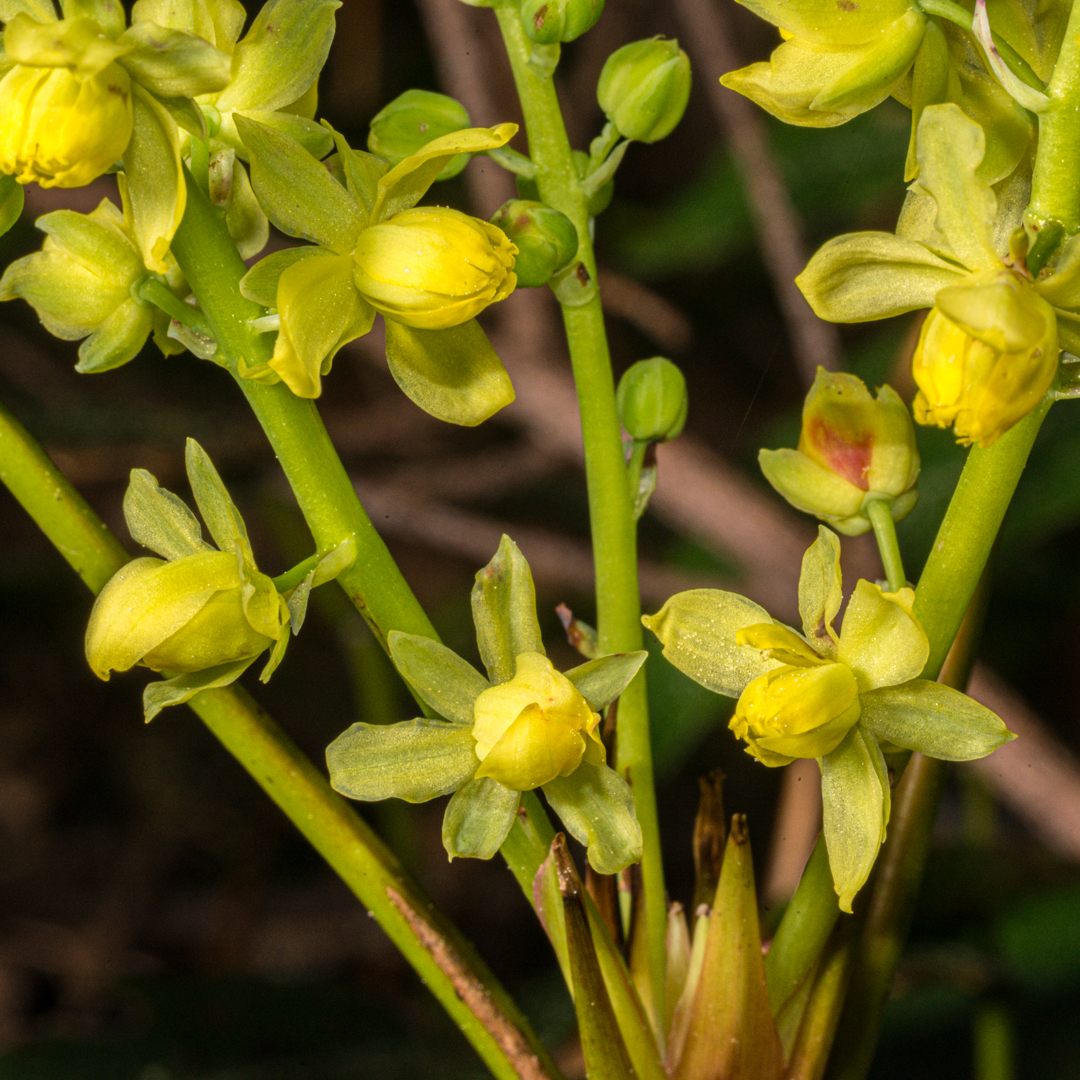
Oregon grape flowers. photo by John F. Williams
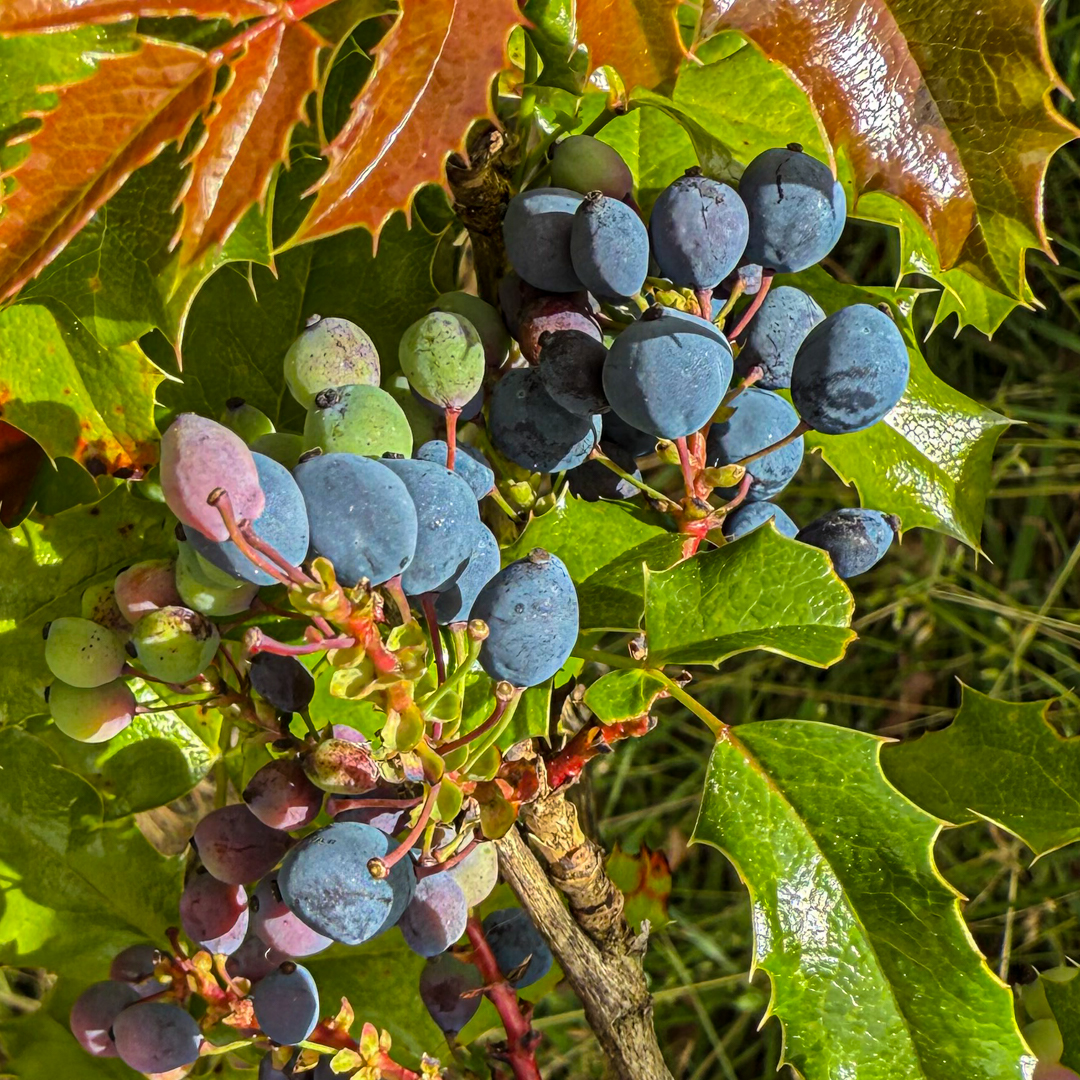
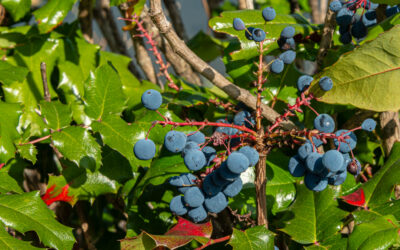
Oregon grape berries. photo by Thomas Noland
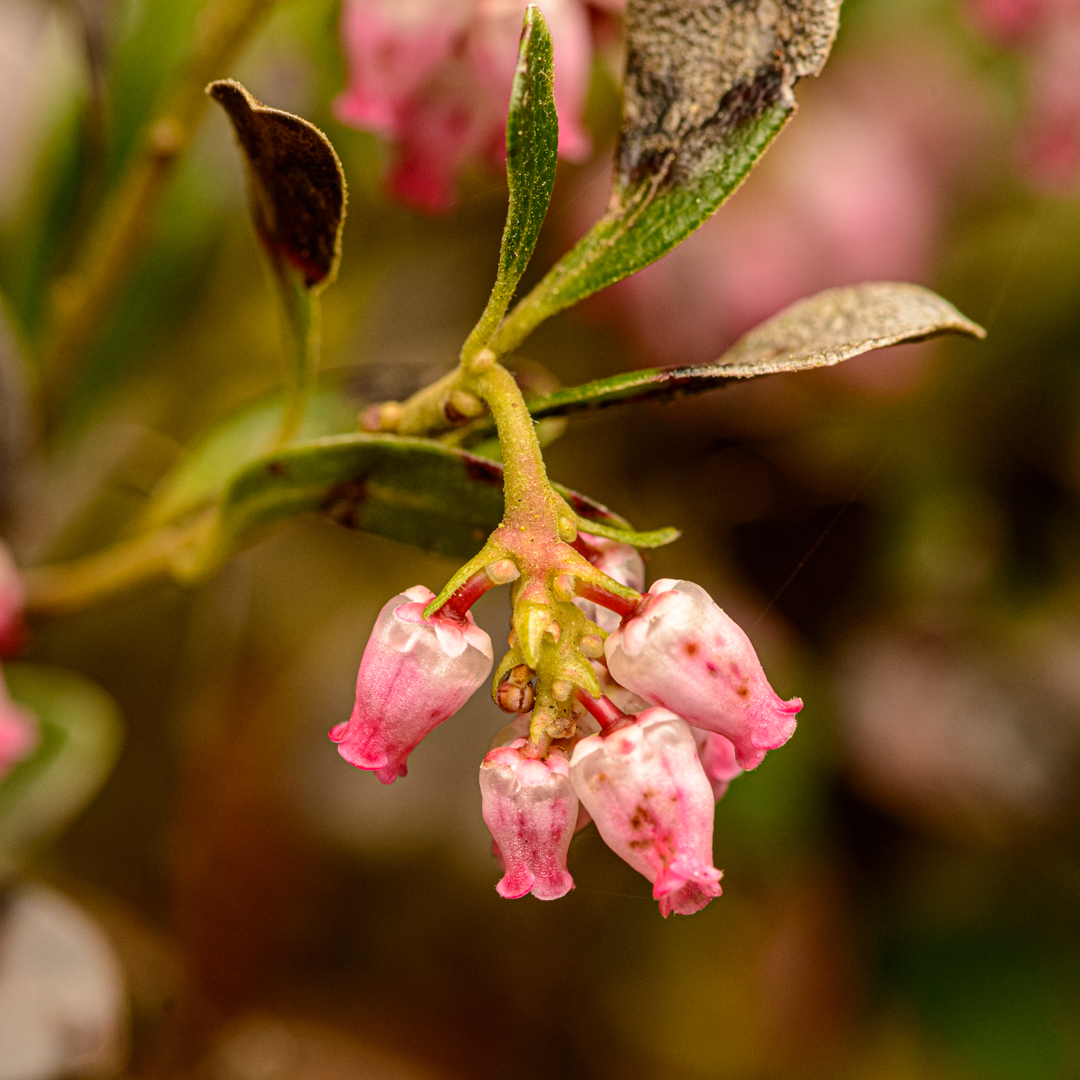
Kinnikinnick flowers. photo by John F. Williams
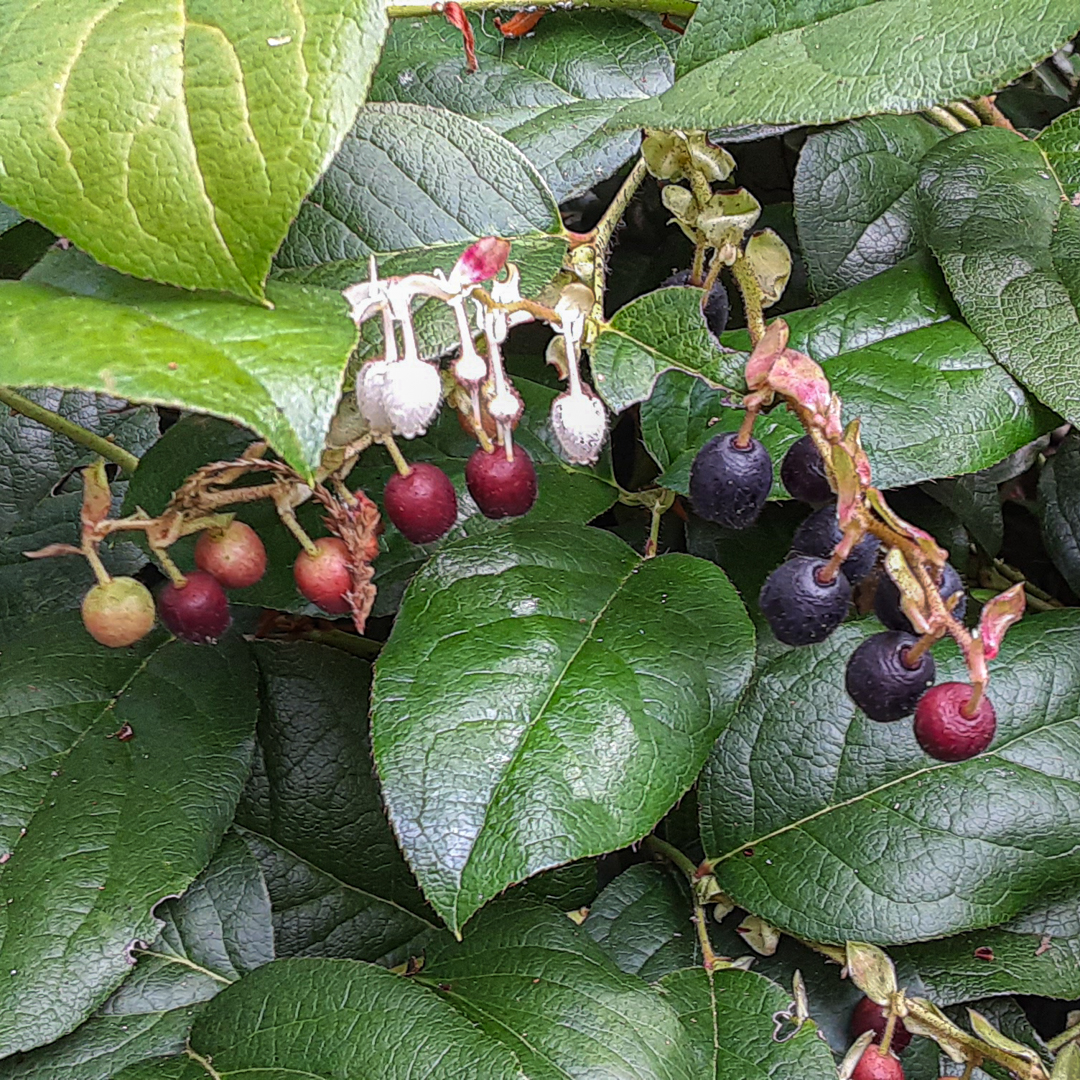
Salal flowers and berries. photo by Thomas Noland
See more about these and other flowers in our 2022 article, “Native Flowering Shrubs” by Julie O’Donald.
white berries in winter
The berries of the snowberry plant are smooth, round, and white, much like a snowball. As previously discussed, berry colors assist plants in their pursuit of propagation, and it seems as though the snowberry plant goes against that premise. What is the ecological role of the snowberry’s white fruit?
The berries of the snowberry plant tend to linger late into winter, providing food for animals when food sources are more sparse. This may be why the berries can be less colorful because they have less competition from other berry plants vying for animals to ingest their fruit and disperse seeds. Bears eat snowberries, and these berries are an important late fall and winter food source for birds such as towhees, robins, thrushes, and waxwings.
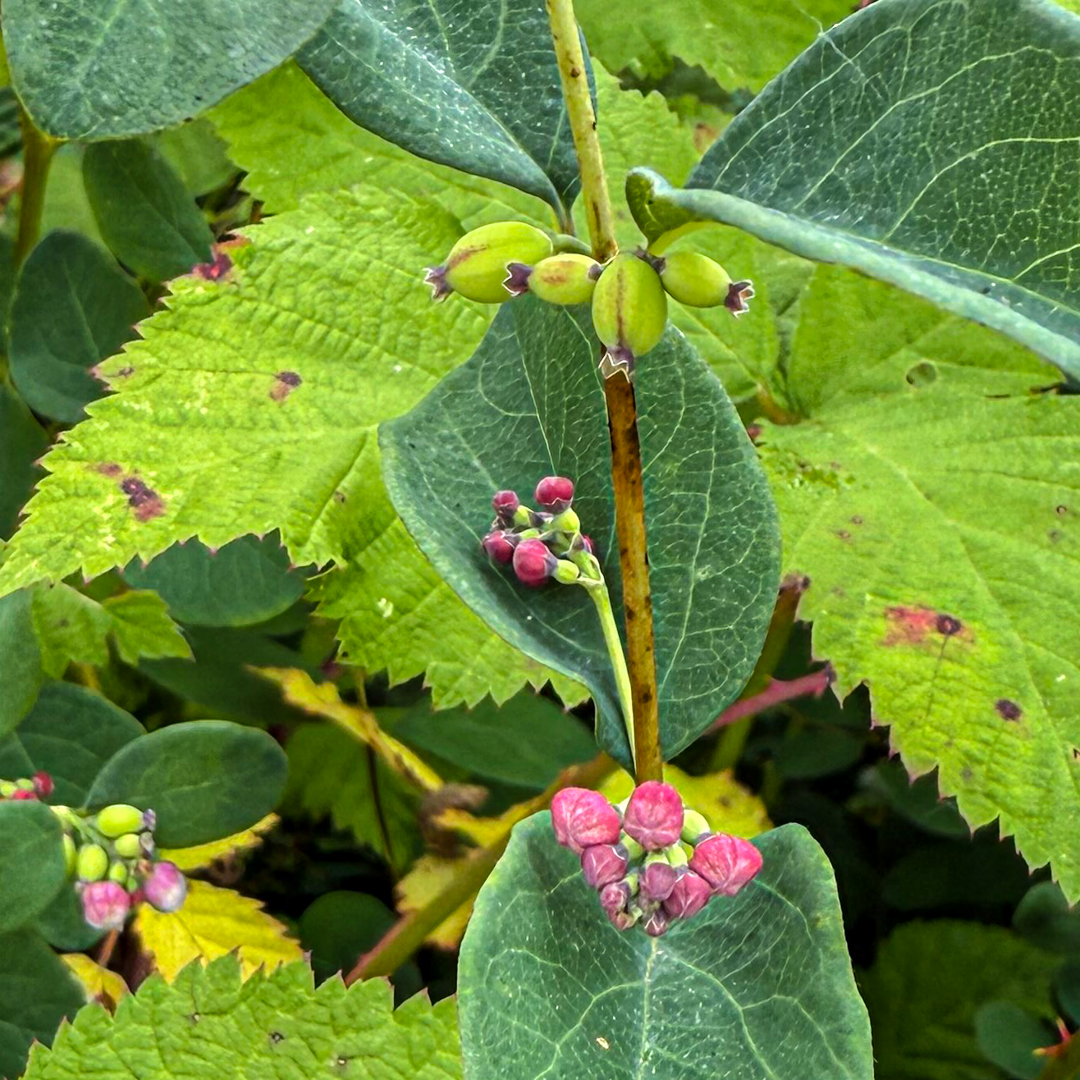
Pink flowers and snowberries forming. photo by Thomas Noland
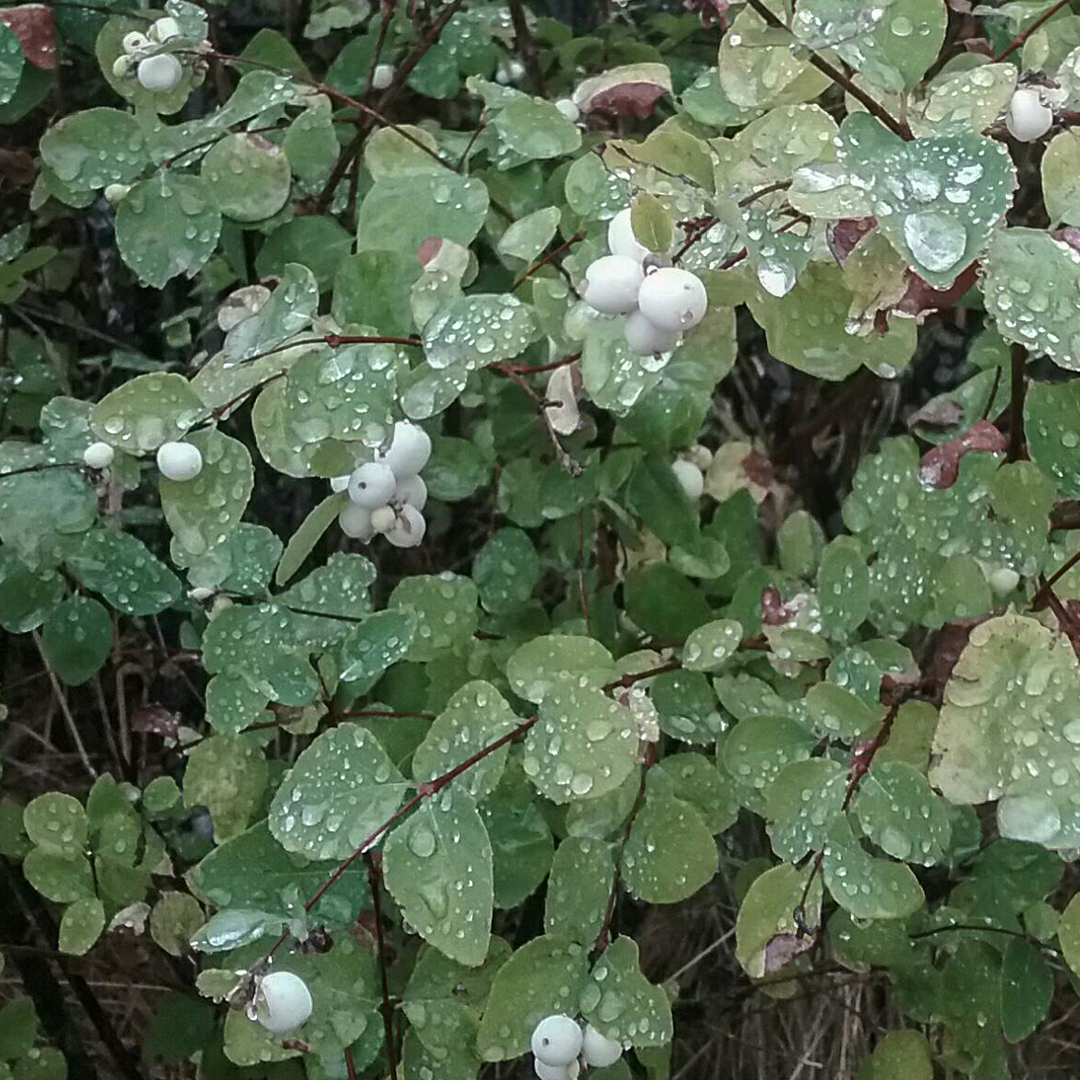
Mature snowberries. photo by Thomas Noland
nature’s palette
The above sampling of berry plants is just an introduction to the spectrum of berries in our area. If you look closely, you will be rewarded with a host of colors, from early spring into winter, throughout the life cycle of berry plants. From start to finish, from the blooms, leaves, and stems, to the berries themselves, and even the “presents” on your windshield, the berry plants of our region are nature’s color palette of the Pacific Northwest and serve an important role in the ecology of the Salish Sea region.
FIND OUT MORE
some general sources for more info:
Native Plants PNW: An Encyclopedia of the Cultural and Natural History of Northwest Native Plants
Washington Native Plant Society
more about fruits that do and don’t ripen after picking:
What is Climacteric and Non-Climacteric Fruit? — PostHarvest Technologies
how animals select berries and other fruit to eat is the subject of ongoing research. Here are a few examples for further thought:
What They See Is What They Eat: While the interconnection between animals and the fruits they eat is complex, the colours of those fruits isn’t a matter of mere luck – Research2Reality
Birds use fruit colour as honest signal of dietary antioxidant rewards: Functional Ecology, Wiley Online Library
Conspicuousness, not colour as foraging cue in plant–animal signalling: Oikos, Wiley Online Library
Avian Selection of the Color-Dimorphic Fruits of Salmonberry, Rubus spectabilis: A Field Experiment on JSTOR

Gunnison Langley lives in Seattle and believes that the Salish Sea region is the most beautiful place on Earth.
He can often be found giving a tree a hug, communing with crows, nibbling on thimbleberries, or chasing after squirrels (be assured, he only wants to be friends with them!)
Gunnison is always looking to meet new folks who enjoy bird watching (especially crows), nature and the PNW as much as he does!
Issue Page
Table of Contents, Issue #28, Summer 2025
Nature Walk in Berry-land
Nature walk in berry-land by Lindsey Davidge and Meilani Lanier-Kamaha’o, Summer 2025Child (age 6): Did you hear the FROG?by Lindsey Davidge and Meilani Lanier-Kamaha’o Summer 2025We document three families plus some classmates at play, focusing on children's...
Blackberries of the Salish Sea
Blackberries of the Salish Sea by Sarah Ottino, Summer 2025Himalayan blackberries at various stages of ripeness. photo by John F. Williamsby Sarah Ottino Summer 2025Editor’s note: Summer is time for blackberries ripening along trails, roadsides, and streams around the...
Our Rowan Tree
Our Rowan Tree by Thomas & Sara Noland, Summer 2025Red-breasted nuthatch caching a berry in mountain ash tree. photo by Thomas Nolandby Thomas & Sara Noland Summer 2025In our front yard is a year-round grocery store and rest stop for wild travelers. It started...
Blush Before the Salmon
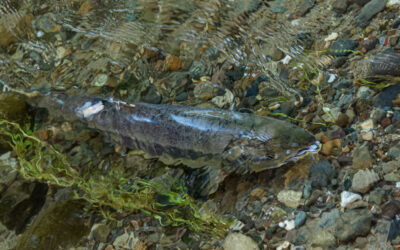
Blush before the salmon by Celeste Hankins, Summer 2025Adult female chum salmon in Chico Creek, Kitsap. photo by John F. Williamsby Celeste Hankins Summer 2025Along the edges of the Salish Sea, where cedar shadows stretch long over moss and fern, the salmonberries...
Poetry 28 A
Poetry 28 A by multiple poets Summer 2025Berries of oregon grape (mahonia). photo by John F. Williamsby multiple poets Summer 2025Blueberry by Nancy Taylor bigger than a pea had been a flower suckled by a bee color of a new bruise but doesn’t hold the pain...
Poetry 28 B
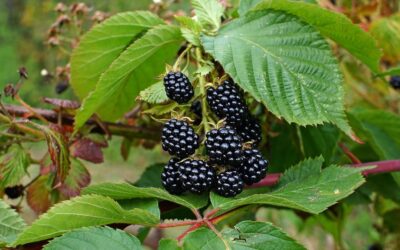
Poetry 28 B by multiple poets Summer 2025Blackberries on the bush. Image by Marevo via Pixabayby multiple poets Summer 2025sun pierced by Carl Jensen The element of fear picking blackberries (you really do get snagged by vines) is balanced against an everyday...
COPYRIGHT
Copyright SEA-Media
All rights reserved. Reproduction or distribution, in whole or in part. without consent of copyright owner is strictly prohibited — except for brief quotations in critical reviews and other noncommercial uses permitted by copyright laws.
SEA-Media is a 501(c)(3) nonprofit corporation
PLEASE HELP SUPPORT
SALISH MAGAZINE
DONATE
Salish Magazine contains no advertising and is free. Your donation is one big way you can help us inspire people with stories about things that they can see outdoors in our Salish Sea region.
We also don't advertise Salish Magazine, so please spread the word of this online resource to your friends and colleagues.
Thanks so much for your interest and your support.