
PILLBUGS, SOWBUGS, AND WOODLICE, OH MY
by Tom Noland, Spring 2022
Oniscus sowbug. photo by John F. Williams

Oniscus sowbug. photo by John F. Williams
PILLBUGS, SOWBUGS, AND WOODLICE, OH MY
by Thomas Noland, Spring 2022
Pillbugs and sowbugs are some of the small creatures you’ll commonly find on the surface of the soil. You’ll often encounter them under rotting wood, in leaf litter, under rocks, and in other dark, moist places. While they are common, they have several truly odd characteristics and they are important recyclers in the ecosystem.
These creatures are terrestrial isopods. Although they are called bugs, they are not insects. They’re a type of crustacean like shrimp and crabs. Isopods evolved in a shallow marine environment during the Paleozoic era roughly 500 to 200 million years ago (this is also known as the Cambrian period).

Upside down Oniscus sowbug showing seven pairs of legs. photo by John F. Williams
There are two types of common terrestrial isopods, the pillbug and the sowbug. Pillbugs belong to the genus Armadillidium. The common pillbug (A. vulgare) was introduced to the United States from Eurasia. These isopods can roll themselves into a ball and have shiny gray plates that remind you of an armadillo. Sowbugs belong to two genera, Oniscus and Porcellio. Unlike the pillbug, they cannot roll themselves completely into a ball, and they aren’t as shiny.
Pillbugs and sowbugs are also known as woodlice or roly-polies. They have flattened bodies; think of your hand placed flat on a table. Their bodies are composed of a cephalothorax and abdomen, joined together in segments like a millipede. They move about using seven pairs of walking legs that are all roughly the same in appearance (hence the name isopod: “iso” meaning the same, and “pod” meaning foot).
Weird fact: terrestrial isopods breathe with their legs, sort of. They have two to five pairs of pleopods (small leg-like appendages) on the abdomen. Aquatic isopods use their pleopods for swimming and breathing. Terrestrial isopods have pleopodal gills covered by an operculum (a type of flap) that allow gas exchange on land. That’s why pillbugs and sowbugs need to live in a damp environment so that these gills can stay moist.
Did you know that pillbugs and sowbugs share a feature with kangaroos and opossums? They also have a pouch, called a marsupium, where they raise their young. Female pillbugs and sowbugs can lay up to 200 eggs in their pouch. The eggs are carried in the marsupium for three to seven weeks. When they hatch, the babies are barely visible and stay in the pouch for another several weeks. Once they leave the pouch they never return.
 Isopod giving birth (video)

Woodlouse or sowbug. drawing by Thomas Noland

Woodlouse or sowbug (legs hidden). photo by John F. Williams
Like crabs and insects, pillbugs and sowbugs have a hard exoskeleton that they shed and replace as they grow, a process called molting. Depending on the species, they can molt up to a dozen times during their lifetime, growing bigger each time. These isopods generally live to around two years, but some have been known to live as long as five years.
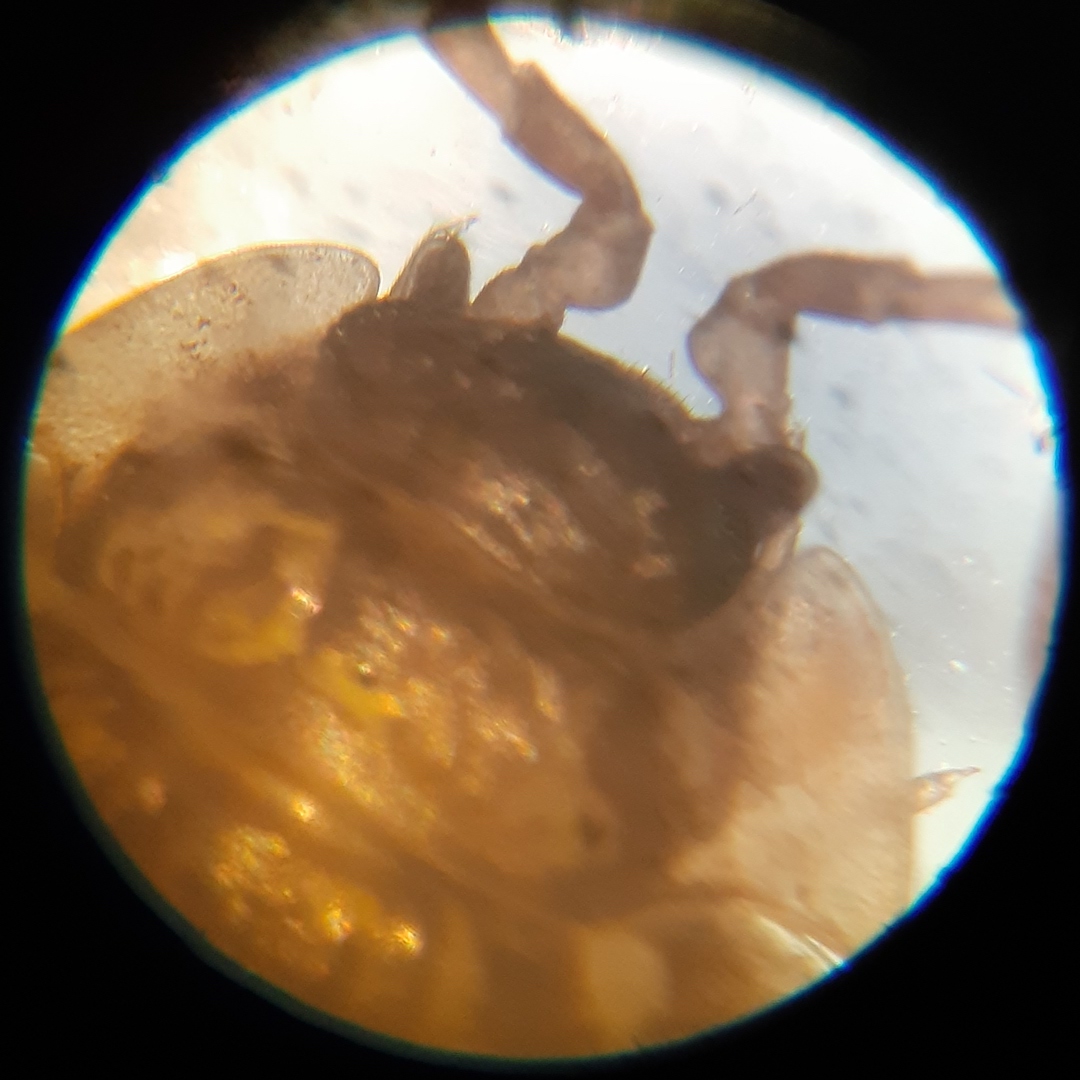
Front end of a sowbug. photo by Thomas Noland
Pillbugs and sowbugs do not urinate, but instead release ammonia waste as a gas through their bodies. They also eat their own feces (known as coprophagy). This behavior is not really understood but scientists think it may be a way for the isopods to retain copper, a mineral needed for survival that is often not easily obtained. Also, these critters drink from both ends of their bodies: using both their mouths and straw-like structures called uropods attached to their abdomens.

Back end of a sowbug. photo by Thomas Noland

Aquatic sowbug. photo by Thomas Noland
For more about isopods and carbon cycling, see the article “Biotic interactions mediate soil microbial feedbacks to climate change”
Pillbugs and sowbugs break down decaying organic material by eating it with their chewing mouthparts, then they return nutrients to the soil in their feces. They are sensitive to changes in their environment and can be used to help indicate the health of an ecosystem. Many aquatic species of sowbugs can tolerate water pollutants and sometimes may be the main kind of invertebrates that can live in a polluted pond or waterway.
Finally, these isopods play a small role in slowing climate change. As the climate warms, the growth of fungus increases, which in turn releases more carbon dioxide into the atmosphere. However, isopods and other creatures in the soil eat the fungus and reduce the carbon dioxide being released into the atmosphere.

Here’s looking at you, kid. photo by John F. Williams
So when you’re out getting firewood from your woodpile, digging in the garden, or looking under rocks or logs, watch out for the roly-polies scurrying away. Be careful and place that rotten wood, stone, or leaf litter back over them carefully as these little backyard cleaning crews have important jobs to do.

Thomas Noland is a naturalist and photographer living in Everett. In addition to his interests in paleobiology, he is a dedicated entomologist and caretaker of numerous rescued cats.
Table of Contents, Issue #15, Spring 2022

Eelgrass Flowering
by Sandy Wyllie-Echeverria and Isabella Brown, Spring 2022 Seagrass Lab, Friday Harbor Laboratories, University of Washington Eelgrass at low tide, showing mostly flat green leaves and a yellowish, round flowering head near the center of the photo. photo by John F....

The Decomposers
Video by Tom and Sara Noland Sara and Thomas Noland are naturalists who live in Everett, Washington. They live in a tiny house with many cats but are fortunate to have a big yard with lots of trees, birds, and lichens. They frequently take field trips to enjoy and...
Marine Ground Dwellers
Images by Jan KocianImages by Jan Kociansometimes worms don’t live in the ground ... especially in the Salish Sea. These curious creatures come in many forms from feathers to trumpets.moon snails and nudibranchs (sea slugs) Some of the denizens of the Salish Sea floor...
I Dig Worms
by Barb Erickson, Spring 2022Nightcrawler photo by SanduStefan from PixabayBy Barb Erickson, Spring 2022I remember the iguana and the earthworm. The iguana lived in the back of the room, in a cage made of two-by-fours and chicken wire. When I say “…in the back of the...
Poetry-15
Spring 2022Salish Sea, Cama Beach Historical State Park, Camano Island, Washington.* photo by Luke VolkmannSalish Sea, Cama Beach Historical State Park, Camano Island, Washington.* photo by Luke VolkmannSpring 2022From the Ground Up by Sheryl Shapiro Venus shining...
COPYRIGHT
Copyright SEA-Media
All rights reserved. Reproduction or distribution, in whole or in part. without consent of copyright owner is strictly prohibited — except for brief quotations in critical reviews and other noncommercial uses permitted by copyright laws.
SEA-Media is a 501(c)(3) nonprofit corporation
PLEASE HELP SUPPORT
SALISH MAGAZINE
DONATE
Salish Magazine contains no advertising and is free. Your donation is one big way you can help us inspire people with stories about things that they can see outdoors in our Salish Sea region.
We also don't advertise Salish Magazine, so please spread the word of this online resource to your friends and colleagues.
Thanks so much for your interest and your support.