
TINY HUNGER
by Lucienne Miodonski
Autumn 2025
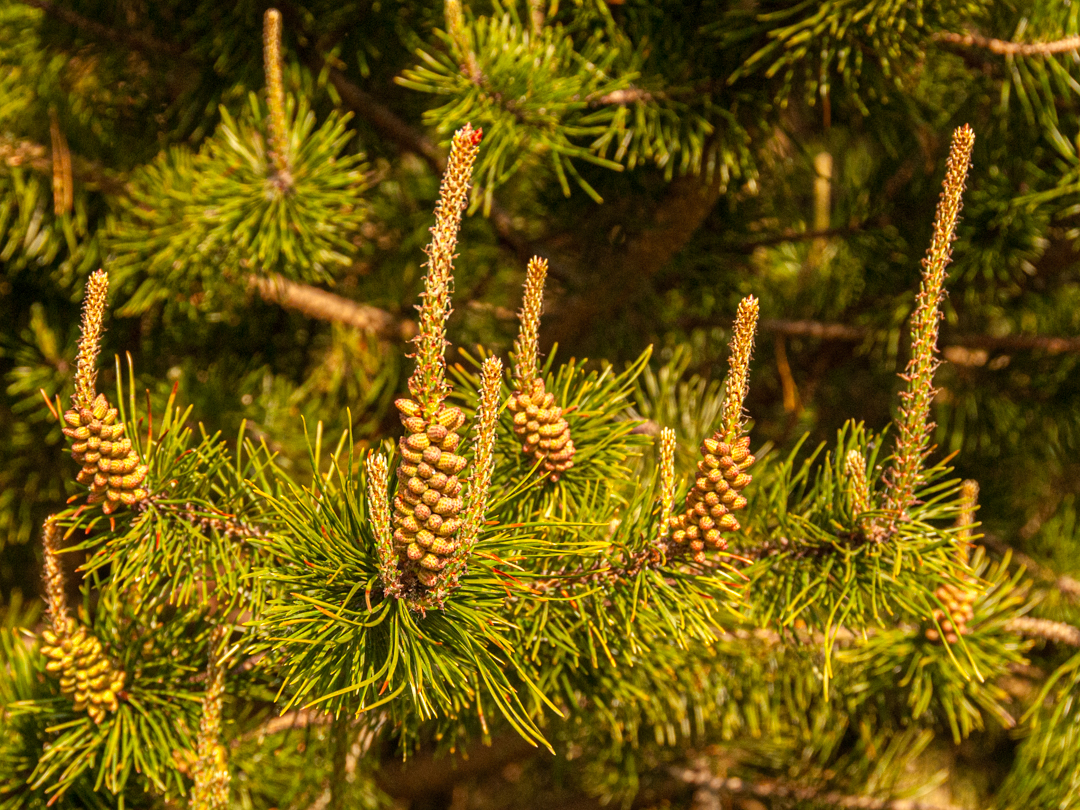
Shore pine. photo by John F. Williams
TINY HUNGER
by Lucienne Miodonski
Autumn 2025
On the southwestern corner of my waterfront property — high on a bluff above the Saratoga Passage, where the land begins to lose its grip on the sea, a single shore pine stands. Its gnarled limbs, twisted by salt spray and decades of wind, lift skyward in quiet defiance. The needles, once green, have burnished to copper, and the bark peels orange and gray. It leans into its last breath, a skeleton of its former self, killed by a beetle smaller than a grain of rice.
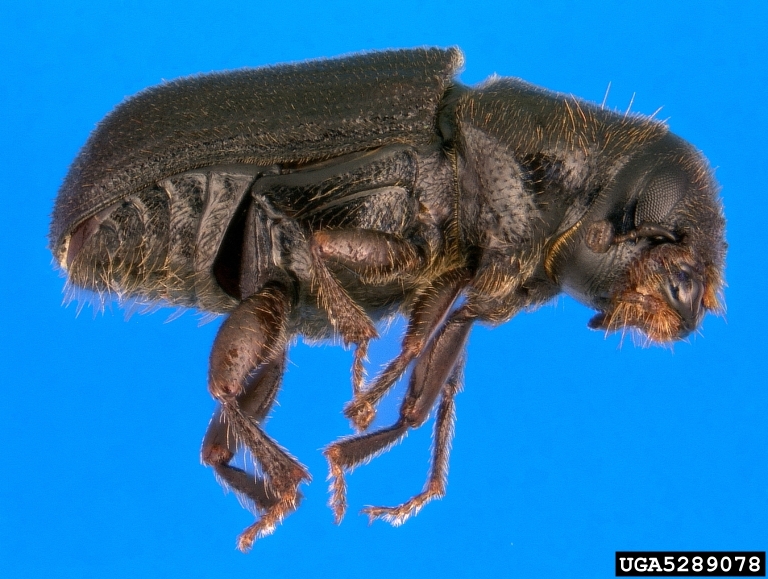
Western pine beetle. photo by Erich G. Vallery, USDA Forest Service – SRS-4552, bugwood.org licensed under a Creative Commons Attribution-Noncommercial 3.0 License
This is how it begins — a hunger so small you would overlook it unless you knew what to look for. The pine beetle has arrived — not as a solitary destroyer — but as part of a living consortium of fungi, bacteria, and mites. Peel back a sliver of peeling bark and a hidden world unfurls, galleries of larval beetles in perfect script, threads of blue-stain fungi branching like veins, and microbes laboring unseen to unlock sap’s chemistry. Together they are changing the trees and forests around us. But what seems, at first glance, like ruin is also an orchestration — not just an ending but of the beginning of something new.
This is not a story of trees lost, but of relationships awakened. It’s a story in which death and renewal share the same breath, and the pine beetle, unexpectedly, becomes an agent of ecological transformation.
the beetle
The mountain pine beetle (Dendroctonus ponderosae) is one of the most well-known bark-boring beetles in western North America. Closely related species, such as the western pine beetle (Dendroctonus brevicomis), are active in the lower elevations of Washington’s coast, including Skagit County and the broader Salish Sea region. Measuring only about the size of a grain of rice, its entire lifecycle, except for adult dispersal, occurs beneath the bark of host pines.
Eggs are laid in galleries in the tree’s inner bark (phloem). Larvae feed, pupate, and emerge the following year as adults to continue the cycle. The beetle is not alone; it carries a suite of organisms with it — fungi, bacteria, and mites — that help transform living pine trees into breeding chambers and future soil.
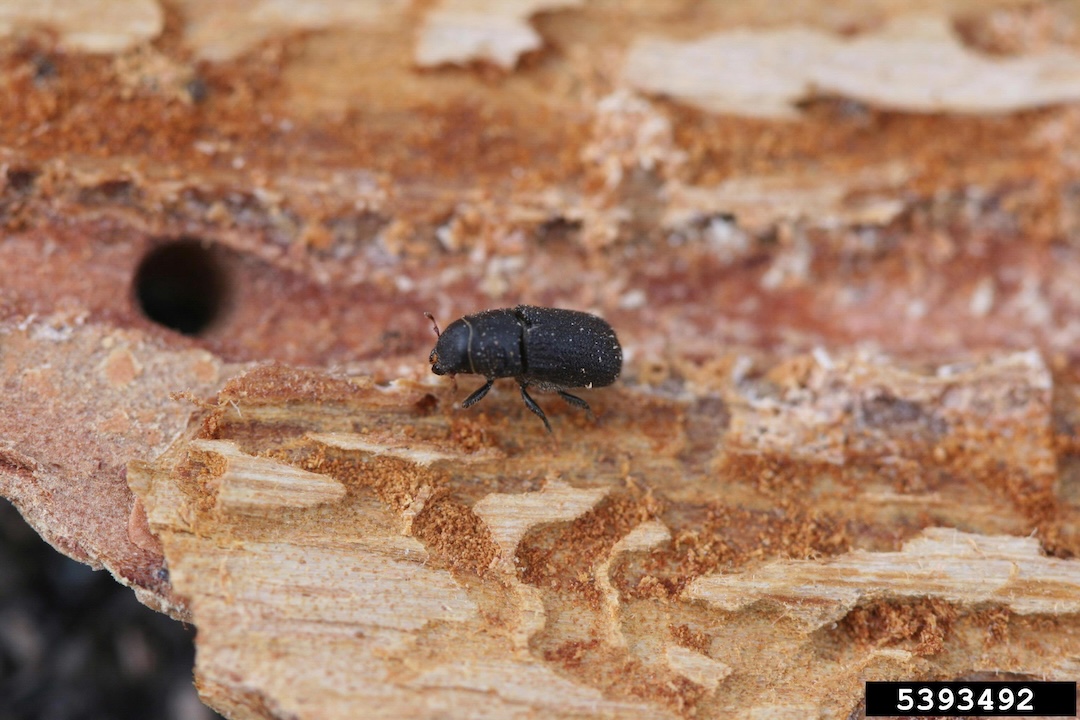
mountain pine beetle and its work on a tree. photo by Whitney Cranshaw, Colorado State University, bugwood.org, licensed under a Creative Commons Attribution-Noncommercial 3.0 License
Tiny and ancient, beetles have evolved in rhythm with the trees they infest, dancing a cycle of death and renewal in forests for millennia. But things are changing. The warming climate has shifted the terms of an old truce. No longer an occasional visitor, it has become an occupying force.
Winters are not arriving with sufficient violence to curb the beetle populations. Where once deep freezes would kill larvae beneath the bark, we now see winter barely touching freezing. A study published in Nature Climate Change notes that bark beetle outbreaks have increased in western North America due to reduced cold-induced mortality and increased drought stress on trees.
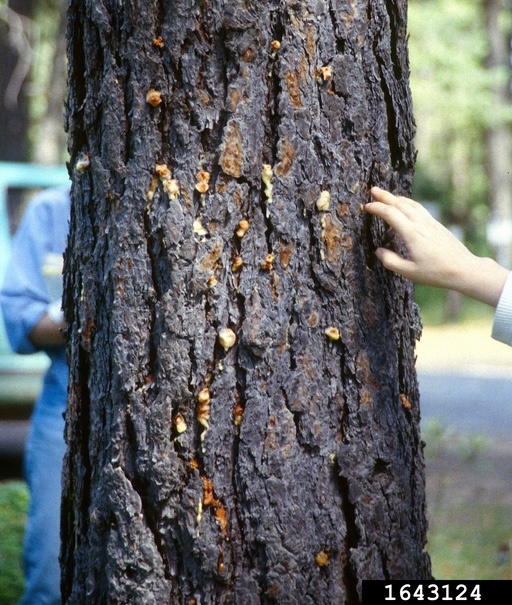
Pitch tubes on a ponerosa pine tree. photo by USDA Forest Service – Coeur d’Alene Field Office , bugwood.org, licensed under a Creative Commons Attribution-Noncommercial 3.0 License
how the attack unfolds
A single western pine beetle won’t fell a healthy tree, but a crowd of them can. Females land and bore into a tree, and the chemical conversation takes over. The females release aggregation pheromones (exo-brevicomin), and males release frontalin, blended with host volatiles, like myrcene, emitted by the pine itself.
The mix recruits more beetles, overwhelming the tree’s defenses. Within days to weeks, foliage fades from green to coppery red; under the bark, beetle larvae and a suite of blue-stain fungi (notably Ophiostoma minus) help girdle water and sugar transport. The tree’s plumbing fails first, then its crown.
Cream-colored pitch tubes pepper mid-trunk, around entry holes, when attacks are successful. Big, white, smeared pitch globes without frass, a sawdust-like waste, often signal a tree has “pitched out” the first attackers and might survive the attack. Later, with severe drought, resin production collapses, and you might see little more than reddish sawdust in bark fissures and at the base. By the time the whole crown glows red, the damage is done, and the brood has usually matured and flown off.
the hidden symbiosis
To view the pine beetle as a lone invader misses the deeper story. It acts as part of a multi-species alliance (symbionts) that cooperates — often with startling elegance — to turn the defenses of a tree into nourishment, shelter, and ultimately soil.
- Fungi: The beetles carry spores of blue-stain fungi (Ophiostoma, Grosmannia, Leptographium) on their exoskeletons. These fungi help colonization by penetrating and weakening tree defenses, helping colonize the phloem and cambium layers while also serving as a protein-rich food source for beetle larvae. This accelerates tree death — a mutualistic relationship essential to the success of outbreaks
- Bacteria: Less visible but just as vital are bacterial partners — Pseudomonas, Rahnella, Serratia, Burkholderia, and others — present in beetle bodies and galleries. These microbes degrade terpenes — volatile defensive chemicals produced by pine trees — that help to detoxify host defenses and enable beetles to colonize stressed trees.
- Mites and nematodes: Microscopic hitchhikers travel with the beetles, forming a complex web of interactions — some parasitic, some mutualistic — that affect beetle success and their impact on trees.
These symbiotic networks reveal a beetle not just as a killer, but as a mobile ecosystem engineer, with microbial helpers that turn toxic tree chemistry into sustenance.
Beetle populations typically exist at low (endemic) levels, but under the right conditions can shift from endemic to epidemic phases, most often triggered by prolonged warm summers and mild winters, allowing for higher overwinter survival rates and capacity for multiple beetle generations per year.
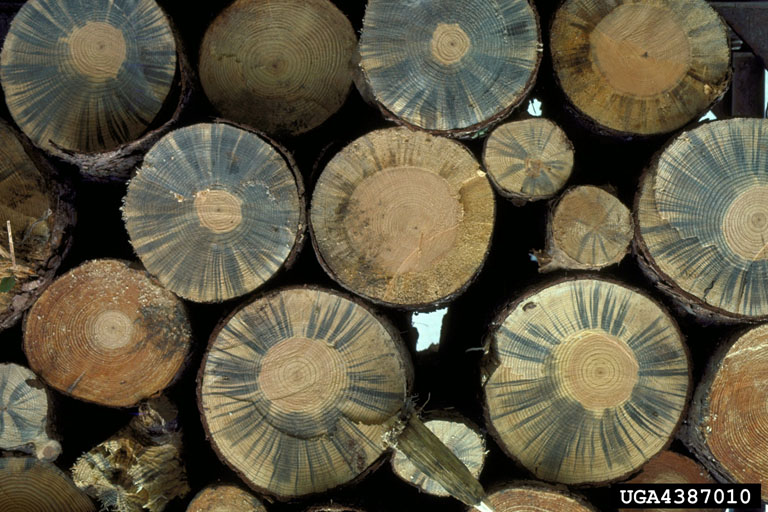
Blue-stain fungi on logs. photo by L.D. Dwinell, USDA Forest Service, bugwood.org, licensed under a Creative Commons Attribution-Noncommercial 3.0 License
the Salish Sea and Skagit Valley
The Skagit Valley and its surrounding foothills have begun to experience the early symptoms of this larger ecological wave. Though not the epicenter of North America’s worst beetle outbreaks, Ponderosa pine, shore pine, and lodgepole pine, already growing on the margins of their climate comfort zone, have been affected by smaller but notable outbreaks. Warming winters mean that beetles, once held in check by cold, now survive in greater numbers and colonize higher elevations and wetter coastlines than ever before.
Reports from the Washington Department of Natural Resources noted significant increases in damage done by western pine and other boring beetles to acreage in western Washington, including areas in and near Skagit County. These numbers, though dwarfed by outbreaks in British Columbia and the Rockies, signal a troubling trend — but also an ecological opportunity.
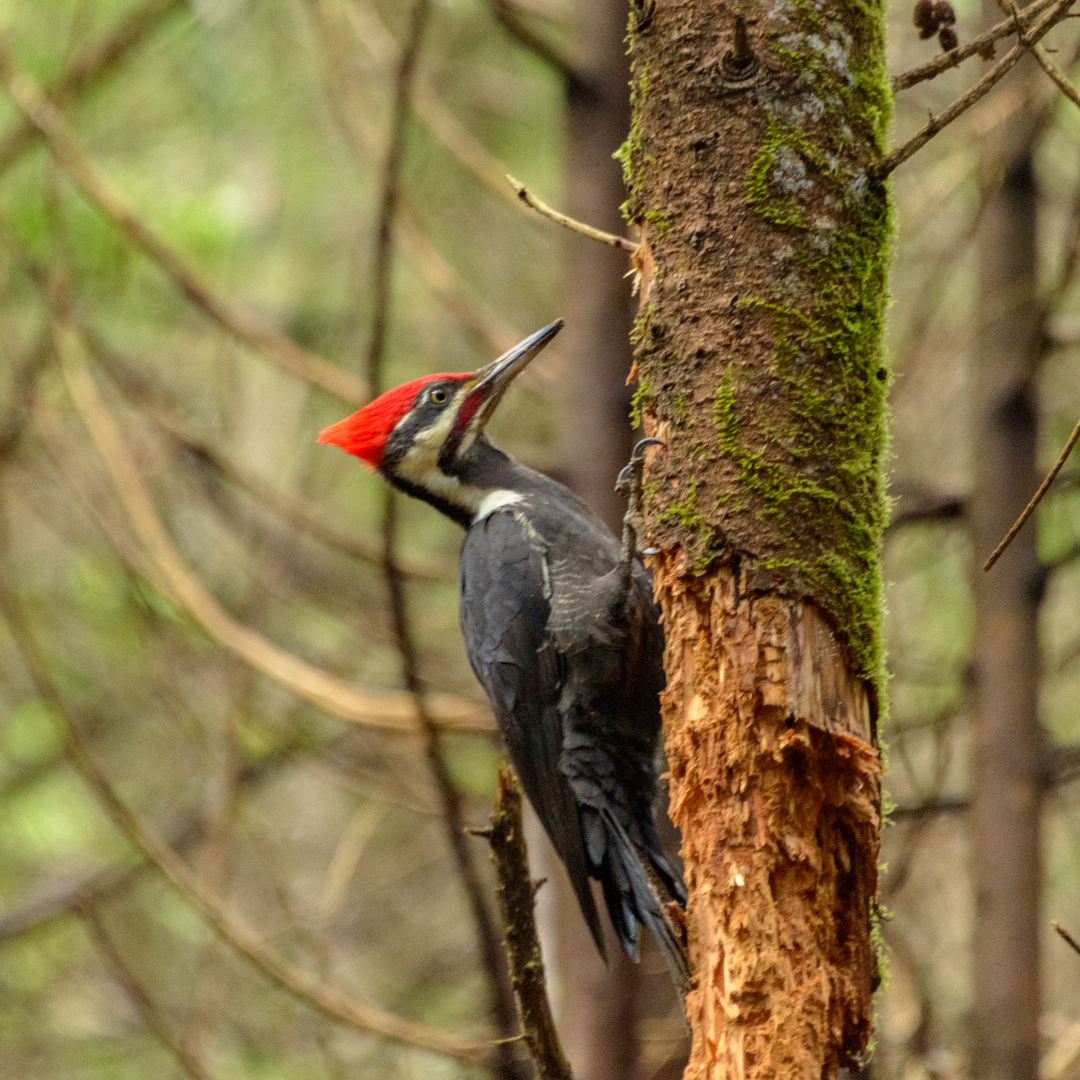
Pileated woodpecker. photo by John F. Williams
ecological role of pine beetles
Despite the ugliness from a human aesthetic standpoint, beetle outbreaks initiate several ecological benefits.
- Forest renewal and successional diversity: By targeting dense mature pine stands, beetles create space and clear the canopy, allowing light to reach the understory, promoting the establishment of younger pines or more diverse vegetation.
- Habitat creation: Dead and dying trees become critical habitat for wildlife: cavity-nesting birds (woodpeckers, chickadees), insects, and other organisms feed on the beetle larvae or use dead trees (snags) for nesting.
- Hydrology and Soil Enrichment: Research shows that beetle-affected forests often experience a temporary increase in soil moisture and nutrient availability. Young regenerating trees exploit this nutrient flush. Minimal impacts to downstream water chemistry and accelerated regeneration were shown in a 2015 USGS study.
rethinking devastation: a shift in perspective
The transformation caused by pine beetles is dramatic and often painful for those of us who live among the trees. Yet when we shift our perspective from short-term aesthetics to long-term ecology, a new picture emerges: one in which beetles are catalysts, not just killers.
They are an ancient, native species, deeply embedded in the evolutionary story. In the Skagit Valley, these patterns are playing out slowly, sometimes invisibly. For example, a tree that dies today will feed a hundred creatures tomorrow.

Ghost of a shore pine. photo by Lucienne Midonski
conclusion
When I look at my ghost of a tree, I mourn. I know one day soon there will be a gap in the sky where it now stands. The sea is the same — restless, slate-colored, loud against the shore — but the horizon will be altered, emptier. What will remain is a silhouette in my memory.
In a world increasingly defined by climate disruption, the pine beetle is both a messenger and a mechanic — revealing our forests’ stress and rebuilding them in its wake. To walk through a beetle-affected stand is to witness an ancient story: life becoming death and death becoming life again. The trees fall, the fungi bloom, the beetles hum their invisible trails, and beneath it all something sacred and essential stirs. This is not an invasion but an invitation.
The forest, even in its apparent ruin, is not dying. It is becoming.
FIND OUT MORE
Shore pines, Native Plants PNW
Anatomy of a tree, USDA Forest Service
Blue stain fungi, Wikipedia
Forest Health Highlights in Washington – 2019, USDA, USFS, WDNR
Western pine beetle, Forest Pest Insects in North America: a Photographic Guide
Western Pine Beetle, also pitch tubes & beetle infestation signs, in the Forest Insect and Disease Leaflet 1, USDA Forest Service
Western Pine Beetle, DecAID, US Forest Service
Mountain pine beetle, Wikipedia
Mountain Pine Beetle, Forest Insect & Disease leaflet 2, USDA Forest Service
Effects of the mountain pine beetle on forest hydrology and chemistry in the southern Rocky Mountains, USGS Ecosystems Land Change Science Program May 30, 2015
Mountain Pine Beetles Colonizing Historical and Naïve Host Trees Are Associated with a Bacterial Community Highly Enriched in Genes Contributing to Terpene Metabolism, Applied and Environmental Microbiology

Lucienne Miodonski is a writer, poet, photographer, and active in dog sports. She has a passion for animals and the outdoors and is deeply curious about the natural world. Lucienne seeks to capture the beauty and complexity of nature and draws inspiration from the world around her. Whether crafting poetry, prose, or images, she strives to create work that is engaging and resonates with authenticity and a sense of wonder. She lives on Camano Island, overlooking the Salish Sea and the Olympic Mountains, with her husband and two dogs.
Issue Page
Table of Contents, Issue #29, Autumn 2025
Stream Bugs
by Mercedes Garcia Autumn 2025Dogfish Creek in Fish Park in Poulsbo, WA. photo by John F. Williams by Mercedes Garcia Autumn 2025Streams are teaming with life of all shapes and sizes. Salmon and sculpin swim along the rocks, dodging the branches and leaves. Within the...
Beneath the Bark
by Celeste Hankins photos by John F. Williams Autumn 2025A cedar tree growing from a nurse log that provides nutrients as it decays. by Celeste Hankins photos by John F. Williams Autumn 2025A fallen cedar isn’t the end of the story. Not here. Along the misty trails...
Poetry 29 B
Poetry 29 B by multiple poets Autumn 2025A wasp in the house! photo by John F. Williamsby multiple poets Autumn 2025Dinner on the Web Judy Shimek Drechsler The spider with a round back endcreates a dinner table of diaphanousstrings capable of holding a cornucopiaof...
Insect Garden
Insect Garden by Sarah Ottino, Autumn 2025A bee helping to pollinate a lupine plant. photo by Sarah Ottinoby Sarah Ottino Autumn 2025A garden is more than flowers and vegetables. It’s an ecosystem — a collaboration of sunlight, soil, water, plants, animals, fungi, and...
Elk and Insects
Roosevelt elk. oil painting by Justin JohnsonA BROADER LOOK AT THE COMPLEX RELATIONSHIPS BETWEEN ELK AND INSECTS IN THE PACIFIC NORTHWEST by Justin Johnson, Autumn 2025Here in North Bend, Washington, we're lucky to live alongside one of the state's resident elk herds....
A Leaf Miner’s Journey
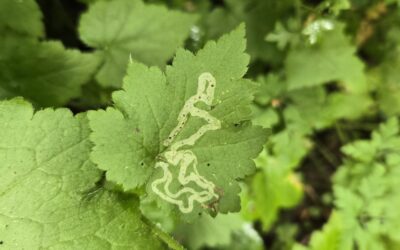
Under Cover — A Leaf Miner's Journey by Mary Johnson, Autumn 2025Leaf mine of Phytomyza tiarellae (a fly) on youth-on-age (Tolmiea menziesii). photo by Mary Johnsonby Mary Johnson Autumn 2025Within the confines of the darkened space, the organism tunnels its way...
Poetry 29 A
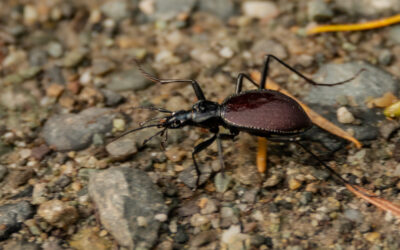
Poetry 29 A by multiple poets Autumn 2025Narrow-collared snail-eating beetle — it eats spiders too! photo by John F. Williamsby multiple poets Autumn 2025A Bug's Life by Diane Moser He scurries across the walltiny legs more nimblethan size seven Keds.Miniscule feelers...
COPYRIGHT
Copyright SEA-Media
All rights reserved. Reproduction or distribution, in whole or in part. without consent of copyright owner is strictly prohibited — except for brief quotations in critical reviews and other noncommercial uses permitted by copyright laws.
SEA-Media is a 501(c)(3) nonprofit corporation
PLEASE HELP SUPPORT
SALISH MAGAZINE
DONATE
Salish Magazine contains no advertising and is free. Your donation is one big way you can help us inspire people with stories about things that they can see outdoors in our Salish Sea region.
We also don't advertise Salish Magazine, so please spread the word of this online resource to your friends and colleagues.
Thanks so much for your interest and your support.