
WHAT THE TIDE LEAVES BEHIND
by Celeste Hankins
Winter 2025-26
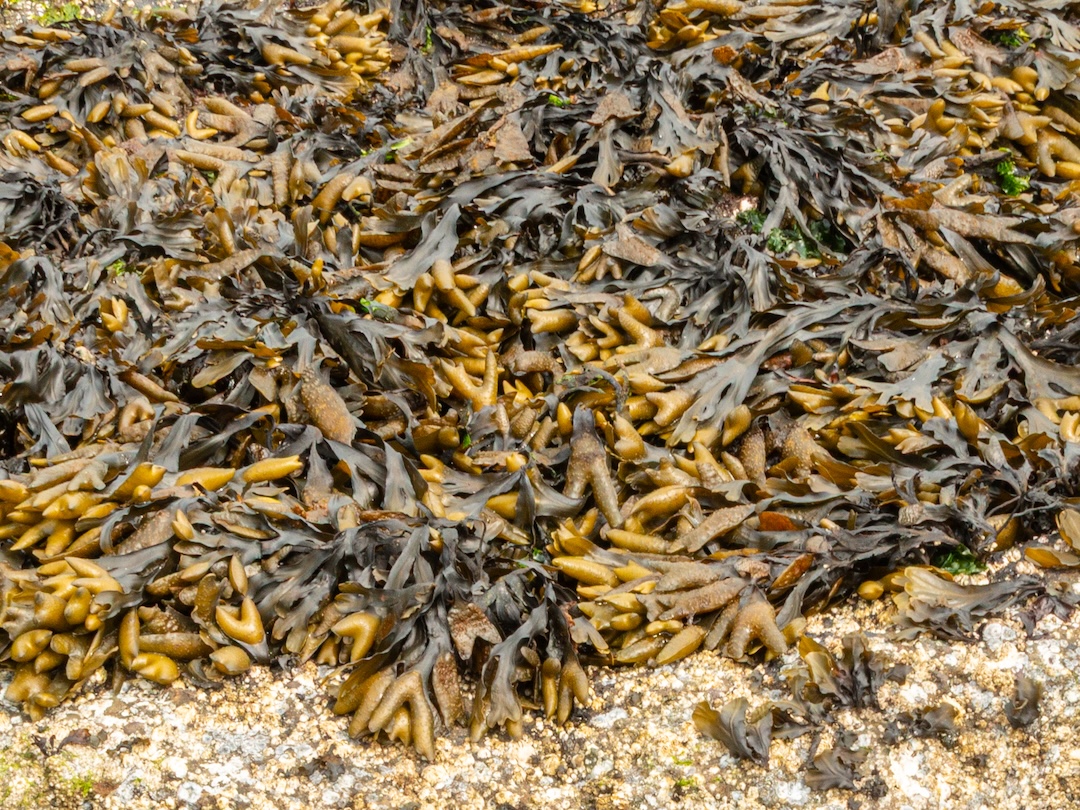
Rockweed at home on rocks on the beach. photo by John F. Williams
WHAT THE TIDE LEAVES BEHIND
by Celeste Hankins
Winter 2025-26
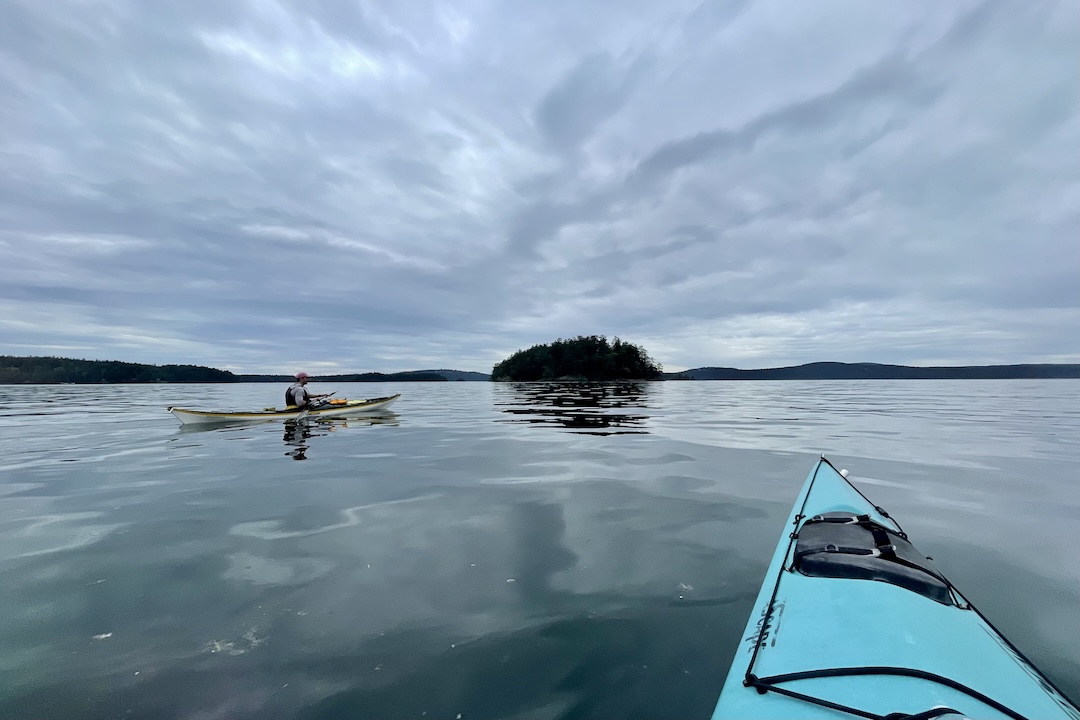
Kayaking through San Juan Islands. photo by Celeste Hankins
I first noticed Pacific Rockweed shortly after moving from Lake Chelan in north central Washington to the coastal forest of the Salish Sea. Thirty years of dust on my sandals and raising kids in a sunbaked, familiar landscape had come to an end, and my life felt tipped into a new tide. On a kayak trip from Deer Harbor on Orcas Island, I dipped my paddle into the sea. Below the surface, olive-green fronds of the common rockweed swayed, their swollen tips bobbing like tiny lanterns. I didn’t know it then, but Pacific Rockweed, or Fucus distichus, would become my quiet teacher of what it means to be remade.
Rockweed waving in the moving water. video by Nancy Sefton
Rockweed, also known as popweed, bladderwrack, or bubble kelp, is one of the coast’s tireless recyclers. It first survives by clinging. Its holdfast grips even the smallest roughness of stone. This seaweed, common in the Pacific Northwest, can endure tides, storms, and even grazing periwinkle snails. But when it finally tears free from its home, its purpose shifts. It drifts into the slick wrack line on shore. Among the buzzing flies, it begins to soften and unravel. Then microbes, crustaceans, and shore plants break the rockweed down and scatter its nutrients into new forms of life. What looks like slippery debris is a nutrient transfer that feeds the shoreline.
For decades, I had my own holdfast in Chelan: the elementary school gym bleachers, the dance studio, the bleached grass of soccer fields. I raised four children there. My roots were thread through the annual apple blossom festival, the summer swimming lessons, holiday concerts. It was a life made up of rhythms as predictable as the tides. For years, I couldn’t imagine being torn loose.
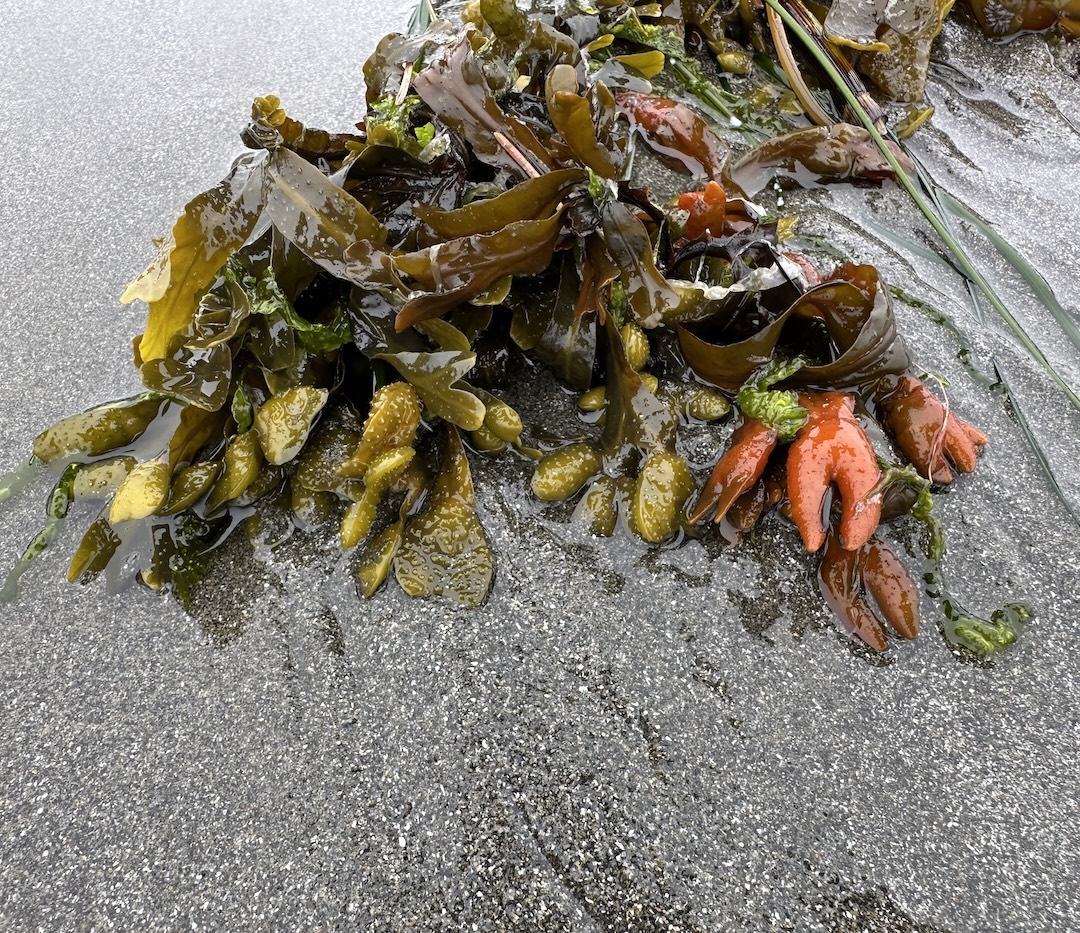
Rockweed in the wrack line. photo by Anna McClelland
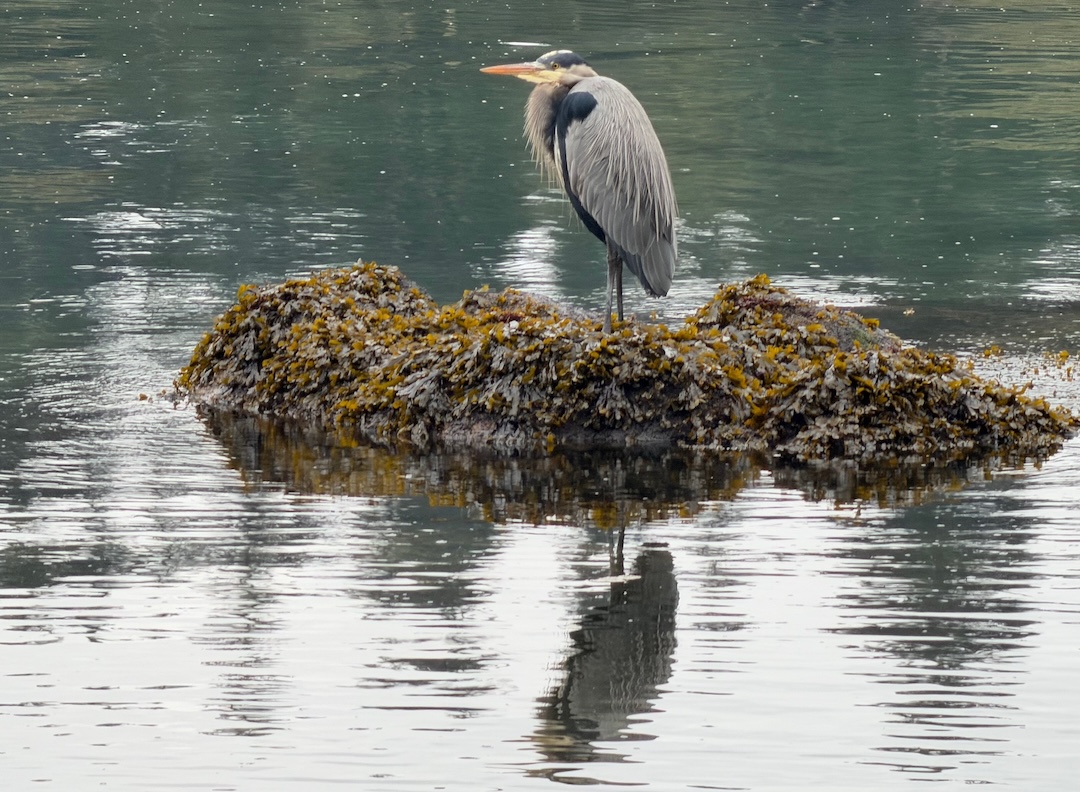
Great blue heron standing on rock covered with rockweed. photo by Karla Piecuch
But even the strongest holdfast eventually yields to force and change. For rockweed, it may be a winter storm that shears whole mats from the shoreline. For me, it was quieter. My kids grew up, my marriage ended. Then the pandemic arrived like an unexpected swell. I fell ill. Then began to drift.
When rockweed becomes unanchored, it begins its greatest work. Its buoyant bladders keep it afloat just long enough to transport nutrients from sea to land. Then, once it reaches the wrack line, its fronds collapse and release carbon and nitrogen back into the earth. Amphipods, isopods, and flies swarm in to feed. Birds follow. Beach plants take up what remains. It’s a messy handoff, but still purposeful. Rockweed’s work doesn’t end when it’s torn loose. It transforms.
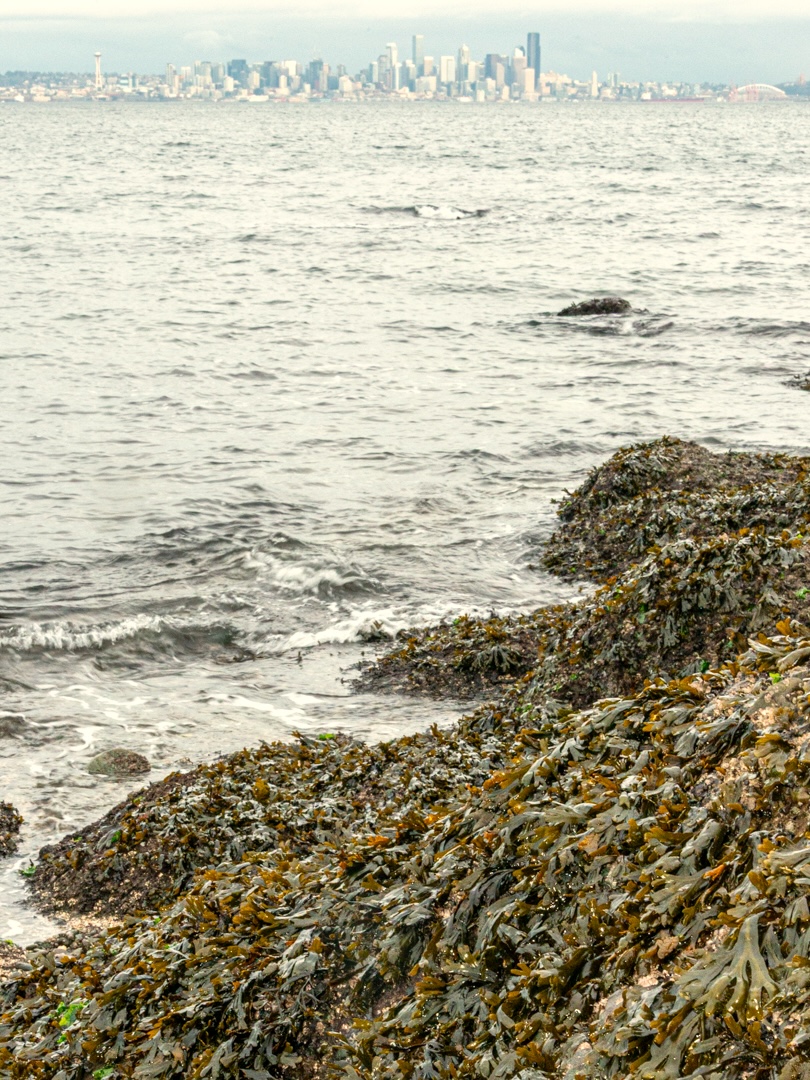
Rockweed covering rocks in the Salish Sea. photo by John F. Williams
I’m beginning to see that my own unraveling served a purpose as well. The years that felt like loss and disorientation opened space for something new. They fed skills, relationships and ways of being that couldn’t have grown in my old landscape. Some changes are dramatic, like the winter storm prying rockweed from stone. Others more gradual, hard to see until you look back and realize you’ve drifted into a new shoreline. Plans I once clung to simply dissolved in brine.
But there were nutrients in what fell apart. The skills I built raising kids, the attention to small things, the endurance. Those fragments didn’t disappear. They found new uses, just as rockweed nourishes long after it untethers.
I’m still in the process of settling, but moving to the Salish Sea was a kind of landfall. Everything here was unfamiliar, the forested coastline, the dampness, the fir needles that cling to my hiking boots. As I studied the natural world and became a nature guide, I felt far removed from the mom I’d been in Chelan. It took time to recognize how much of my old life has composted into this one. It wasn’t only loss. It was recalibration. The curiosity I once poured into mothering resurfaced as curiosity about tide pools and orcas and rockweed.
Here, tides remake the shoreline twice a day, loosening that rockweed and laying it down again. What collapses, however, doesn’t disappear. It feeds the living edge between land and sea.
At the tideline, rockweed taught me that we are recycled too. Nothing from our past is wasted. Not the years of mothering, not the illness, nor the drift. All of it becomes material for whatever season comes next.

Celeste Hankins is a freelance writer and nature guide living in the Pacific Northwest, just a short hike from the Salish Sea. She has an MA in Science Writing from Johns Hopkins University and is a certified marine naturalist from the San Juan Whale Museum. Celeste also volunteers as a habitat interpreter at the Seattle Aquarium and as a citizen scientist monitoring sea birds and harbor porpoises. Come rain or shine, you can find Celeste narrating scenic cruises on the fjord, swimming with seals, or leading family beach walks.
Issue Page
Table of Contents, Issue #30, Winter 2025-26
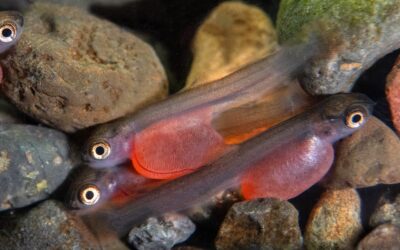
Salmon: Upstream Recyclers
SALMON: UPSTREAM RECYCLERS by Paul Dorn Winter 2025-26Salmon alevins. photo by John Gussman by Paul Dorn Winter 2025-26The salmon life cycle begins with a tiny fertilized egg buried in clean freshwater stream gravel. Years later that egg has grown into an adult who...
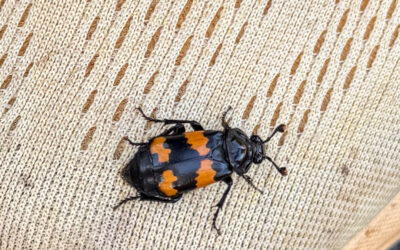
Undertakers of the Forest
UNDERTAKERS OF THE FOREST Boreal Burying Beetles by Thomas Noland Winter 2025-26Boreal burying beetle (Nicrophorus defodiens). photo by Thomas Noland by Thomas Noland Winter 2025-26something rotten, something good I crawled out of the leaf litter this morning, and my...
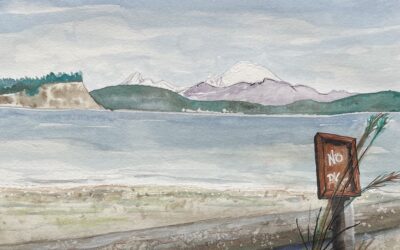
Nature’s Recyclers — Big picture
by Dr. Adelia Ritchie Winter 2025-26View of myriad habitats in which nature recycles, from Norwegian Point, Washington. watercolor by Adelia Ritchie by Dr. Adelia Ritchie Winter 2025-26The Salish Sea, that vast inland waterway stretching between Washington and British...
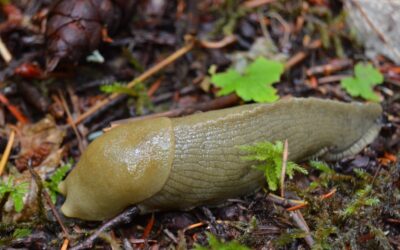
The Slowdown on Slugs
by Sarah Ottino Winter 2025-26A disrupted banana slug has retracted its tentacles. photo by Sarah Ottino by Sarah Ottino Winter 2025-26As the drizzle and mud return, slugs emerge into the open. Moist and damp for much of the year, the Pacific Northwest is a slug...
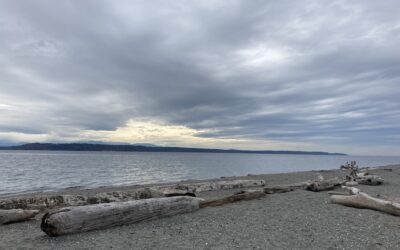
Driftwood and Sand
by Gunnison Langley Winter 2025-26Driftwood logs on a beach. photo by Gunnison Langley by Gunnison Langley Winter 2025-26A stroll on the beach offers plentiful examples of how nature recycles. A late fall morning outing last year on the beach at Seattle’s Carkeek Park...
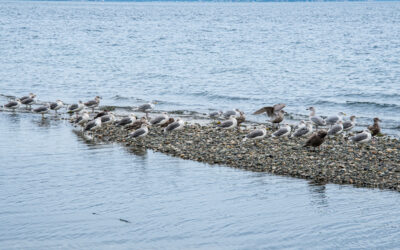
Poetry 30
by multiple poets Winter 2025-26Seagulls at the edge of the tide. photo by John F. Williams by multiple poets Winter 2025-26Recycle, a Watercolor by Carl Jensen A she gull lies flattenedthe gray of her barely distinct from sand or sky.Nearby the flock shifts with the...
COPYRIGHT
Copyright SEA-Media
All rights reserved. Reproduction or distribution, in whole or in part. without consent of copyright owner is strictly prohibited — except for brief quotations in critical reviews and other noncommercial uses permitted by copyright laws.
SEA-Media is a 501(c)(3) nonprofit corporation
PLEASE HELP SUPPORT
SALISH MAGAZINE
DONATE
Salish Magazine contains no advertising and is free. Your donation is one big way you can help us inspire people with stories about things that they can see outdoors in our Salish Sea region.
We also don't advertise Salish Magazine, so please spread the word of this online resource to your friends and colleagues.
Thanks so much for your interest and your support.