
Blackberries of
the Salish Sea
by Sarah Ottino, Summer 2025
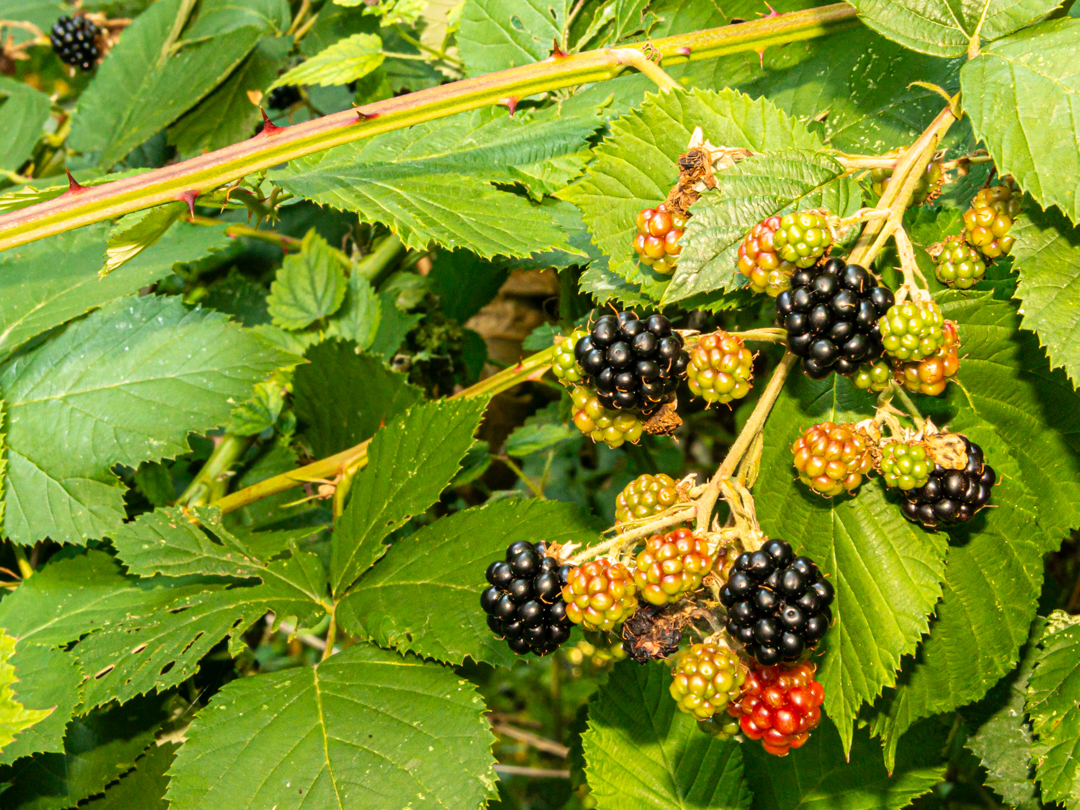
Himalayan blackberries at various stages of ripeness. photo by John F. Williams
Blackberries of the Salish Sea
by Sarah Ottino
Summer 2025
Editor’s note: Summer is time for blackberries ripening along trails, roadsides, and streams around the Salish Sea region. Whether you’re snacking on blackberries during a casual walk or out on a serious berry-picking expedition, knowing something about these plants’ ecology and history will enrich your experience. Read on for an introduction to our local blackberries and their cousins.
Blackberries are a culinary delight; however, they can also be an ecological fright. Three species of blackberry grow around the Salish Sea. Trailing blackberry (Rubus ursinus) is a native treat, but the other two, Himalayan blackberry (Rubus armeniacus) and evergreen blackberry (Rubus laciniatus), are non-native and invasive species with a tendency to take over.
Blackberries are in the rose family (Rosaceae) and the genus Rubus. Blackberries, along with their Rubus siblings, produce compound berries. A compound berry, also called an aggregate fruit, is made up of individual drupelets that are like mini berries. The flowers of Rubus species have multiple carpels, the female reproductive structure. When fertilized, each carpel produces a drupelet with a seed. Since all the carpels are part of the same flower, the drupelets are all connected into a single berry.
Blackberries and raspberries are both part of the Rubus genus and can be difficult to tell apart. A key difference is how the berries detach from the stem. When plucked, a raspberry pulls away from its receptacle (the part that connects the berry to the stem) leaving a hollow berry, which makes an excellent hat for little fingers. The receptacle of blackberries, however, comes off with the berry, and leaves it filled like a stuffed olive. All three blackberry species develop white to pink flowers from April to June. Their berries ripen in mid to late summer.
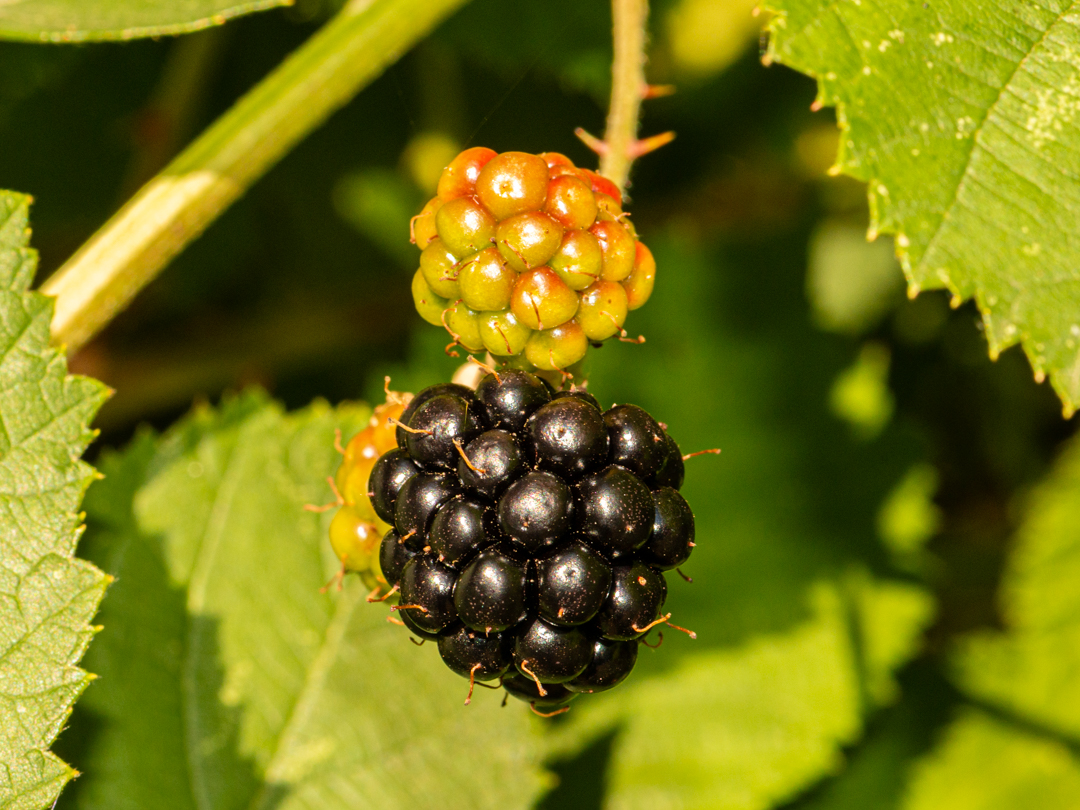
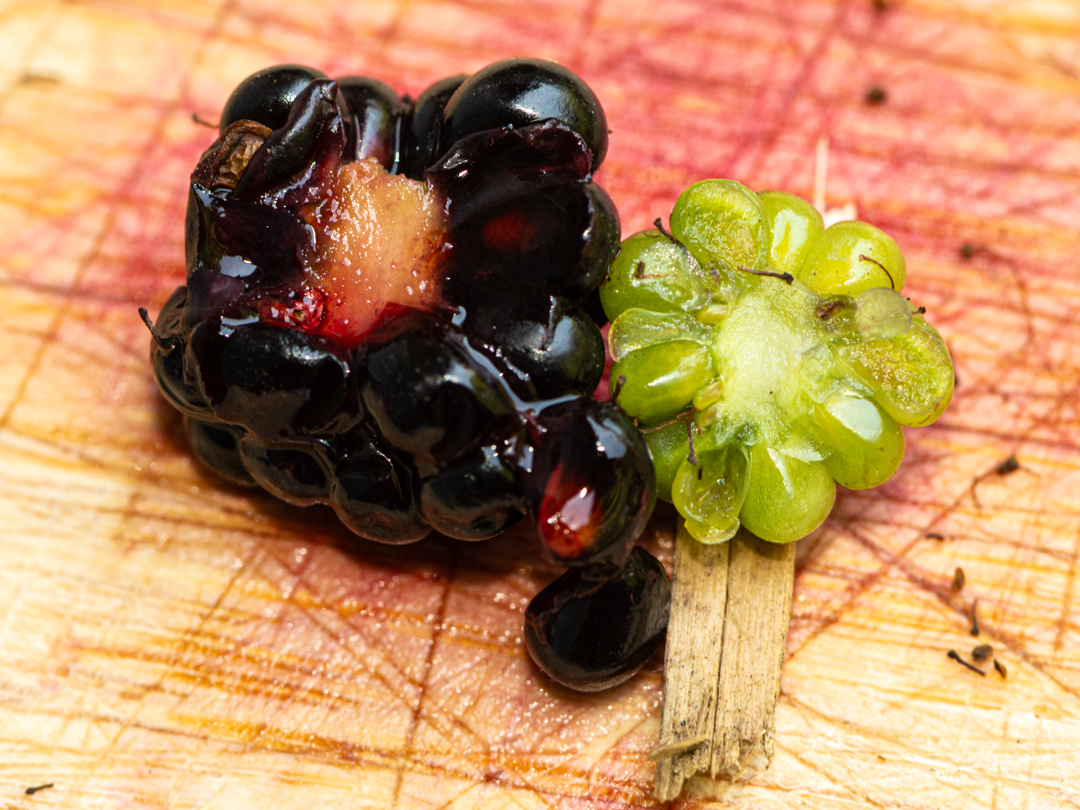
Young and mature blackberries sliced in half to show the receptacle surrounded by drupelets. photo by John F. Williams
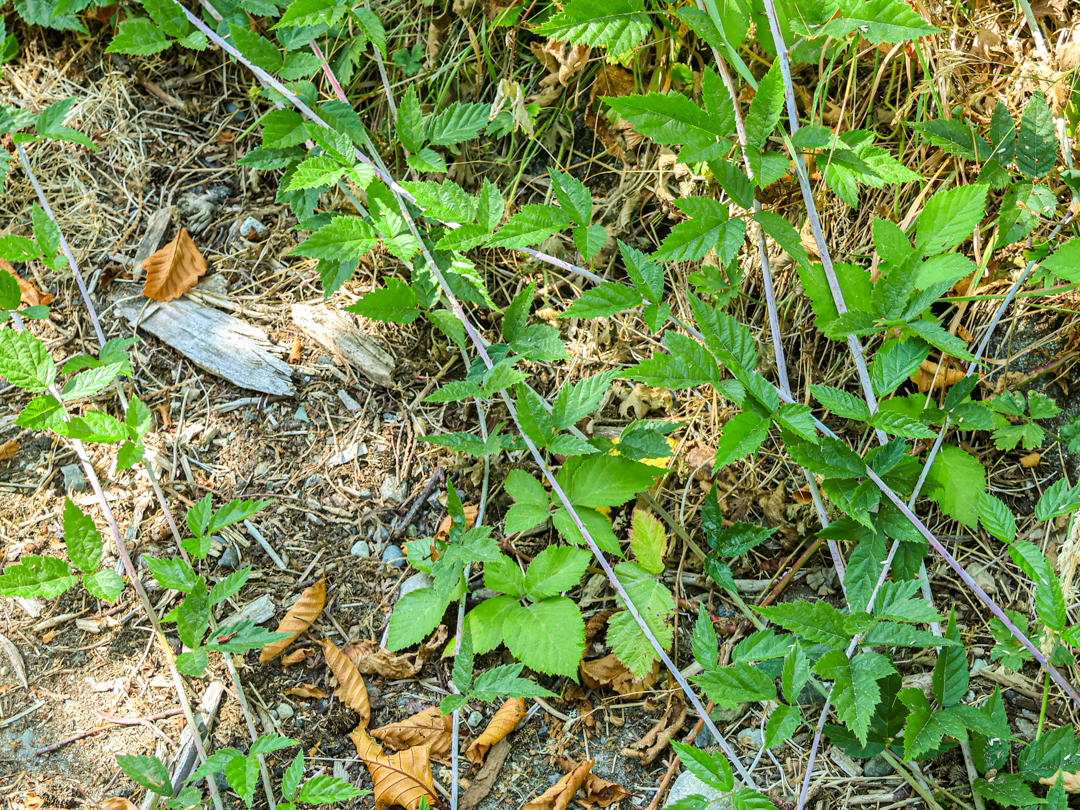
Trailing blackberry on pavement. photo by Thomas Noland
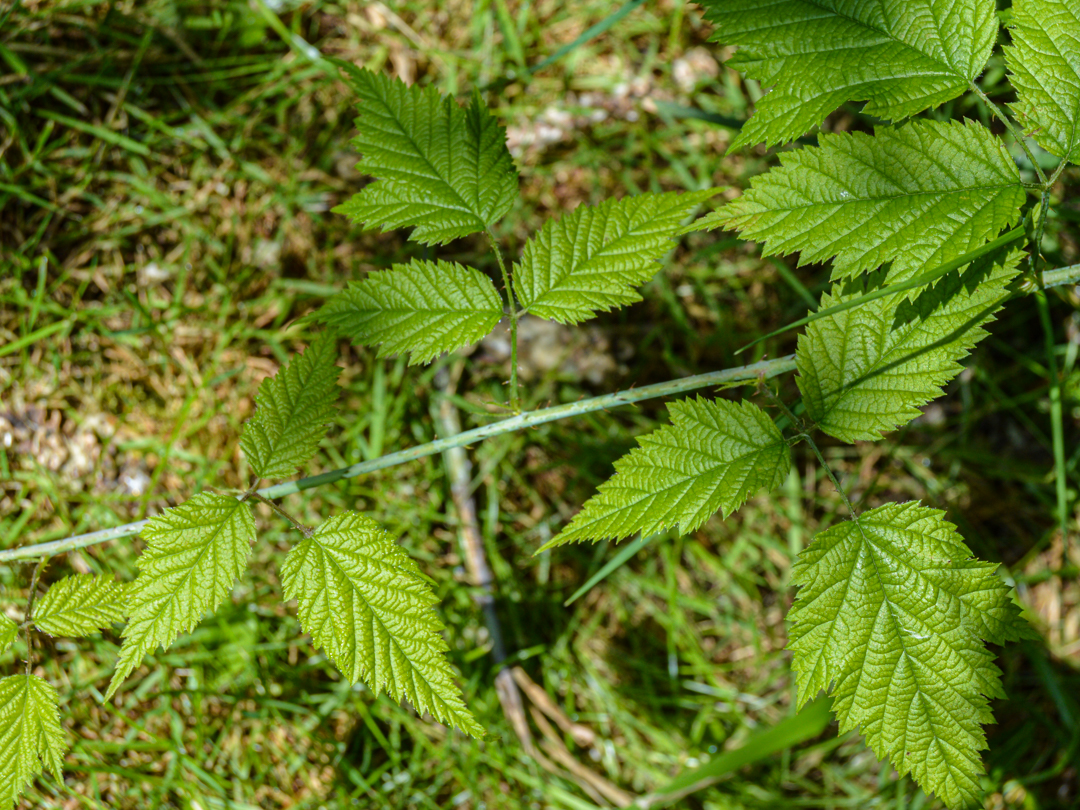
Closeup of trailing blackberry leaves. photo by Sarah Ottino
know your blackberries
Trailing blackberry is the only native blackberry in the Salish Sea region. Other common names include California blackberry, Pacific blackberry, California dewberry, and Douglas berry. True to its name, this species tends to grow low to the ground in a vine-like manner. It has delicate, curved prickles along the stem and underside of the leaves. The stems of some individual plants are glaucous, meaning they have a grey-blue color with a white powdery appearance. The leaves are deciduous and grow in clusters of three pointed and toothed leaflets. After pollination, the female flowers develop into small blackberries. While these berries may be small, they are bursting with flavor. Trailing blackberry is quite hardy and can be found growing in disturbed sites and low- to mid-elevation forests. The growth form, trio of leaflets, shape of the leaves, and coloring make it distinguishable from its non-native counterparts.
 prickles are not thorns
Prickles are sharp protrusions of a plant’s epidermis (skin), while a thorn is a modified stem. Learn more about prickles, thorns, and spines in Salish Magazine’s article The Plant Armory.
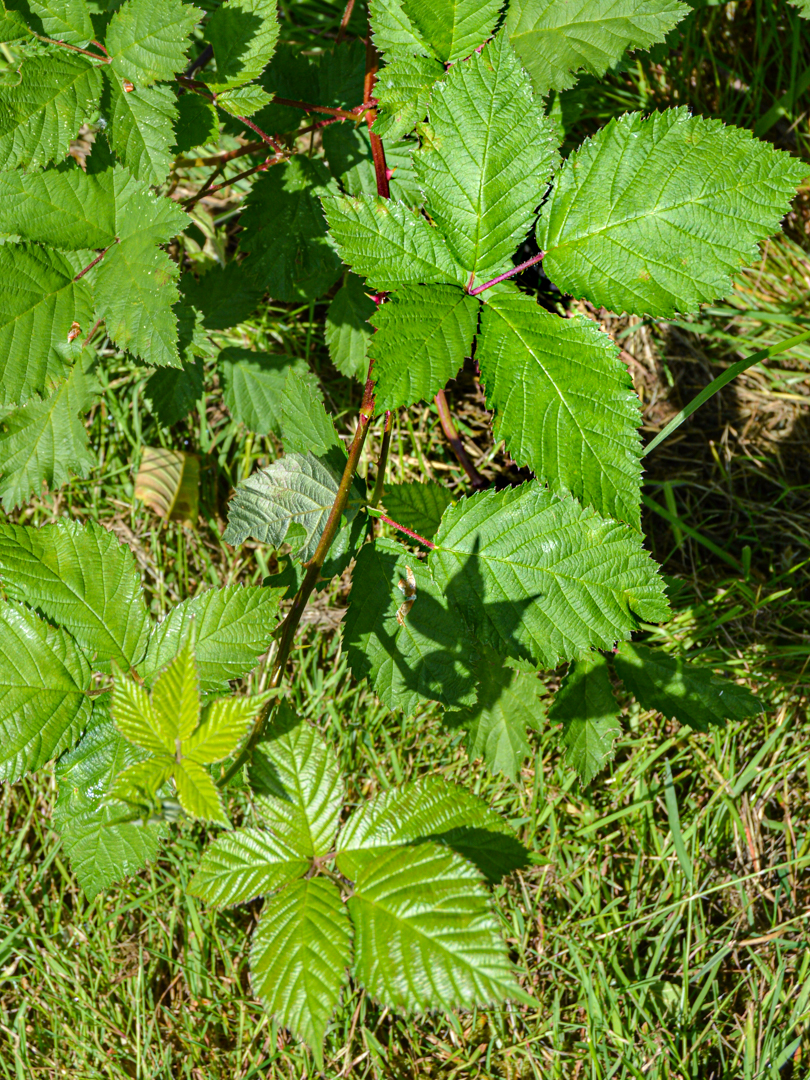
Five-leaflet cluster of Himalayan blackberry. photo by Sarah Ottino
Himalayan blackberry is native to the Caucasus region of Eurasia. It was intentionally introduced to the East Coast of the United States in 1885 by Luther Burbank and became established on the West Coast by 1945. Himalayan blackberry has erect canes that grow straight up then arc back toward the ground as they lengthen. The prickles of this species are stouter than those of the trailing blackberry. Its leaves are toothed and tend to be evergreen, though not always. They grow in clusters of three to five leaflets. Young leaflets tend to be more pointed, but mature leaflets are often oval.
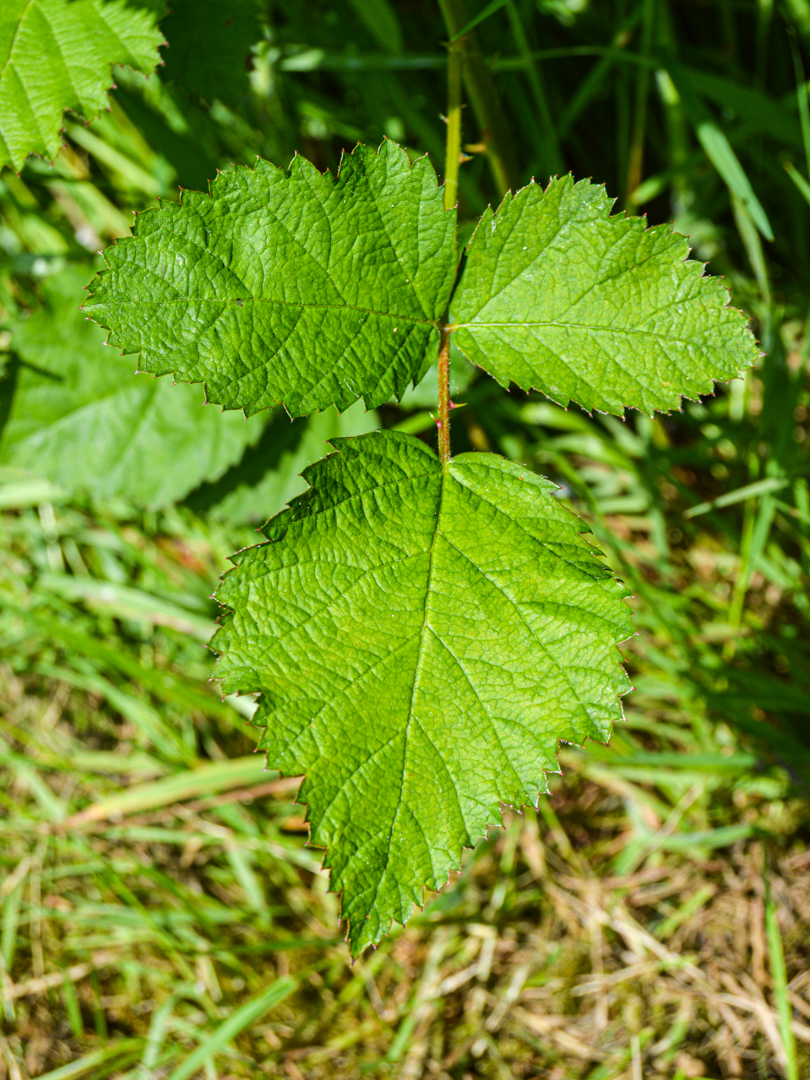
Three-leaflet cluster of Himalayan blackberry. photo by Sarah Ottino
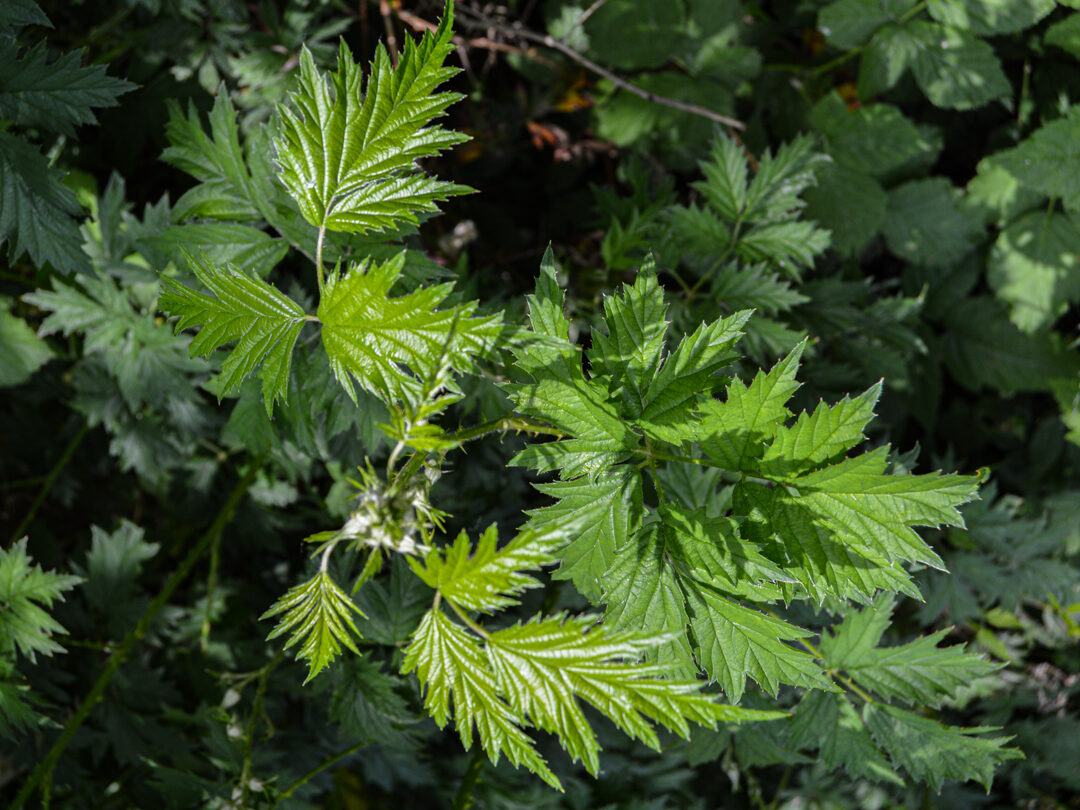
Deeply lobed leaves of evergreen blackberry. photo by Sarah Ottino
Evergreen or cutleaf blackberry is also native to Eurasia and was introduced for cultivation. Its growth form is similar to Himalayan blackberry with arching canes.
However, unlike Himalayan blackberry leaflets, which are oval with toothed margins, evergreen blackberry leaflets are pointed and deeply lobed. The canes have very sharp hooked prickles that can be red.
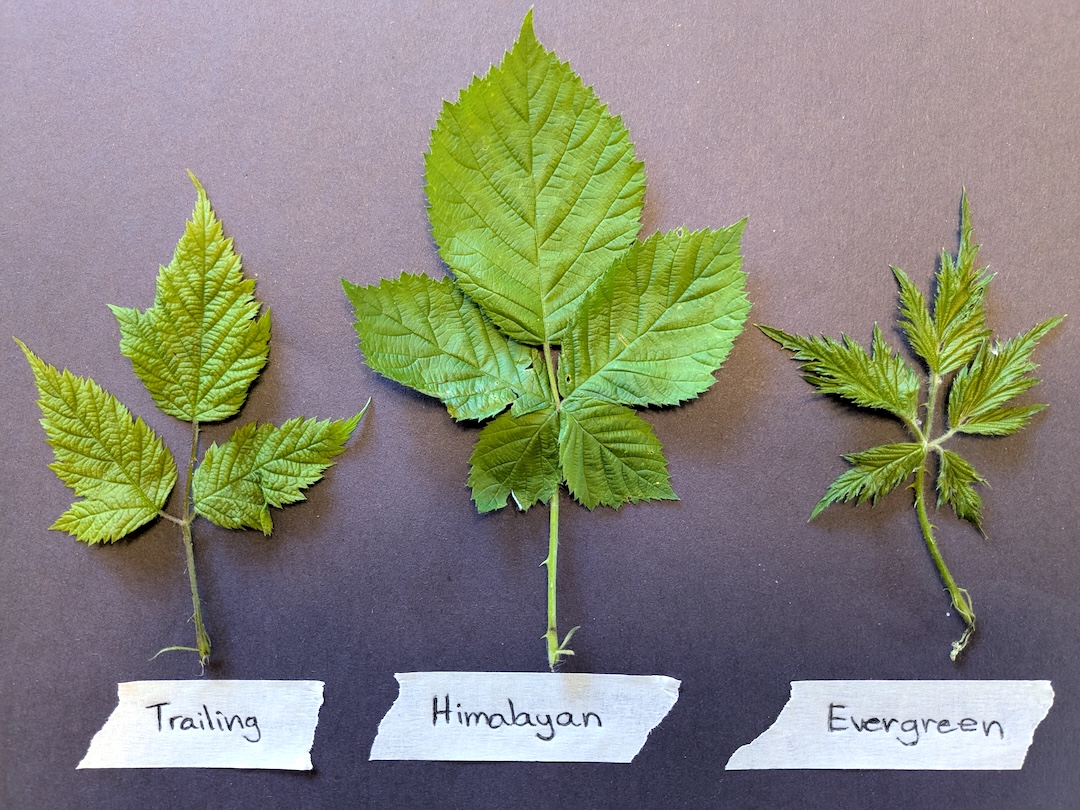
Examples of trailing, Himalayan, and evergreen blackberry leaves. photo by Sarah Ottino
similar species
The leaves of evergreen blackberry with their lace-like appearance are easily distinguishable. However, Himalayan blackberry and trailing blackberry can be confused with other Rubus species. When sporting only three leaflets, Himalayan blackberry can be confused with trailing blackberry as well as the native salmonberry (Rubus spectabilis). If the plant has upright growth, as opposed to vine-like growth, trailing blackberry can be ruled out.
To decide between Himalayan blackberry and salmonberry, flower and berry color can be good indicators. Blackberry flowers are white or light pink, while salmonberry flowers are vibrant pink. Ripe salmonberries are yellow-orange or red, while ripe blackberries are black. Finally, looking at the surrounding area for mature plants can also be helpful. If the area has a thicket of mature salmonberry nearby, there is a good chance that the young shoot is also a salmonberry.
Blackcap raspberry (Rubus leucodermis) is another blackberry lookalike that is native to the Salish Sea region. It has groups of three leaflets that are white on the underside. It has glaucous stems like trailing blackberry, but it has upright, arching canes like Himalayan blackberry.
Identification of Rubus species is not always easy. Cross-pollination between species is not uncommon, and the amount of sun an individual plant receives can impact its coloring and growth form. While each species has some distinguishable characteristics, not every plant displays them.
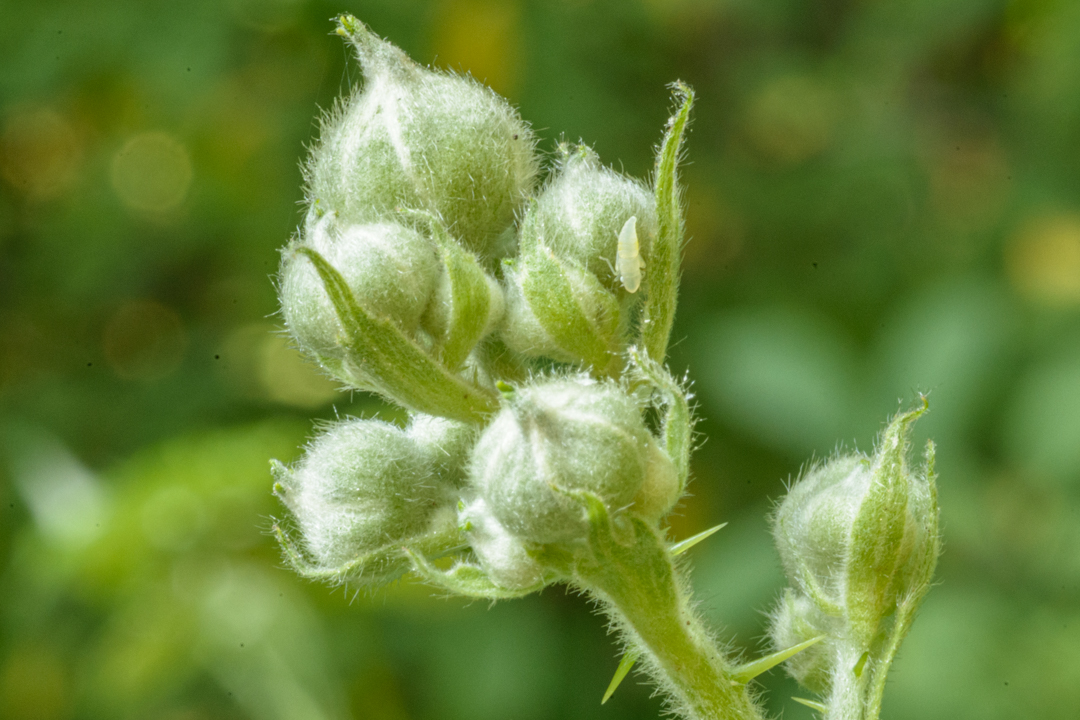
Young flower buds of Himalayan blackberry hosting a tiny, white visitor. photo by John F. Williams
blackberry ecology
All three species of blackberry in the Salish Sea region have ecological roles. They develop flowers that are appreciated by insect pollinators, produce berries that are devoured by both birds and mammals, provide cover for smaller animals, and reduce erosion on hillsides.
The three species all reproduce via seeds. The two non-native species can develop seeds with or without fertilization of the flowers (asexual seed production is called apomixis). They can also reproduce vegetatively, with stem tips and fragments developing roots and sprouting new canes. Their fast growth and success at reproducing allow these three blackberry species to quickly take over disturbed sites, forming a monoculture.
While trailing blackberry can consume an open area, its growth is less aggressive than its invasive relatives. Trailing blackberry’s vine-like growth stays lower to the ground, allowing taller species to survive around it. The non-native Himalayan blackberry and evergreen blackberry form dense thickets several feet high. Their arching canes engulf streams, creating barriers for wildlife, and overtake neighboring plants, including trees. While a monoculture of blackberry plants can benefit a few species, a landscape rich with species diversity is healthier. Biodiversity is vital for keeping water and air clean, as well as helping mitigate the effects of natural disasters and disease outbreaks.
The scientific term for asexual seed production is apomixis. In addition to this and the other reproductive strategies of invasive blackberry species, scientists have documented that these species can hybridize with native Rubus species. Click to see: Spontaneous hybrids between native and exotic Rubus in the Western United States produce offspring both by apomixis and by sexual recombination | Heredity
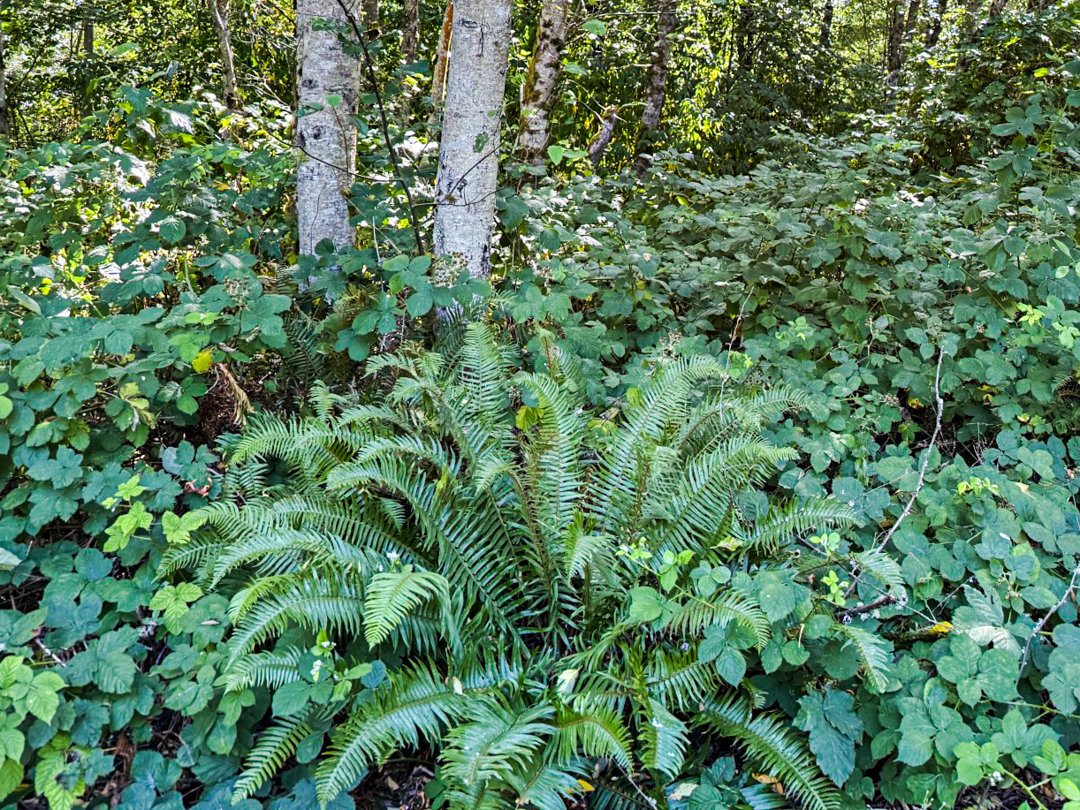
Large Himalayan thicket on the edge of a forest. photo by Thomas Noland.
battling the invaders
Due to their aggressive growth, both Himalayan and evergreen blackberries are listed as Class C noxious weeds in Washington State. Since both species are widespread, control and removal is encouraged but not required by law.
Himalayan and evergreen blackberry are hardy and take time to eliminate. Gardeners with a blackberry infestation have a battle ahead of them, but all is not lost. Repeated mowing, cutting, or goat grazing of fresh shoots, combined with the removal of root balls, will eventually lead to success, though the process may take several years. As land is reclaimed, adding mulch and planting new species will help prevent blackberries from once again dominating.
As the climate changes, aggressive plants such as invasive blackberries are more likely to outcompete other plants. Himalayan blackberry has a high tolerance for different water, light, and soil conditions, which allows it to grow in areas where more sensitive native plants cannot. As the climate changes, increases in wildfires will create disturbed areas for Himalayan blackberry to grow, and changes in rain patterns may be less impactful for this species.
As humans, we can opt to remove invasive plants from private property and replace them with natives. We can also join work parties to help public lands recover. Finally, going out blackberry picking can be a fun and delicious activity that keeps a few seeds from getting the chance to sprout.
what’s in a name?
Scientific names are not static. As botanists learn more about plants, scientific names get changed. Himalayan blackberry is an example of a species that has had many name changes. Currently Rubus armeniacus is the accepted scientific name, but it has historically been called Rubus discolor and Rubus procerus. Rubus bifrons is another scientific name for Himalayan blackberry, and there is a debate over whether Rubus armeniacus and Rubus bifrons are the same species.
FIND OUT MORE
Evergreen Blackberry | Burke Herbarium
Evergreen Blackberry | WA Noxious Weed Control Board
Himalayan Blackberry | Burke Herbarium
Himalayan Blackberry | WA Noxious Weed Control Board
Trailing Blackberry | Burke Herbarium
Salmonberry | Burke Herbarium
Blackcap Raspberry | Burke Herbarium
Fire Effects on Rubus Armeniacus | US Forest Service

Sarah Ottino — Freelance Writer & Photographer
Sarah loves to write, create, and explore nature. She travels full-time in a 20 ft. Airstream with her husband and her border collie, Nimbus. She uses life’s adventures as inspiration for healthy living, outdoor recreation, and environmental content. She often uses her photography or design graphics to complement her writing. Her website is: www.naturewritten.com
Issue Page
Table of Contents, Issue #28, Summer 2025
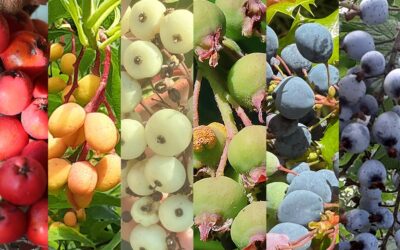
A Rainbow of Berries
A Rainbow of Berries by Gunnison Langley, Summer 2025An artistic rainbow of berries. photos by Thomas Noland, composition by Susan Merrillby Gunnison Langley Summer 2025Often in the pursuit of filling our bellies with delectable berries, we overlook that berry plants...
Nature Walk in Berry-land
Nature walk in berry-land by Lindsey Davidge and Meilani Lanier-Kamaha’o, Summer 2025Child (age 6): Did you hear the FROG?by Lindsey Davidge and Meilani Lanier-Kamaha’o Summer 2025We document three families plus some classmates at play, focusing on children's...
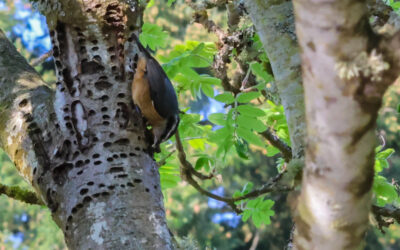
Our Rowan Tree
Our Rowan Tree by Thomas & Sara Noland, Summer 2025Red-breasted nuthatch caching a berry in mountain ash tree. photo by Thomas Nolandby Thomas & Sara Noland Summer 2025In our front yard is a year-round grocery store and rest stop for wild travelers. It started...
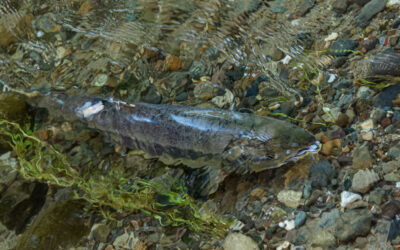
Blush Before the Salmon
Blush before the salmon by Celeste Hankins, Summer 2025Adult female chum salmon in Chico Creek, Kitsap. photo by John F. Williamsby Celeste Hankins Summer 2025Along the edges of the Salish Sea, where cedar shadows stretch long over moss and fern, the salmonberries...
Poetry 28 A
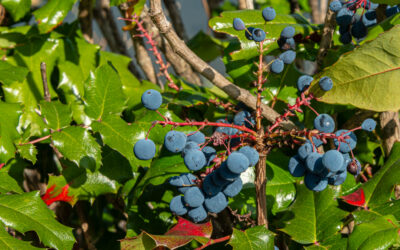
Poetry 28 A by multiple poets Summer 2025Berries of oregon grape (mahonia). photo by John F. Williamsby multiple poets Summer 2025Blueberry by Nancy Taylor bigger than a pea had been a flower suckled by a bee color of a new bruise but doesn’t hold the pain...
Poetry 28 B
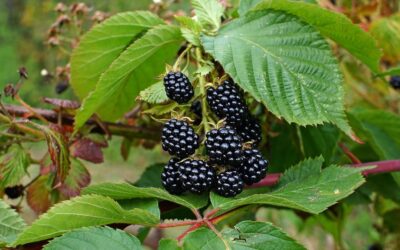
Poetry 28 B by multiple poets Summer 2025Blackberries on the bush. Image by Marevo via Pixabayby multiple poets Summer 2025sun pierced by Carl Jensen The element of fear picking blackberries (you really do get snagged by vines) is balanced against an everyday...
COPYRIGHT
Copyright SEA-Media
All rights reserved. Reproduction or distribution, in whole or in part. without consent of copyright owner is strictly prohibited — except for brief quotations in critical reviews and other noncommercial uses permitted by copyright laws.
SEA-Media is a 501(c)(3) nonprofit corporation
PLEASE HELP SUPPORT
SALISH MAGAZINE
DONATE
Salish Magazine contains no advertising and is free. Your donation is one big way you can help us inspire people with stories about things that they can see outdoors in our Salish Sea region.
We also don't advertise Salish Magazine, so please spread the word of this online resource to your friends and colleagues.
Thanks so much for your interest and your support.