
Under Cover — A Leaf Miner’s Journey
by Mary Johnson, Autumn 2025
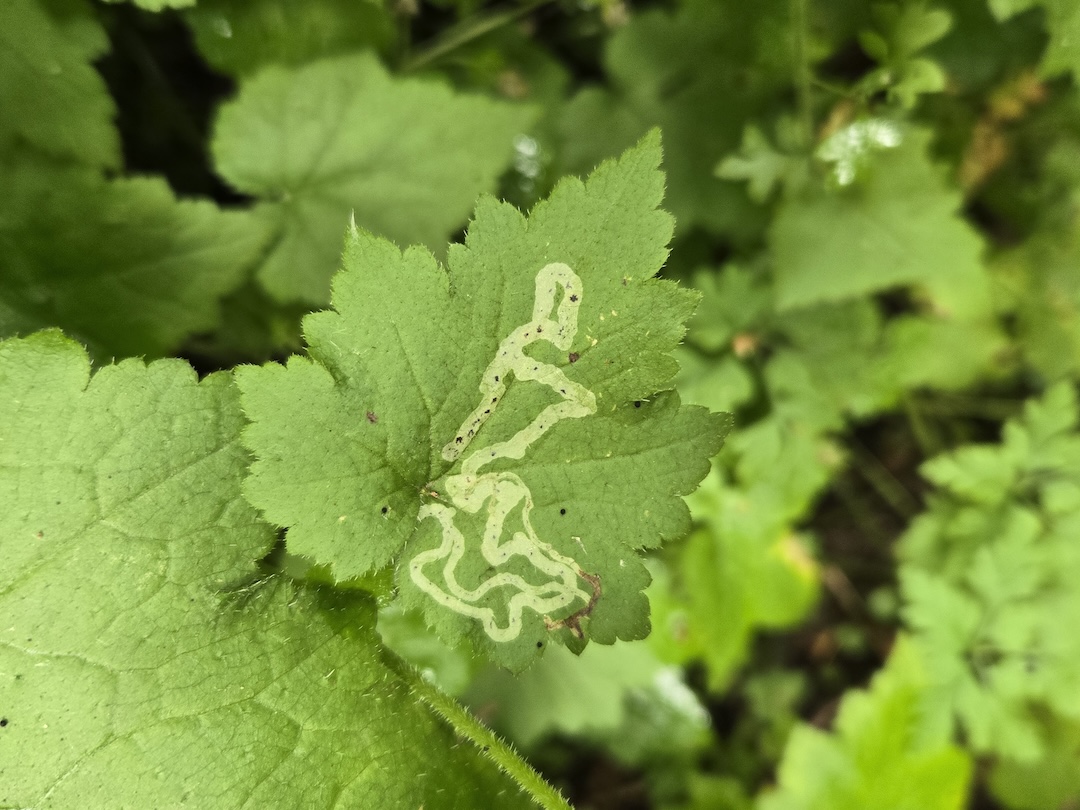
Leaf mine of Phytomyza tiarellae (a fly) on youth-on-age (Tolmiea menziesii). photo by Mary Johnson
Under Cover — A Leaf Miner's Journey
by Mary Johnson
Autumn 2025
Within the confines of the darkened space, the organism tunnels its way forward, like a miner working deep in the earth. It excavates at a pace imperceptible to the human eye, though its journey may last just a few weeks. With a flattened body and stumps that suffice for legs, the organism advances by moving its ill-defined head back and forth, from side to side, ingesting what is in front of it as it goes. It has what it needs to exist within this temporary home: an abundance of nutrients, shelter from the alien outside world, and relative safety from predation.
Most likely you’ll never see this tiny organism, the larval form of a leaf miner — the name used to describe certain species of flies, moths, beetles, or sawflies. That’s because at this stage of its lifecycle its entire world exists between the ultra-thin epidermal layers of a leaf, in the mesophyll, within which it is perfectly suited to grow and thrive.
The leaf miner comes to this larval existence from an egg that its adult mother deposited on or within the leaf. Once hatched, the insect larva embarks on its journey with a singular purpose: to eat its way through the leaf’s soft tissue until the timing is right to pupate, the next stage of its complete metamorphosis. Depending on the species, pupation may occur within the leaf itself. Then, once adulthood is reached, the insect emerges and flies away. Some larvae may emerge from the leaf, drop down, and pupate in the soil. Until either time, the larva remains hidden and unseen from our human eyes, snug within the structural framework of the leaf’s cell walls, the sturdy roof and floor of its temporary home.
But nature betrays its presence, as I discovered.
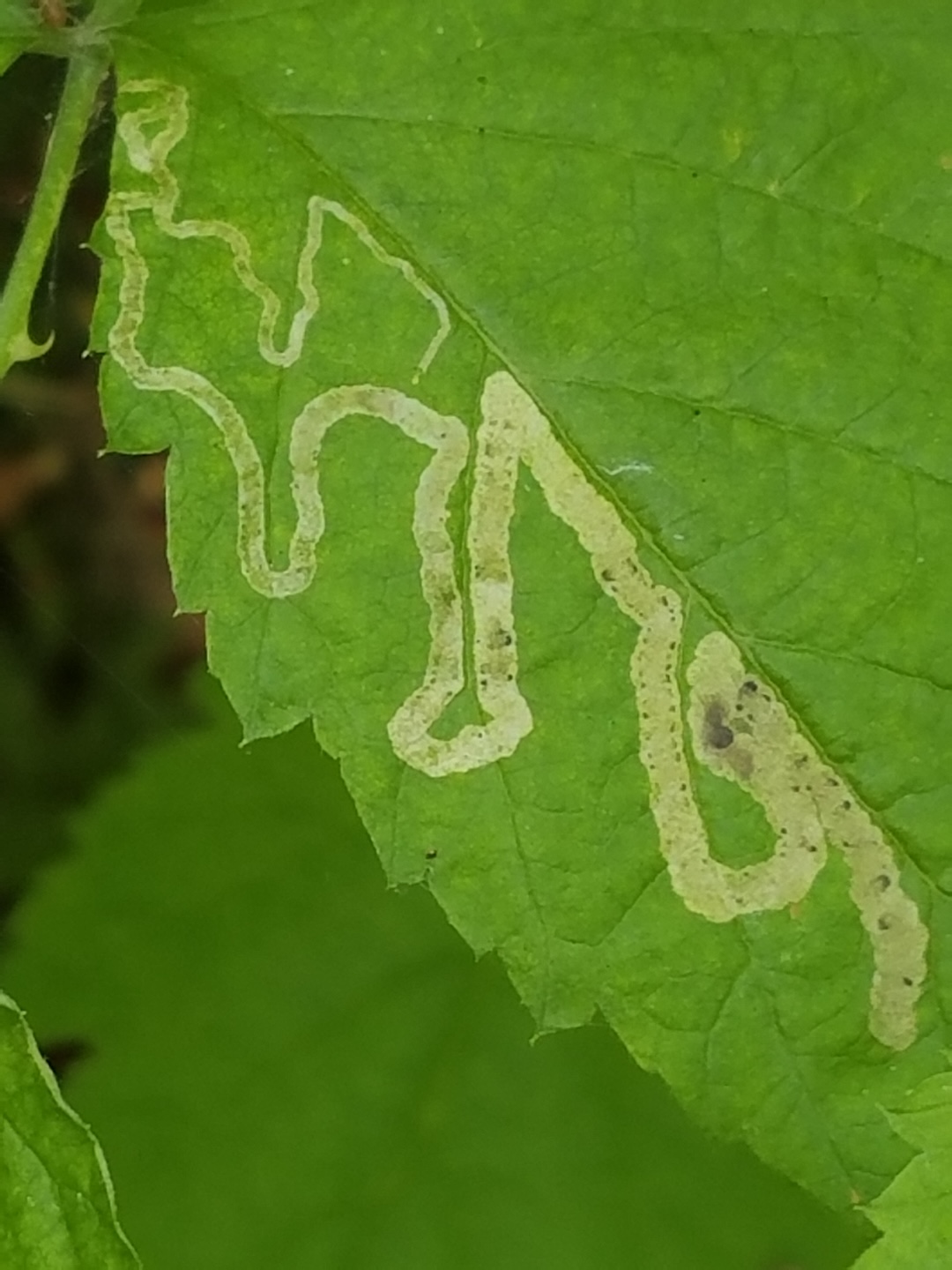
Leaf mine of Agromyza vockerothi, a fly, on a native blackcap raspberry (Rubus leucodermis) leaf. photo by Mary Johnson
While in my yard checking the ripening fruit on the native blackcap raspberry (Rubus leucodermis) plants, my eye was drawn to some strange marks on one of the leaves, which looked to me like botanical scribbling on its surface: a pale but discernible trail meandering this way and that across one half of the leaf.
While the larva had been ingesting leaf tissue and excavating tunnels, nature was imprinting its movements on the leaf’s surface. Before me lay a visual recording — a roadmap of sorts — of the larva’s life journey within, the trail widening as its body grew.
With the help of iNaturalist.org, I identified the linear mine as belonging to Agromyza vockerothi, a fly.
I thought my encounter that day with the leaf mine was a unique, one-off discovery. Surely I would never find anything quite like it again. But soon I began finding mines — with little effort — throughout the yard. Scientists call this phenomenon the Baader-Meinhof effect or frequency illusion: noticing something for the first time and then soon afterward encountering it again, often in multiple places. The leaf mines had been there all along, of course. But finding that first one was enough to deepen my intrigue and awareness; my brain was now primed for finding more of them.
Soon, I had assembled a photo gallery of leaf miner “art.” On a fallen Pacific madrone (Arbutus menziesii) leaf, I discovered the larva of a different species, the Madrona skin miner (Marmara arbutiella, a moth), which had journeyed far within the glossy leaf, excavating in ways that produced an extensive trail of fanciful, squiggly lines and dizzying loops.
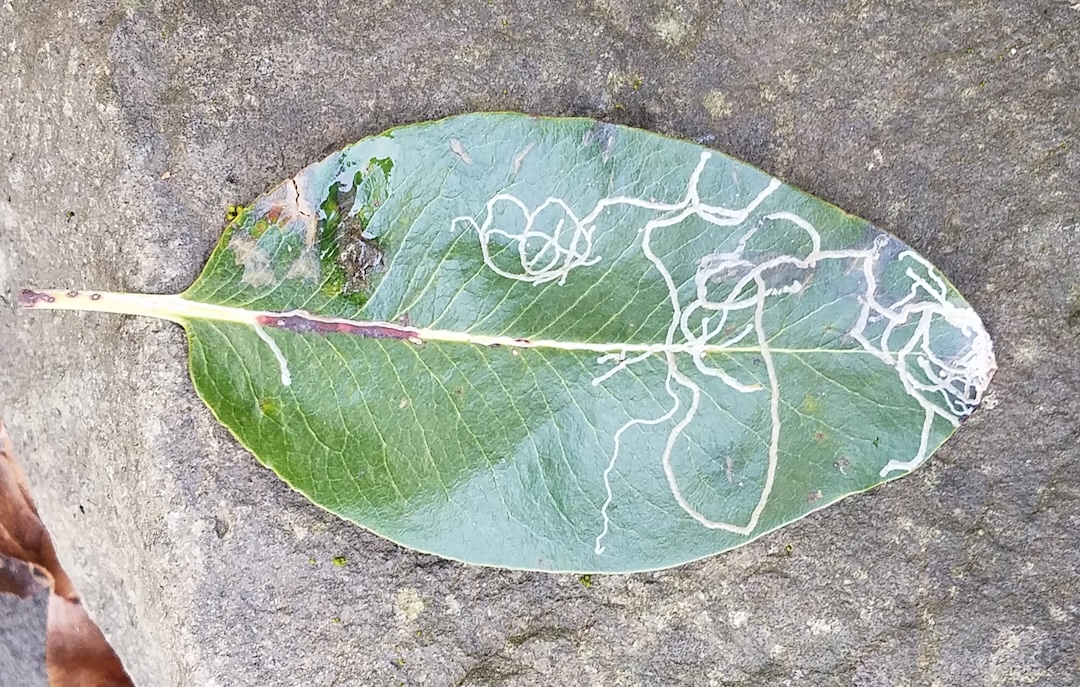
Leaf mine of the Madrona skin miner (Marmara arbutiella, a moth) on a native Pacific madrone (Arbutus menziesii) leaf. photo by Mary Johnson
On a shiny non-native English holly (Ilex aquifolium) leaf, instead of a linear trail I found a rosy blotch, like a botanical tattoo. This larva (Phytomyza ilicis, a fly) didn’t travel far from where it started, instead excavating a specific patch of the leaf.
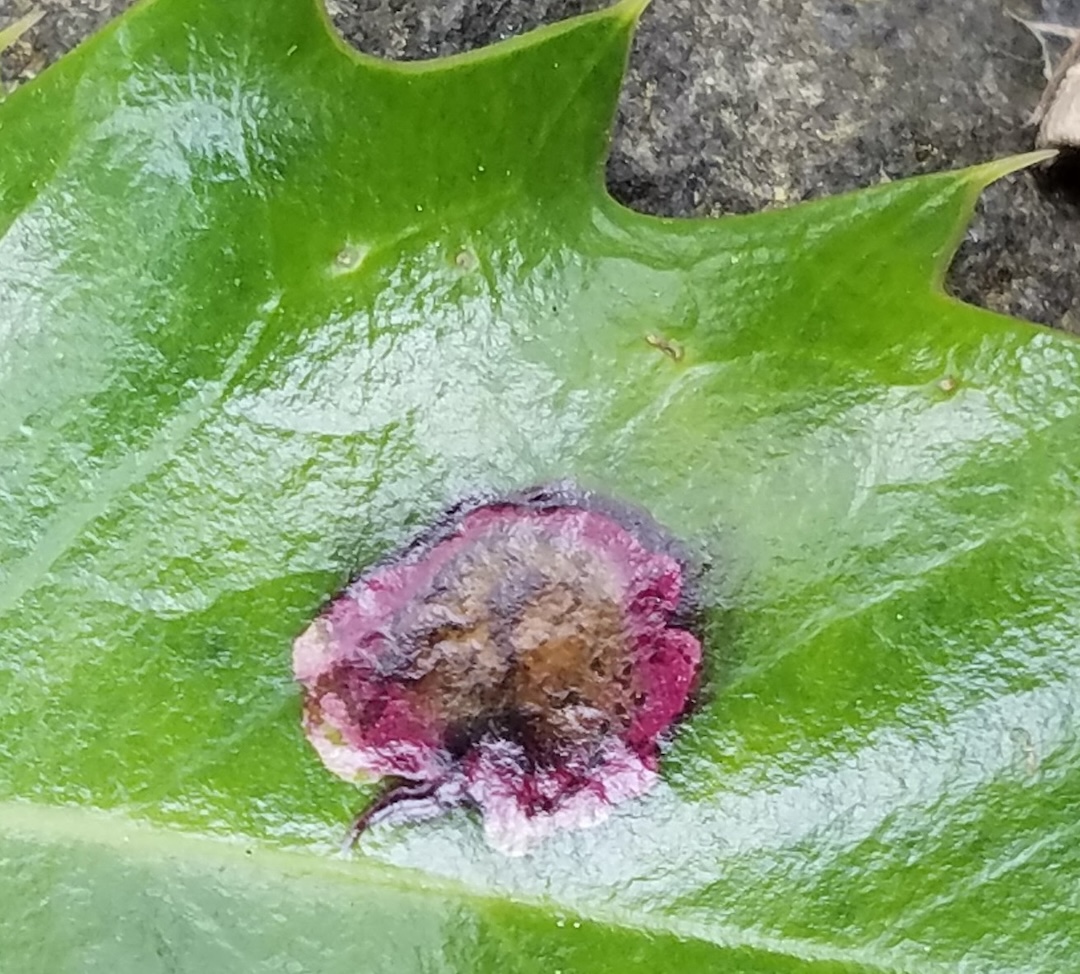
Leaf mine of Phytomyza ilicis, a fly, on a non-native English holly (Ilex aquifolium) leaf. photo by Mary Johnson
Another species of the fly Agromyza, this one Agromyza idaeiana, created the broad mines I found on a native large-leaved avens (Geum macrophyllum) leaf.
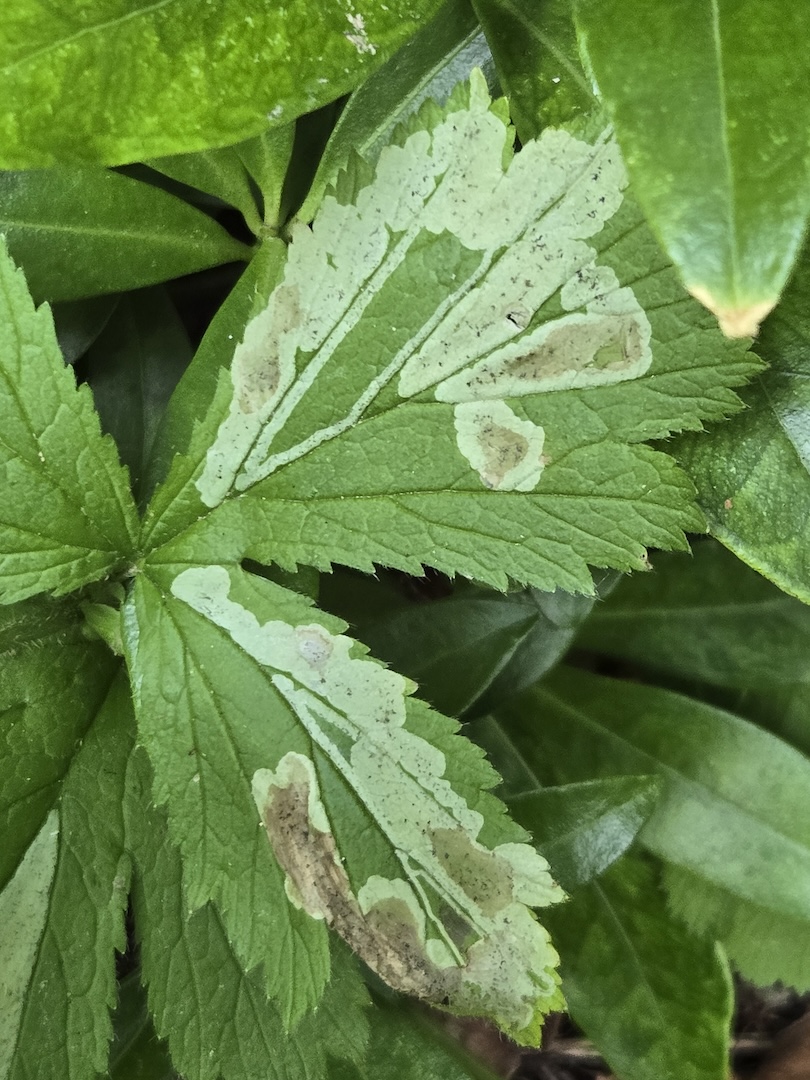
Leaf mine of Agromyza idaeiana (a fly) on a native geum (Geum macrophyllum) leaf. photo by Mary Johnson
On the leaf of a native beaked hazelnut (Corylus cornuta), I discovered the mine of the hazel leaf miner moth (Stigmella microtheriella). Notable within this mine is the dark central line of frass, a term used to refer to the larva’s excrement.
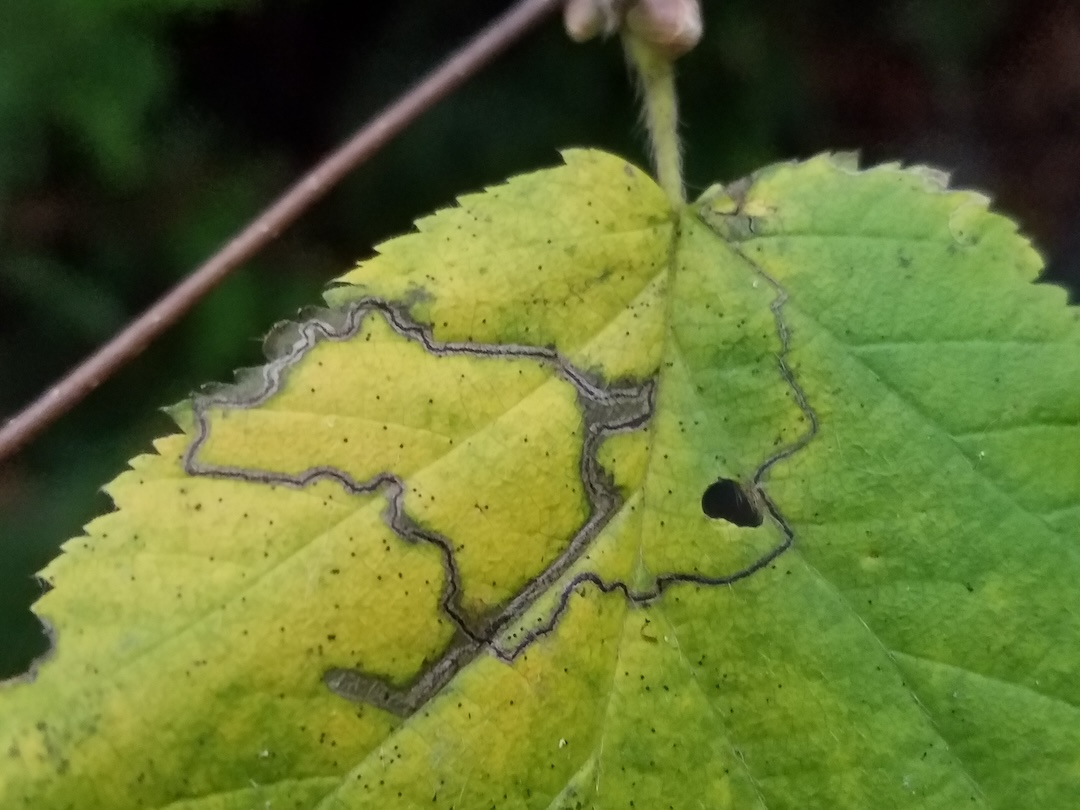
Leaf mine of the hazel leaf miner (Stigmella microtheriella, a moth) on a native beaked hazelnut (Corylus cornuta) leaf. photo by Mary Johnson
The iNaturalist project site for leaf miners states that, in North America alone, there are at least 40 families of moths, 10 families of flies, 6 families of beetles, and 2 families of sawflies whose larvae are leaf miners.
These insects are typically host-specific, and the form of the mine — linear, blotch, or variations thereof — will differ depending on the larva producing it. Thus knowing the name of the host plant and the pattern of the mine can often help identify the species of leaf miner, as I was able to do by uploading photos of the mines to iNaturalist. If a species cannot be identified by its mine pattern or other characteristics, the larvae can be reared to adulthood, a method commonly used by leafminer researchers. The study of leaf miners is ongoing. While new species are still being discovered, the identity of some species remains a mystery.
Do leaf miners serve any higher purpose other than offering up their larvae’s botanical sketchings for us to discover and enjoy?
Fossilized leaf mines dating back as far as the Late Triassic period have been discovered. These mines appeared millions of years before our own species appeared in geological time. Scientists who study these trace fossils can gain important insights into the evolution of plant–insect herbivore interactions.
From an ecological perspective, leaf miners are an important part of nature’s complex food web. Adults may become nourishment for birds and other insects, and the larvae themselves may become prey to the parasitoid larvae of parasitic wasps, which lay their eggs in or adjacent to the mine. Though leaf miners can be a significant pest in the agricultural sector, in our own gardens and in surrounding wildlands, the damage they do to a leaf is mostly cosmetic. I welcome their presence and consider them evidence of a healthier, more biodiverse ecosystem.
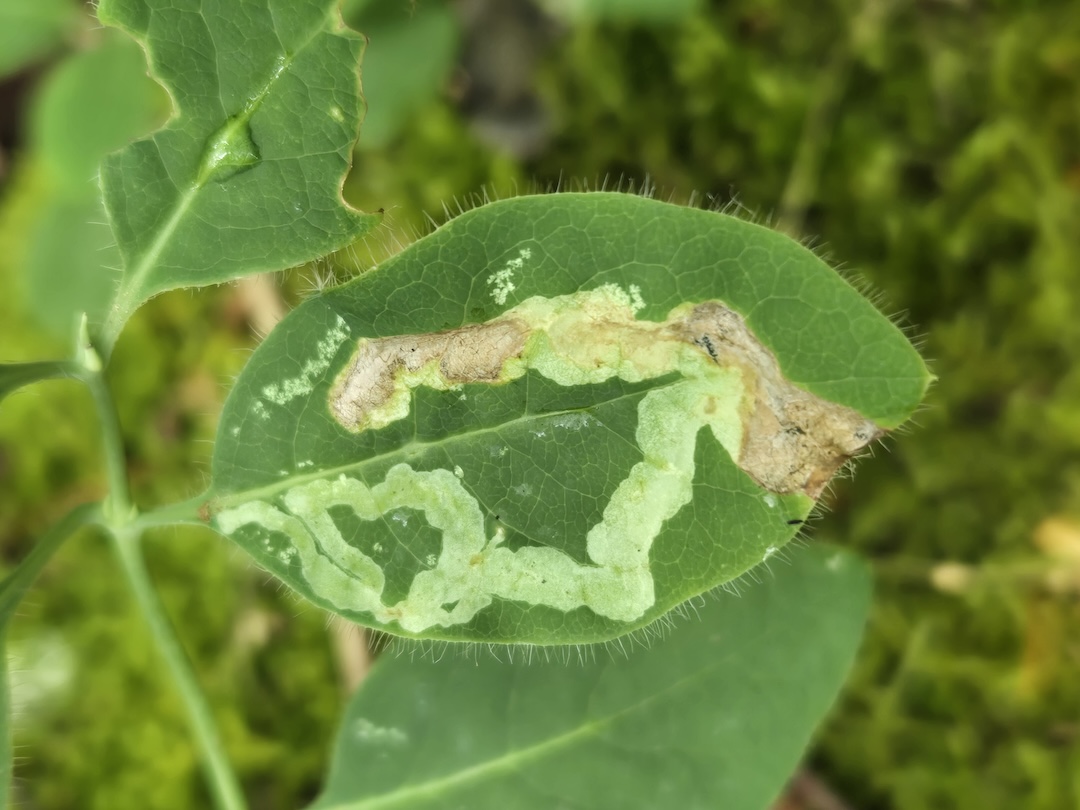
Leaf mine of Aulagromyza cornigera (a fly) on a native orange honeysuckle (Lonicera cilosa) leaf. photo by Mary Johnson
Leaf miners continue to persist on Earth, mostly going unnoticed. If they do capture our attention, perhaps along the trail or in our yards, we might stop to admire the intriguing patterns their larvae leave. We might take a photograph. Curiosity may lead us further to learn the name of the species that made the mine. We then have a label for our find, and we can be content to leave it at that.
But as with so many other discoveries in nature, that first encounter with a leaf mine may raise questions in our minds, leaving us wanting more: What other insect species make marks, such as holes instead of mines, on leaves? What will happen to a species if the plant its larvae mines goes extinct? How can I take better photographs of things like this I find along the trail? We find our world suddenly expanding and forming new connections, taking us far beyond just knowing the name of something we discovered on a leaf. This is how building a relationship — creating our own journey — with nature can begin.
FIND OUT MORE
Charley Eisenman has written extensively about leaf miners and has coauthored many peer-reviewed publications.
- Book: Leafminers of North America, Charley Eisenman. Everything to do with the natural history of leaf mines and how to identify their mines.
- Book: Tracks & Sign of Insects and other Invertebrates – A Guide to North American Species, Charley Eisenman and Noah Charney, Stackpole Books. 2010. Chapter 10 is devoted to leaf mines.
- Website: https://charleyeiseman.com
Read about the oldest leaf mine trace fossil.
- Imada, Y., Oyama, N., Shinoda, K. et al. Oldest leaf mine trace fossil from East Asia provides insight into ancient nutritional flow in a plant–herbivore interaction. Sci Rep 12, 5254 (2022). https://doi.org/10.1038/s41598-022-09262-1

Mary Johnson is a former freelance technical writer and editor, who now writes stories about paying attention to the natural world and its inhabitants. A Washington Native Plant Society steward, she is particularly interested in the interrelationships between native plant species and insects.
Issue Page
Table of Contents, Issue #29, Autumn 2025
Stream Bugs
by Mercedes Garcia Autumn 2025Dogfish Creek in Fish Park in Poulsbo, WA. photo by John F. Williams by Mercedes Garcia Autumn 2025Streams are teaming with life of all shapes and sizes. Salmon and sculpin swim along the rocks, dodging the branches and leaves. Within the...
Tiny Hunger
by Lucienne Miodonski Autumn 2025Shore pine. photo by John F. Williams by Lucienne Miodonski Autumn 2025On the southwestern corner of my waterfront property — high on a bluff above the Saratoga Passage, where the land begins to lose its grip on the sea, a single...
Beneath the Bark
by Celeste Hankins photos by John F. Williams Autumn 2025A cedar tree growing from a nurse log that provides nutrients as it decays. by Celeste Hankins photos by John F. Williams Autumn 2025A fallen cedar isn’t the end of the story. Not here. Along the misty trails...
Poetry 29 B
Poetry 29 B by multiple poets Autumn 2025A wasp in the house! photo by John F. Williamsby multiple poets Autumn 2025Dinner on the Web Judy Shimek Drechsler The spider with a round back endcreates a dinner table of diaphanousstrings capable of holding a cornucopiaof...
Insect Garden
Insect Garden by Sarah Ottino, Autumn 2025A bee helping to pollinate a lupine plant. photo by Sarah Ottinoby Sarah Ottino Autumn 2025A garden is more than flowers and vegetables. It’s an ecosystem — a collaboration of sunlight, soil, water, plants, animals, fungi, and...
Elk and Insects
Roosevelt elk. oil painting by Justin JohnsonA BROADER LOOK AT THE COMPLEX RELATIONSHIPS BETWEEN ELK AND INSECTS IN THE PACIFIC NORTHWEST by Justin Johnson, Autumn 2025Here in North Bend, Washington, we're lucky to live alongside one of the state's resident elk herds....
Poetry 29 A
Poetry 29 A by multiple poets Autumn 2025Narrow-collared snail-eating beetle — it eats spiders too! photo by John F. Williamsby multiple poets Autumn 2025A Bug's Life by Diane Moser He scurries across the walltiny legs more nimblethan size seven Keds.Miniscule feelers...
COPYRIGHT
Copyright SEA-Media
All rights reserved. Reproduction or distribution, in whole or in part. without consent of copyright owner is strictly prohibited — except for brief quotations in critical reviews and other noncommercial uses permitted by copyright laws.
SEA-Media is a 501(c)(3) nonprofit corporation
PLEASE HELP SUPPORT
SALISH MAGAZINE
DONATE
Salish Magazine contains no advertising and is free. Your donation is one big way you can help us inspire people with stories about things that they can see outdoors in our Salish Sea region.
We also don't advertise Salish Magazine, so please spread the word of this online resource to your friends and colleagues.
Thanks so much for your interest and your support.