
Joys & Woes: Anna’s Hummingbirds
by Anya Gavrylko, Summer 2024

Anna’s hummingbird. photo by Veronika Andrews via Pixabay
Joys & Woes: Anna’s Hummingbirds
by Anya Gavrylko
Summer 2024
My freshman year of college I was in a regular state of awe as I adjusted to my new surroundings. I had moved to Seattle from the suburbs of Chicago, and I was entirely unfamiliar with the whimsy of the Pacific Northwest. I felt so immersed in daily wonders — every glimmering ripple across the Puget Sound, pink hues that hugged Tahoma at sunset, charismatic houseboats that dotted the edges of Portage Bay. My love and curiosity continually evolved as I learned more about my new home away from home.
A pivotal moment in my college career was when I took a course about the natural history of the Puget Sound. I initially signed up for the class to fulfill a graduation requirement for my Environmental Studies degree, and figured it would be worthwhile to learn more about the lands and waters around me. Little did I know the class would crack my heart and spirit open to the magic of birding and plant identification. I could hardly have anticipated the immense gratitude that would trail my every step after my connection to my local natural environments deepened.
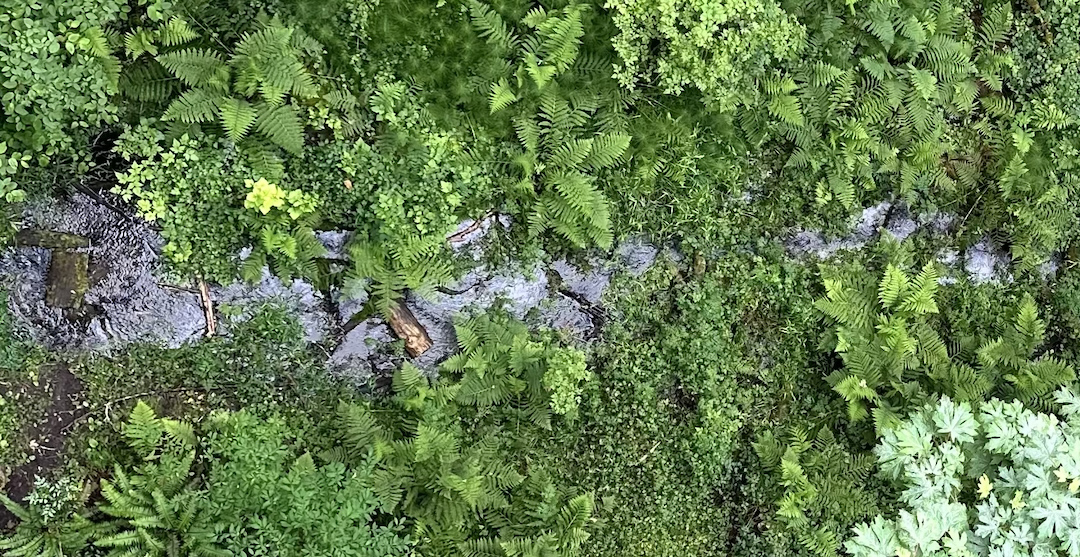
Aerial view of Ravenna Creek. photo by Anya Gavrylko
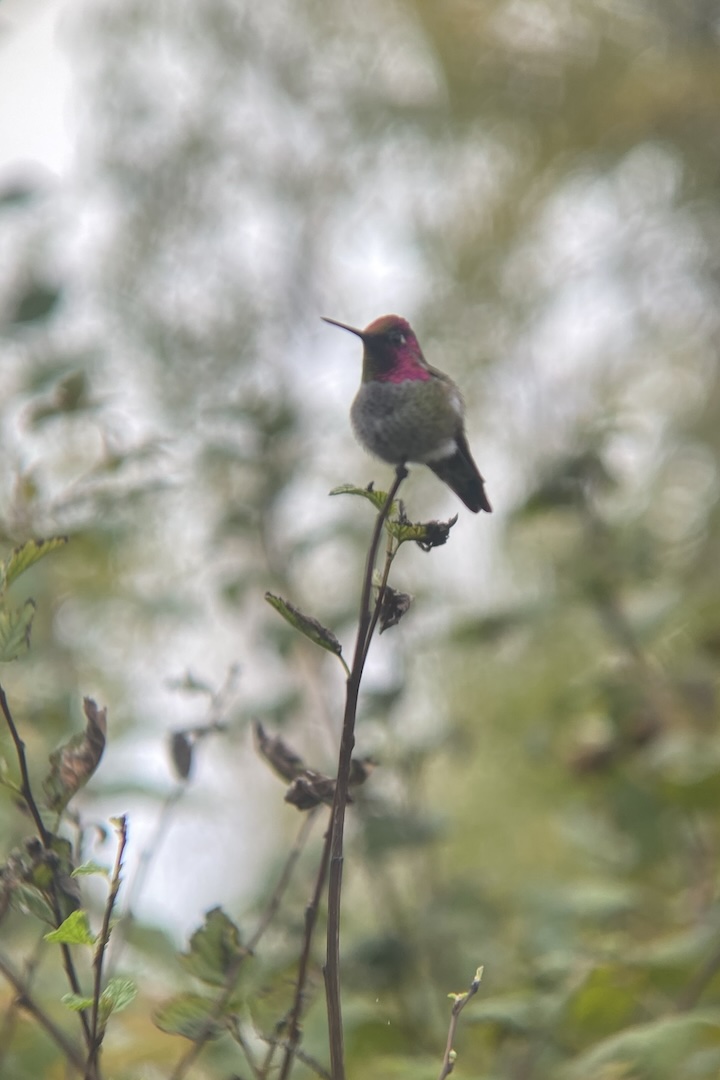
Anna’s hummingbird. photo by Barrett Ihde
As part of our learning, we had an assignment to keep a weekly observation journal at one location throughout the course. I chose a spot along Ravenna Creek, where the sun peeked through the branches and reflected upon the small, steady rush of water. I was overtaken with awe as over the course of an hour I saw five hummingbirds visit the nearby red flowering currant in full bloom. One by one they would arrive, savoring their turn; in the sunshine their heads and necks were melted rubies. I was transfixed by their dance of stillness and swiftness, not quite able to articulate what made their movement so distinct. I would later learn that hummingbirds are the only birds with the ability to hover due to the way they loop their wings in a figure eight pattern.
Throughout that class our professor emphasized how nature is alive in the city, and how once we knew where to look our perceptions would morph and we would begin to see the life, the wonder, that surrounded us. At that moment I began to understand what he meant. I started to see Anna’s hummingbirds (Calypte anna) on a daily basis as I recognized where our daily routes overlapped and as my ears became more attuned to their metallic song. Slowly my daily outings became freckled with many different kinds of birds — juncos, jays, chickadees, and ospreys. My world felt more saturated, more colorful, as I began to notice my winged neighbors, and it was only a matter of time before I took up the art of birding.
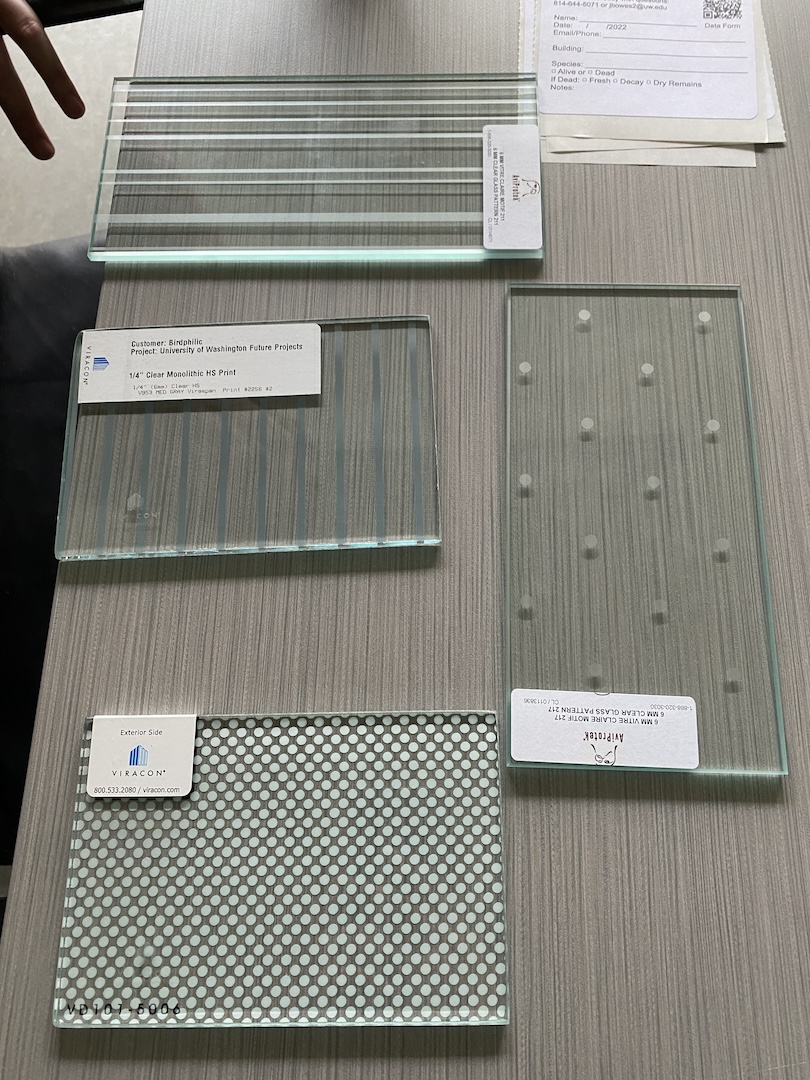
Examples of decals used to make bird safe window glass. photo by Anya Gavrylko
My hobby unexpectedly melded into a job as I was hired for a research assistant position on campus where I supported a bird collision monitoring project. Although the reality was harsh (window collisions currently kill up to a billion birds in the United States alone), there were many silver linings. Architectural design solutions to create safer buildings existed, and our research was going to contribute to a growing body of knowledge about bird building collisions, specifically in the Pacific Northwest. I was excited to be a part of this work, to hopefully contribute to a safer world for my beloved friends. One of my responsibilities was to slowly walk the perimeter of buildings with design features that increased the likelihood of bird collisions, and to record any birds that I found. Although in my head I understood and accepted the nature of this grave task, my emotions were often more difficult to calibrate.
I had started the position at the end of summer, when the days felt heavy and long, the promise of autumn just on the horizon. As I finished circling the last building on my first solo route, I sat down to rest in a shady spot, under a sympathetic tree. I was in a small courtyard surrounded by wooden buildings with beautifully tall windows reflecting the gently swaying Western Red Cedars. I had not found any birds that day along my path, which was partially a relief, but also frustrating, as we knew that crows and other scavengers often got to the collision victims much sooner than we could.
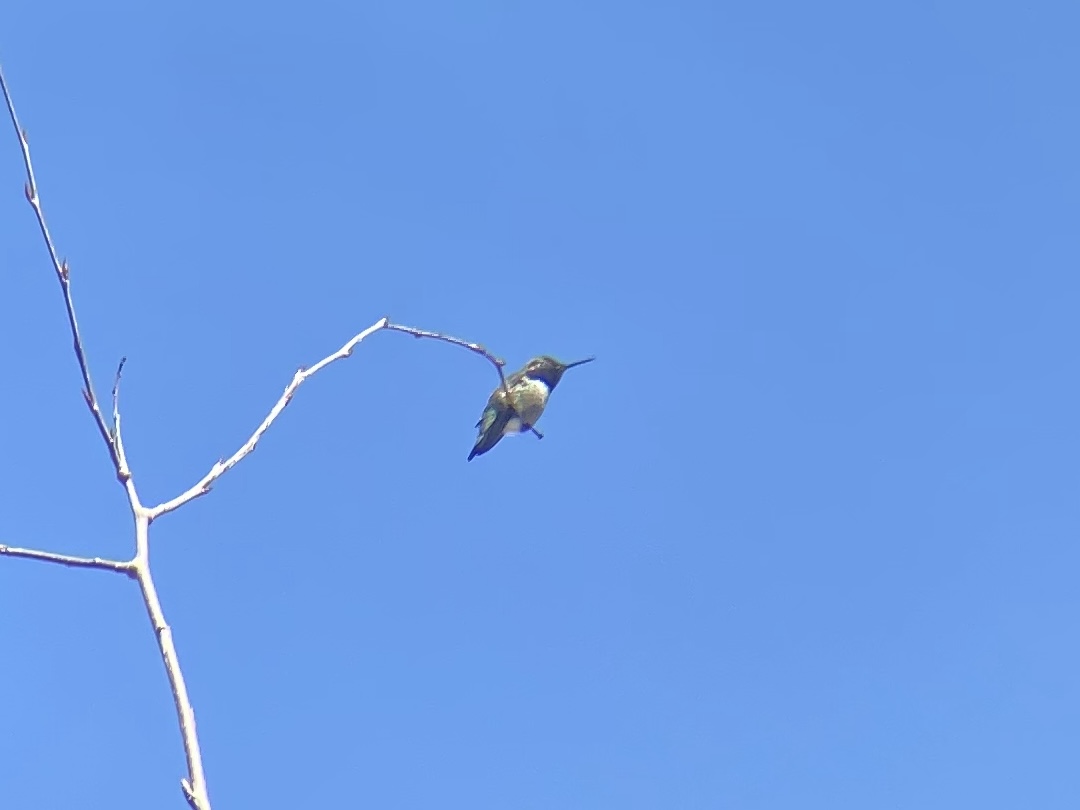
Anna’s hummingbird perched on a branch. photo by Anya Gavrylko
As I sat in the silence of an empty campus, two Anna’s hummingbirds appeared suddenly, as they always do, and drew invisible spirals in the air as they swooped around one another. I felt at peace, for a moment, a smile creeping over my face as the warmth of the day and the whimsy of the hummingbirds radiated around me. This moment of serenity cruelly slipped away as the two hummingbirds unexpectedly altered their course, tenaciously flying towards what they believed to be a tree, but what was in fact a deadly illusion. Before I even had the chance to react I heard two fatal thumps as their small bodies collided with the glass. My heart shriveled as I ran up to where they lay, ready to implement the emergency protocol I had been taught to increase their chances of survival post collision, but it was too late. The two females lay motionless, their necks limp as I held them in my hands. Tears streamed down my cheeks, and I choked back sobs. I shook as an intense ache washed over me that is unique to witnessing the transition from life to death before your eyes. Although I had never gotten to see a hummingbird so close before, I felt very far away, like I was watching this all unfold from a distance, unable to quite grasp what I was experiencing.
The sad reality was that the two Anna’s hummingbirds had seen the visual of the trees in the windows, but had not been able to recognize them as a reflection. Reflective glass surfaces along with transparent glass skyways and railings are amongst the deadliest of architectural designs, as birds are not able to perceive the presence of a solid surface. They are not stupid or wrong for doing this, they are simply trying to navigate harsh, deadly built environments that are not ecocentric.
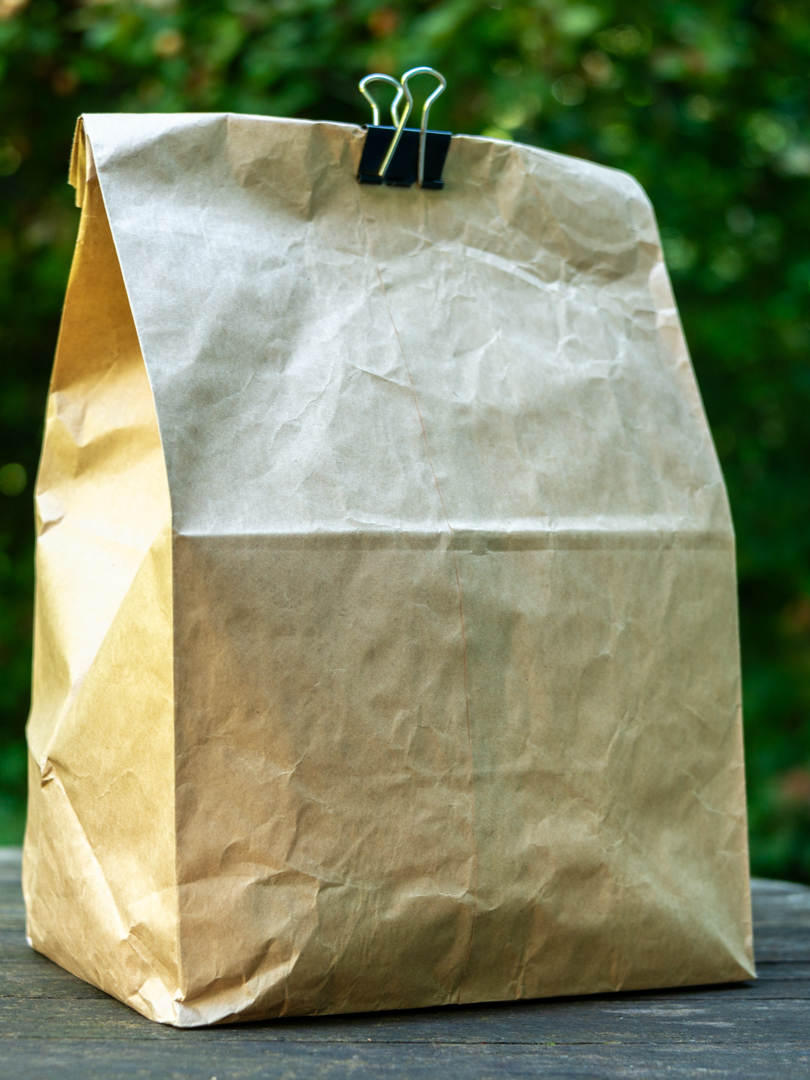
Paper bag sealed with binder clip. photo by John F. Williams
Many moons later, one of my friends called me and told me he had spotted a male Anna’s hummingbird that had just suffered a window collision, but that the bird was still alive. My friend was on his way to work, so he did not have time to help but wanted to see if there was anything I could do. I biked down with gloves, a brown paper bag, a small towel, and a burning intention, as I was determined for a different end to the story this time. I pedaled forward even though the fear of finding another small, lifeless body dragged along with me.
As I arrived, I found the hummingbird, injured, but alive. Definitely alive. I prepared the paper bag with a small towel at the bottom and gingerly placed the bird into the bag, carefully folding the top over and sealing it with a small black binder clip. This allows for birds to recover from their injuries more quickly, as being in a small, dark space makes them feel safe and protected, allowing for their body to heal. As per protocol, I waited 30 minutes before opening the bag to check on my little friend. There were three possibilities:
- He could have recovered and then flown out of the bag.
- He could be alive but still resting.
- Or (the thought that made my neck grow cold) he could be dead.
With hesitation and anticipation, I opened the bag and saw two little beads looking up at me, his small body breathing delicately, expanding and collapsing quickly. He was still alive, but not healed. I was relieved, but still worried. I had to wait another 30 minutes, and if at that point he was still not ready to fly, I would have to take him to an animal recovery center. I called a friend to ask if I could borrow her car, to be ready if the moment came. 30 minutes later the moment did come, as the brave hummingbird looked up at my face yet again, but remained in place. Although I still felt concerned, the knot in my chest was loosening slightly. If he had made it this far, just maybe he would live. He was a fighter, and the animal recovery center was still open. I wished for the both of us to be graced with good luck. I carried him over to the car, walking as quickly as I could in a smooth, delicate manner. I was about two minutes away from the car when I sensed movement between my fingers as the paper bag rustled slightly. Curious, I stopped and opened the bag for a third time.
This time, he flew away.
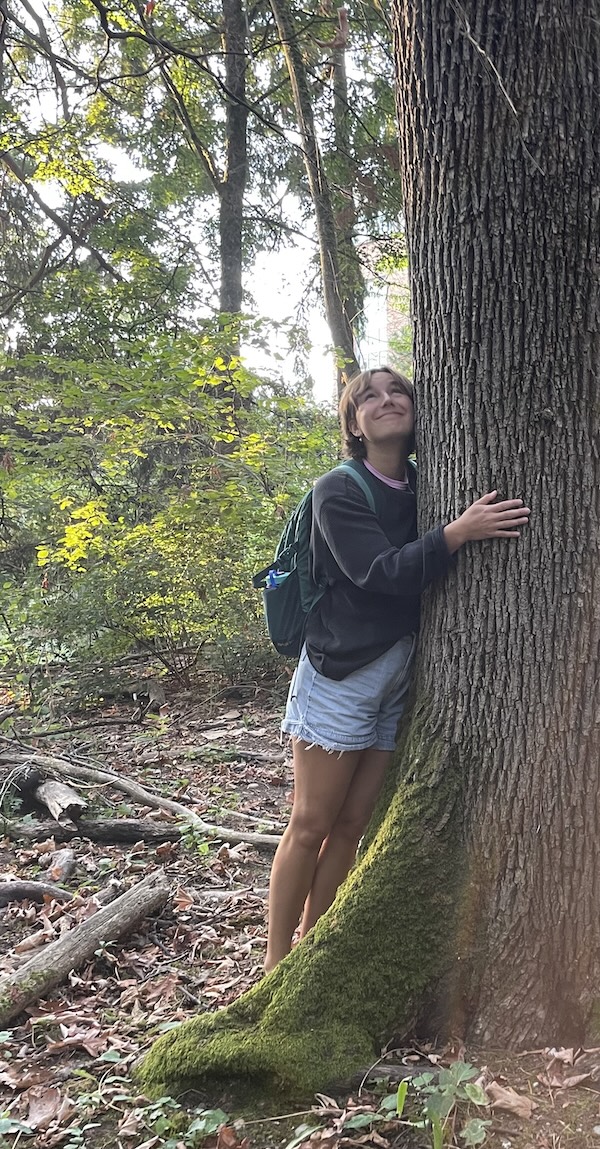
Anya Gavrylko is a recent graduate from the University of Washington, where she studied Environmental Studies and Urban Planning. She loves exploring the Pacific Northwest, and is especially fond of birding, tide pooling, and looking for native wildflowers. Anya lives close to Ravenna Park and can often be found getting lost in thought on the Ravenna Park Bridge.
Her E-Portfolio: https://anyagavrylko.wixsite.com/cep-eportfolio
Table of Contents, Issue #24, Summer 2024

Pocket Beach
by Julie Jeanell Leung, Summer 2024images by Julie Leung except as notedPocket beach in Myrtle Edwards Park, adjacent to Olympic Sculpture Park in Seattle.by Julie Jeanell Leung, Summer 2024images by Julie Leung except as notedLooking through Alexander Calder's...
Avalon Pond
by Joshua Ralph, Summer 2024Everett Crowley park, Vancouver Canada. photo by Chelaxy Designs via Unsplashby Joshua Ralph Summer 2024a history in a landscape Nestled within the far southeast corner of what is today Vancouver, British Columbia, lies a 40-hectare park,...
Wild Birds and Window Collisions
by Jeff Beyl, Summer 2024Black-capped chickadee. photo by Skyler Ewing via Pexelsby Jeff Beyl Summer 2024It happened again this morning. At first, I thought it was a gunshot. My head jerked, my shoulders jumped, and I quickly ducked beside the breakfast table. I...
Salamanders, Stormwater, and Skateboards
by Susan McCleary, Jessica Sandoval, Max Lambert, Claire Kerwin, Summer 2024Yauger Pond when the area is not flooded. photo courtesy of WDFWby Susan McCleary, Jessica Sandoval, Max Lambert, Claire Kerwin Summer 2024Map of the route of water from Yauger Park to the...
The Wild Indoors
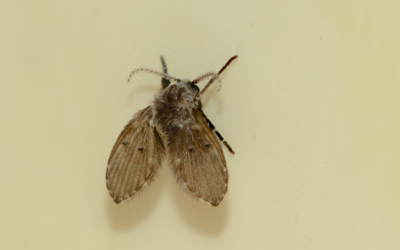
by Sarah Ottino, Summer 2024 images by Sarah Ottino except as noted Clogmia albipunctata or drain fly, less than 1/4" long. photo by John F. Williamsby Sarah Ottino images by Sarah Ottino except as noted Summer 2024Many of us think of nature as being restricted to the...
Neanderthals in the House
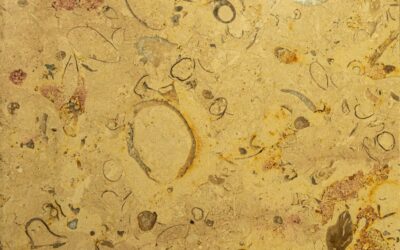
by David B. Williams, Summer 2024 images by David B. Williams except as notedFrench Limestone containing fossils in an exterior wall of Westlake Center, Seattle. photo by John F. Williamsby David B. Williams images by David B Williams except as noted Summer 2024In the...
Poetry 24
by multiple poets Summer 2024photo by of John F. Williamsby multiple poets Summer 2024Three Colleagues and a Coyote by Jessica Levine This poem was written in the morning of April First, describing the wild and wonderful life of being a bike commuter in the city. This...
COPYRIGHT
Copyright SEA-Media
All rights reserved. Reproduction or distribution, in whole or in part. without consent of copyright owner is strictly prohibited — except for brief quotations in critical reviews and other noncommercial uses permitted by copyright laws.
SEA-Media is a 501(c)(3) nonprofit corporation
PLEASE HELP SUPPORT
SALISH MAGAZINE
DONATE
Salish Magazine contains no advertising and is free. Your donation is one big way you can help us inspire people with stories about things that they can see outdoors in our Salish Sea region.
We also don't advertise Salish Magazine, so please spread the word of this online resource to your friends and colleagues.
Thanks so much for your interest and your support.