
Salamanders, Stormwater, and Skateboards: The Ecological Marvel of Yauger Park
by Susan McCleary, Jessica Sandoval, Max Lambert, Claire Kerwin, Summer 2024

Yauger Pond when the area is not flooded. photo courtesy of WDFW
SALAMANDERS, STORMWATER, AND SKATEBOARDS: THE ECOLOGICAL MARVEL OF YAUGER PARK
by Susan McCleary, Jessica Sandoval, Max Lambert, Claire Kerwin
Summer 2024
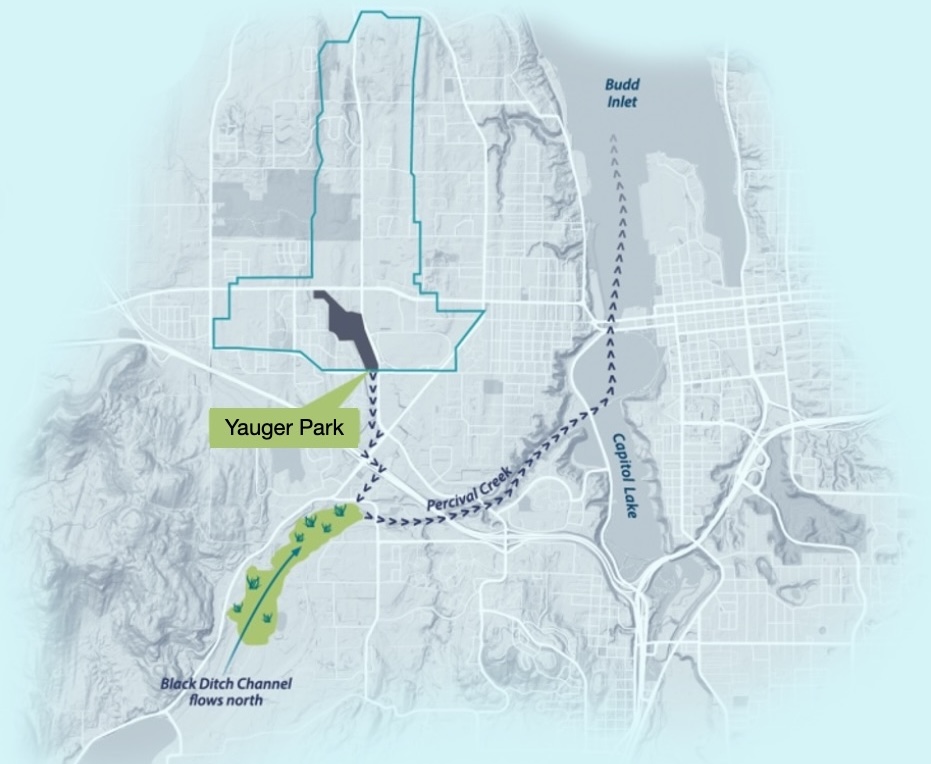
Map of the route of water from Yauger Park to the Salish Sea. The area that drains into Yauger Park is outlined in blue. Water then flows from Yauger Park’s pond to Black Lake Ditch, through Percival Creek, and into Capitol Lake where it then enters Budd Inlet. image courtesy of the City of Olympia
Yauger Park is unique. Located in West Olympia at the southernmost tip of the Salish Sea, it’s a splash of green on a canvas of grey. Flanked by Capitol Mall, housing, and small strip malls, Yauger Park offers a space in the urban environment where people can connect with nature and enjoy time outdoors. The park consists of ballfields, a skate park, kids play area, and a natural area with walking paths. But Yauger Park is not only an urban oasis where people and animals can thrive; it’s a critical part of the City of Olympia’s stormwater management system. Yauger Park Regional Stormwater Complex stores, channels, and filters runoff from 570 acres of urban landscape.

Jessica Sandoval, of the Washington Department of Fish and Wildlife (WDFW), searching for Olympic minnows in Yauger Park’s pond. photo courtesy of WDFW, 2024
follow the water
When it rains, storm drains and pipes collect the water running off the hard surfaces of streets and parking lots surrounding Yauger Park and direct it to the park. From there, the water flows through engineered features like bioswales, weirs, and rain gardens to the park’s pond. These stormwater features are designed to mimic natural systems that existed before the area was urbanized. Historically, natural wetlands would have captured this rainwater and snow melt, letting sediment settle out and slowing the rushing water to protect streams. Stormwater ponds fill some of the lost protective functions wetlands once provided. They allow water to infiltrate back into the ground to help reduce flooding, while filtering out pollutants like oil, fertilizers, bacteria, and tire particles.
But the raindrop’s journey doesn’t end there! From Yauger Park, stormwater flows through a series of pipes, ditches, storm ponds, and man-made wetlands. The water then spills into Black Lake Ditch and passes through Percival Creek, where it enters Capitol Lake and finally reaches the salty waters of Budd Inlet. Yauger Park benefits life downstream, cleaning the water running off Olympia’s roads before reaching the Salish Sea.
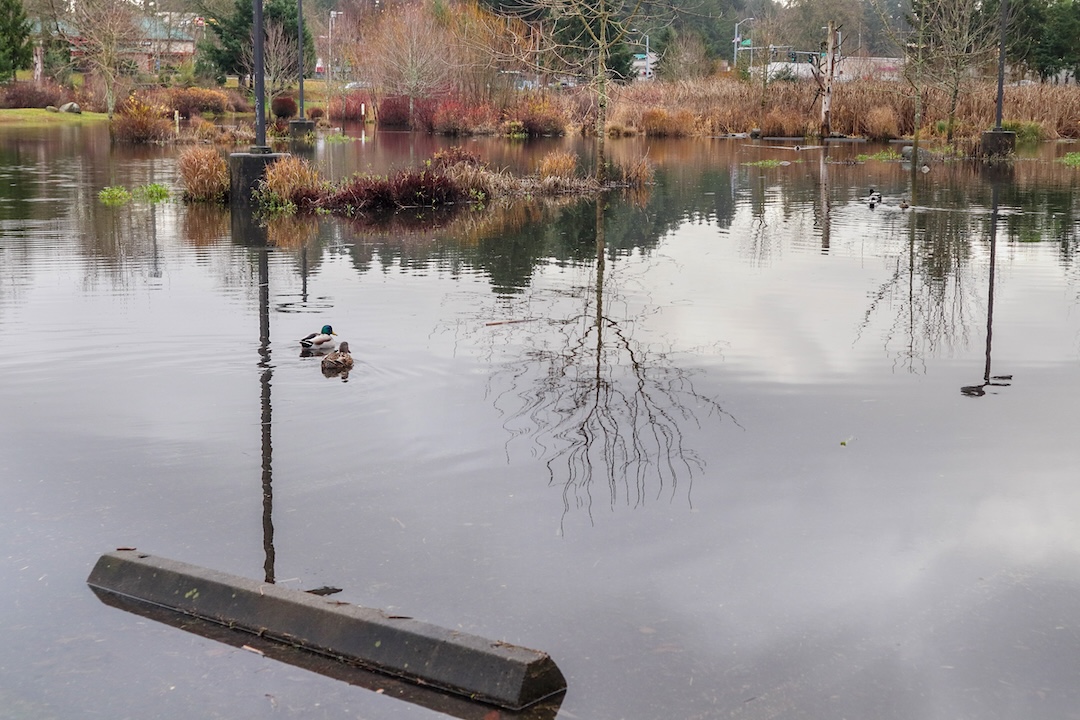
In the rainy season, Yauger Park’s pond is designed to overflow its banks and flood the park’s parking lots and ball fields. photo courtesy of the City of Olympia
insights into stormwater pond biodiversity
Last year a team of scientists at the Washington Department of Fish and Wildlife (WDFW) began studying if and how stormwater ponds can serve more ecological benefits. Specifically, this research is exploring whether stormwater ponds can support biodiversity by providing habitat for wildlife, including birds, amphibians, and beavers. This study is underway in roughly 200 ponds across the Washington lowlands flowing into the Salish Sea. Ten city and county partners are working with WDFW to understand how their stormwater infrastructure can help address biodiversity loss in the Salish Sea, in streams, and in the stormwater ponds themselves.
The researchers selected stormwater ponds in neighborhoods with different community attributes. This will help the team understand if and how stormwater pond habitat and biodiversity differ among communities with varying income levels and other socioeconomic characteristics. This research can help us provide equitable access to nature for all urban and suburban communities in the Salish Sea region.
During surveys at Yauger Park this year, WDFW staff found plenty of evidence of beaver activity, including chew marks on the park’s trees! There was also a diversity of ducks and songbirds using the water and surrounding vegetation. And it’s more than mallards! Stormwater ponds like Yauger Park’s are home to various waterfowl like mergansers, buffleheads, and wood ducks, and songbirds like red-winged blackbirds. These ponds can even be home to protected species. For instance, the researchers discovered a large population of the beautiful Olympic mudminnow (Novumbra hubbsi), a state Sensitive species and Species of Greatest Conservation Need in Washington.

WDFW found Olympic mudminnows in Yauger Park’s pond. Olympia mudminnows are between 2-3 inches long. They thrive in healthy wetlands and WDFW has identified them as Sensitive and a Species of Greatest Conservation Need under Washington’s State Wildlife Action Plan. photo courtesy of WDFW
Particularly noteworthy were the salamanders. The team counted nearly 500 northwestern salamander (Ambystoma gracile) egg masses in this expansive stormwater pond! This is an exciting find with one large caveat: when the rains ease in the spring, the pond recedes to its normal, much smaller footprint. During this annual reduction of water, the team observed hundreds of stranded salamander egg masses in the park’s ballfields and parking lots. Water levels also recede as the year progresses in natural wetlands, too — but much later in the summer, allowing egg masses to mature without being stranded on dry land. Despite the pond’s water decreasing, dozens of egg masses persisted and likely hatched into larval salamanders. This work is starting to illuminate how we can create win-win solutions to deal with stormwater and ongoing biodiversity loss.

WDFW found Northwestern salamanders and egg masses in Yauger Park’s pond. Northwestern salamanders are 5.5-8.7 inches long. photo courtesy of WDFW
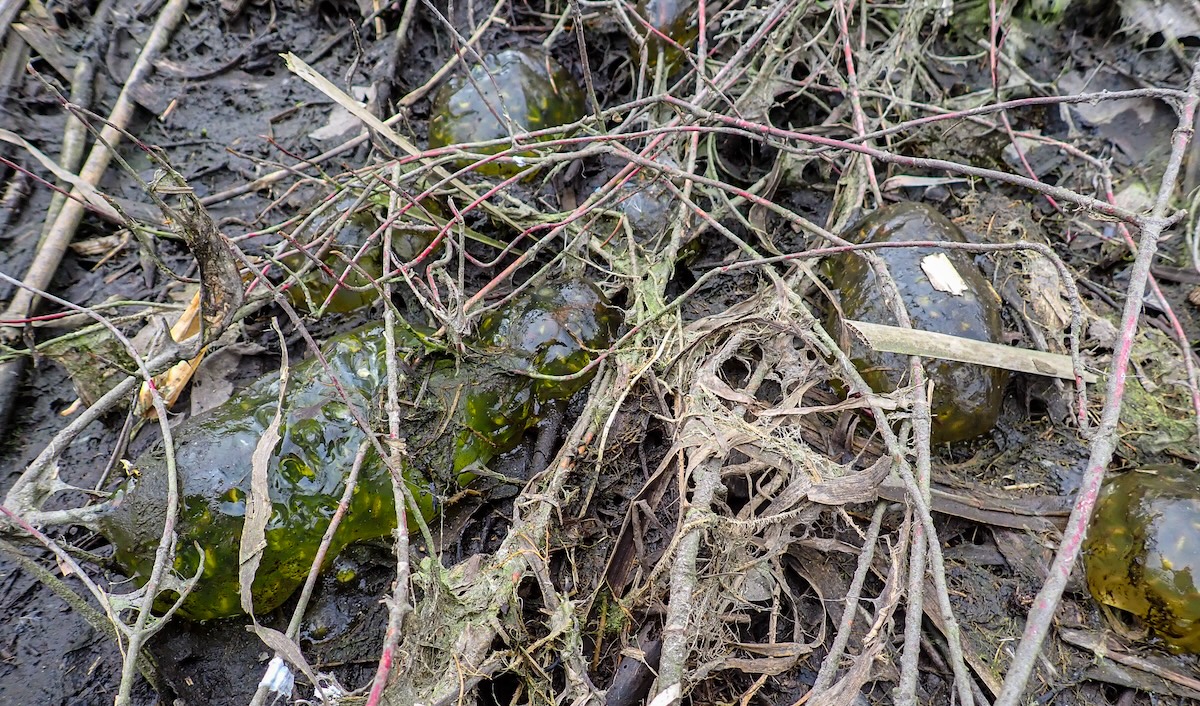
Northwestern salamander egg masses were spotted on dry land in Yauger Park’s pond after the water levels receded. The eggs need to be in water to survive and hatch. photo courtesy of WDFW
Washington State has lost roughly one-third to one-half of its wetlands. This trend is not unique to Washington; wetlands have decreased across the United States. European and American settlers drained and filled wetlands, first for agriculture and then for urban and residential development. Wetlands provide important services like controlling flooding and cleaning water. They are also home to diverse wildlife species. Numerous fish, birds, mammals, reptiles, and amphibians rely on wetlands to survive. With the loss of wetlands, their populations have plummeted, resulting in degraded biodiversity. The biggest threat to biodiversity is habitat loss. Without somewhere to live, many species simply cannot persist. Some species we consider to be relatively common were much more abundant before the loss of our many wetlands. WDFW’s study is helping us understand how to replicate habitat conditions of wetlands in stormwater ponds. Our urban areas can be part of the solution to stemming the tide of biodiversity loss for wetland species.
WDFW’s scientists are measuring a range of habitat conditions, including pond vegetation and pond water levels. The scientists are monitoring bird diversity and abundance with a combination of acoustic recording devices and binocular surveys. They’re studying amphibians by counting frog and salamander eggs in late winter and then using nets to see how well the tadpoles and larval salamanders grow in spring and summer. They’re also keeping tabs on beaver and muskrat activity by looking for chewed trees, lodges, and other signs. In 2025, after the final year of studying the 200+ ponds around the Salish Sea, the results will be able to tell us if and how we can enhance biodiversity in stormwater ponds while also allowing the ponds to maintain their engineered functions for managing stormwater.
community science in action
Stormwater ponds aren’t just petri dishes for professional scientists; they offer an opportunity for every member of the community to experience and study biodiversity close to home. In 2022 naturalist Erin Frank of Olympia and her son conducted their own study of invasive and native amphibians in several of their neighborhood stormwater ponds. Although they found some invasive amphibians, they largely found that their stormwater ponds were home to abundant populations of native frog and salamander species.
Who thought investigating neighborhood stormwater ponds would turn up not only hundreds of Nerf darts, but also relevant observations for conservation?! My kid went from cringing at checking nets to a salamander-wrangling, species-counting pro who could identify a handful of amphibians in every stage of their lives; egg masses to mature in the span of a couple months in our own neighborhood! — Erin Frank
If the emerging research shows that we can manage stormwater ponds for biodiversity, participatory science by community members like the Franks will be critically important for growing the next generation of naturalists and developing the data we need to recover biodiversity in our cities and suburbs.

There are biodiverse stormwater ponds throughout the Salish Sea region. Use this map to find one to visit! Thousands of smaller stormwater ponds also surround the Salish Sea and are home to numerous species. image courtesy of WDFW
salish sea stewardship
Thousands of stormwater ponds already exist in western Washington and larger stormwater parks are popping up across the Coast Salish region. “When you stand in a well-designed stormwater park, it doesn’t feel like you’re in an engineered water quality project. You feel like you’re in a park,” explains Jessie Israel, director of Puget Sound conservation at the Nature Conservancy. “Success looks like stormwater solutions that benefit people and nature.” Stormwater parks demonstrate the resilience of nature and the role that plants, soil, and wildlife can play in salmon and ecosystem recovery.
Stormwater parks and ponds are a vital approach to restoring ecosystems and cleaning the waters flowing into the Salish Sea. Clean water is key to the wildlife and natural beauty we treasure in the Pacific Northwest. It’s why we live here. While stormwater parks help us recover the Salish Sea ecosystem, keeping pollutants out of stormwater is the first line of defense. Each of us living, working, and playing in this beautiful region has a role to play in protecting our waters. Through our day-to-day choices, actions, and volunteerism, we can make a difference.
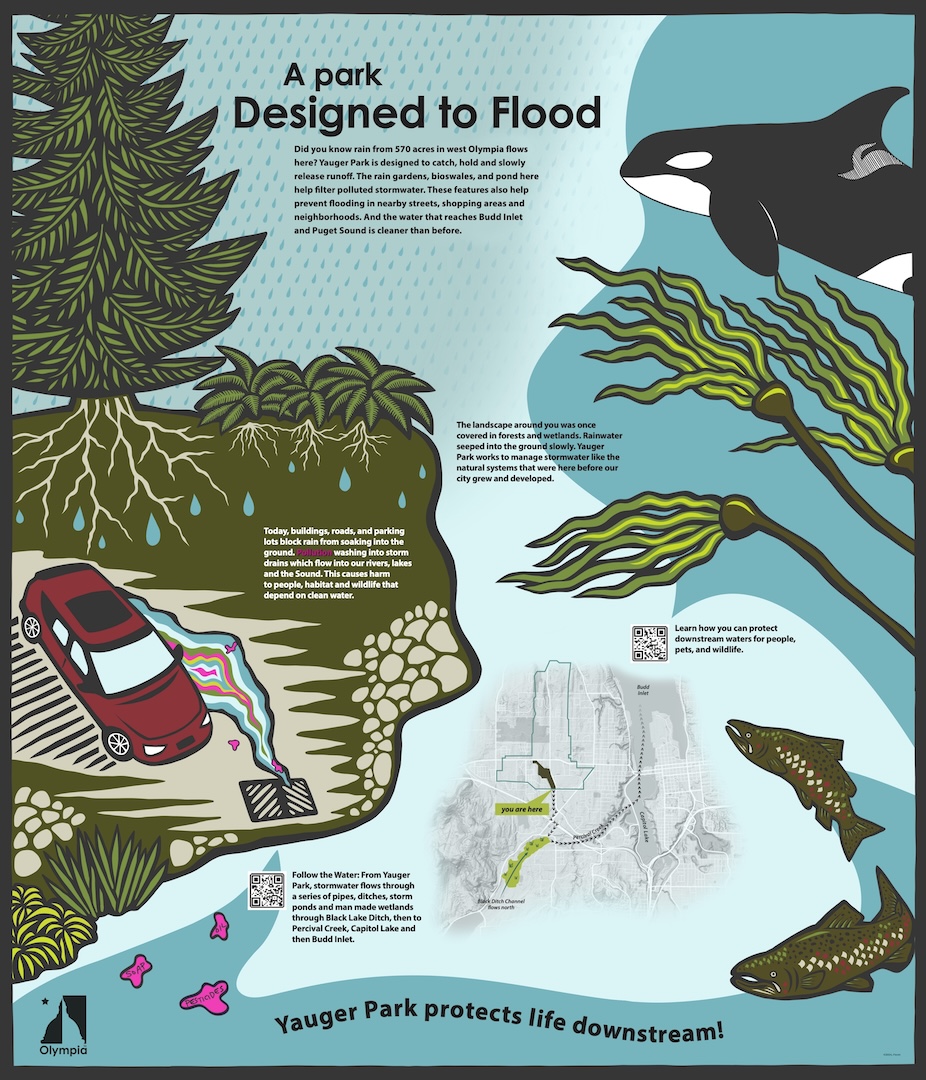
Yauger Park’s new interpretive signage, “A Park Designed to Flood.” courtesy of the City of Olympia
Stream Team of Thurston County, Puget Sound Starts Here, WDFW and other agencies, and tribal nations are working toward a cleaner, more biodiverse Salish Sea. They are sharing resources with the community and providing opportunities for people to connect with nature, get involved, and make an impact.
Stream Team offers workshops, fun nature-based, family-friendly events, volunteer activities, and hands-on community science opportunities. Puget Sound Starts Here provides educational resources for teachers and the community as well as region-wide event listings. WDFW’s Habitat at Home program supports people in building and connecting wildlife habitat where they live, work, and play.
When you’re in the Olympia area, stop by Yauger Park to see the biodiversity for yourself. New educational signage and sculptures are coming to the park this summer. They will guide visitors through the park’s features and give tips on everyday ways that we can protect the Salish Sea’s watershed.
Susan McCleary: Susan is a Senior Outreach Specialist for the City of Olympia’s Storm and Surface Water Utility and Coordinator for Stream Team of Thurston County. Her work focuses on stormwater pollution programs that engage business, residential and middle school audiences.
Jessica Sandoval: Jessica is a research biologist at the Washington Department of Fish and Wildlife specializing in pond and wetland biodiversity. She earned her master’s degree from Southern Illinois University Edwardsville and previously helped lead recovery efforts for endangered reticulated flatwoods salamanders in Florida.
Max Lambert: Max started this research when he was a senior research scientist at the Washington Department of Fish and Wildlife where he led a team of scientists in addressing biodiversity conservation in Washington. He is now the Director of Science for The Nature Conservancy in Washington.
Claire Kerwin: Claire is the Habitat at Home coordinator at Washington Department of Fish and Wildlife, where she supports residents in building and stewarding habitat for wildlife where they live, work, and play. She earned her master’s degree at The Evergreen State College where she studied herbicidal impacts on Indigenous foods.
Table of Contents, Issue #24, Summer 2024

Pocket Beach
by Julie Jeanell Leung, Summer 2024images by Julie Leung except as notedPocket beach in Myrtle Edwards Park, adjacent to Olympic Sculpture Park in Seattle.by Julie Jeanell Leung, Summer 2024images by Julie Leung except as notedLooking through Alexander Calder's...
Avalon Pond
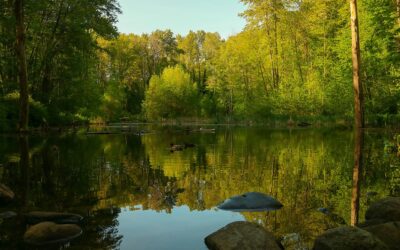
by Joshua Ralph, Summer 2024Everett Crowley park, Vancouver Canada. photo by Chelaxy Designs via Unsplashby Joshua Ralph Summer 2024a history in a landscape Nestled within the far southeast corner of what is today Vancouver, British Columbia, lies a 40-hectare park,...
Wild Birds and Window Collisions
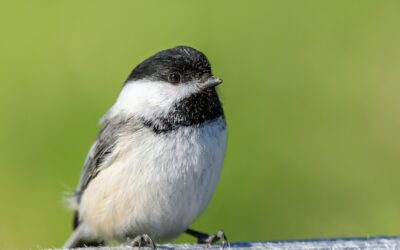
by Jeff Beyl, Summer 2024Black-capped chickadee. photo by Skyler Ewing via Pexelsby Jeff Beyl Summer 2024It happened again this morning. At first, I thought it was a gunshot. My head jerked, my shoulders jumped, and I quickly ducked beside the breakfast table. I...
The Wild Indoors
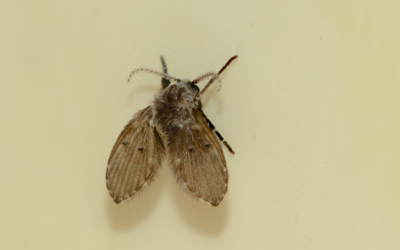
by Sarah Ottino, Summer 2024 images by Sarah Ottino except as noted Clogmia albipunctata or drain fly, less than 1/4" long. photo by John F. Williamsby Sarah Ottino images by Sarah Ottino except as noted Summer 2024Many of us think of nature as being restricted to the...
Neanderthals in the House
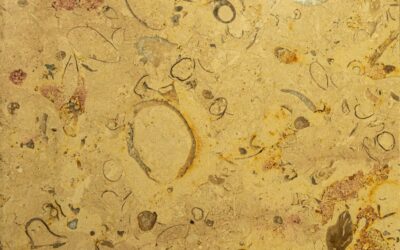
by David B. Williams, Summer 2024 images by David B. Williams except as notedFrench Limestone containing fossils in an exterior wall of Westlake Center, Seattle. photo by John F. Williamsby David B. Williams images by David B Williams except as noted Summer 2024In the...
Joy & Woes: Anna’s Hummingbirds
by Anya Gavrylko, Summer 2024Anna's hummingbird. photo by Veronika Andrews via Pixabayby Anya Gavrylko Summer 2024My freshman year of college I was in a regular state of awe as I adjusted to my new surroundings. I had moved to Seattle from the suburbs of Chicago, and...
Poetry 24
by multiple poets Summer 2024photo by of John F. Williamsby multiple poets Summer 2024Three Colleagues and a Coyote by Jessica Levine This poem was written in the morning of April First, describing the wild and wonderful life of being a bike commuter in the city. This...
COPYRIGHT
Copyright SEA-Media
All rights reserved. Reproduction or distribution, in whole or in part. without consent of copyright owner is strictly prohibited — except for brief quotations in critical reviews and other noncommercial uses permitted by copyright laws.
SEA-Media is a 501(c)(3) nonprofit corporation
PLEASE HELP SUPPORT
SALISH MAGAZINE
DONATE
Salish Magazine contains no advertising and is free. Your donation is one big way you can help us inspire people with stories about things that they can see outdoors in our Salish Sea region.
We also don't advertise Salish Magazine, so please spread the word of this online resource to your friends and colleagues.
Thanks so much for your interest and your support.