
SACRED STREAM INSECTS AND THE NUTRIENT CYCLE
by Gavin Tiemeyer, Winter 2020
Photos courtesy of King County except where noted
SACRED STREAM INSECTS AND THE NUTRIENT CYCLE
by Gavin Tiemeyer, Winter 2020
Photos courtesy of King County except where noted
Learning about the natural cycles that govern the health of the Salish Sea starts with peering into your local stream. There you’ll find the hidden world of benthic macroinvertebrates.
In the summer of 2019, while a communications intern on assignment for King County Department of Natural Resources and Parks, I was first introduced to the intriguing world of benthic macroinvertebrates. With the sun barely peeking out over the Cascades, I packed into a truck with two members of the County’s stream bug monitoring team and headed out to Coal Creek Natural Area in Bellevue, Washington. Treading lightly, I followed the two young professionals into the living stream. I watched attentively as one of them used a Surber sampler, a tool reminiscent of a butterfly net, to capture bugs hiding in the rocks and pebbles. Meanwhile, the other team member used a convex spherical densiometer, a tool used to measure the forest canopy above the stream.
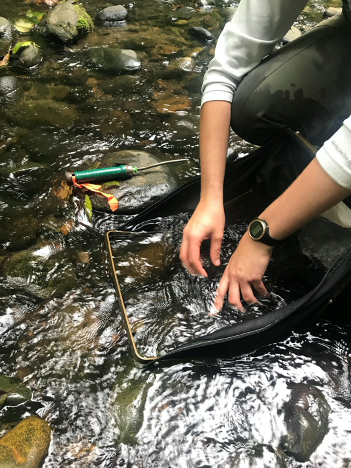
A Stream Team Member collects a sample of benthic macroinvertebrates using a Surber sampler tool.
Here, surrounded by the beauty of second growth riparian habitat and the watchful eyes of a family walking their labradoodle, I was evangelized to the importance of sacred stream insects; the closest I’ll ever come to a baptism by water.
The contents of the Surber sampler were dumped into a bin, and lo and behold, creepy crawlers began to emerge as if disturbed from a deep slumber: snails, worms, crustaceans, and a spectrum of insect larvae (stream bugs) completing various stages of life cycle metamorphosis. These are called benthic macroinvertebrates because they dwell at the bottom (benthic) in sediment, on rocks, and other woody debris, and can be seen with the naked eye (macro).

Benthic macroinvertebrates collected in the sample are sifted out from rocks and other debris and put in an alcohol solution to be sent to the lab for identification.

A stonefly larva emerges from its hiding place.
What do all benthic macroinvertebrates have in common? They’re indispensable. Benthos (organisms that live on, in, or near the bottom of a body of water) provide essential ecosystem services that keep streams healthy. They also fill a vital spot in the stream food web. Learning about these creepy crawlers is fun and helps us to better appreciate the role animals play in keeping the Salish Sea a livable place. You need only trek as far as your local stream, and with a level of care, stop and notice the world just below the water. No special equipment needed.

Even the most ramshackle urban stream harbors life and is something to be cherished.
the nutrient cycle
The importance of benthic macroinvertebrates in freshwater ecosystems has much to do with what they eat and how they provide food for other plants and animals. By eating and being eaten, they’re responsible for ensuring that nutrients are cycled throughout the freshwater food web and flow to the right biotic channels. More simply put, stream bugs eat plant material, such as fallen leaves and other detritus, and are then chomped on by other animals such as salmon, juvenile Signal crayfish, and even other predatory stream bugs.
Think of stream bugs as miniature, edible garbage collectors. On a cosmic scale, by being eaten, benthos help other animals utilize energy that plants have captured from the sun. Their importance within the stream food web is quite significant. “Without the stream bugs, organic materials won’t be processed, nutrients won’t get recycled back into the system, and many consumers won’t have any food,” reads the King County Stream Bug Monitoring website. “In short, the system degrades until it is unhealthy or dead, then most bugs couldn’t live there even if they wanted to.”
Up close and personal with the stonefly larva. Notice the fuzzy gills the insect uses to breathe in the cool running water of a stream.

Up close and personal with the stonefly larva. Notice the fuzzy gills the insect uses to breathe in the cool running water of a stream.
The way a stream bug eats also says a lot about its unique function in the freshwater food web and in what part of the stream you’re likely to find it. For example, the stonefly larvae, of which there are many different species, are often found on stones and other wood debris in the fast-moving portion of a stream ecosystem. Functional feeding groups for stream bugs include shredders, scrapers, collectors, and predators, and are best described using adjectives like cool and awesome.
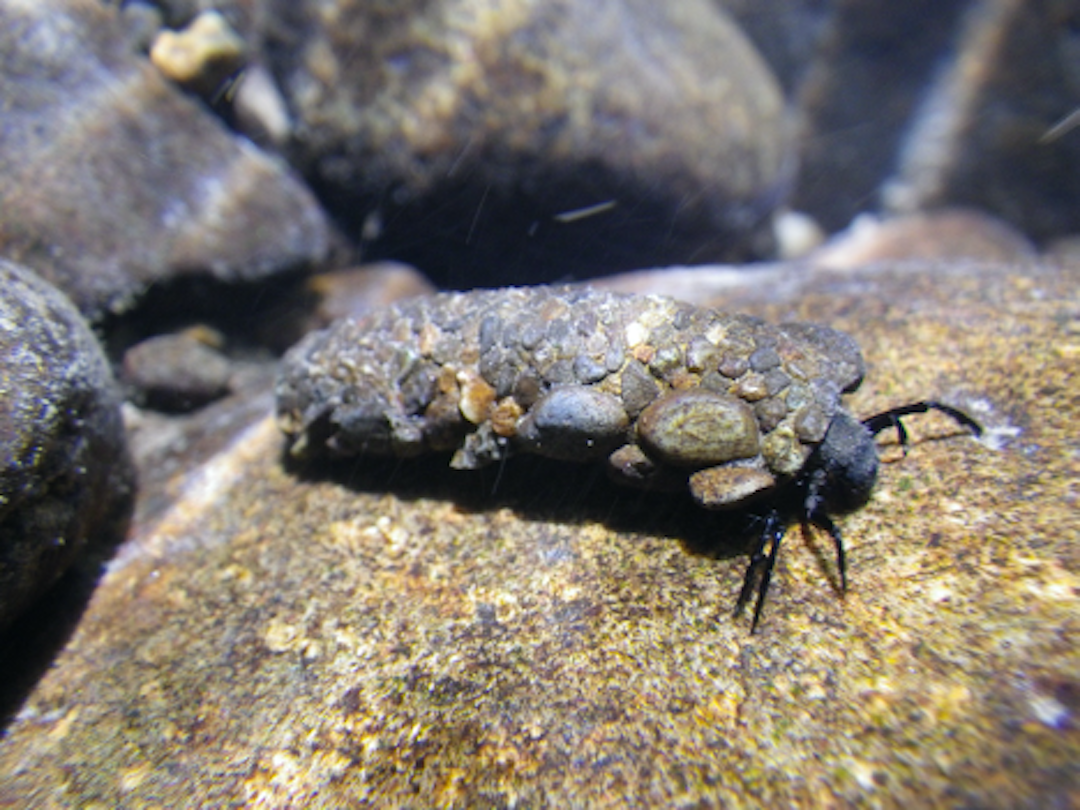
Shredders and scrapers include the slender winter stonefly larvae, water pennies, and my personal favorite: caddisfly larvae. The caddisfly larva is a shredder that noshes on fallen plant debris from the tree canopy above the stream. This fastidious insect fastens a casing made of stone to protect its fleshy, developing body, reinforced with super silk that has long been the envy of the scientific community. You’ll find these little guys attached to rocks in slower moving water where plant detritus collects. Look closely and you’ll notice the larvae moving around in their stone houses — a dance to move oxygen over the gill tufts they use to breathe.

Going mobile: Caddisfly larvae construct homes from found objects, such as pebbles and other woody debris, and are unique based on each individual species.
A shredder’s trash is another collector’s treasure. The detritus broken up by the shredders is consumed by the collectors, such as aquatic earthworms, dixid midges, and freshwater clams and mussels. And, in case you’re wondering, they also eat the poop of other animals. Indeed, nothing is wasted in the stream.
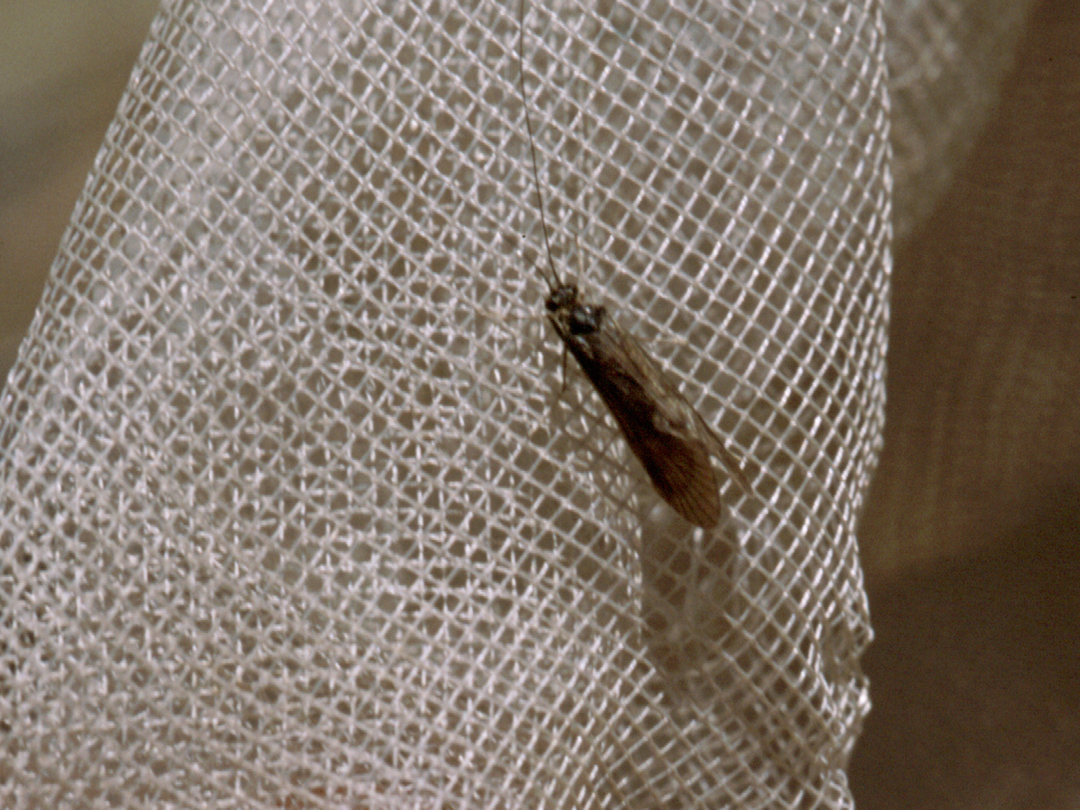
Many of the aquatic insect larvae mentioned above take to the wing as adults to mate, deposit eggs into the stream, and then die, completing a remarkable water-to-land transmogrification. Just think, the dragonfly cruising above your garden in the summer — picking off unsuspecting flying insects with staggering accuracy — spent most of its life in the water, most likely close to your house. Some species of mayfly live a mere day out of the water as adults and are much more concerned about sex than food, having shed the mouthpieces they used, as aquatic larvae, to eat

To provide a sense of scale, this mayfly larva is no bigger than the smallest portion of this person’s fingerprint.
stream bug monitoring
As if maintaining the health of freshwater ecosystems wasn’t enough responsibility, benthic macroinvertebrates’ sensitivity to pollution makes them great biological indicators of overall stream health. Because of this, aquatic ecologists working for resource management agencies in both the US and Canada have a vested interest in monitoring the presence — or absence — of stream bugs in the streams of the Salish Sea.
Take for example, the stream bug monitoring program of the Natural Resources and Parks Department of King County, Washington. Using a sampling method called the Benthic Index of Biological Integrity (B-IBI) aquatic ecologists can measure the presence of bugs and get a pretty good idea of the overall health of a stream ecosystem. To give you a good idea of what stream bugs are up against, read this statement from the King County Stream Health Indicators webpage: “The biodiversity of a stream declines as flow regimes are altered, habitat is lost, chemicals are introduced, energy cycles are disrupted, and alien taxa invade.” Streams receive a report card, ranging on a scale of 1 through 5, based on the prevalence of three major types of stream bugs (mayfly, stonefly, and caddisfly) that are sensitive to pollution. Other indicators are measured as well, such as the presence of bugs that aren’t nearly as picky about where they live, and can make home in more polluted water spaces.
So, one important proviso when visiting your local stream: If it’s polluted, you’re unlikely to see many of the benthos discussed in this article. On a recent trip to Longfellow Creek in West Seattle, I was unable to spot any dancing caddisfly larvae, or the molted exoskeleton of stonefly larvae. I did however encounter a Signal crayfish, a Washington native, and reader beware, they pinch—they pinch hard!


Editor’s CAUTION: Urban streams and ponds are often quite polluted, so always wash your hands afterward if you touch the water. A stream can rise quite quickly after a rainstorm, so watch for fast or deep water. If you’re going to wade, go with a partner, wear heavy boots, and watch out for debris, both natural and human. Professional stream monitors might have to sacrifice their stream bugs for the sake of detailed identification by bug experts, and they hold scientific collection permits to do so. The rest of us should always gently replace any rocks, sticks, or bugs we pick up back where we found them.

Stoneflies
regaining a sense of responsibility for the world around us
The Environmental Protection Agency estimates that in five years the human population in the Salish Sea region will reach nine million — that’s nine million of us competing for the natural resources that make the region such a desirable place to live. Freshwater is at the top of the list. We use freshwater for drinking, agricultural production, and for recreation. Competing for the same resource, and existence in a human-dominated world, are the animals that inhabit the streams, rivers, and lakes of the Salish Sea. With their compound eyes, hooked claws, and mandibles, stream bugs don’t elicit the same noble adoration as the other Salish Sea animals we revere, but they are just as deserving of our attention. Without them streams would fall into disrepair. We wouldn’t have salmon, and without salmon we wouldn’t have orcas. You get the picture.
In his book Celebrate the Solstice: Honoring the Earth’s Seasonal Rhythms through Festival and Ceremony environmentalist Richard Heinberg writes, “As consumers, we have lost our sense of responsibility — which after all, is the ability to respond: the ability to sense and align with the fundamental rhythms of nature and of life itself as it bubbles up from the core of our being. To regain our proper human responsibilities, we must begin to take more of an interest in the welfare of our immediate natural surroundings.”
Concerning ourselves with the welfare of our immediate surroundings starts with something as simple as visiting your local stream. There, we are reminded that we share our home with other creatures who do so much for us and ask nothing in return save for the right to exist.
Interested in learning more about benthic macroinvertebrates? You’re in luck—The Salish Sea region is full of people and organizations who care deeply about sacred stream insects. Take for example the Stream Bug Monitoring Program of King County, Washington, which I promoted so vigorously in this article. Beyond that, a quick Google or YouTube search provides a slew of field guides and entertaining videos.
This photo gallery shows some other life stages of insects discussed above. It also contains one exuvium that was left behind as the adult emerged.
Click on the gallery to see it full-sized with captions.
Photos by Thomas Noland




Gavin is a recent graduate from the Master of Environmental Studies Program at the Evergreen State College in Olympia Washington—although he calls Seattle home. Through writing and visual storytelling, he is keen to challenge the dichotomy between nature and the built environment. “Drawing attention to the relationships we share with animals in big cities is a great reminder that nature is not always something pristine and out there, but directly around us and integrated deeply within.” Writing this piece helped to recall a childhood memory of finding dancing caddisfly larvae in a stream behind the house he grew up in as a child.
Table of Contents, Issue #10, Winter 2020
Woodland Witness
by Zoe Wadkins Winter 2020 Drawings by Zoe Wadkinsby Zoe Wadkins, Winter 2020 Drawings by Zoe WadkinsIn the three years since our first introduction, I have walked this loop of Deer Creek more than one hundred times. Its rich macroinvertebrate habitat constitutes a...
Restoring Forests
by Dan Hintz, Winter 2020You can see this 2019 Mountains to Sound Greenway tree planting site at Lake Sammamish State Park, located along Issaquah Creek. Photo by Katie Egresi.You can see this 2019 Mountains to Sound Greenway tree planting site at Lake Sammamish State...
Salish Sea and Dinosaur Pee
by Sarah Lorse, Winter 2020 Photo by Sarah Lorseby Sarah Lorse, Winter 2020 Photo by Sarah LorseHow wonderfully wet things are here beside the Salish sea. Whether it is a big fat raindrop dangling off your nose or the impressive volume of a king tide, water is all...
See the Salish Sea by Saddle
by Jessica C. Levine, Winter 2020 Photos by Jessica C. Levineby Jessica C. Levine, Winter 2020 Photos by Jessica C. LevineI spend a considerable amount of time pondering cycles. As a cyclist, I bike year round. I’m also a naturalist and place-based science educator....
Many Cycles of Nature
by Leigh Calvez, Winter 2020 Photos by John F. Williams except as notedby Leigh Calvez, Winter 2020 Photos by John F. Williams except as notedAs children we come into a world filled with the cycles of nature. We watch with wonder as the first crocuses of spring poke...
Swallow Season
by Donna Bunten, Winter 2020 Photos by Donna Bunten except as notedPhoto by John F. WilliamsPhoto by John F. Williamsby Donna Bunten, Winter 2020 Photos by Donna Bunten except as notedI dread August—the end of summer, sliding farther down the slope towards darkness,...
Issue 10 Poetry
Winter 2020Photo by Adelia RitchiePhoto by Adelia RitchieWinter 2020Water Drop By Mahathi Mangipudi Wide strokes of grey paint the sky On the windward side of the Cascades Air masses from the Pacific Ocean Saturated with water vapor Condense into little...
The Many Lives of Tree
by Pat Kirschbaum, Winter 2020Photo by John F. WilliamsPhoto by John F. Williamsby Pat Kirschbaum, Winter 2020We are so lucky in the Pacific Northwest to have many places to go where we can be surrounded by trees. As I sat alongside a nearby stream recently, I...
Community Gardens
by Alison Ahlgrim, Winter 2020Photo by Michael YatesPhoto by Michael Yatesby Alison Ahlgrim, Winter 2020My first visit to Everett was a reconnaissance mission to see if my husband and I might like to live there. Drawn to the water, we ended up at the waterfront...
COPYRIGHT
Copyright SEA-Media
All rights reserved. Reproduction or distribution, in whole or in part. without consent of copyright owner is strictly prohibited — except for brief quotations in critical reviews and other noncommercial uses permitted by copyright laws.
SEA-Media is a 501(c)(3) nonprofit corporation
PLEASE HELP SUPPORT
SALISH MAGAZINE
DONATE
Salish Magazine contains no advertising and is free. Your donation is one big way you can help us inspire people with stories about things that they can see outdoors in our Salish Sea region.
We also don't advertise Salish Magazine, so please spread the word of this online resource to your friends and colleagues.
Thanks so much for your interest and your support.