
SWALLOW SEASON
by Donna Bunten, Winter 2020
Photos by Donna Bunten except as noted
Photo by John F. Williams

Photo by John F. Williams
SWALLOW SEASON
by Donna Bunten, Winter 2020
Photos by Donna Bunten except as noted
I dread August—the end of summer, sliding farther down the slope towards darkness, decay, cold. Even though the heat may fool others into thinking summer has finally arrived, I know better. The days are noticeably shorter, the angle of the sun casts different shadows on the pasture, and the evening—once filled with the songs and chatter of birds—is eerily silent except for an occasional robin alarm call or a flock of Canada geese hollering as they land in the field across the road. Most of all, it’s the end of swallow season.

I live at the southernmost tip of Puget Sound, where I have a peek-a-boo view of Eld Inlet. For 35 years I’ve been getting to know the cycles of this landscape and its inhabitants. One of these cycles belongs to my favorite summer resident: the barn swallow.
Our house, known to many folks in the neighborhood as “the bird house,” is home this year to 17 pairs of barn swallows. They build their mud “half-basket” nests under the eaves on all sides of the house and garage. Each of these nests produces 3 to 5 babies, and most of them do it twice. That means it’s possible for our house to add as many as 170 barn swallows to the local population.

Photo by wileydoc, Pixabay
But not all the nestlings fledge, and not all fledglings survive. This year I found 6 dead babies below the nests — some barely growing feathers, others feathered but no clue as to what happened to them. One fell out of a nest and was mauled by our cairn terrier before I could rescue it. At least one was hit by a car on the busy road in front of our house. Who knows how many others were snacks for Cooper’s hawks or crows. Life is full of risks. One slight error by a young bird whose skills at flying aren’t quite solid means that the end of its life supports the beginning of another. Life, in the largest sense, cycles into and out of an infinite number of forms.
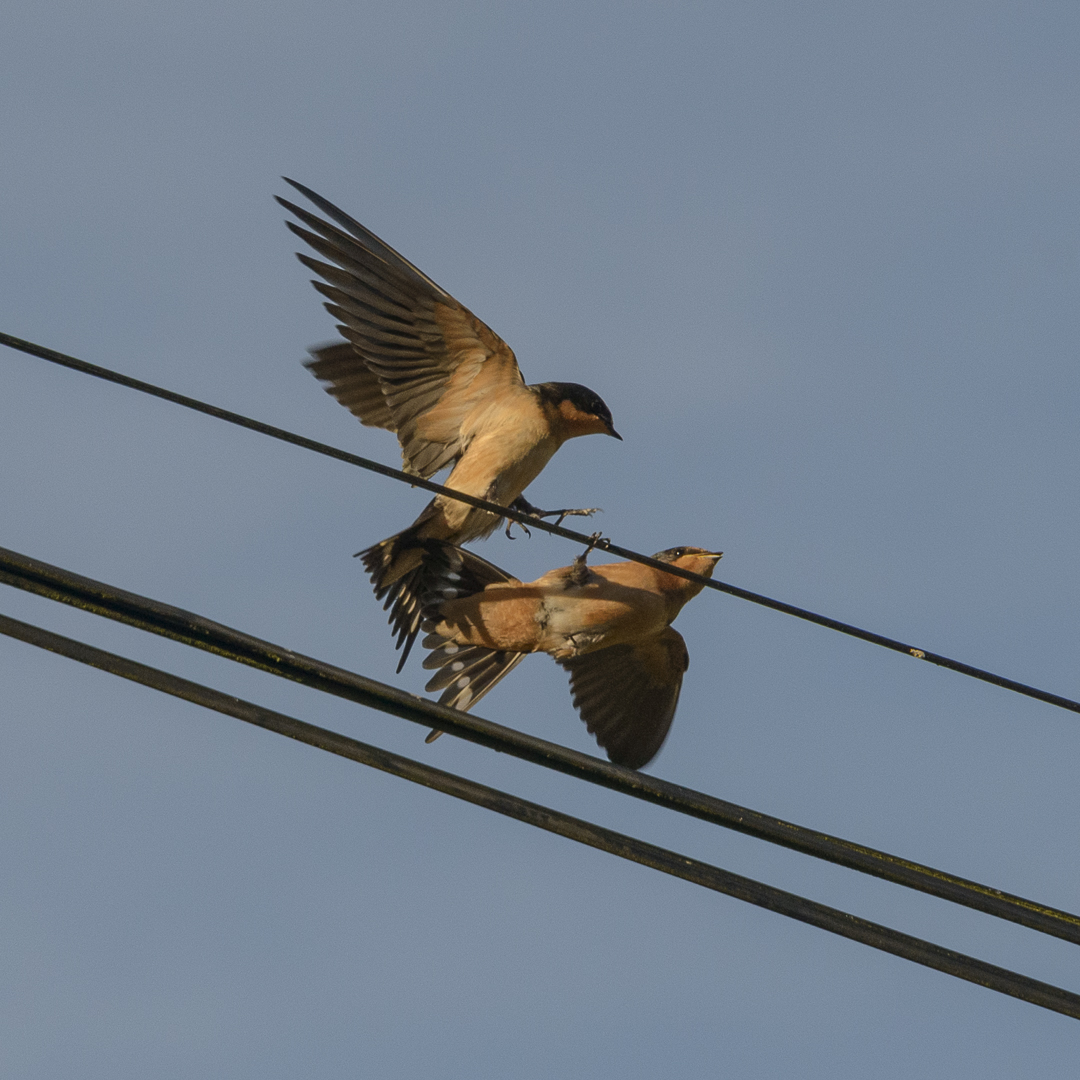
Photo by John F. Williams
When the barn swallows first appear in early April, I watch them skim the greening pasture for emerging flies, midges, and mosquitos. Having survived the winter months, the insects take advantage of warmer temperatures and longer days to begin the next stage of their life cycle. Eggs hatch, larvae molt or pupate, and adults take wing to feed on nectar, plant juices and other insects before laying more eggs. One form transforms into another. The swallows time their arrival to take advantage of this increasing food source.
In May, I listen to the barn swallow’s courtship song, a liquid flow of warbles and twitters ending with a curious metallic grinding sound. I watch them mate on the telephone wire, the male fluttering above the female for a brief moment of contact before they both swirl off to feed. Soon the pairs will begin building new nests, or refurbishing old ones, under the eaves of our house and garage.
Photo by John F. Williams
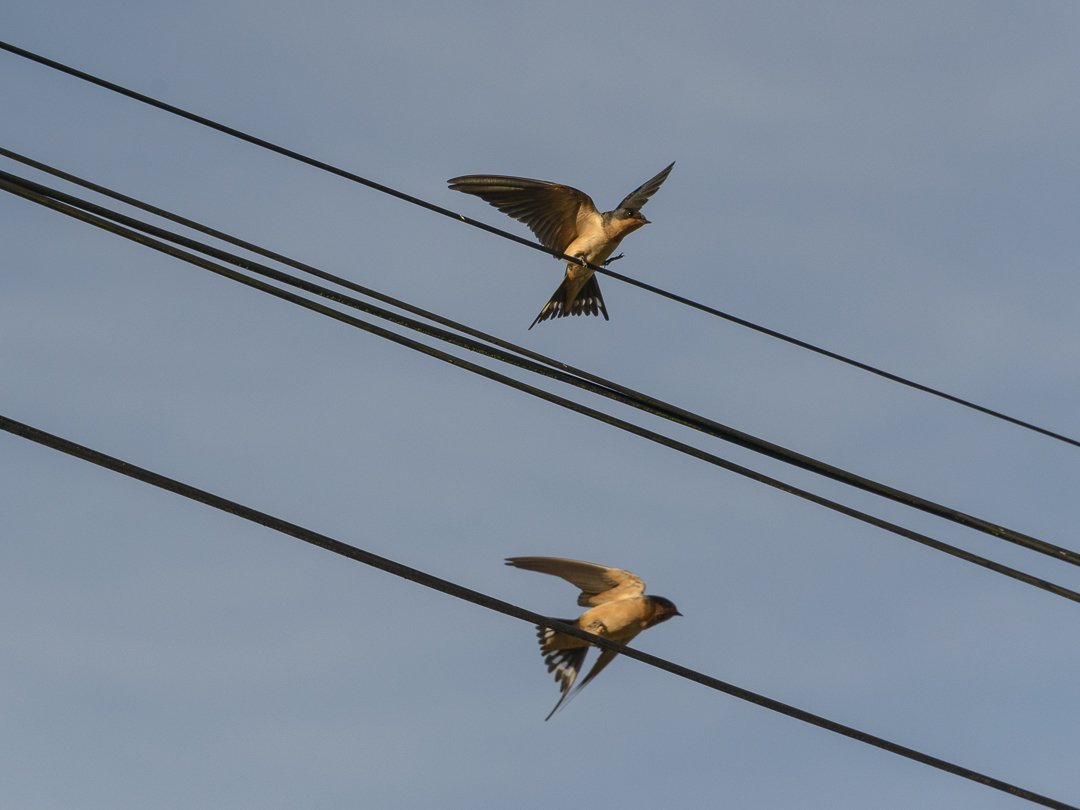
Photo by John F. Williams

For three years, a pair of barn swallows has inhabited an unusual nest on the front porch light outside my kitchen window. The first year it was a modest little nest, a full bowl of mud braided with grasses anchored between the fixture and the porch wall. The next year the couple decided to add on, building the bowl up to twice its original height and embellishing it with white tail feathers from our leghorn rooster. Perhaps the birds decided to reduce the space between the porch ceiling and the top of the mud bowl, making it harder for predators to raid the nest. This year the swallows are using it again, adding new white rooster feathers that arc over the rim. And the interior of the bowl is lined with soft, warm feathers as well.
Below the nests, small mounds of white-brown squiggles quickly form on the ground around the house as the nestlings poop over the edge of the nest. When the winter rains come, the mounds dissolve and nitrogen and other nutrients are washed into the soil. The rhododendrons around my house take up those nutrients and host scale insects that will feed the Pacific wren and other birds finding shelter in the evergreen foliage.

I tape down diapers of plastic bags in an attempt to catch the droppings below the front porch nests and install small wooden shelves under the nests above the windows. But in spite of my efforts, at the end of the season I still have to scrub away the whitewash from the sides of the house. Which leads one to ask, “Why do you encourage these dirty birds?”
For one practical reason: They are eating hordes of insects that I find annoying like flies, mosquitos, and gnats. The swallows transform these insects into tiny white brown-speckled eggs. The eggs in turn become nestlings that require constant feeding. And soon the fledglings are devouring their own hefty share of insects as they glide and dive over the cow pies in the pasture. When the swallows depart at the end of summer, flies and mosquitos appear in our house.
But the main reason I host these little acrobats is that they bring me joy. My heart leaps in spring when I spot the first unmistakable shape swooping over the pasture. I follow the progression of nesting, feeding, fledging with great interest. I have a connection to, a relationship with, these bright-eyed flyers. I watch an adult sit on the nest and notice when she perches on the side, peering down into the cup—the eggs are hatching! I chuckle at the enormous beaks on spindly neck-stalks that strain up out of the nest as an adult arrives with food. I marvel at the little feathered balls that wobble up to the rim of the nest, rotate and promptly eject a white fecal sac over the edge. I gaze into four pairs of beady eyes that watch me while I wash my dishes. And I fret over their first attempts at flight, fluttering down to the porch railing with a parent chirping encouragement. I count them, wondering what happened to the missing baby when only three return to the nest at night.
In recent years, I’ve learned to pay attention to the barn swallow alarm calls. When I hear the strident “da-deet de-deet! da-deet de-deet!” and see the squadron of little jet fighters scrambling above the house, I scan the sky for a Cooper’s hawk, or a raven, or a delivery person approaching the front door. When I walk down to the mailbox, I become the focus of their alarms. The adult birds repeatedly dive around my head, and I hear the click of their tiny beaks snapping a warning: “Stay away from our nests!”
One of my favorite swallow behaviors is the feather game. This is how it’s played: One swallow arrives with a fluffy white chicken feather and drops it. As the feather floats downward, another swallow swoops in to catch it and carry it skyward. Another drop, another save. One afternoon I count 20 drops before the birds let it fall and fly off. I want to believe that this is pure fun and not just competition for nest liners or some practical training on how to catch insects.
Photo by John F. Williams
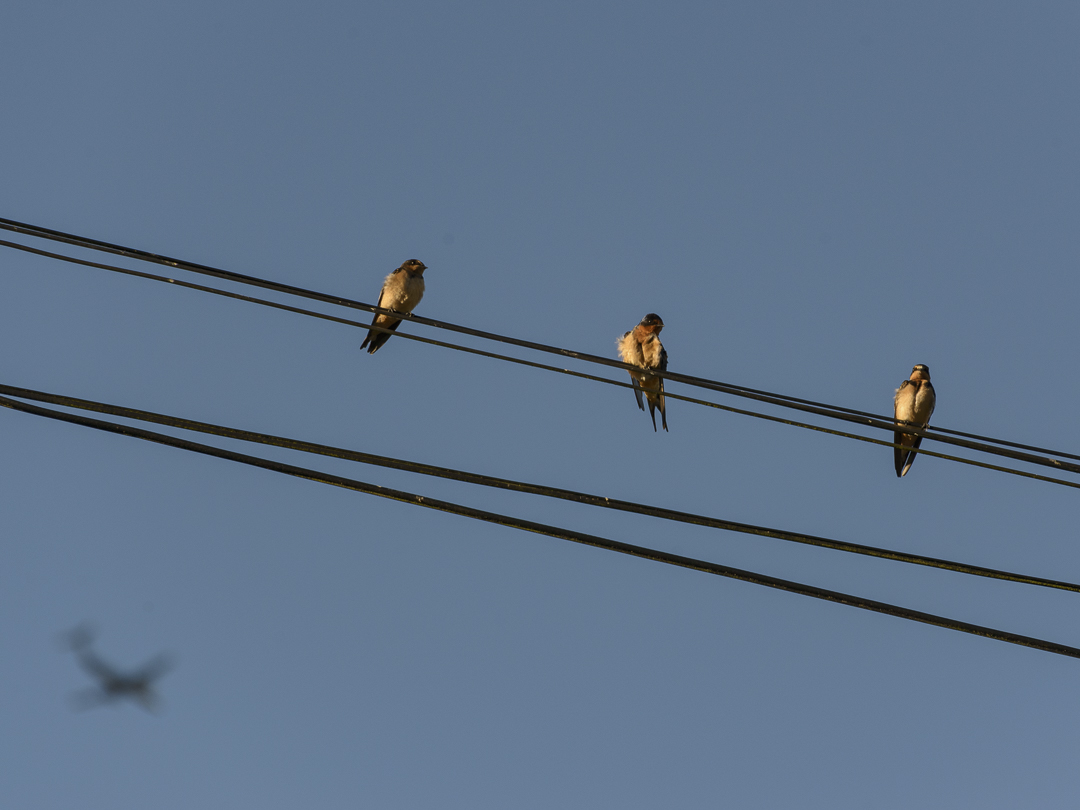
Photo by John F. Williams
It’s late August now, and the sky outside my window is full of swallows. They perch on the wires connecting our house to the power pole out by the road, preening and pooping—the asphalt beneath is always speckled with white splotches until the rains come. And in the early morning light, the longer wire along the road is strung with more than a hundred bird beads, mostly barn swallows with a dozen or so violet-green swallows mixed in. A few parents are still frantically feeding nestlings. Do they have a sense of urgency brought on by the shortening days to get the last ones out of the nest and flight-approved?
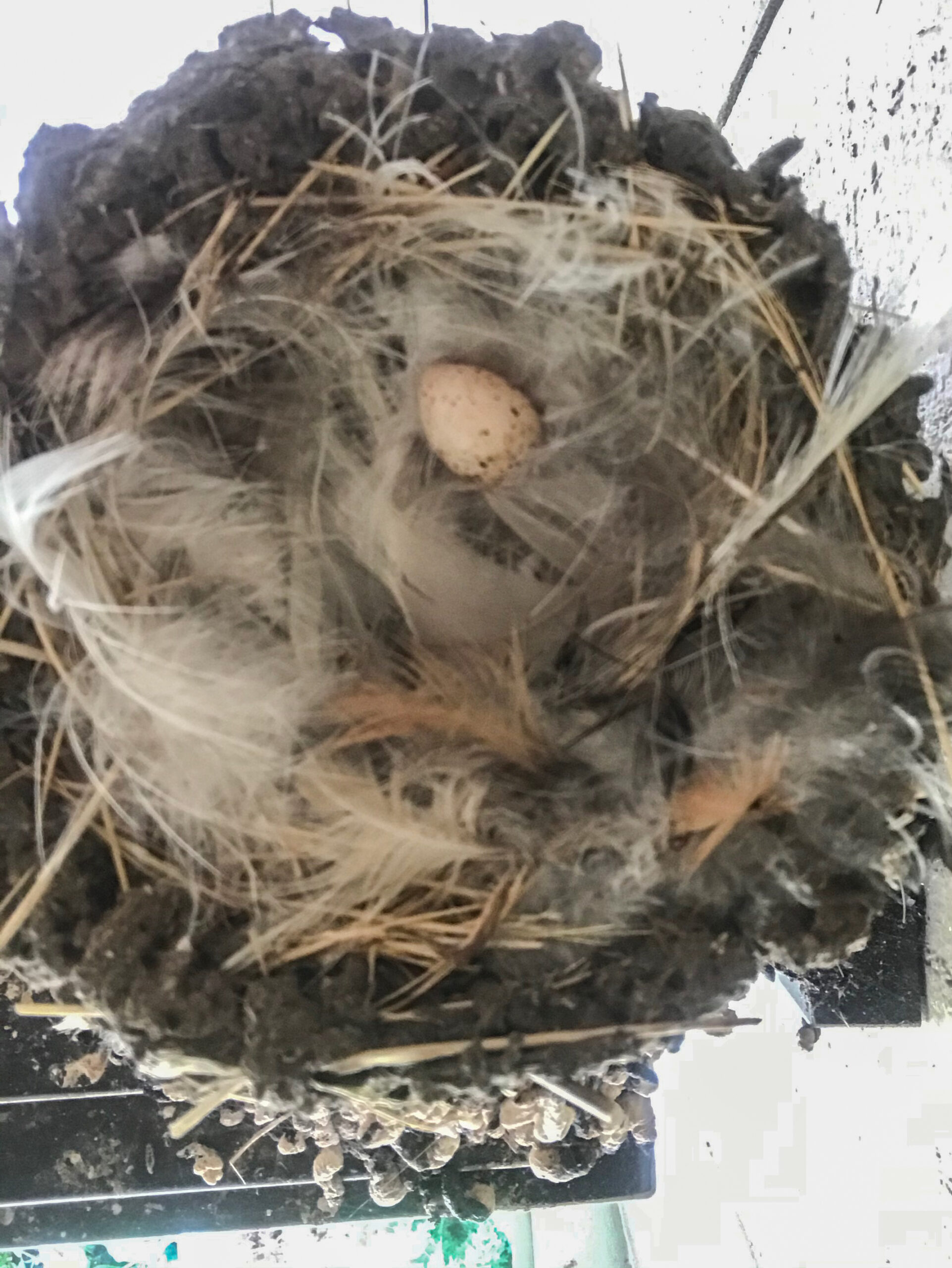

The second front-porch brood has fledged and no longer comes back at night, nor do the parents. I climb a stepladder to peek inside and see the soft bowl of white and copper chicken feathers—and one wee swallow egg the shape of a raindrop. Something inside this little capsule wasn’t right. Perhaps it wasn’t fertilized and thus never developed. Or something in the cell division after fertilization went awry and the development abruptly stopped. I hold it gently in my hand, marveling and wondering.
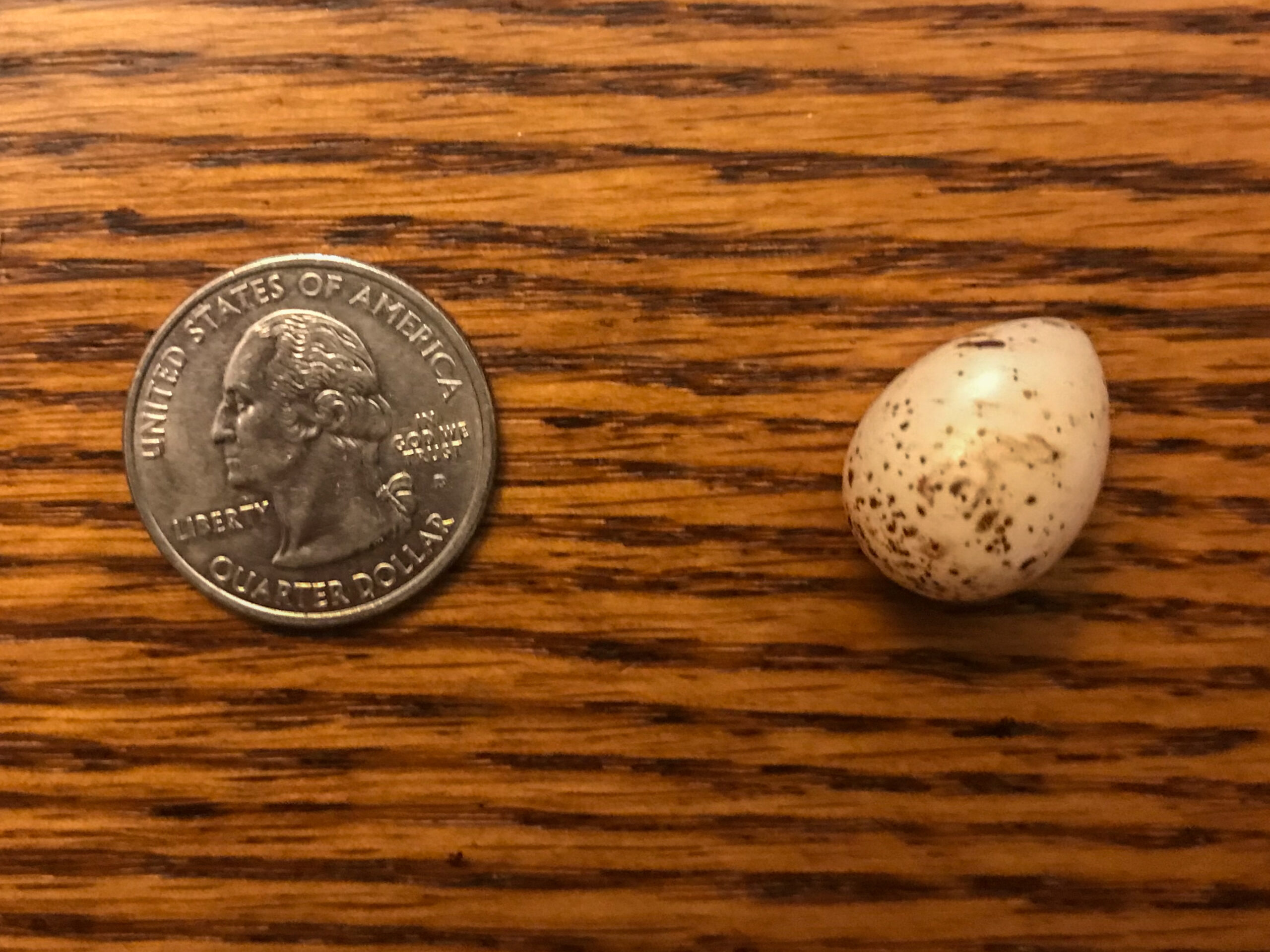
One day soon there will be a change in the weather. A front will come through, and the next day the wires will be empty. The constant burbling chatter of summer mornings will be absent. Sure, in the next two weeks I’ll see a few swallows swooping over the pasture, passing through from summering grounds farther north. But one day they will be gone for good, and I’ll pull out the brushes and hose to begin the end-of-the-swallow-season clean-up.

Click on the image above to visit the Cornell University LAB OF ORNITHOLOGY web page for the barn swallow migration animation.
For the Barn Swallow Class of 2020, it’s not the end—it’s the beginning of a grand adventure. Migration! Endless days of flying and feeding on their way to Central and South America, filling up on the greater variety of insects in the tropics. I wonder if they travel in the same group of one hundred or mingle and divide randomly. What predators must they avoid? Do they play the feather game along the way? When they get to their wintering grounds, the adults molt their body and flight feathers. THAT must take a lot of energy. Are they less active during this transformation? When the change in day length triggers the push to move again, do they make false starts? Do they make a direct flight or do they stop to rest and feed for a week or two along the way?
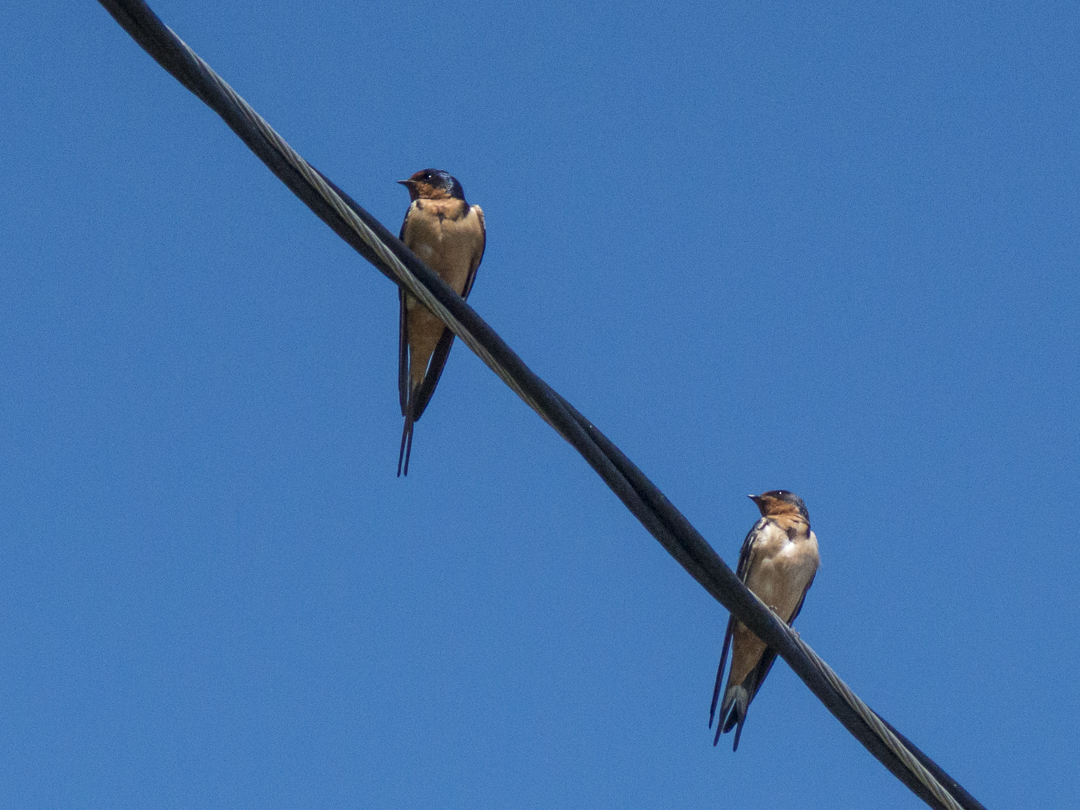
Photo by John F. Williams
And this year brings other sobering questions. How many of the barn swallows made it through the fires in Oregon and California? Did they change course to avoid the flames and smoke? Were there enough insects available to sustain them? The cycles I take for granted are being impacted in increasingly obvious ways as weather patterns become unpredictable.
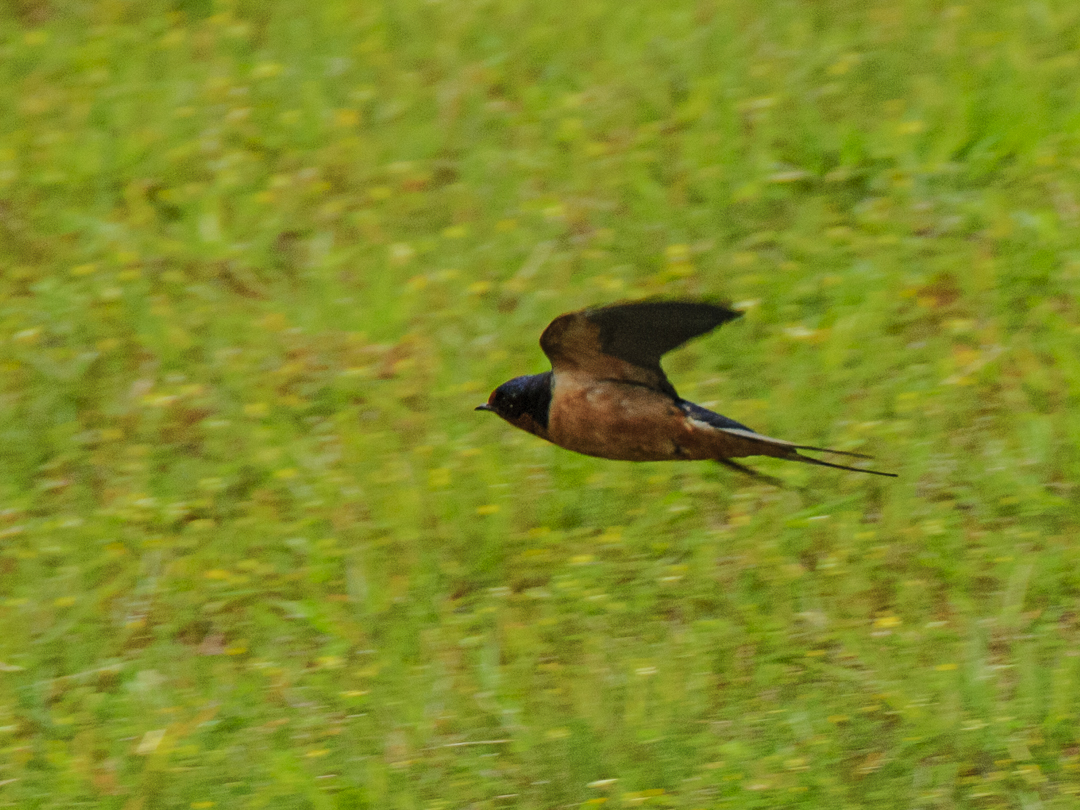
Photo by John F. Williams
So many things to ponder in the deep, dark nights of December. Where are the swallows now? What’s beginning to emerge under the leaf litter, the end of last year’s foliage? The stinking carcasses of chum salmon in the creek down the road might look like the end of the salmon run, but eggs are nestled like precious jewels in the gravel—the Wheel of Life is turning. Soon the sun will rise a little earlier and set a little later. At least that cycle is unaltered. I’ll start thumbing through seed catalogs, and in a few short months I’ll scan the skies for those graceful little birds with inky blue wings. A new swallow season will begin.
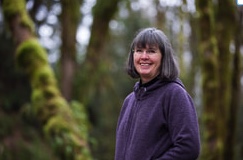
Donna Bunten studied natural history and ornithology at The Evergreen State College and recently retired from the Department of Ecology, where she helped local governments adopt good wetland protection programs. Donna believes that much of what ails us, both individually and as a society, can be healed by paying attention to the natural world with wonder and curiosity. She is looking forward to spending her days observing her world and writing about what she sees. Donna lives in Olympia with her husband, son, an assortment of chickens and two cairn terriers.
Table of Contents, Issue #10, Winter 2020
Woodland Witness
by Zoe Wadkins Winter 2020 Drawings by Zoe Wadkinsby Zoe Wadkins, Winter 2020 Drawings by Zoe WadkinsIn the three years since our first introduction, I have walked this loop of Deer Creek more than one hundred times. Its rich macroinvertebrate habitat constitutes a...
Restoring Forests
by Dan Hintz, Winter 2020You can see this 2019 Mountains to Sound Greenway tree planting site at Lake Sammamish State Park, located along Issaquah Creek. Photo by Katie Egresi.You can see this 2019 Mountains to Sound Greenway tree planting site at Lake Sammamish State...
Salish Sea and Dinosaur Pee
by Sarah Lorse, Winter 2020 Photo by Sarah Lorseby Sarah Lorse, Winter 2020 Photo by Sarah LorseHow wonderfully wet things are here beside the Salish sea. Whether it is a big fat raindrop dangling off your nose or the impressive volume of a king tide, water is all...
See the Salish Sea by Saddle
by Jessica C. Levine, Winter 2020 Photos by Jessica C. Levineby Jessica C. Levine, Winter 2020 Photos by Jessica C. LevineI spend a considerable amount of time pondering cycles. As a cyclist, I bike year round. I’m also a naturalist and place-based science educator....
Many Cycles of Nature
by Leigh Calvez, Winter 2020 Photos by John F. Williams except as notedby Leigh Calvez, Winter 2020 Photos by John F. Williams except as notedAs children we come into a world filled with the cycles of nature. We watch with wonder as the first crocuses of spring poke...
Sacred Stream Insects
by Gavin Tiemeyer, Winter 2020 Photos courtesy of King County except where notedby Gavin Tiemeyer, Winter 2020 Photos courtesy of King County except where notedLearning about the natural cycles that govern the health of the Salish Sea starts with peering into your...
Issue 10 Poetry
Winter 2020Photo by Adelia RitchiePhoto by Adelia RitchieWinter 2020Water Drop By Mahathi Mangipudi Wide strokes of grey paint the sky On the windward side of the Cascades Air masses from the Pacific Ocean Saturated with water vapor Condense into little...
The Many Lives of Tree
by Pat Kirschbaum, Winter 2020Photo by John F. WilliamsPhoto by John F. Williamsby Pat Kirschbaum, Winter 2020We are so lucky in the Pacific Northwest to have many places to go where we can be surrounded by trees. As I sat alongside a nearby stream recently, I...
Community Gardens
by Alison Ahlgrim, Winter 2020Photo by Michael YatesPhoto by Michael Yatesby Alison Ahlgrim, Winter 2020My first visit to Everett was a reconnaissance mission to see if my husband and I might like to live there. Drawn to the water, we ended up at the waterfront...
COPYRIGHT
Copyright SEA-Media
All rights reserved. Reproduction or distribution, in whole or in part. without consent of copyright owner is strictly prohibited — except for brief quotations in critical reviews and other noncommercial uses permitted by copyright laws.
SEA-Media is a 501(c)(3) nonprofit corporation
PLEASE HELP SUPPORT
SALISH MAGAZINE
DONATE
Salish Magazine contains no advertising and is free. Your donation is one big way you can help us inspire people with stories about things that they can see outdoors in our Salish Sea region.
We also don't advertise Salish Magazine, so please spread the word of this online resource to your friends and colleagues.
Thanks so much for your interest and your support.