
SEE THE SALISH SEA BY SADDLE
by Jessica C. Levine, Winter 2020
Photos by Jessica C. Levine
SEE THE SALISH SEA BY SADDLE
by Jessica C. Levine, Winter 2020
Photos by Jessica C. Levine
I spend a considerable amount of time pondering cycles. As a cyclist, I bike year round. I’m also a naturalist and place-based science educator. That means being under the weather is not a sickness, but a gift. On a bike, a cycle simply demands that you be in the moment, and in nature.
On my bike commute to work I watch and wonder without a windshield. Some months, I can watch with my eyes closed; in spring I can hear the chorus of frogs. I roll right up to the edge of the lake where I’ve collected water samples for my science students. The metamorphosis from the gelatinous eggs is a wondrous cycle.
From the saddle I see sunrise shift through the seasons, and I feel the sun on my face or the rain drops on my cheeks. I’m under the weather.
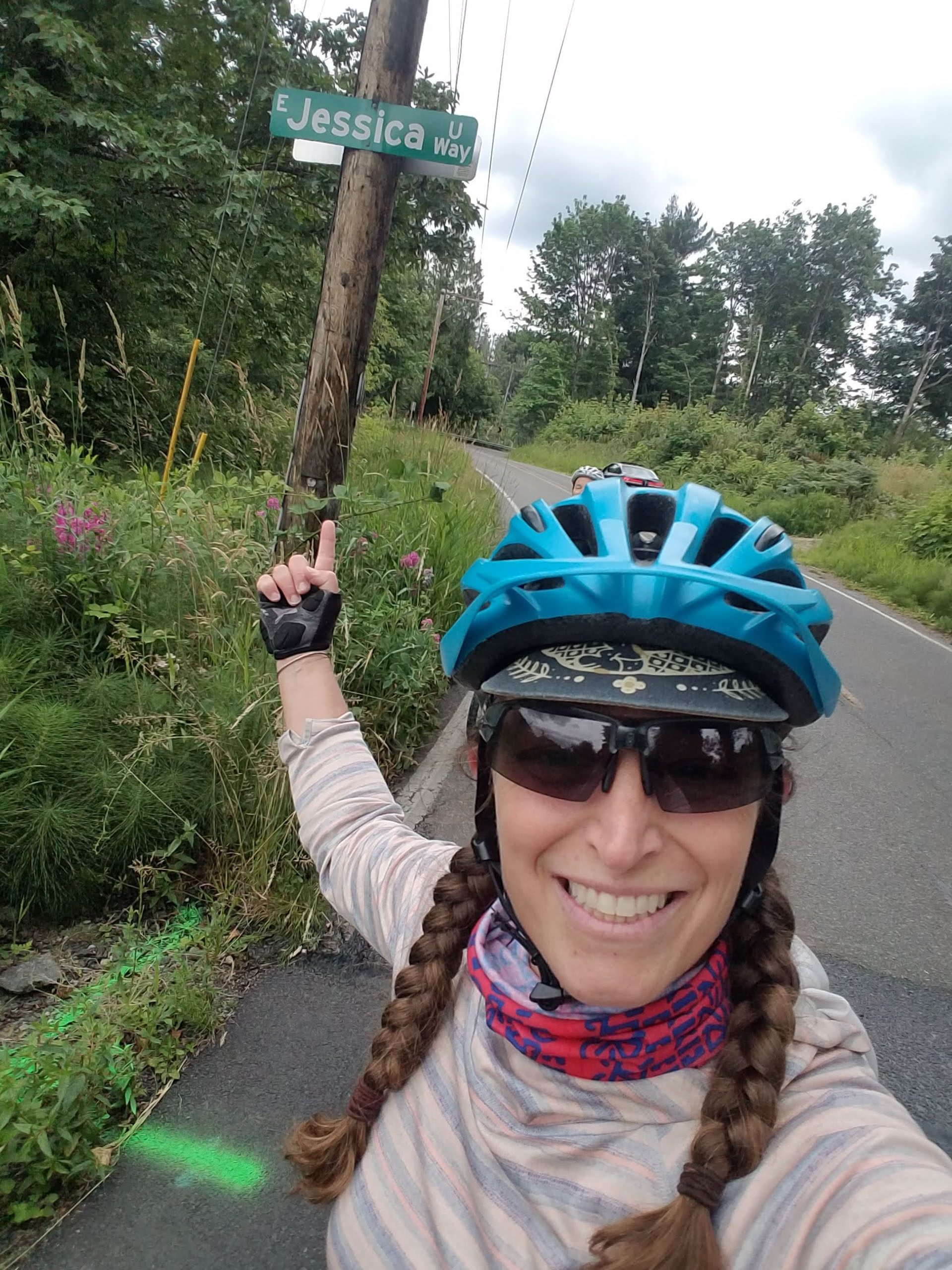
I’m also under the Bigleaf Maples. There are a few towering over the trail, at the edge of Lake Washington, that I look up to. For most of the year, they offer shade and the confirmation that we are members of the same carbon cutting crew. Those large leaves are factories of chloroplasts, converting carbon and sunlight into oxygen and sugars.
I breathe easier, smiling, knowing this marvel of science. By October, frequently in both directions of the commute, I’m bathed in the golden syrup of sunrises and sunsets; standing in my pedals, with my face to the cornucopia of lingering leaves high in broad branches. Those ocherous leaves, that turn pavement into paradise, might catch a fender, crinkle, and turn a spoke song.
For months now, damp bark is a conduit for rain running into the mat of moss below. Bare and bold branches boast the Bald Eagle, but by February I bike beneath buds, the air scented with nearby sarcococca. New leaves, and pendant flowers of spring are in the air. Samaras, the winged achene seeds, helicopter to the trail. I spin my wheels around with joy.
 See a photo essay about Bigleaf Maples in our Summer 2020 issue
Like these trees, I take root in place. Never more so than this summer. due to the pandemic. I had planned to bike in Europe, but when plans shifted, I cycled close to home.
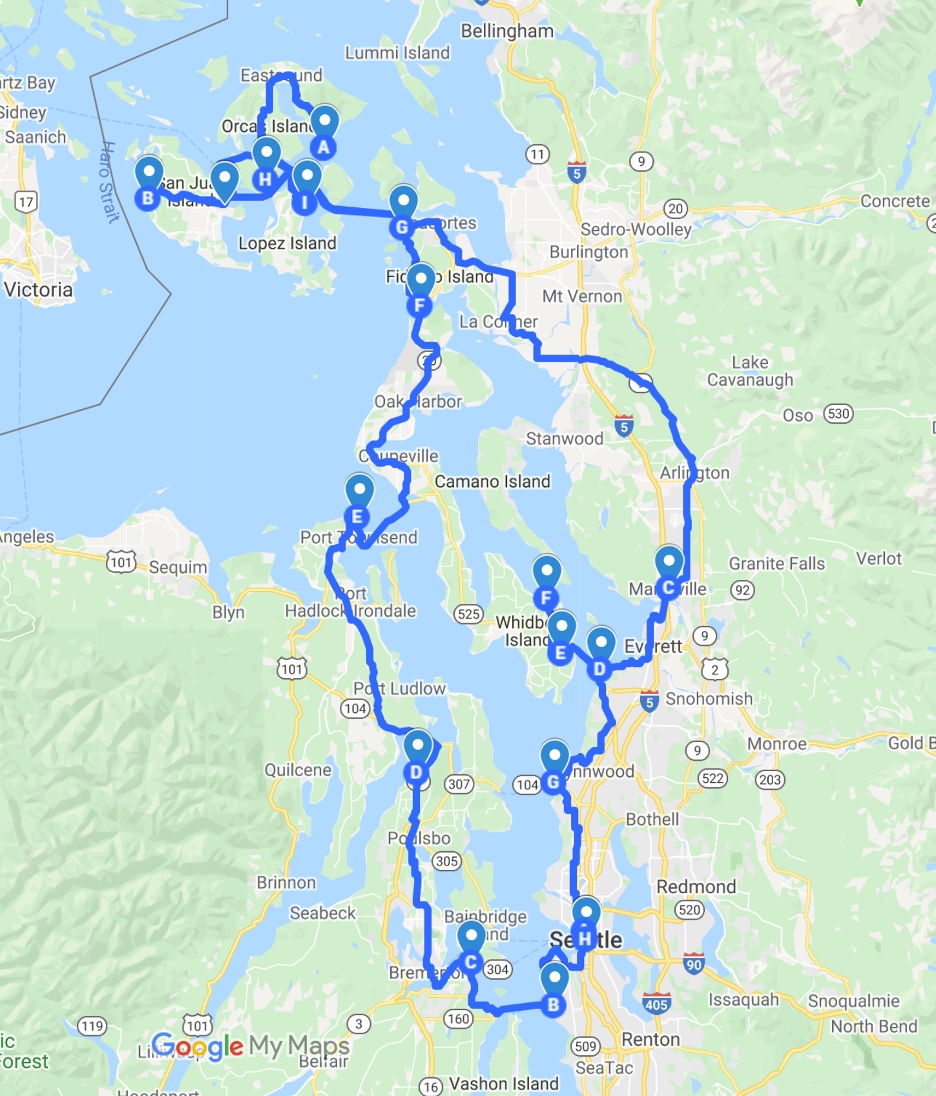
Plan C would be to See the Salish Sea by Saddle. I crafted a 350 mile loop right from my house. On this adventure Pedaling the Puget, I gained a new appreciation for cycles of the Sound. More than two weeks later I returned home a bit renewed. Like any animal in metamorphosis, or any flower to seed, I am the same species but changed. Covid crisis created a sort of chrysalis; I emerged anew.
Not drastically, but subtly, in much the same way one cannot step twice in the same river. All these local rivers and creeks and tributaries lead into Puget Sound. From the slow pace of the pedal, I had the opportunity to be more attentive to my place on the Puget and marvel at both the body of water and the region of important cultural, natural, and historical beauty. Puget Sound is home to the Coast Salish people, who have been stewards of this region’s land and waters since time immemorial.
Let me take you for a loop.
Come along for the ride.
Enjoy the views. Enjoy the Sound.
I began on the beaches in my own city of Seattle. Alki Beach in West Seattle sported a low tide as I rounded the point. I lifted my hand from the handlebars and waved to the sea stars in Constellation Park.
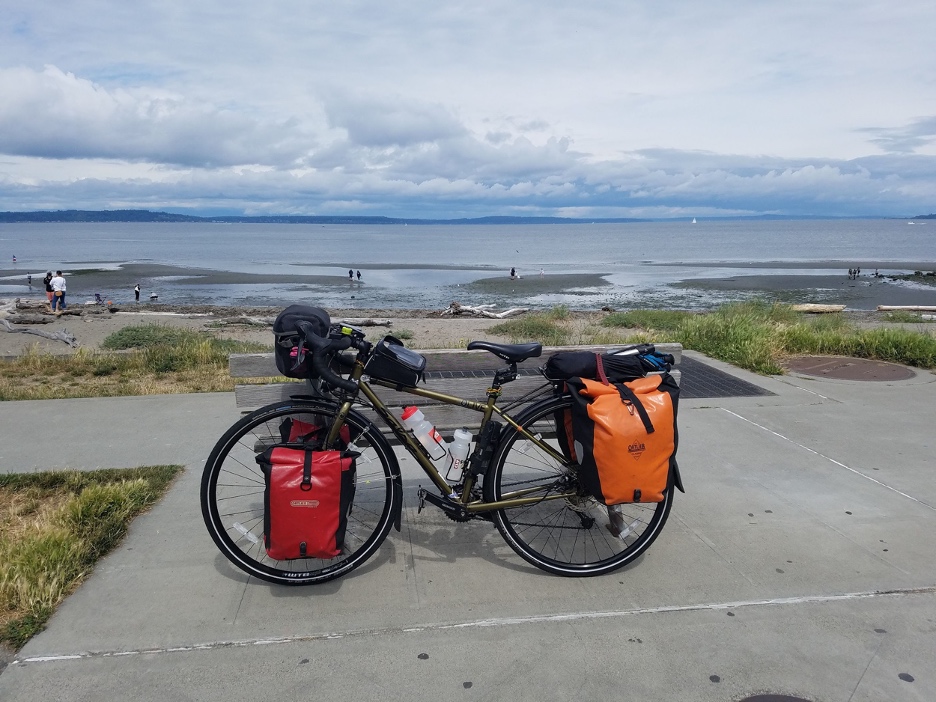
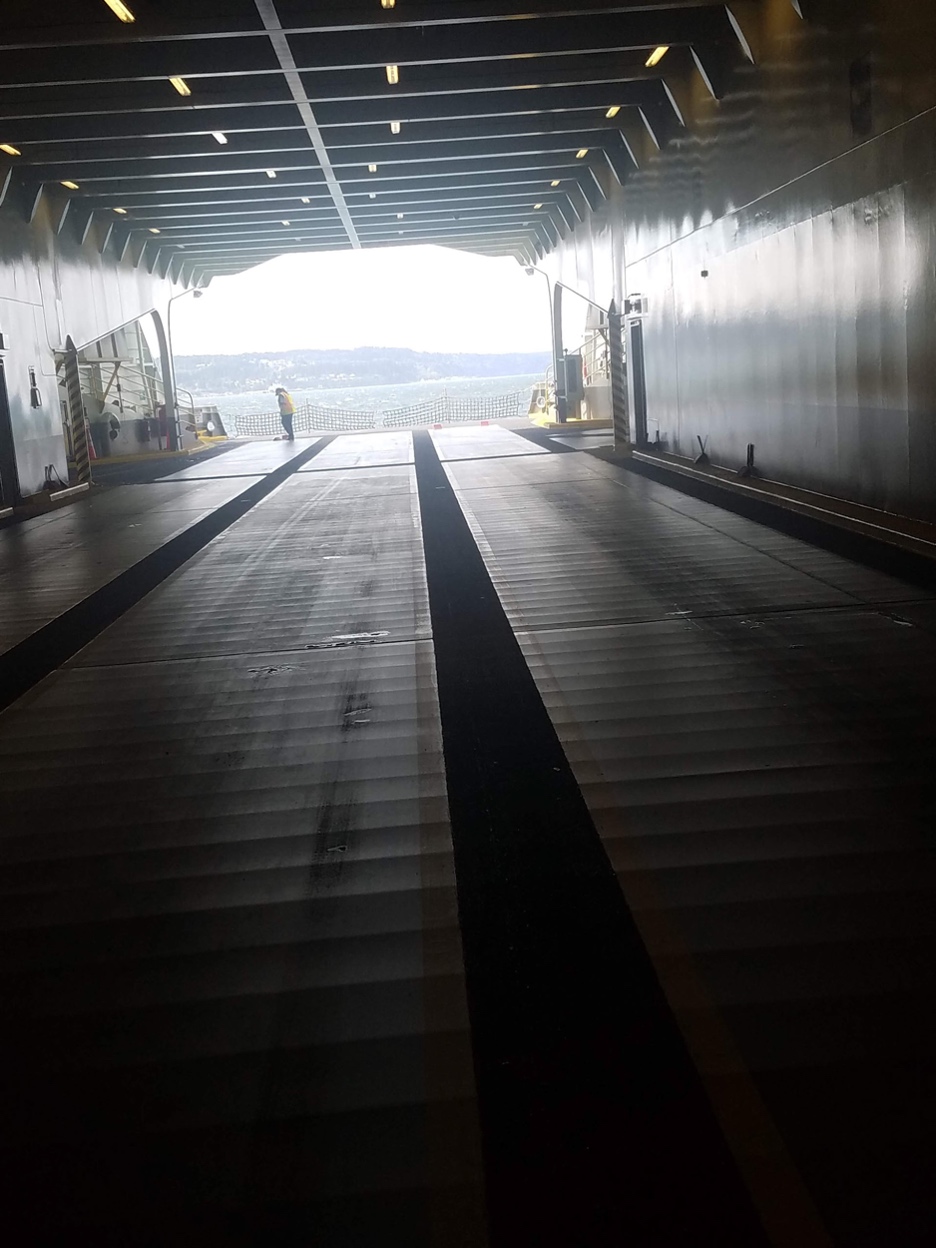
By Washington State Ferry, I made it over to the Kitsap Peninsula, riding to Manchester State Park. My route would include a number of ferries linking peninsulas and islands across the sound. From Port Orchard I took the Bremerton Foot ferry across the Sinclair Inlet, up along Viking Avenue to Poulsbo, a Scandinavian Heritage village on a bit of the Puget so similar to Norwegian fjords I could taste the brunost before I stopped for lunch. In the shade of a big leaf maple on Big Valley Road I met Mackenzie at the edge of her driveway on her pink bike. She asked me about snakes and mentioned the wild ones in her garbage bin. After my snack, I slithered away on my skinny tires.
If I was somewhat nervous crossing the Hood Canal bridge, even with the wide shoulders, the seal swimming alongside me, gave me peace of mind. Creatures of our Sound, like selkies of Scottish lore, always seem to look out for me. Or maybe I look out for them.
Cycling onto the Olympic Peninsula I was cornered when I stopped to triangulate my route along Highway 104 towards Route 19. My GPS wanted me to cut the hypotenuse, and so did Google Maps. So, I found myself on a quiet forest road along the Shine Quarry. I was alone among the silence, alders, and wildflowers. Thimbleberry’s bright red fruit, like an incessant tiny blinking traffic light, begged me to stop for a taste of the jam.
The Chimacum Valley is home to agricultural wonders, including the FinnRiver Cidery, where owner Chrystie Kinsler and I spoke about bioregionalism, food justice and the power of place, as I sipped cider in the sun. I turned off the Beaver Valley Road and onto the Larry Scott Memorial Trail — a 7.4 mile multi-use trail that winds into Port Townsend, through the trees, and then alongside the sound, near the Port Townsend Paper Mill. There is a scent of salt and sulfur — a stinging reminder of our economic interactions with our Northwest forests.
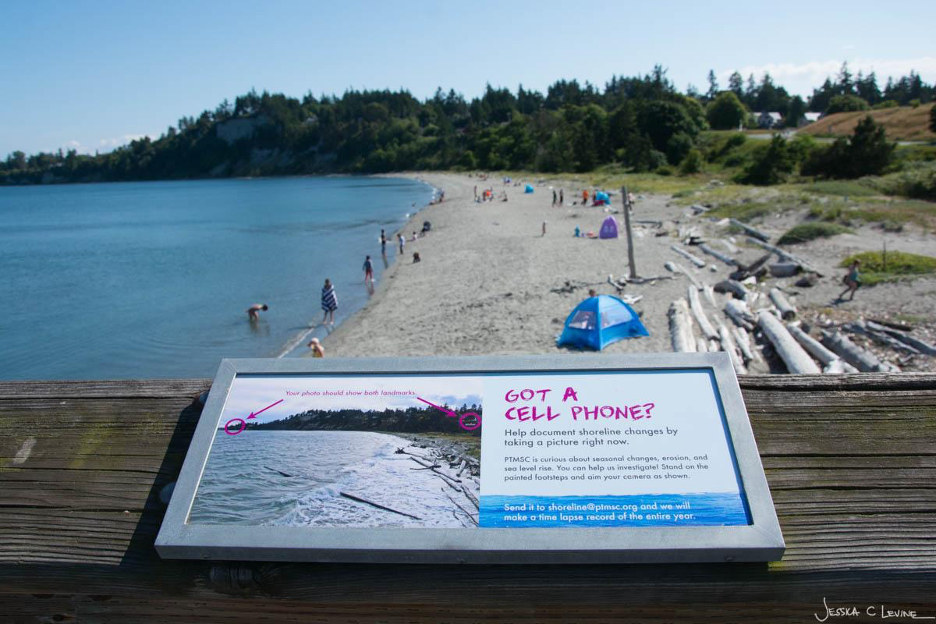
Artful homes along the back streets off Discovery Road rolled into Fort Worden and it was downhill from the officers quarters to the beautiful beach at this state park full of concrete batteries and bike friendly beauty.
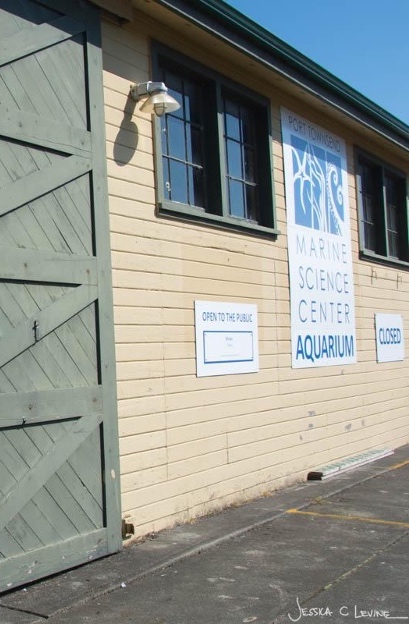
One can peer from the pier at the sedimentary systems and snap a photo to document changes in the shoreline. We are all scientists when we share data. I wished the Marine Science Center was open so I could science teacher it up while looking more closely at the creatures beneath the surface.
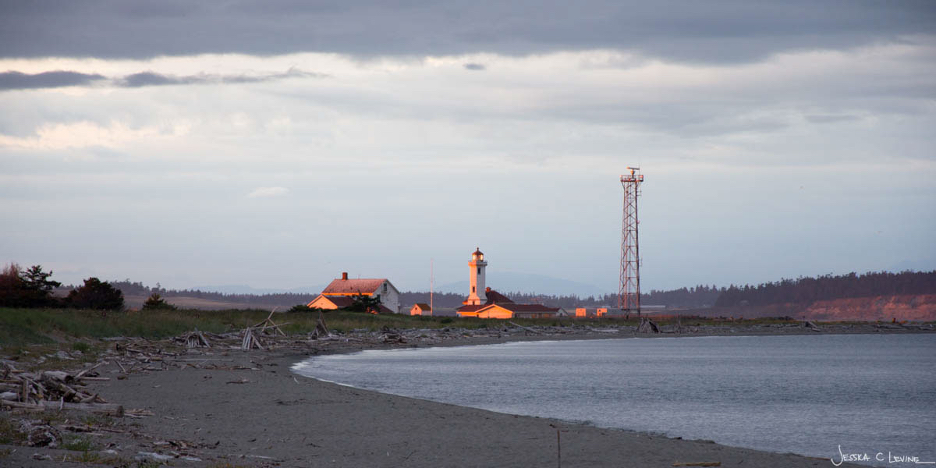
The lighthouse at Point Wilson guards the entrance to Admiralty Inlet and the Strait of Juan de Fuca
At low tide, one can walk around the point and stare into the Strait and across to Fort Ebbey and further north to the San Juan Islands.
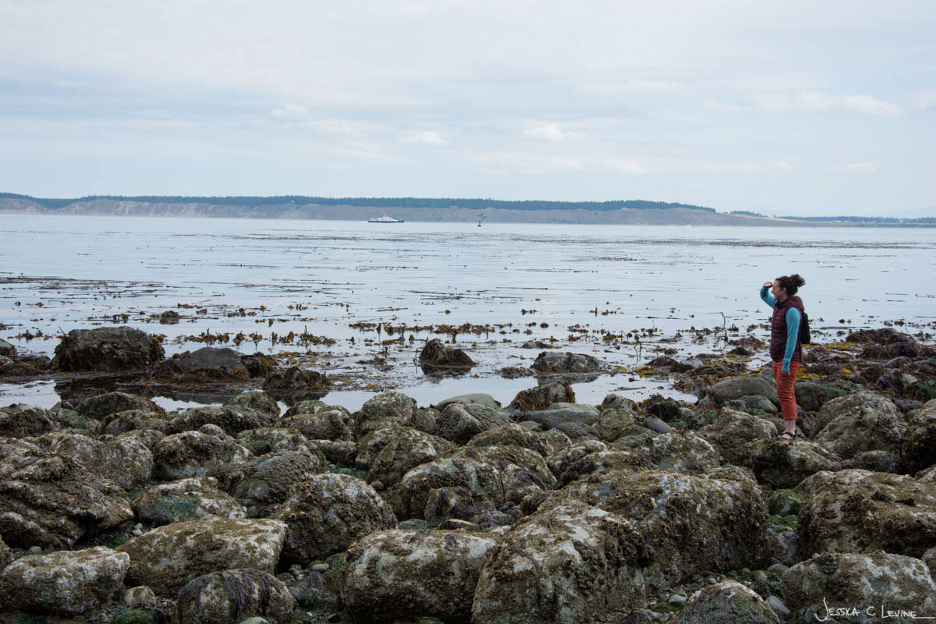
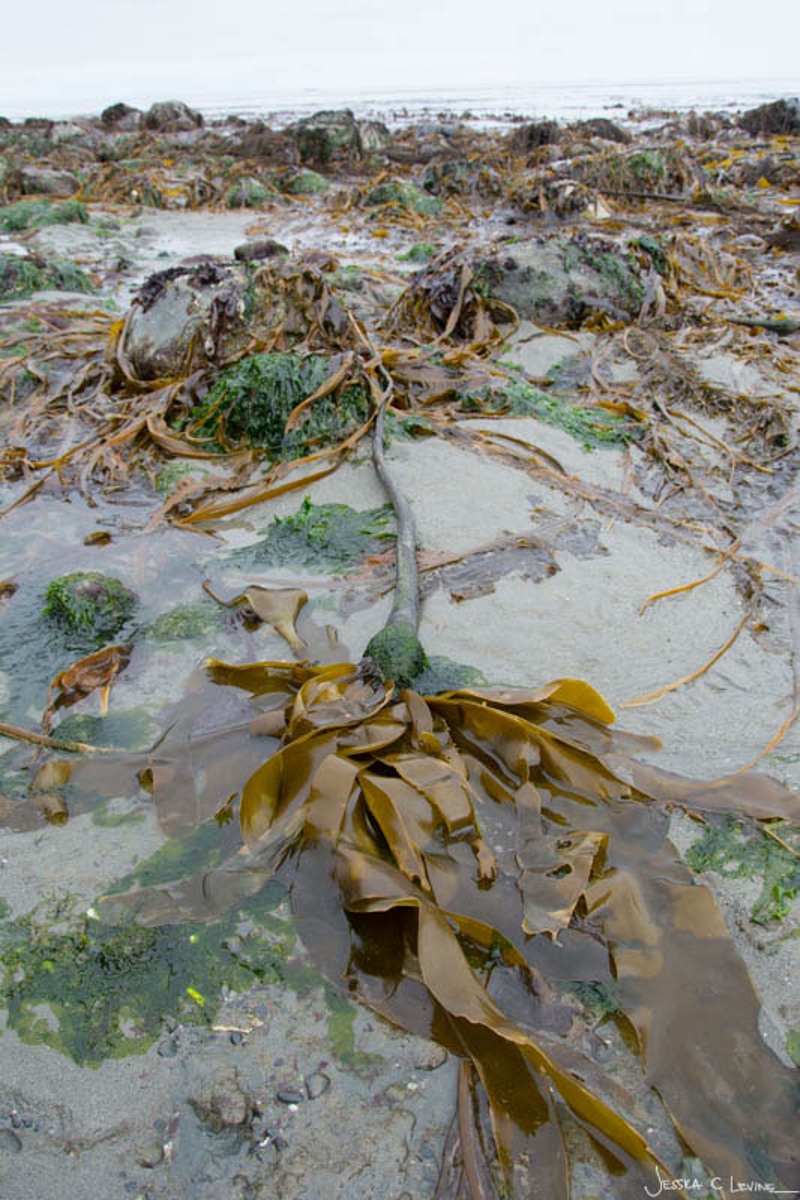
We danced on boulders shaped like shoulders of elephants, while the kelp forest danced in the rough and tumble of the surf. The pneumatocyst bobbed it’s buoyant head and waved bronze blades beckoning me closer to the edge. I was barefoot and longing, looking deep. Deep down, I always long for whales. Down deep, the hold fast of the bull kelp clings tightly to rocks.
“When the tide is out the table is set.” This adage from our coast Salish elders is true not just for us humans, but for other marine foragers like the otter and eagle.
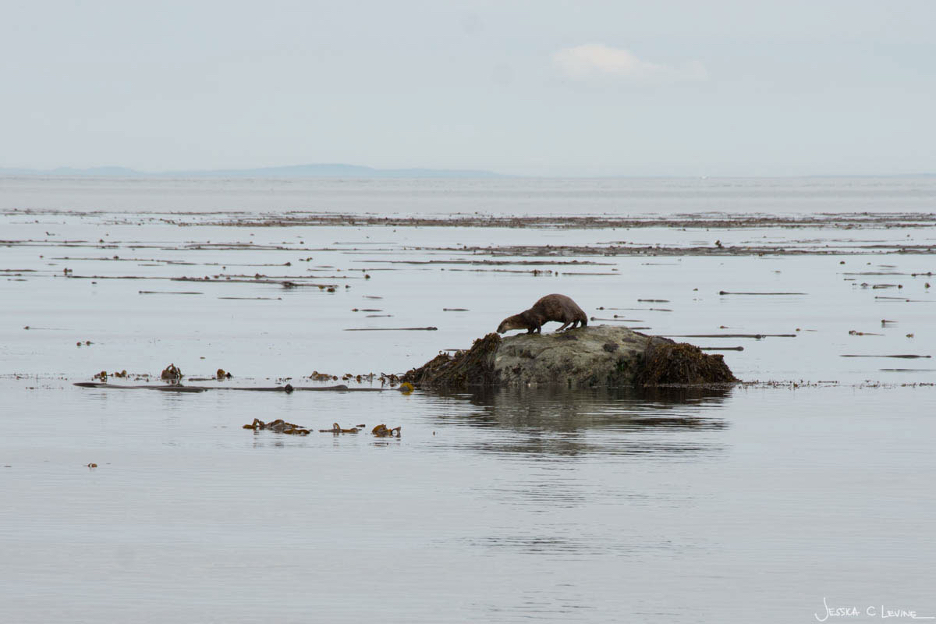
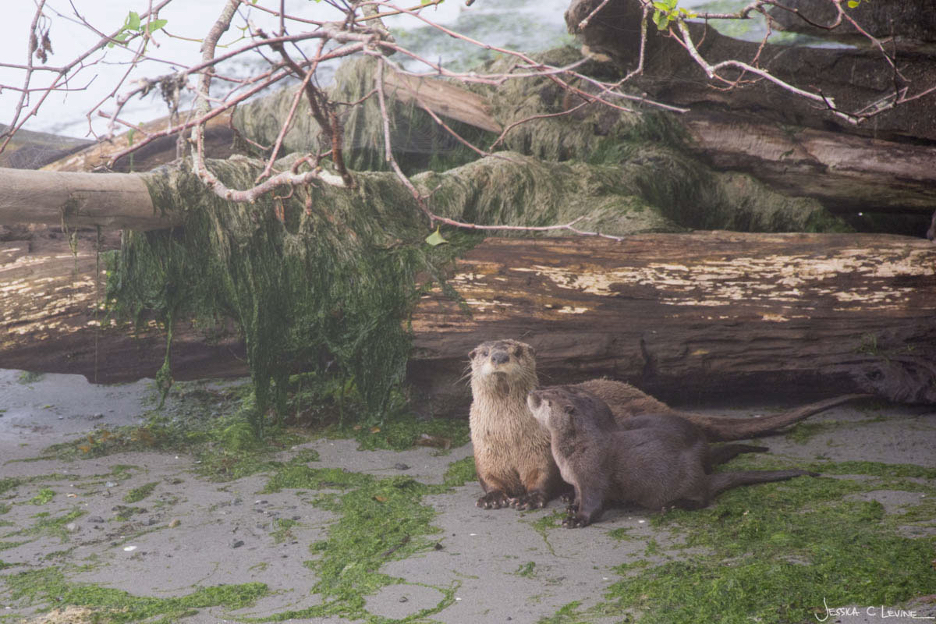
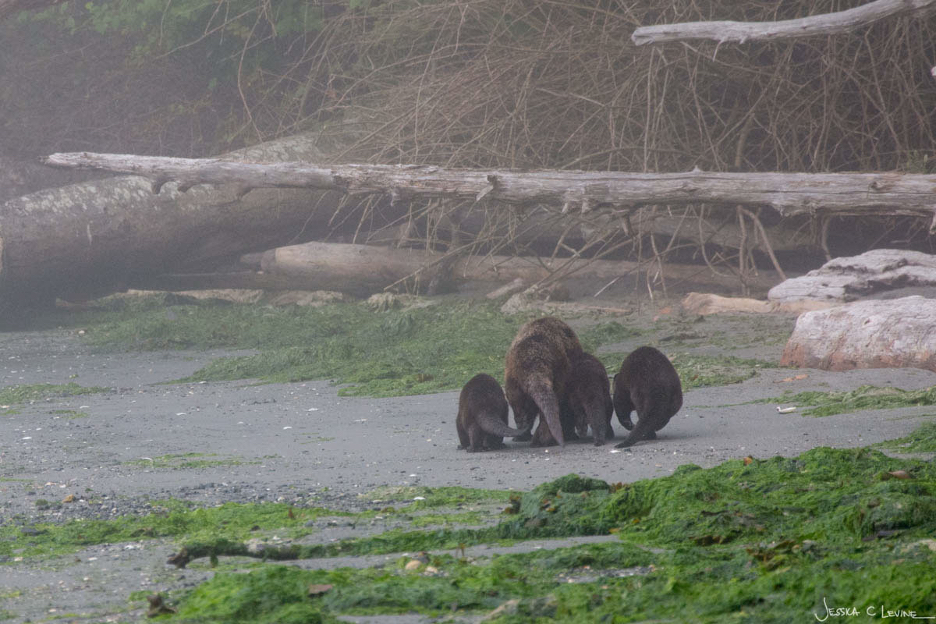
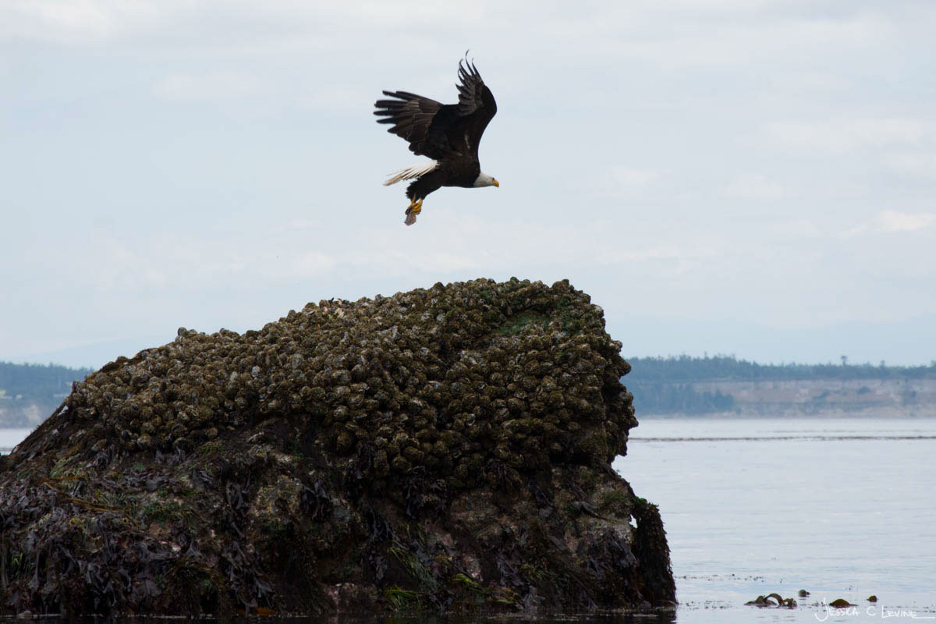
The Port Townsend-Coupeville ferry brings cyclists to Whidbey Island, where the aptly named Madrona Way hugs along the crescent of Penn Cove. Bronze-barked beauties lean strongly over the road and reach thick dark green leaves towards the water. Dozens of mussel rafts dot, or square rather, the surface of the Cove. According to Penn Cove Shellfish, mussel farming enhances the habitat and health of the marine ecosystem. Each raft supports between 900 and 2500 mussel lines and can yield up to 50 pounds of mussels per line.
I muscled up the Zylstra Road hill waving bye-bye to the bivalves by bicycle. I continued up the northern half of the island where Navy planes occasionally buzzed overhead. From the Deception Pass bridge I looked over at the waters and wondered again: What color is the Puget? Such a diverse palette of place.
From Fidalgo Island, I ventured to the San Juan Islands where, for most of a week, I cycled the scenic byways, looping the islands served by lapping the interisland ferry system. There are ample opportunities in state and county parks with first-come-first-served bike camping. Beaches, books, bonfires, sunsets, and surf. I know owl be back.
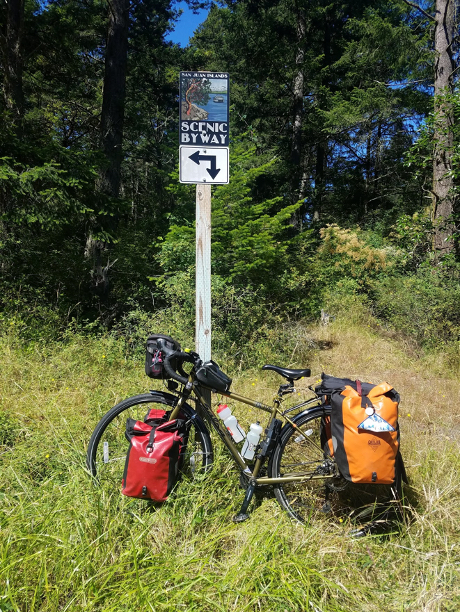
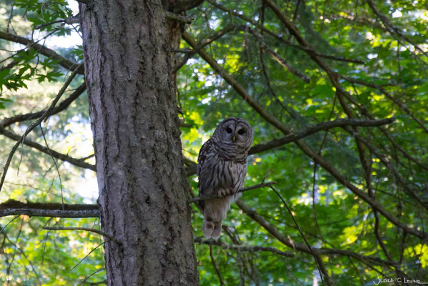
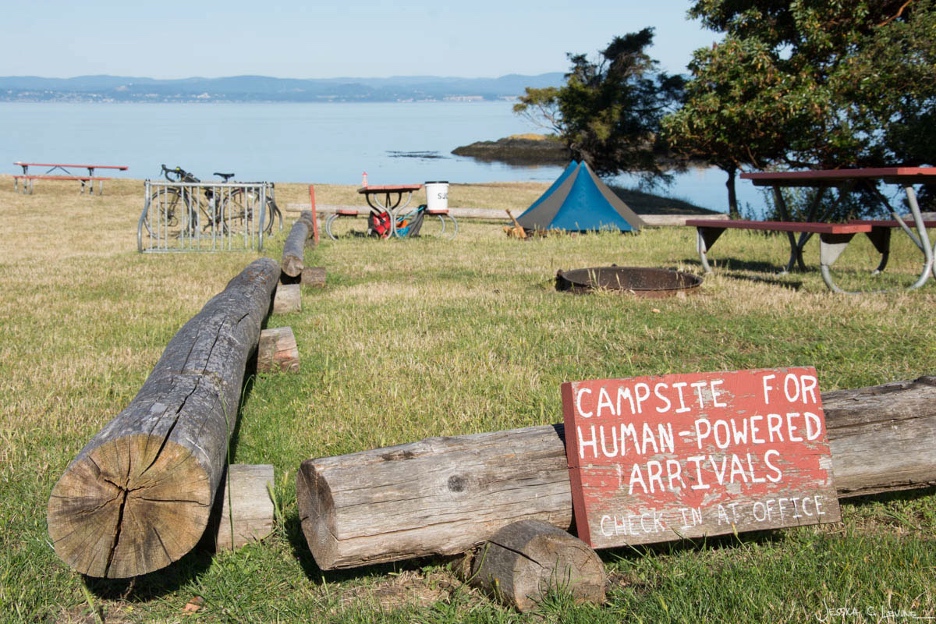
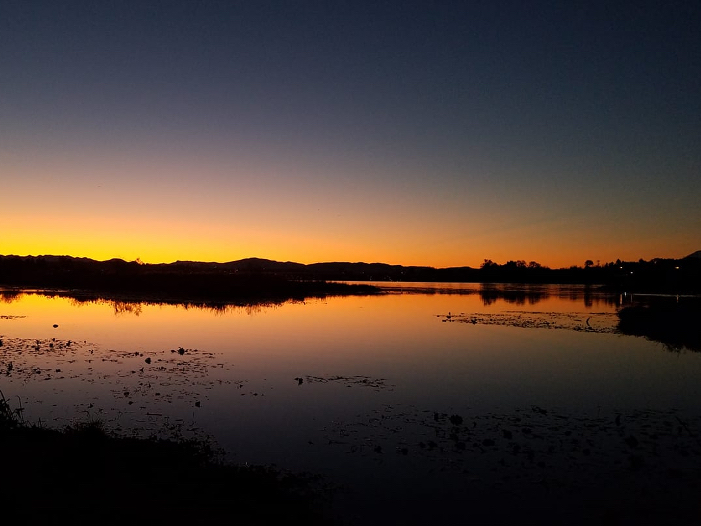
Sunset from San Juan County Park was on fire!
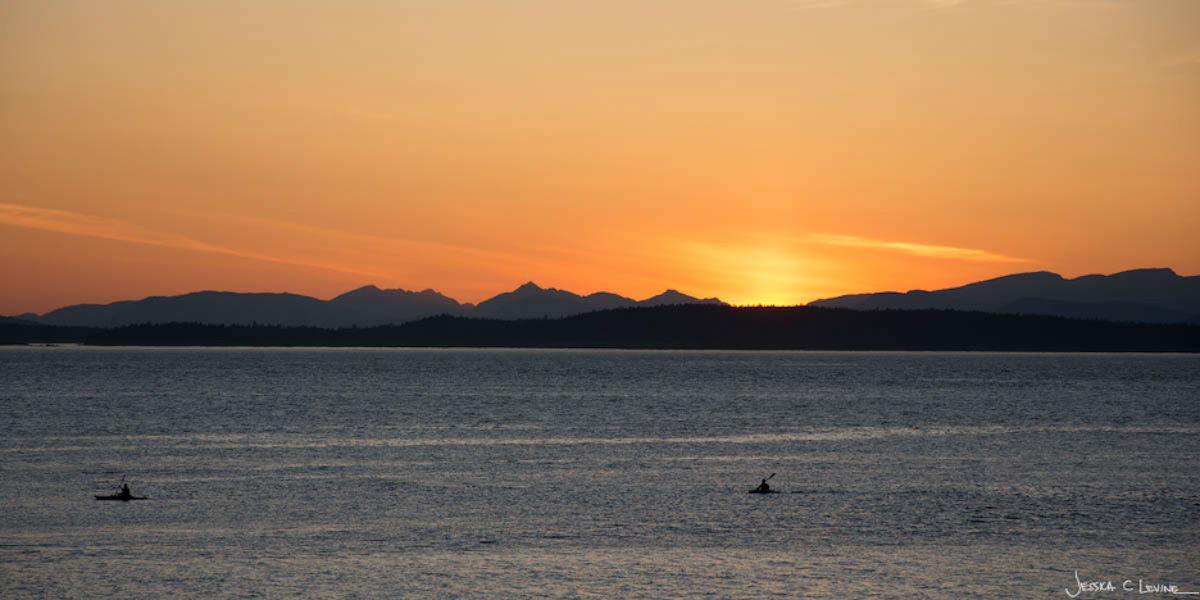
Sunset from San Juan County Park was on fire!
Returning to the mainland on the loop home, I meandered out of Anacortes to find the Tommy Thompson Trail across the Fidalgo Bay Aquatic Reserve. The trail is named for two Tommy Thompsons — a father and son. The son was a train enthusiast. The father, a renowned chemist, and oceanographer began research in the 1920s at what was the San Juan Island Puget Sound Biological Station (now the University of Washington Friday Harbor Labs where he was a director from 1931–1951). According to the Annacortes Now website, one of the goals of the station at the time was to “instruct grade school teachers in the fundamentals of biology so that they in turn may create and foster interest in biology in the children under them.”
Talk about full circle.
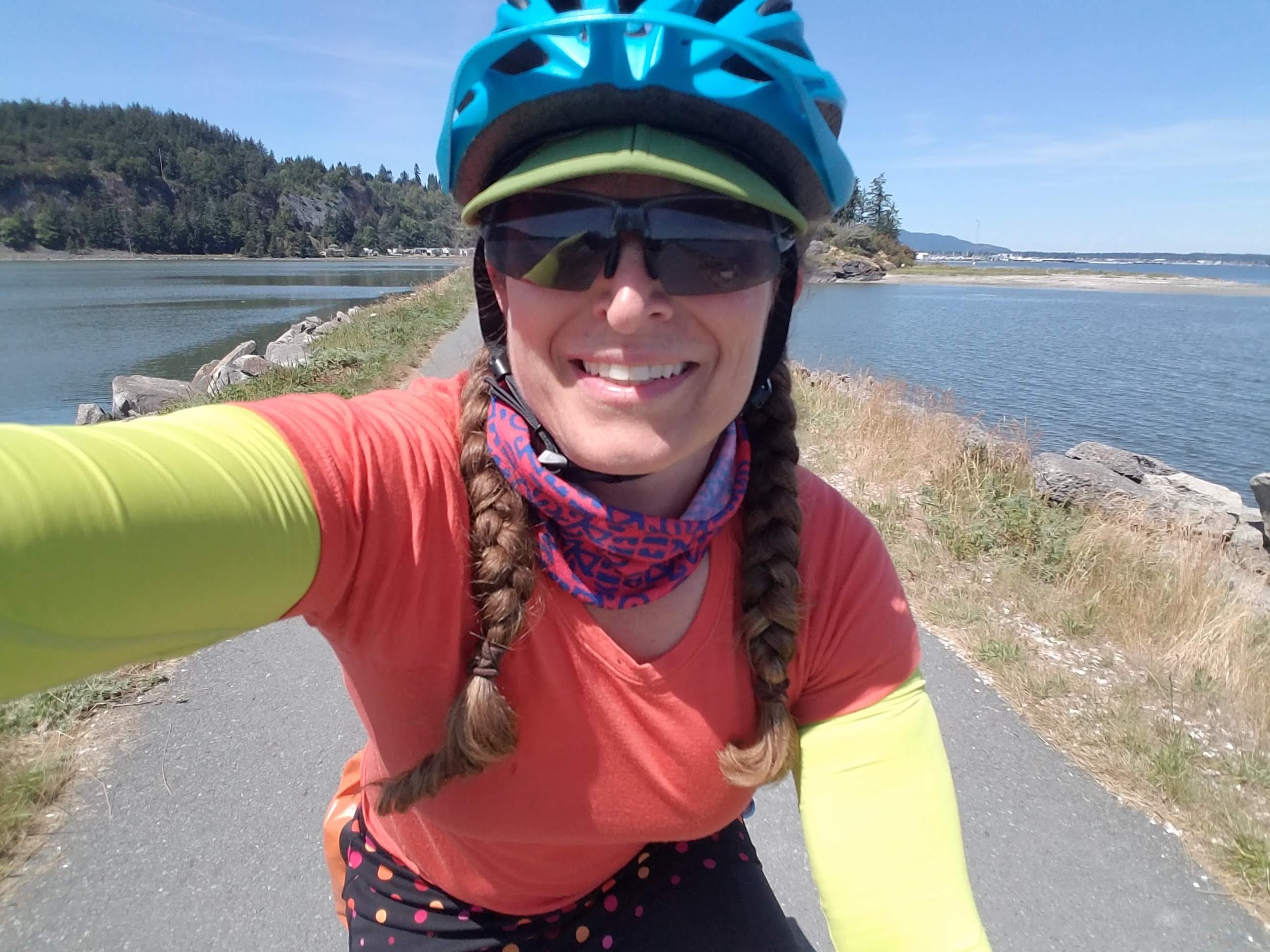
On the Tommy Thompson Trail, Anacortes
I soared along the trail with herons; their long legs, like a kite tail from wide wings. We soared together over the Swinomish Channel which cuts the island from the mainland of Skagit County. It’s the confluence and flood plains of the Skagit and Swinomish Rivers that makes rich alluvial soils for our region’s productive agriculture. I biked on Best Road by crop names in fence rows remembering spring tulip tours. Green melons, red peppers, chartreuse and tasseled corn, and other colorful produce, filled sturdy wooden hip-height displays at Snowgoose Produce, on Fir Island–the result of the split of the North Fork and South Fork of the Skagit River. I treated myself to a cold ice cream.
Seeking shade from the hot summer’s day, the dappled light of the forests of Snohomish County’s Centennial trail was a respite. The rail trail goes over the Stillaguamish River, and I pondered poems by Robert Sund, or at least the title of his collection– Ish River Country.
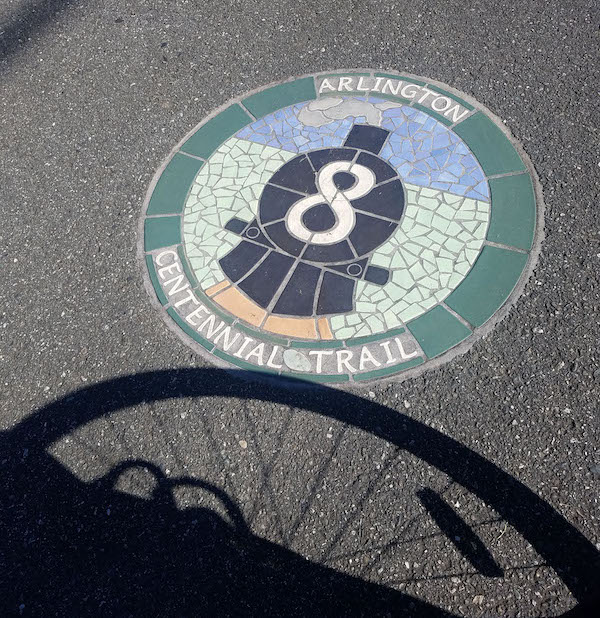
Along the I-5 corridor heading south, I began, not only the physical journey, but the mental journey home. My bike helps me find balance, fight climate change, and connect with cultural and natural communities while exploring life the two wheeled way. Seeing the Salish Sea in this loop, in this cycle, by bicycle, shifted my views. Without windshields, without reservations, and with wide wonder, by Pedaling the Puget, and pedaling through a pandemic, I gained a new appreciation, new questions, and new connections to my place on the Puget.
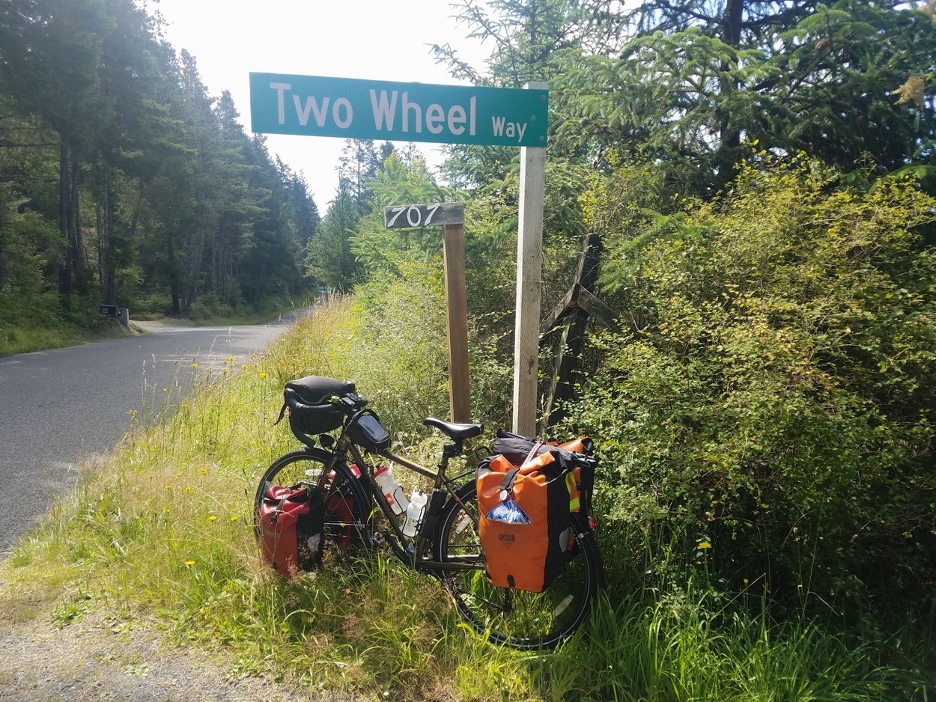
Puget Sound is a wondrous ecosystem, linked by ferries and rivers, and roads, and trails. From the broad leaves, the thimbleberry, the bull kelp, the eagle, the otter, the salt, the sulfur, the shade, the mussels, and the chorus of the frogs, I am here on the Salish. I am home.
Ride on, write on, right on.
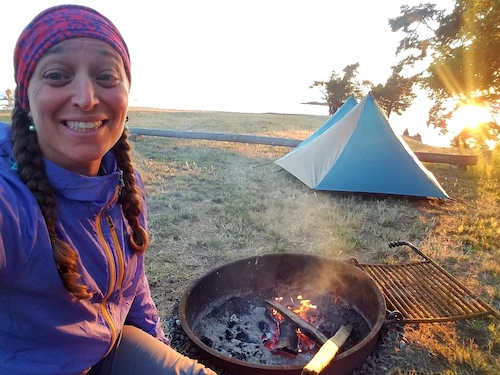
Jessica is a peripatetic of place. A three time Poetry on Buses poet, regular bike commuter and adventure cyclist, Jessica Levine is also a passionate middle school science teacher, with a photographic eye, punny poetic ear, and love of learning and storytelling.
Table of Contents, Issue #10, Winter 2020
Woodland Witness
by Zoe Wadkins Winter 2020 Drawings by Zoe Wadkinsby Zoe Wadkins, Winter 2020 Drawings by Zoe WadkinsIn the three years since our first introduction, I have walked this loop of Deer Creek more than one hundred times. Its rich macroinvertebrate habitat constitutes a...
Restoring Forests
by Dan Hintz, Winter 2020You can see this 2019 Mountains to Sound Greenway tree planting site at Lake Sammamish State Park, located along Issaquah Creek. Photo by Katie Egresi.You can see this 2019 Mountains to Sound Greenway tree planting site at Lake Sammamish State...
Salish Sea and Dinosaur Pee
by Sarah Lorse, Winter 2020 Photo by Sarah Lorseby Sarah Lorse, Winter 2020 Photo by Sarah LorseHow wonderfully wet things are here beside the Salish sea. Whether it is a big fat raindrop dangling off your nose or the impressive volume of a king tide, water is all...
Many Cycles of Nature
by Leigh Calvez, Winter 2020 Photos by John F. Williams except as notedby Leigh Calvez, Winter 2020 Photos by John F. Williams except as notedAs children we come into a world filled with the cycles of nature. We watch with wonder as the first crocuses of spring poke...
Swallow Season
by Donna Bunten, Winter 2020 Photos by Donna Bunten except as notedPhoto by John F. WilliamsPhoto by John F. Williamsby Donna Bunten, Winter 2020 Photos by Donna Bunten except as notedI dread August—the end of summer, sliding farther down the slope towards darkness,...
Sacred Stream Insects
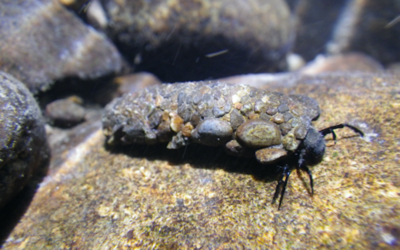
by Gavin Tiemeyer, Winter 2020 Photos courtesy of King County except where notedby Gavin Tiemeyer, Winter 2020 Photos courtesy of King County except where notedLearning about the natural cycles that govern the health of the Salish Sea starts with peering into your...
Issue 10 Poetry
Winter 2020Photo by Adelia RitchiePhoto by Adelia RitchieWinter 2020Water Drop By Mahathi Mangipudi Wide strokes of grey paint the sky On the windward side of the Cascades Air masses from the Pacific Ocean Saturated with water vapor Condense into little...
The Many Lives of Tree
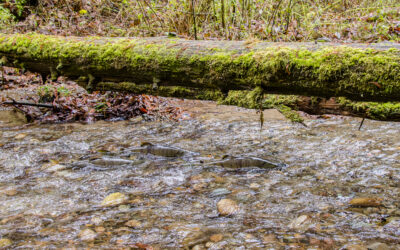
by Pat Kirschbaum, Winter 2020Photo by John F. WilliamsPhoto by John F. Williamsby Pat Kirschbaum, Winter 2020We are so lucky in the Pacific Northwest to have many places to go where we can be surrounded by trees. As I sat alongside a nearby stream recently, I...
Community Gardens
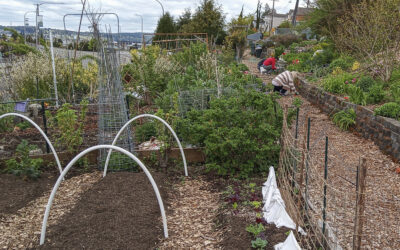
by Alison Ahlgrim, Winter 2020Photo by Michael YatesPhoto by Michael Yatesby Alison Ahlgrim, Winter 2020My first visit to Everett was a reconnaissance mission to see if my husband and I might like to live there. Drawn to the water, we ended up at the waterfront...
COPYRIGHT
Copyright SEA-Media
All rights reserved. Reproduction or distribution, in whole or in part. without consent of copyright owner is strictly prohibited — except for brief quotations in critical reviews and other noncommercial uses permitted by copyright laws.
SEA-Media is a 501(c)(3) nonprofit corporation
PLEASE HELP SUPPORT
SALISH MAGAZINE
DONATE
Salish Magazine contains no advertising and is free. Your donation is one big way you can help us inspire people with stories about things that they can see outdoors in our Salish Sea region.
We also don't advertise Salish Magazine, so please spread the word of this online resource to your friends and colleagues.
Thanks so much for your interest and your support.