
CASCADE MOUNTAINS, THE SALISH SEA, AND DINOSAUR PEE
by Sarah Lorse, Winter 2020
Photo by Sarah Lorse

CASCADE MOUNTAINS, THE SALISH SEA, AND DINOSAUR PEE
by Sarah Lorse, Winter 2020
Photo by Sarah Lorse
How wonderfully wet things are here beside the Salish sea. Whether it is a big fat raindrop dangling off your nose or the impressive volume of a king tide, water is all around us. What is extraordinary about the water here in Western Washington, and all over the globe, is that it is finite.
When you turn on your faucet, the water you drink is essentially the same water a salmon swam in, a seal splashed in, and a stegosaurus slurped up. Before you start worrying about dino germs, know that the water cycle is Nature’s way of allowing water to clean itself.

Photo by Sarah Lorse
the water cycle
This is our planet’s way of recycling and reusing Earth’s water supply over and over again. Each molecule of water is made up of atoms — two hydrogen atoms and one oxygen atom to be exact — H2O. Water molecules tend to “stick” together at room temperature, forming drops of water. Because Earth lies within the “Goldilocks zone” in our solar system, Earth’s temperatures allow water to exhibit all three phases of matter — solid (ice and snow), liquid (lakes, streams, oceans, and rain), and gas (water vapor).
So it doesn’t take much to cause a molecule of water to journey from one part of the water cycle to another part. As a cycle, there is no true beginning or end, but there are four main parts:
-
- Precipitation (rain, snow, sleet, hail)
- Accumulation (streams, rivers, lakes, seas, and oceans)
- Evaporation (water vapor)
- Condensation (clouds, dew)
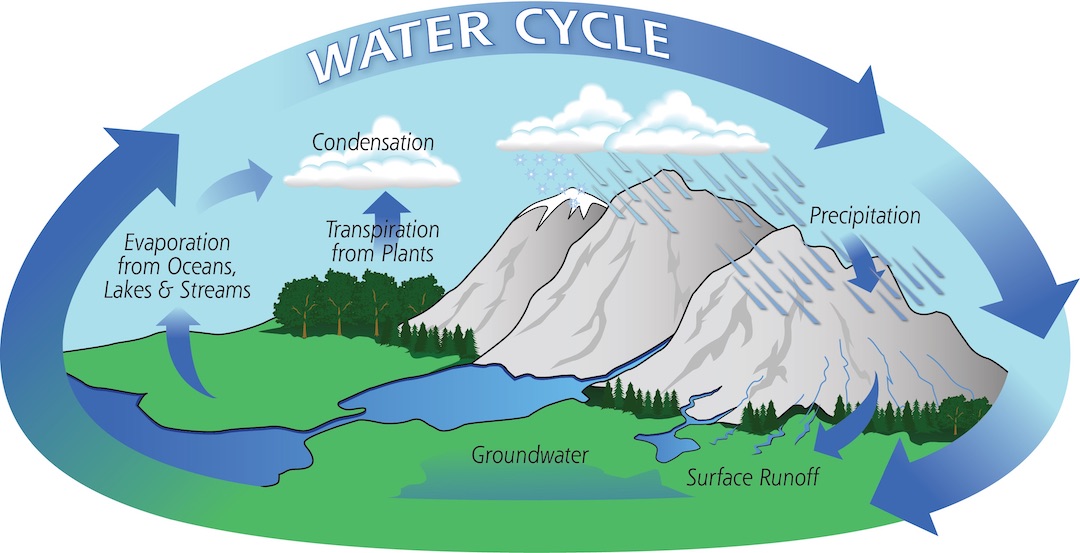
Graphic courtesy of NASA
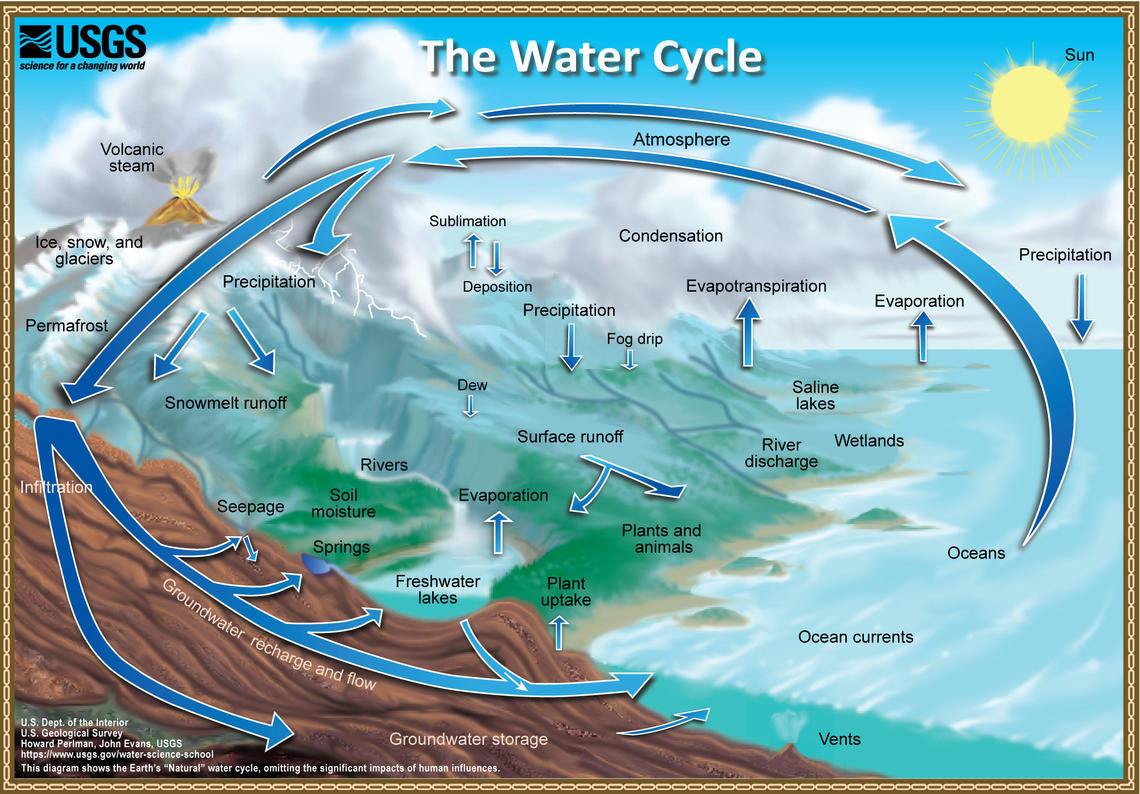
If you’d like to see lots more detail about the water cycle, click on this image!
Graphic courtesy of Howard Perlman, USGS and John Evans, USGS
Anyone who has spent any time in the Pacific Northwest is familiar with precipitation, water that is falling from the sky. During the fall, winter, and spring, most of our precipitation comes in the form of liquid rain, but some of it falls as solid snow or hail.
Once the falling water reaches the earth, it accumulates as the snowpack in the Cascade and Olympic mountains, in lakes, rivers, or even in the ground. During the accumulation phase, water is available for people, plants, and animals to use. During the summer, the Salish Sea receives very little precipitation, so the plants and animals living here rely on the water that accumulated during the soggy seasons. As mountain snows begin to melt, drip by drip, tiny streams form among the alpine heather and begin their downward journey guided by gravity.
Some water seeps into the soil, giving a drink to the mountain blueberries, and some splashes down a boulder field, letting a hoary marmot quench its thirst. As those drops of water flow downstream, they join up with water drops from other mountain streams to form larger streams and rivers, eventually finding their way to the sea.
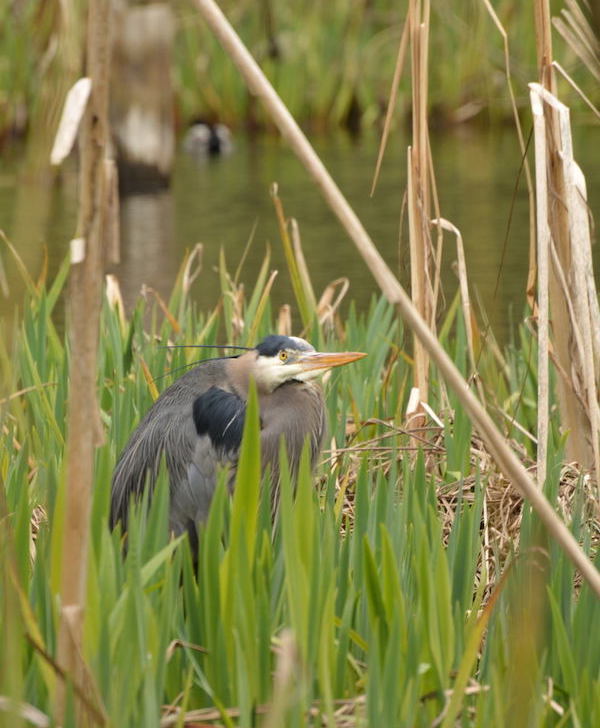
Photo by Sarah Lorse
These rivers come to life with spring drizzles, and snowmelt fills them to the top of their banks. Salmon make their redds in these rivers, raccoons wash their paws, and hummingbirds sip the spray as rivers tumble over falls.
For many humans in the Pacific Northwest, our drinking water also comes from rivers — the Cedar, Tolt, Skagit, and Nooksack Rivers are a few.
A salmon redd is a depression in a streambed’s gravel, created by the upstroke of the female salmon’s body and tail, where she deposits a few hundred eggs.
Learn more:
Video by John Gussman
Eventually, as these rivers get close to sea level, they widen and wander their way through farm fields or constructed channels to meet the Salish sea where freshwater and saltwater finally come together.
The Salish Sea is not the final destination, though. As the sun peeks out from behind the clouds, it calls the water molecules to it.
The molecules heat up under the sun’s energy and start to vibrate. When they get excited enough, they go through a phase change from liquid to gas. This is evaporation, when water vapor leaves the earth and rises into the atmosphere. Salts and pollutants are left behind as water evaporates: water’s way of cleaning itself.
Video by John Gussman
The higher the water vapor rises, the colder it becomes. Water vapor does not like the cold. The water molecules find a dust particle to cling to, and through condensation, these tiny droplets collect into a cloud. From this cloud, water will once again fall as precipitation.
Each molecule of water goes on a unique journey. Some water molecules may stay locked away in an aquifer (a body of rock or sediment that contains slow-moving underground water) for thousands of years. Other water molecules in a river may hydrate a bear and then be released in the forest where a tree takes them in. No matter how long water stays in one part of the cycle, it will eventually continue on, relentlessly flowing toward the sea.
Photo by Sarah Lorse
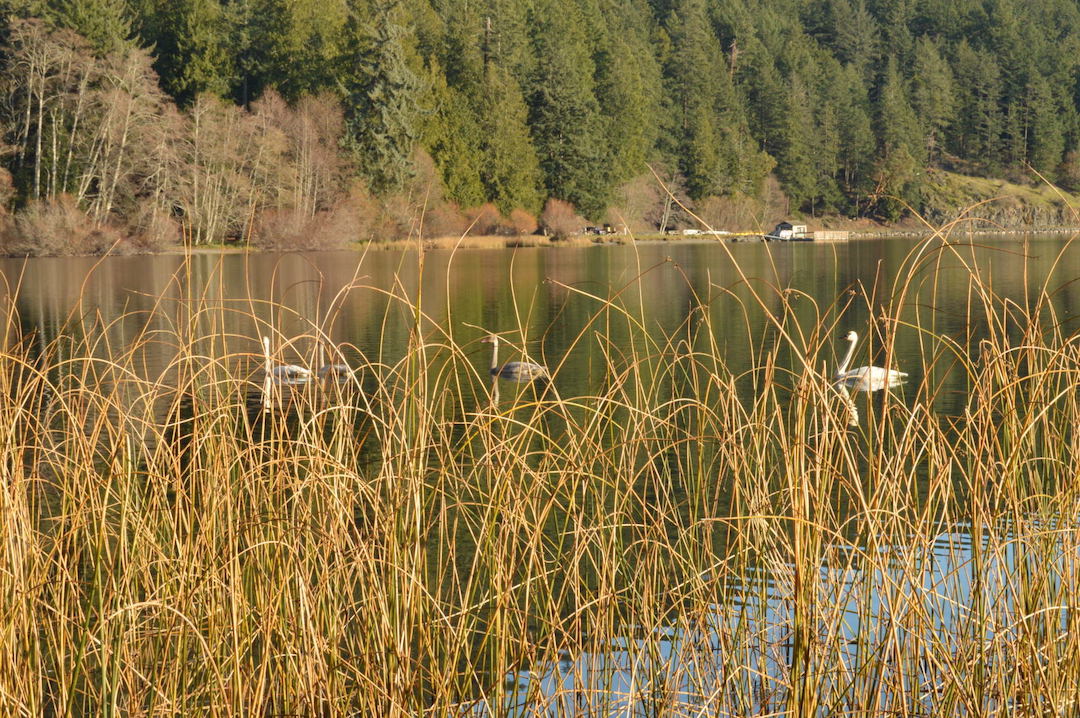
Photo by Sarah Lorse
all connected
As water flows from the Cascade Mountains and the Olympic Mountains to the Salish sea, it collects things along its way. The faster the water flows, the more it can carry. A river at its peak flow can move rocks and logs, while water that settles into a pond drops its load into the depths.
Living organisms need water to survive. Unfortunately, not all of them have access to clean water. Left to its own devices, the water cycle, in partnership with plants, soil, and rocks, keeps the earth’s water pure. The problem arises when this system is tampered with.
On a hot summer day after finishing a run, you stick a glass under the tap, turn it on, and fill it up with refreshing water. Imagine that, instead, your glass of water is filled with bacteria, algae, and chemicals.
What once starts as pristine mountain water quickly picks up motor oil, dog poop, soap, pesticides, herbicides, and so much more. All of these nasties end up in the Salish sea, the life-giving water for millions of organisms. Although sewage from our homes receives some treatment in wastewater treatment plants before being released, rainwater and what it carries down a storm drain does not.
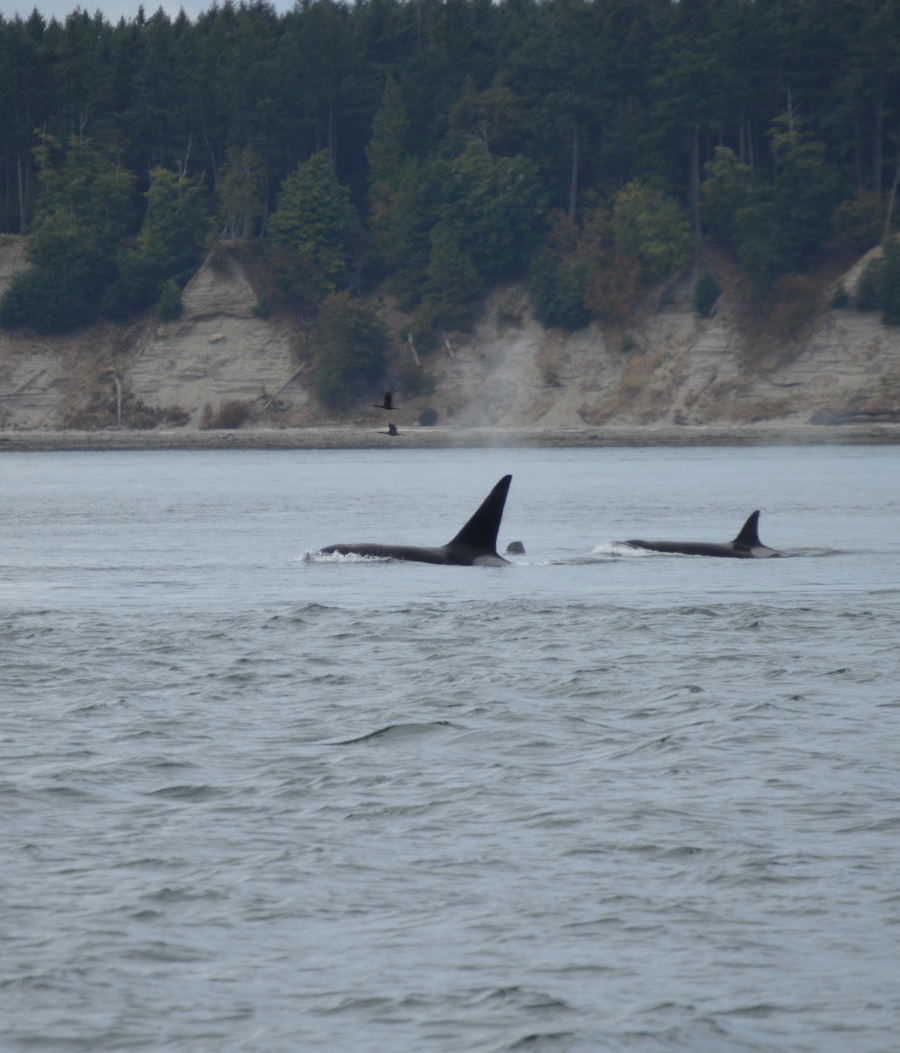
Photo by Sarah Lorse

This image is from a video by Laura James of a West Seattle outfall. Click on the image to see the one minute video about plastics in our environment that contains the outfall video.
how you can help
The world’s water is a shared resource and the responsibility of keeping it clean falls on all our shoulders. A few simple actions you can get started with are:
- Properly washing your car: Wash your car on the lawn, so soap does not go down the storm drain OR go to a carwash that properly handles the soapy water, such as Brown Bear or a Puget Sound Car Wash Association car wash.
- Caring for your garden and lawn naturally: Instead of using chemical fertilizers and pesticides that run off with the rain, you can apply compost, which slowly releases nutrients into the soil where plants can use it. Check with your city, county, or conservation district for more tips on water-friendly gardening.
- Pick up after your pets: Dog poo is full of bacteria, micro-organisms, and excess nutrients that are harmful to soil, humans and other animals. When it is left on the side of a trail, sidewalk, or on your lawn, the rain washes these pathogens and nutrients into storm drains and waterways.
- Caring for your car: Be sure to have your vehicle regularly inspected to check for oil, coolant, and antifreeze leaks and get them fixed.
- Reduce plastic use: Opt for reusable plastics and water bottles over single use plastics.
While these things are easy for individuals to do, they will not solve the greater clean water issue on their own. A big impact on water quality is land development. Forests and wetlands act as filters to clean water. When land is developed for agriculture, housing, or industry, those filtering properties are lost and new sources of pollution are introduced.
 See Issue 9 of Salish Magazine for more about wetlands and their important roles in the water cycle.
Taking small steps in our everyday life is beneficial but that alone will not ensure clean water for all living things. To make a bigger impact, continue to educate yourself, your friends, and family. You can learn more about caring for the Salish Sea from the Washington State Department of Ecology. Taking action by voting and being involved in policy-making will influence regulations governing care of water bodies and mitigation of land development.
Water connects plants, animals, and people locally, globally, and across time. It is easy for us to take our accessible clean water for granted, and when this happens, we end up abusing it. When we all make it our responsibility to keep the world’s water clean, everyone benefits.
Water
damp moist dewy wet
humid steaming sticky sweat
rain hail sleet snow
fog mist cloud rainbow
brook river creek stream
pond lake ocean sea
raft boat surfboard ski
thunderstorm waterspout tsunami
cyclone typhoon hurricane
wild northeaster wind wave train
ice liquid vapor slush
flow drip burble gush
torrent rapids waterfall
glacier iceberg plump snowball
drink bathe swim splash shower
sprinkle it on a bright red flower.
— poem by Adelia Ritchie
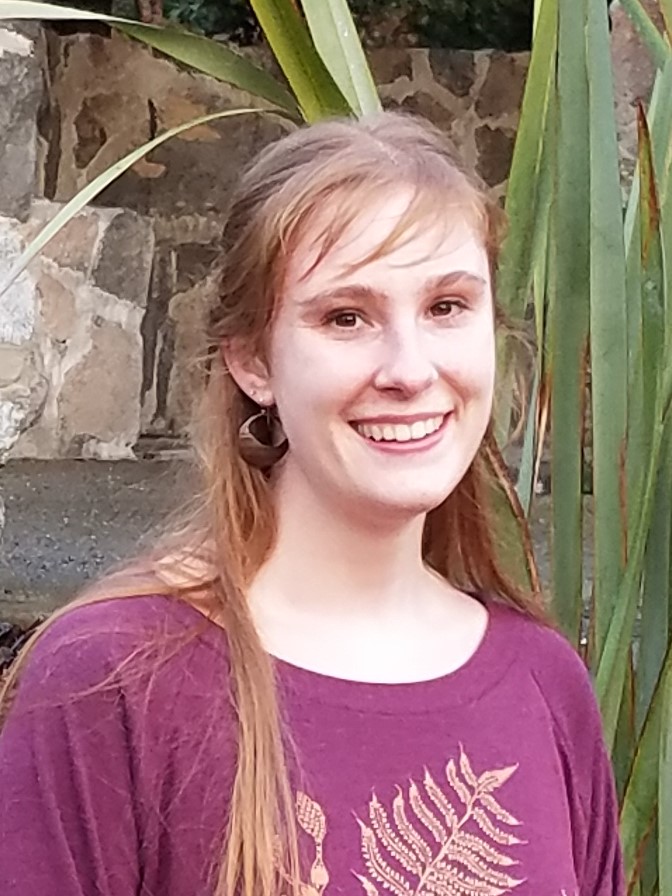
Sarah Lorse is a Seattle-born naturalist, writer, and photographer. She has worked many jobs in the environmental field and is currently working as an organic landscaper. She loves to connect others to nature through her work, whether it is teaching about the benefits of native plants or encouraging responsible recreation practices.
When she is not working, she can be found playing outside. She loves climbing (rocks, mountains, and trees), gardening, and just observing the natural world.
You can find more of her work on her website www.naturewritten.com or by following her on social media @flora_nativa_.
Table of Contents, Issue #10, Winter 2020
Woodland Witness
by Zoe Wadkins Winter 2020 Drawings by Zoe Wadkinsby Zoe Wadkins, Winter 2020 Drawings by Zoe WadkinsIn the three years since our first introduction, I have walked this loop of Deer Creek more than one hundred times. Its rich macroinvertebrate habitat constitutes a...
Restoring Forests
by Dan Hintz, Winter 2020You can see this 2019 Mountains to Sound Greenway tree planting site at Lake Sammamish State Park, located along Issaquah Creek. Photo by Katie Egresi.You can see this 2019 Mountains to Sound Greenway tree planting site at Lake Sammamish State...
See the Salish Sea by Saddle
by Jessica C. Levine, Winter 2020 Photos by Jessica C. Levineby Jessica C. Levine, Winter 2020 Photos by Jessica C. LevineI spend a considerable amount of time pondering cycles. As a cyclist, I bike year round. I’m also a naturalist and place-based science educator....
Many Cycles of Nature
by Leigh Calvez, Winter 2020 Photos by John F. Williams except as notedby Leigh Calvez, Winter 2020 Photos by John F. Williams except as notedAs children we come into a world filled with the cycles of nature. We watch with wonder as the first crocuses of spring poke...
Swallow Season
by Donna Bunten, Winter 2020 Photos by Donna Bunten except as notedPhoto by John F. WilliamsPhoto by John F. Williamsby Donna Bunten, Winter 2020 Photos by Donna Bunten except as notedI dread August—the end of summer, sliding farther down the slope towards darkness,...
Sacred Stream Insects
by Gavin Tiemeyer, Winter 2020 Photos courtesy of King County except where notedby Gavin Tiemeyer, Winter 2020 Photos courtesy of King County except where notedLearning about the natural cycles that govern the health of the Salish Sea starts with peering into your...
Issue 10 Poetry
Winter 2020Photo by Adelia RitchiePhoto by Adelia RitchieWinter 2020Water Drop By Mahathi Mangipudi Wide strokes of grey paint the sky On the windward side of the Cascades Air masses from the Pacific Ocean Saturated with water vapor Condense into little...
The Many Lives of Tree
by Pat Kirschbaum, Winter 2020Photo by John F. WilliamsPhoto by John F. Williamsby Pat Kirschbaum, Winter 2020We are so lucky in the Pacific Northwest to have many places to go where we can be surrounded by trees. As I sat alongside a nearby stream recently, I...
Community Gardens
by Alison Ahlgrim, Winter 2020Photo by Michael YatesPhoto by Michael Yatesby Alison Ahlgrim, Winter 2020My first visit to Everett was a reconnaissance mission to see if my husband and I might like to live there. Drawn to the water, we ended up at the waterfront...
COPYRIGHT
Copyright SEA-Media
All rights reserved. Reproduction or distribution, in whole or in part. without consent of copyright owner is strictly prohibited — except for brief quotations in critical reviews and other noncommercial uses permitted by copyright laws.
SEA-Media is a 501(c)(3) nonprofit corporation
PLEASE HELP SUPPORT
SALISH MAGAZINE
DONATE
Salish Magazine contains no advertising and is free. Your donation is one big way you can help us inspire people with stories about things that they can see outdoors in our Salish Sea region.
We also don't advertise Salish Magazine, so please spread the word of this online resource to your friends and colleagues.
Thanks so much for your interest and your support.