

Edmonds Marsh.
Edmonds Marsh: Small but mighty
by Katherine Derbyshire
Photos by Bill Anderson except as noted
Spring 2024
The Edmonds Marsh is a saltwater estuary formed where Shellabarger Creek and Willow Creek flow into Puget Sound. On the oldest street map of Edmonds I found, from 1900 or so, it is labeled simply “marsh.” It extends south from Dayton Street to the bluff where the Point Edwards Condominiums now stand, and east to just beyond what is now Edmonds Way. Even on that map, though, a dike carrying the Great Northern Railroad (now BNSF) tracks separates the Marsh from the Sound. Land use maps dating to 1897 show heavy logging near the immediate shoreline.
 You can see a land use map and associated information using this link. It is the Land classification sheet, Washington, Seattle quadrangle (1897). Washington 1:125,000 topographic quadrangles, in WSU Libraries Digital Collections.
Covering almost 100 acres on those old maps, the Marsh is now only 22 acres, but it still plays an important role in the ecology of the Edmonds shoreline.
Estuaries represent transitions, from freshwater streams to the saline ocean. They are among the most diverse ecosystems in the world, with species evolved to not just survive, but thrive in the changing conditions. Temperate estuaries are less thoroughly studied than those in the tropics, but researchers at the University of Victoria found that the Cowichan Estuary on Vancouver Island captured twice as much carbon as an equivalent acreage of 20-year-old forest.
“Blue Carbon Storage in a Northern Temperate Estuary Subject to Habitat Loss and Chronic Habitat Disturbance: Cowichan Estuary, British Columbia, Canada,” Tristan J. Douglas, Goetz Schuerholz, S. Kim Juniper, Frontiers in Marine Science, Vol. 9 (2022)
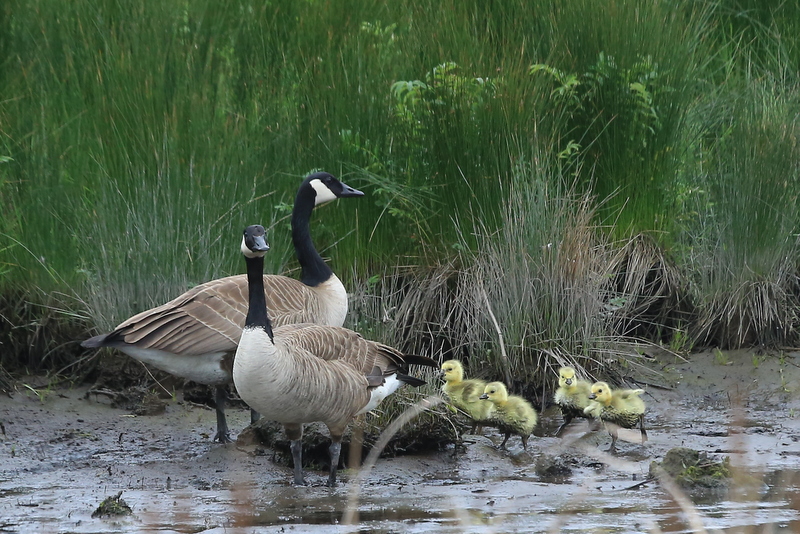

Temperate estuaries contain at least four different habitats. The wettest and most saline, the oyster beds, lie at the edge of open water and are submerged most of the time. A little closer to shore, mudflats are typically exposed at low tide. They lack visible vegetation, but host algae, photosynthetic microbes, and invertebrates that feed on them. Still closer to shore, eelgrass meadows provide food and shelter for young salmon and forage fish. The water here is still salty, but not as deep, allowing correspondingly more light for photosynthesis.
salty transition
Still further inland, the marsh habitat varies in salinity with the tides and the time of year; the boundary between “saltwater” and “freshwater” marsh species is not clearly defined. The wet winters of the Salish Sea bring abundant flows of freshwater and the sediment it carries. In our drier summers, freshwater flow diminishes and saltwater moves further inland. However defined, estuary marshes are critical habitat for salmon during smoltification, the transition from freshwater to saltwater metabolism. In these relatively safe waters, young salmon can feed and grow for up to a year, depending on the species. Young salmon from throughout Puget Sound use stream estuaries and coastal embayments as important way stations en route to the ocean. Besides salmon, mussels and forage fish linger among salt-tolerant reeds. Both resident and migrating birds use marshes to rest, feed, and breed. More than 190 species of birds have been observed in the Edmonds Marsh, for example.
As the water becomes less saline, freshwater species like cattails replace salt-tolerant reeds. Frogs, turtles, and other species that require ready access to land become more prevalent. Eagles, herons, and song birds nest in surrounding trees.

The Encyclopedia of Puget Sound defines all of Puget Sound as an estuarine system. Its depth and the tidal flow through the Straits of Georgia and Juan de Fuca drive the exchange of water between the Sound and the open ocean.
Here is a link to a geographic overview of Puget Sound and the Salish Sea by the Encyclopedia of Puget Sound, a product of the University of Washington’s Puget Sound Institute.

Map courtesy of National Oceanic and Atmospheric Administration (NOAA)
Puget Sound includes many component estuaries, from the Billy Frank Jr. Nisqually National Wildlife Refuge (Nisqually NWR) in the south to the largest contributor of freshwater, the Skagit River, in the north. Over the years since settlement, almost all of these have been modified to a greater or lesser degree. Dikes and levees prevent saltwater flow into what are now farmer’s fields, office parks, and residential neighborhoods. Upstream dams trap freshwater and sediment. Roads and parking lots contribute rivers of toxic runoff.
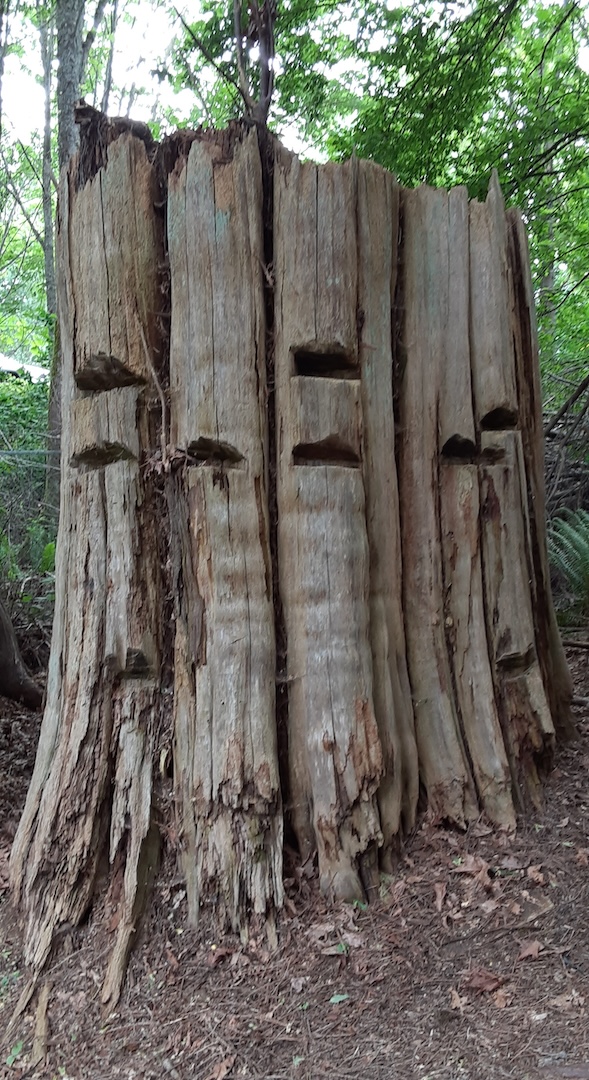
This giant cedar stump near the Willow Creek fish hatchery still shows where early loggers cut notches into the wood so they could insert springboards. The springboards provided platforms where loggers could stand as they cut the tree down. photo by Sara Noland
destruction and rebirth in edmonds
George Brackett bought the property that would become Edmonds in 1870, and proceeded to dike and drain the area near the waterfront. My recent tour of the site with Greg Ferguson, an Edmonds Steward and member of the Edmonds Marsh Estuary Advocates (EMEA), was a walk through decades of environmental insults. Much of the Marsh property was purchased by Unocal in the 1920s, who filled part of it to develop a tank farm and an asphalt plant. Drainage pipes diverted much of the upstream freshwater directly into Puget Sound. A tide gate blocked saltwater flow. Cattails proliferated. So did invasive species like knotweed and deadly nightshade. By the 1980s, the Marsh had been reduced to its current size and almost entirely converted to freshwater habitat. The hundred years ending in 1978 tell a story of almost complete ecosystem destruction.
If the history of Edmonds Marsh before 1978 is a history of ecosystem destruction, the years since are a story of recovery. In 1978, the Port of Edmonds purchased the Harbor Square development; Unocal deeded the remaining Marsh property to the City of Edmonds in 1981. In 1988, the City of Edmonds agreed to reopen the tide gate, allowing saltwater to flow into the estuary again. (It remains closed during winter high tides to prevent flooding.) Unocal’s tank farm — now the responsibility of Chevron — was decommissioned in 1991, with site cleanup beginning soon after. Since then, Ferguson said, salt-tolerant plants have begun to reclaim the oceanside portions of the Marsh, with reeds and sedges displacing cattails.
See more about the cleanup of the Unocal Edmonds site.
Still, Ferguson explained, there is a lot of work to be done. Though saltwater flows into the Marsh again, it does so through a 1600-foot pipe extending deep into Puget Sound. Salmon from the Willow Creek micro-hatchery in the southern corner of the Marsh property can reach the Sound, but none can return. Upstream, much of the water that once flowed into Willow Creek now passes over roads and parking lots before making its way to a system of stormwater drainage pipes. This water — full of petrochemicals and other compounds, many of them highly toxic to fish — currently flows untreated into the Sound.
In the Marsh itself, parts of the former Unocal tank farm remain highly contaminated. Fully reincorporating it into the Marsh ecosystem would involve removing and replacing large amounts of contaminated soil. The project is made more complicated by the positioning of a stormwater pipe directly under the former Unocal property.
While details like these add complexity, the City of Edmonds is continuing restorative work. The next step considers alternative ways to daylight Willow Creek. Freed from its current drainage pipe, the Creek could facilitate access to the Marsh for young and returning salmon.
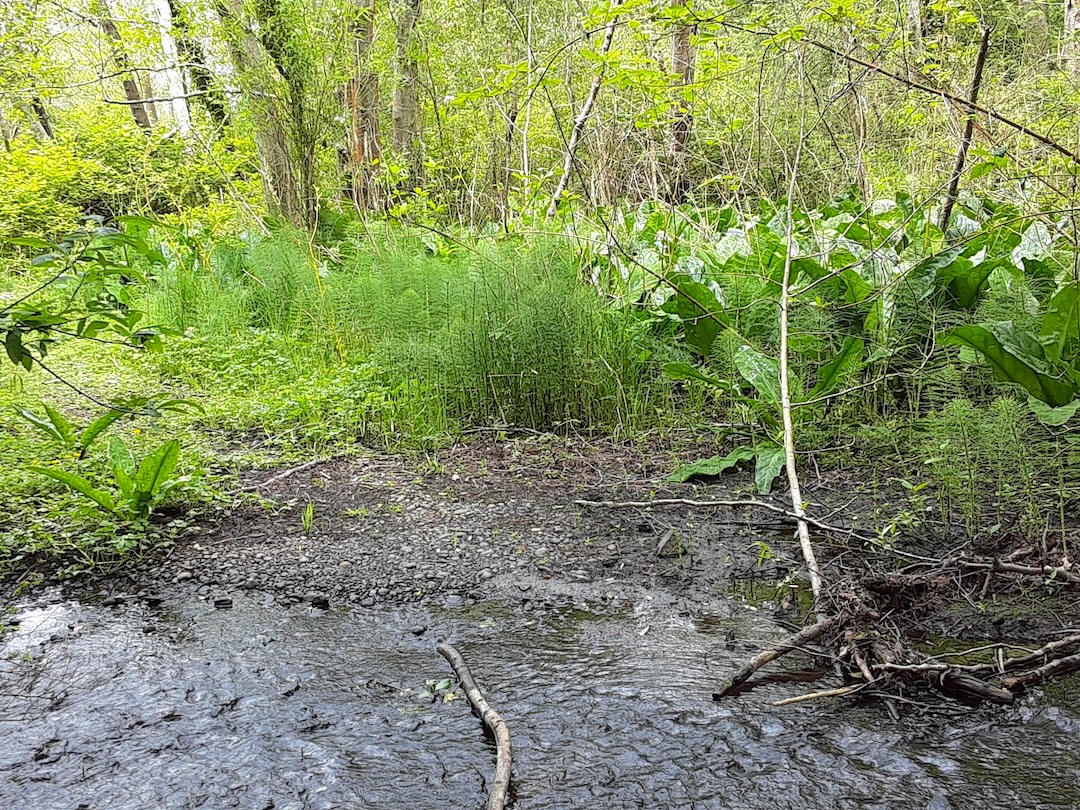
Willow Creek flows through a forested wetland near the fish hatchery. photo by Sara Noland
Improving tidal flows along the Willow Creek channel would improve water quality. Improved riparian habitat along the Creek would support a more complete ecosystem. Creek restoration alone is not enough, though. Contaminated sediments and stormwater contamination still need to be addressed as well.
Elsewhere in Puget Sound, a few restored estuaries have recovered to something approaching their pre-settlement conditions. The success of potential restoration projects depends on the amount of ecosystem degradation, with heavily industrialized sites like tank farms posing many more challenges than former agricultural sites like the Nisqually NWR. Upstream water sources vary in quality as well. The sources of the Nisqually and, on the Olympic Peninsula, the Elwha lie in protected National Parks. Rivers like the Duwamish and the Shellabarger and Willow Creeks in Edmonds drain more industrial surroundings and bring significant toxins to their estuaries. These differences, in turn, affect the cost of restoration projects and the political will to complete them. Successes like the Nisqually NWR show what is possible, but the future of the Edmonds Marsh has yet to be written.

salt marshes and rising seas
Over all of this hangs the looming threat of sea level rise. While humans tend to think in years or decades, the cedars that once overlooked the Marsh can live for centuries. In the short term, estuaries help protect shorelines, providing a buffer between coastal development and pounding waves. In the long term, though, the outlook is grim. By the end of this century, the parking lot near Marina Beach Park where Ferguson and I talked could be under nearly five feet of water at high tide. A spruce or cedar planted on the edge of the Marsh today could drown in saltwater before reaching maturity. Cities and volunteer organizations alike face hard choices as they invest their limited resources. Is the best strategy to plant based on a best guess, or to plant a wide variety of species and allow nature to pick the winners? What happens to contaminated soils and our efforts to clean them up as sea levels rise?
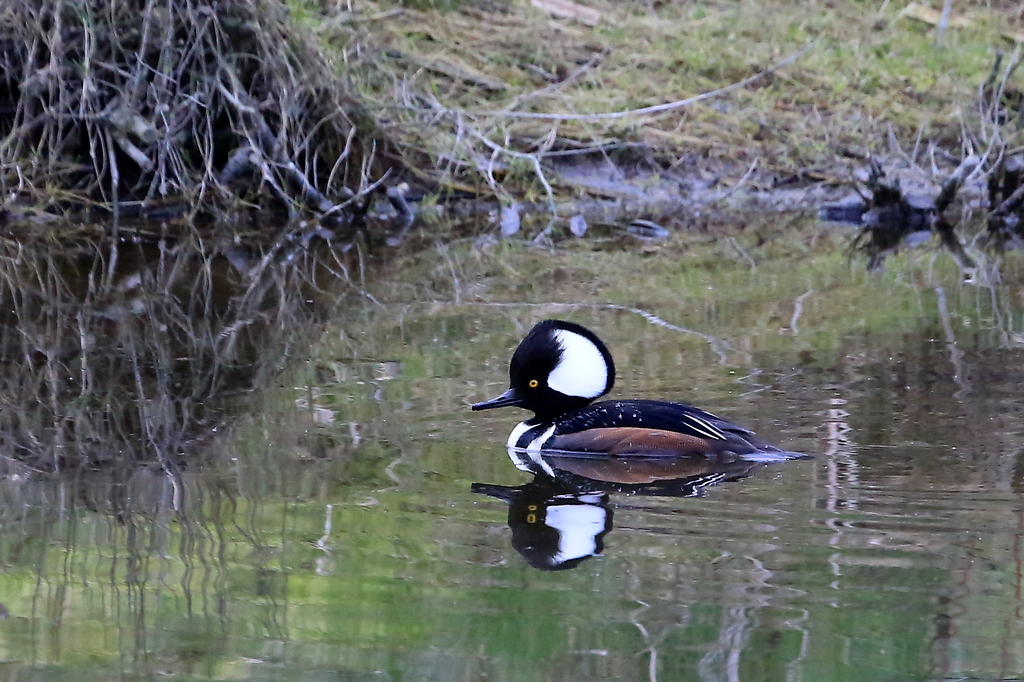
The future of Edmonds Marsh poses hard questions with no obvious answers. In the present, though, ducks paddle in the brackish water. Seagulls wheel, silhouetted against the setting sun. The Marsh is alive.
getting there
Edmonds Marsh is accessible through the Harbor Square office park, 180 W. Dayton Street in downtown Edmonds, WA.
The Edmonds Marsh Estuary Advocates have assembled a large collection of materials about both the Edmonds Marsh and other estuaries around the Sound. Their site is an invaluable resource. The EMEA site also hosts paintings of the Marsh and information about a grant the organization recently helped the City of Edmonds obtain to further study soil contamination, flood risk, and the future of the Marsh.
Link to Edmonds Marsh Estuary Advocates site.
FIND OUT MORE
Similar ecosystems, large and small, can be found throughout Puget Sound. The largest and healthiest is probably the Billy Frank Jr. Nisqually National Wildlife Refuge in Olympia, Washington.
The Meadowdale Beach Park and Estuary Restoration Project, completed in 2023, faced challenges similar to the Edmonds Marsh restoration. Lund’s Gulch Creek was similarly isolated from the sound by BNSF tracks. The Meadowdale project’s success helps demonstrate what stakeholders can achieve when they work together.
Katherine Derbyshire is a Seattle area freelance writer focused on science and technology. Follow her at:
Table of Contents, Issue #24, Summer 2024

Pocket Beach
by Julie Jeanell Leung, Summer 2024images by Julie Leung except as notedPocket beach in Myrtle Edwards Park, adjacent to Olympic Sculpture Park in Seattle.by Julie Jeanell Leung, Summer 2024images by Julie Leung except as notedLooking through Alexander Calder's...
Avalon Pond
by Joshua Ralph, Summer 2024Everett Crowley park, Vancouver Canada. photo by Chelaxy Designs via Unsplashby Joshua Ralph Summer 2024a history in a landscape Nestled within the far southeast corner of what is today Vancouver, British Columbia, lies a 40-hectare park,...
Wild Birds and Window Collisions
by Jeff Beyl, Summer 2024Black-capped chickadee. photo by Skyler Ewing via Pexelsby Jeff Beyl Summer 2024It happened again this morning. At first, I thought it was a gunshot. My head jerked, my shoulders jumped, and I quickly ducked beside the breakfast table. I...
Salamanders, Stormwater, and Skateboards
by Susan McCleary, Jessica Sandoval, Max Lambert, Claire Kerwin, Summer 2024Yauger Pond when the area is not flooded. photo courtesy of WDFWby Susan McCleary, Jessica Sandoval, Max Lambert, Claire Kerwin Summer 2024Map of the route of water from Yauger Park to the...
The Wild Indoors
by Sarah Ottino, Summer 2024 images by Sarah Ottino except as noted Clogmia albipunctata or drain fly, less than 1/4" long. photo by John F. Williamsby Sarah Ottino images by Sarah Ottino except as noted Summer 2024Many of us think of nature as being restricted to the...
Neanderthals in the House
by David B. Williams, Summer 2024 images by David B. Williams except as notedFrench Limestone containing fossils in an exterior wall of Westlake Center, Seattle. photo by John F. Williamsby David B. Williams images by David B Williams except as noted Summer 2024In the...
Joy & Woes: Anna’s Hummingbirds
by Anya Gavrylko, Summer 2024Anna's hummingbird. photo by Veronika Andrews via Pixabayby Anya Gavrylko Summer 2024My freshman year of college I was in a regular state of awe as I adjusted to my new surroundings. I had moved to Seattle from the suburbs of Chicago, and...
Poetry 24
by multiple poets Summer 2024photo by of John F. Williamsby multiple poets Summer 2024Three Colleagues and a Coyote by Jessica Levine This poem was written in the morning of April First, describing the wild and wonderful life of being a bike commuter in the city. This...
COPYRIGHT
Copyright SEA-Media
All rights reserved. Reproduction or distribution, in whole or in part. without consent of copyright owner is strictly prohibited — except for brief quotations in critical reviews and other noncommercial uses permitted by copyright laws.
SEA-Media is a 501(c)(3) nonprofit corporation
PLEASE HELP SUPPORT
SALISH MAGAZINE
DONATE
Salish Magazine contains no advertising and is free. Your donation is one big way you can help us inspire people with stories about things that they can see outdoors in our Salish Sea region.
We also don't advertise Salish Magazine, so please spread the word of this online resource to your friends and colleagues.
Thanks so much for your interest and your support.