
Neanderthals in the House
Or At Least Their Relatives, and Ours, Tooby David B. Williams, Summer 2024
images by David B. Williams except as noted
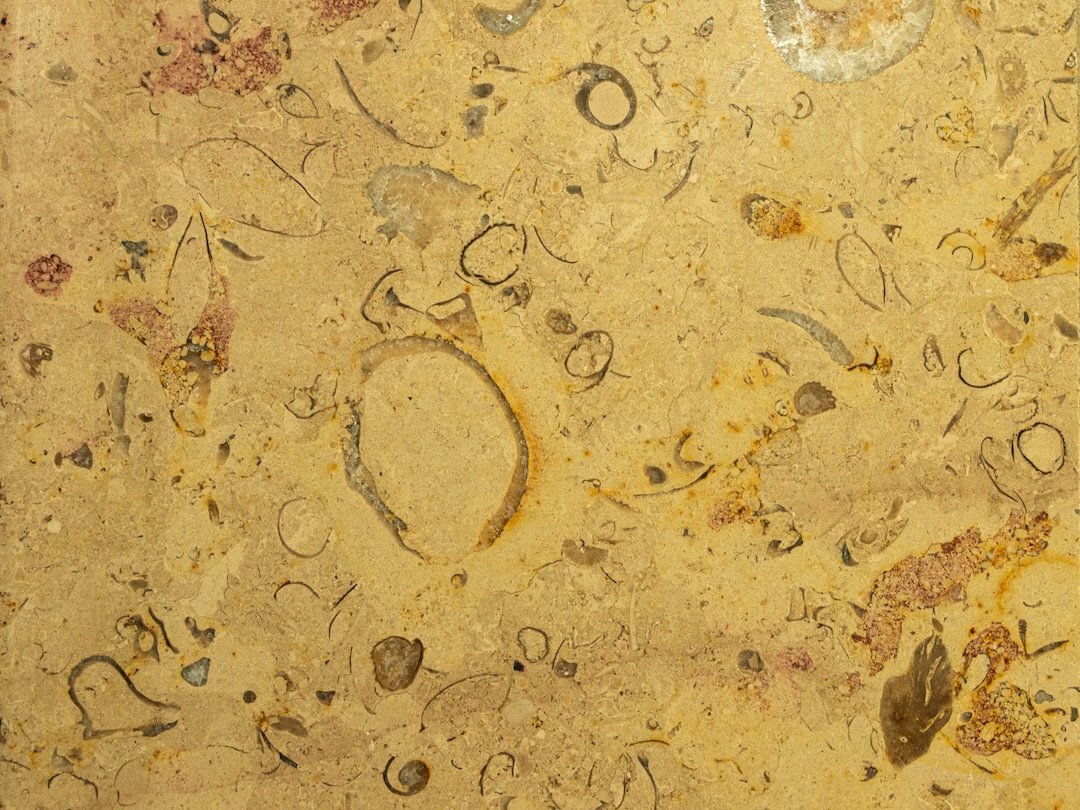
French Limestone containing fossils in an exterior wall of Westlake Center, Seattle. photo by John F. Williams
Neanderthals in the House
Or At Least Their Relatives, and Ours, Too.by David B. Williams
images by David B Williams except as noted
Summer 2024
In the past few weeks, a fossil story out of Europe attracted the attention of geogeeks and others worldwide. An unidentified man visiting his parents to see their newly renovated floors noticed what looked like a mandible in the travertine tiling. (He should know as he’s a dentist.) Turns out the travertine came from quarries in Turkey, near where others have found the fossilized remains of animals such as mammoths, giraffes, and turtles, as well as early hominids. They are between 800,000 to 1.7 million years old. At present, the recently-noticed mandible has not been identified to species though it’s clearly a relative in our genus.
You don’t have to travel to Europe (plus the location is being kept secret to protect the family’s privacy) to see fossils in quarried travertine. Down at the opposite end of our coast line, in Los Angeles, the Getty Museum is covered in travertine. Like all travertine, the Getty rock formed in a hot springs, where water that had percolated through limestone reached the surface, released carbon dioxide, and became supersaturated in the mineral calcite, which then precipitated out of the water and accumulated. A well-known example of travertine is Mammoth Hot Springs in Yellowstone National Park.
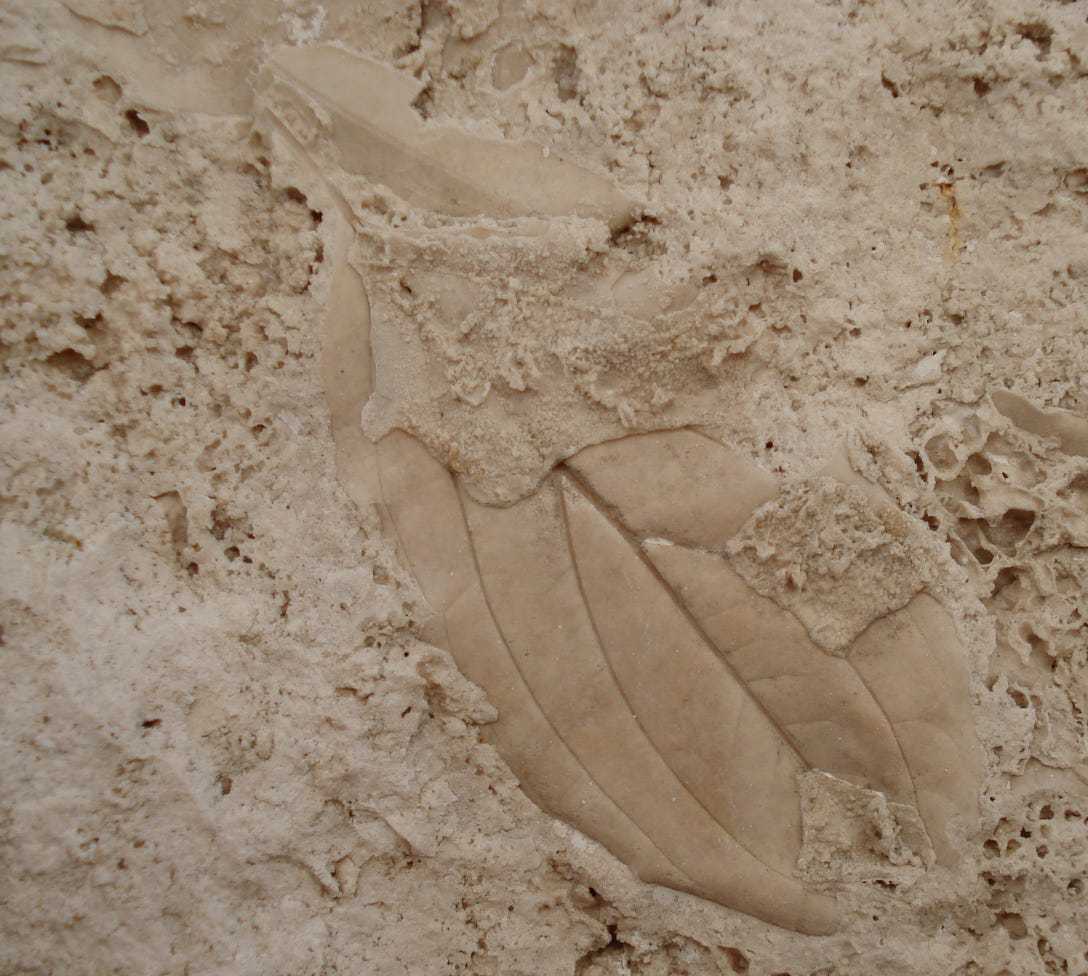
One of about a gazillion fossil leaves at the Getty. Note the insect damage at the top upper edge of the leaf.
The Getty travertine came from Tivoli, Italy, about 20 miles from Rome, home to the most famous travertine building in the world, the Colosseum, which came from the same quarries. At the Getty, fossils (less than 165,000 years old) are everywhere. Primarily leaves, the fossils look like poplars, ivy, and dogwoods and are so detailed and well-preserved, one can pick out individual veins and stems and even tell if the leaf is upside down or right side up. The leaves look as if one could simply peel them off the panels. The fossils are so beautiful there’s really no need to go into the museum.
If you don’t want to go to LA, you still have many options for urban fossils in Seattle. (We have several travertine buildings, but I have not found any leaves, or mandibles, despite spending a heap of time investigating them.) Here are a few examples.

German limestone — Quarried near Treuchtlingen, Germany, from 155-million-year-old marine deposits. The most common fossils — irregularly shaped and darker than the surrounding matrix — are sponges, bottom dwelling, filter feeders that formed small mounds. Ammonites are the largest fossils. They are coiled-shell animals that resemble a top down view of a cinnamon roll (without frosting, mind you). Other fossils include belemnites and forams, single celled critters that look like oatmeal flakes in this rock but which are way, way more cool than that. A similar limestone, from France, covers the floors of Westlake Mall though it lacks ammonites and has more coral.
Examples can be found in several locations:
- Cherry Hill branch of Swedish Hospital — First floor in main building.
- SeaTac Airport — A/B Food concourse columns.
- Grand Hyatt Hotel — Floor of lobby.
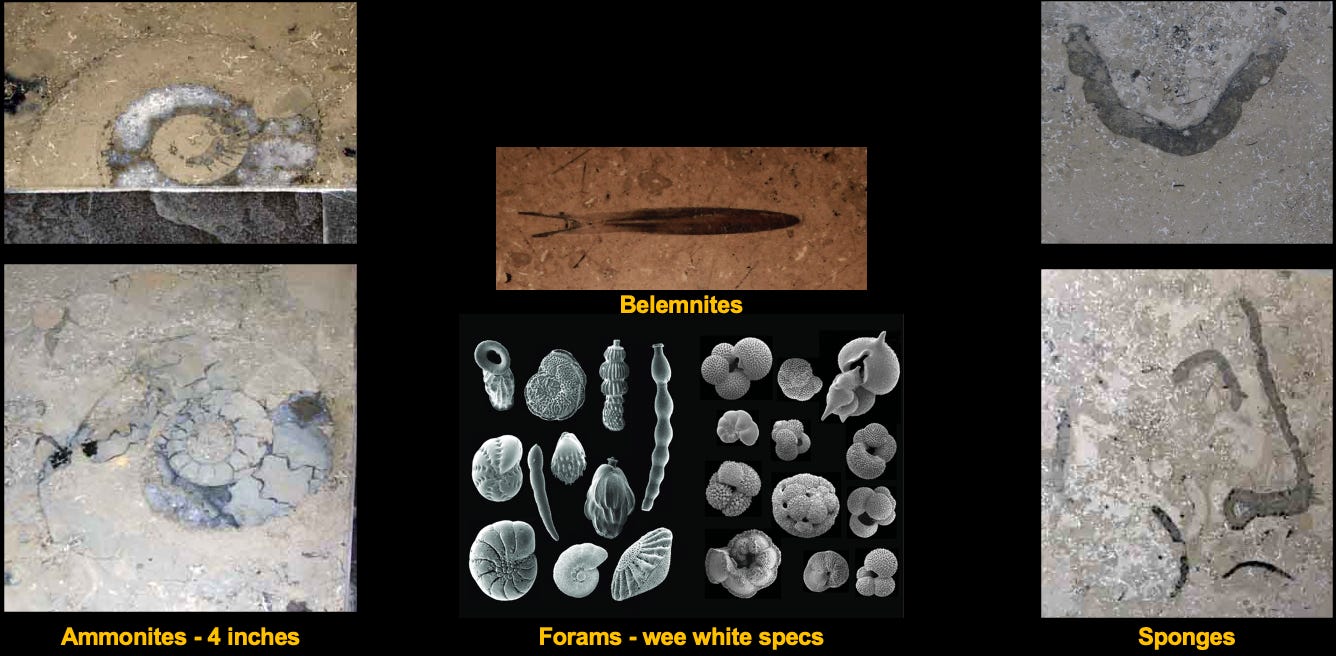
Fossils found in the Treuchtlingen limestone
Salem Limestone — 330 million years old – Quarried in Indiana and consisting of many fossilized invertebrates that lived in a warm, shallow sea when the midwest looked like the Bahamas. Most common are crinoid (a sea star relative) stems, which resemble small (less than 1/3 inch) poker chips; horn corals; and bryozoans, an animal that lived in colonies that resemble Rice Chex cereal. Most of the fossils are broken into bits, but they can still be puzzled out. The limestone also has a starring role in one of the best movies ever, Breaking Away.
Locations to see them include the exterior walls of the Rainier Club, University Presbyterian Church, and the old Seattle Times building.

Yellow = crinoid. Blue = bryozoan. Red = coral. Sadly this panel is better than any in Seattle (it’s from Indiana), but it gives you an idea of what can be found.
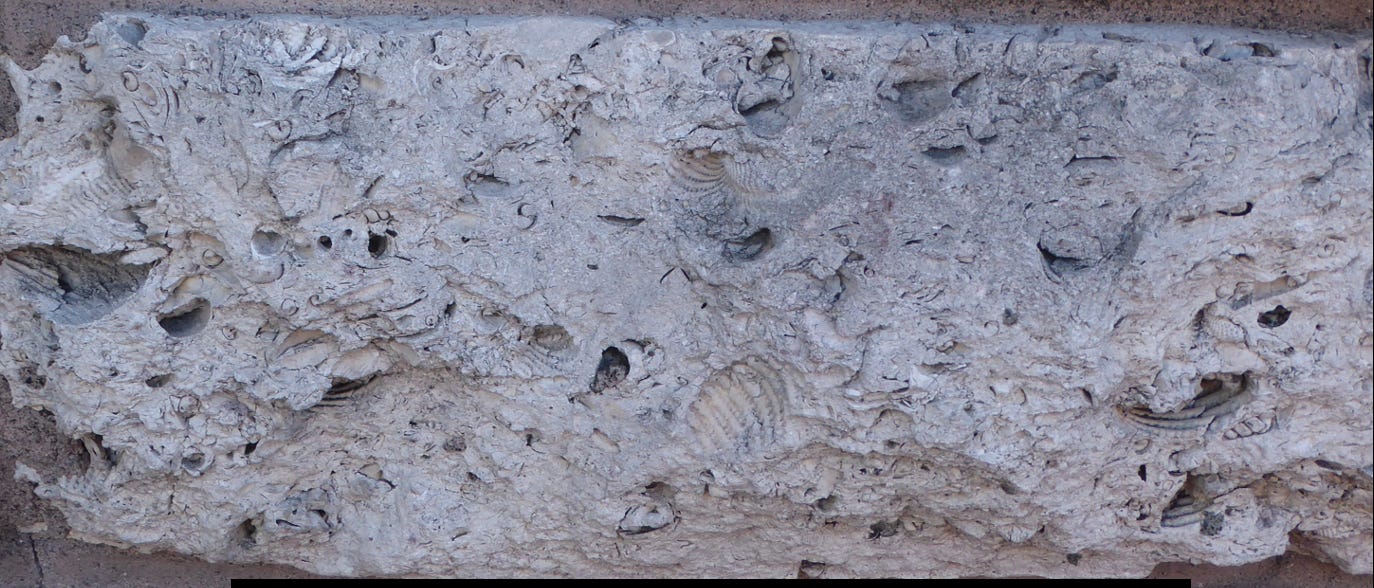
Texas Limestone — The 105-million-year-old Walnut or Edwards Formation limestone was deposited on a shallow marine platform. Though limited in diversity the fossils are pretty abundant. They include casts and molds of an oyster (the ribbed shell) and a gastropod, probably in the genus Turritella, which, as the name implies, is turret-like. I have found these in several buildings including a store at the NE corner of McGraw St. and Queen Anne Ave. N. and a dentist’s office on the SW corner of N 72nd St. and N Greenwood St., as well as one in Port Angeles.
Building stone fossils are one of my favorite features of the urban natural world. As I have written and said many times, nature is all around us, if we take the time to slow down and pay attention. Plus, we all know there’s far too much bad architecture out there, so if you focus on the rock you can ignore the ugliness. Happy exploring!
FIND OUT MORE
This article was originally published in David B. Williams’s Street Smart Naturalist: Explorations of the Urban Kind, a free newsletter oriented toward building stronger connections to place through stories of human and natural history in the Pacific Northwest. You can subscribe to the newsletter via the link above.
If you want to dive deeper into the subject of building stone in urban environments, see the book: Stories in Stone by David B. Williams.

David B. Williams is an author, naturalist, and tour guide whose award-winning book, Homewaters: A Human and Natural History of Puget Sound is a deep exploration of the stories of this beautiful waterway. He is also the author of Too High and Too Steep: Reshaping Seattle’s Topography and Seattle Walks: Discovering History and Nature in the City. Williams writes a free weekly newsletter, the Street Smart Naturalist.
https://geologywriter.com
Table of Contents, Issue #24, Summer 2024

Pocket Beach
by Julie Jeanell Leung, Summer 2024images by Julie Leung except as notedPocket beach in Myrtle Edwards Park, adjacent to Olympic Sculpture Park in Seattle.by Julie Jeanell Leung, Summer 2024images by Julie Leung except as notedLooking through Alexander Calder's...
Avalon Pond
by Joshua Ralph, Summer 2024Everett Crowley park, Vancouver Canada. photo by Chelaxy Designs via Unsplashby Joshua Ralph Summer 2024a history in a landscape Nestled within the far southeast corner of what is today Vancouver, British Columbia, lies a 40-hectare park,...

Wild Birds and Window Collisions
by Jeff Beyl, Summer 2024Black-capped chickadee. photo by Skyler Ewing via Pexelsby Jeff Beyl Summer 2024It happened again this morning. At first, I thought it was a gunshot. My head jerked, my shoulders jumped, and I quickly ducked beside the breakfast table. I...
Salamanders, Stormwater, and Skateboards
by Susan McCleary, Jessica Sandoval, Max Lambert, Claire Kerwin, Summer 2024Yauger Pond when the area is not flooded. photo courtesy of WDFWby Susan McCleary, Jessica Sandoval, Max Lambert, Claire Kerwin Summer 2024Map of the route of water from Yauger Park to the...
The Wild Indoors
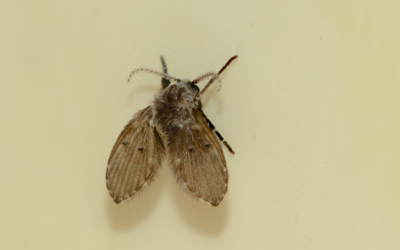
by Sarah Ottino, Summer 2024 images by Sarah Ottino except as noted Clogmia albipunctata or drain fly, less than 1/4" long. photo by John F. Williamsby Sarah Ottino images by Sarah Ottino except as noted Summer 2024Many of us think of nature as being restricted to the...
Joy & Woes: Anna’s Hummingbirds
by Anya Gavrylko, Summer 2024Anna's hummingbird. photo by Veronika Andrews via Pixabayby Anya Gavrylko Summer 2024My freshman year of college I was in a regular state of awe as I adjusted to my new surroundings. I had moved to Seattle from the suburbs of Chicago, and...
Poetry 24
by multiple poets Summer 2024photo by of John F. Williamsby multiple poets Summer 2024Three Colleagues and a Coyote by Jessica Levine This poem was written in the morning of April First, describing the wild and wonderful life of being a bike commuter in the city. This...
COPYRIGHT
Copyright SEA-Media
All rights reserved. Reproduction or distribution, in whole or in part. without consent of copyright owner is strictly prohibited — except for brief quotations in critical reviews and other noncommercial uses permitted by copyright laws.
SEA-Media is a 501(c)(3) nonprofit corporation
PLEASE HELP SUPPORT
SALISH MAGAZINE
DONATE
Salish Magazine contains no advertising and is free. Your donation is one big way you can help us inspire people with stories about things that they can see outdoors in our Salish Sea region.
We also don't advertise Salish Magazine, so please spread the word of this online resource to your friends and colleagues.
Thanks so much for your interest and your support.