
SALT MARSHES
by Ron Hirschi, Autumn 2020
Gumweed photo by John F. Williams
Gumweed photo by John F. Williams
SALT MARSHES
by Ron Hirschi, Autumn 2020
I’ve enjoyed, studied, mapped, and tried to protect wet places for pretty much my entire life. So, I thought I’d take the opportunity to share some with you.
Top of my list are salt marshes. Those along the shore may be reachable simply because they are fringing a beach or at the mouth of a river or stream. Others may be reached by canoe or kayak, but given how much of Washington shores are privately owned, it’s a good idea to check that the salt marsh you want to visit has public access.
Salt marshes are coastal wetlands that are flooded and drained by salt water brought in by the tides. They are marshy because the soil may be composed of deep mud and peat. Peat is made of decomposing plant matter that is often several feet thick. Peat is waterlogged, root-filled, and very spongy. Because salt marshes are frequently submerged by the tides and contain a lot of decomposing plant material, oxygen levels in the peat can be extremely low––a condition called hypoxia. Hypoxia is caused by the growth of bacteria that produce the sulfurous rotten-egg smell that is often associated with marshes and mud flats.
thorndyke bay (hood canal)
My introduction to salt marshes was at the age of 13. My Grandpa took me duck hunting to his spot on Thorndyke Bay. In those days we could easily access the bay by way of a road from Highway 104. Today you can get here best by small boat or kayak.
Kayaking or canoeing down from the north allows you to trace a unique piece of shoreline. High, clay bluffs line the shore from South Point to the bay. Here is where an occasional mastodon tusk falls from the glacial leavings and if you are at a low tide, Dungeness crab await in the eelgrass shallows, or sea-run cutthroat lurk, interested in a variety of flies you might toss. Here too, maple trees seem to fall onto the beach as if pulled on a carpet from above. Not a good place to build your dream home!
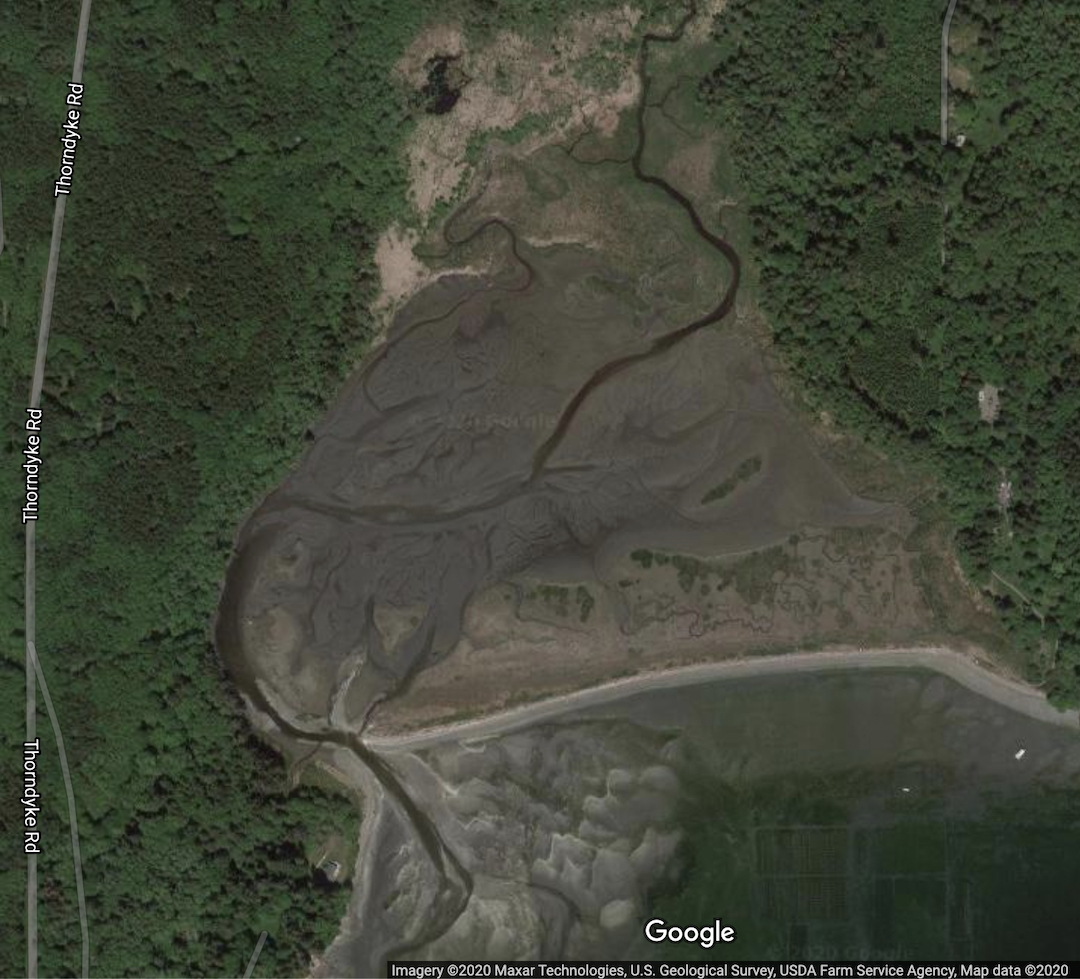
Once at the bay, you will first notice a long spit like many others in the Salish Sea. The inner, more protected edges of the spit are lined with a variety of plants that live in this environment and pretty much no place else. Here, where the spit protects the inner bay waters where Thorndyke Creek flows into Hood Canal, was where I fell in love with native plants like gumweed, pickleweed and salt grass.
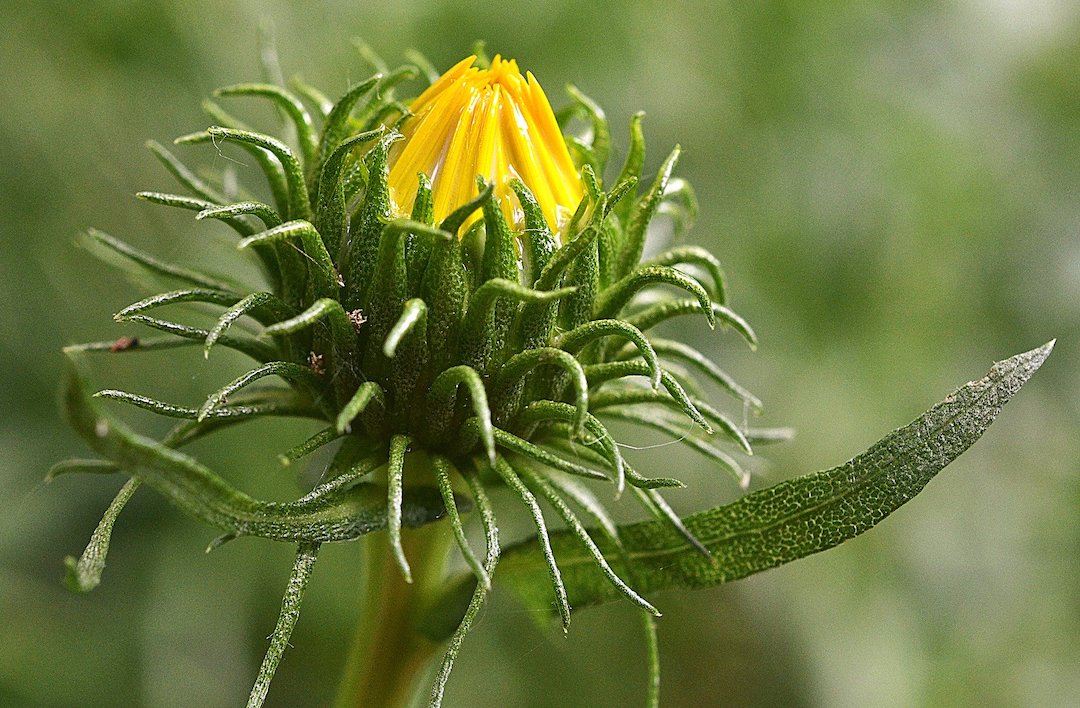
Photo courtesy of Anemone123, Pixabay
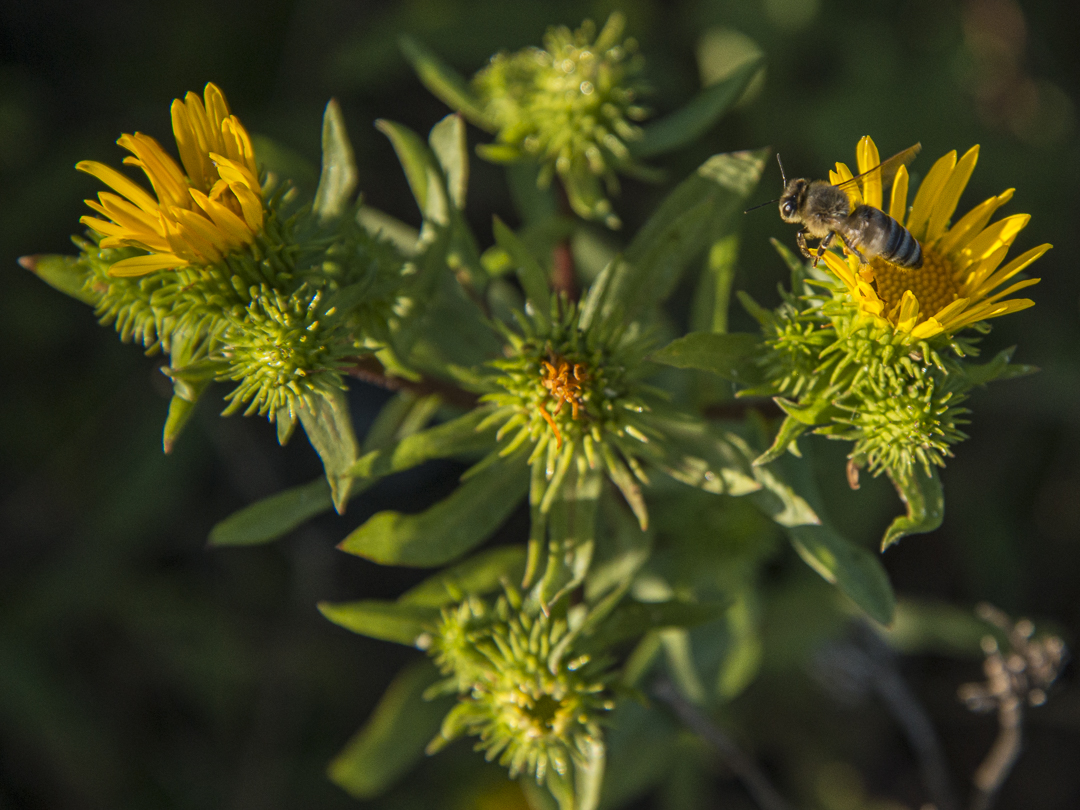
Grindelia, also known as gumweed, is a tall sticky plant with yellow flowers. It grows up higher than others with a mix of meadow species, including a beautiful purple aster.
Farther into the salt marsh you will notice narrow cuts, channels of water that bring high water up into the marsh you are now enjoying. Low, fairly dense plants include my favorites: salt grass and pickleweed.

Pickleweed photo courtesy of Mary Jo Adams
Pickleweed is a native segmented succulent plant that can withstand and grow in high salinity conditions. Pluck one and taste. It’s kind of salty but not bad with a satisfying crunch.
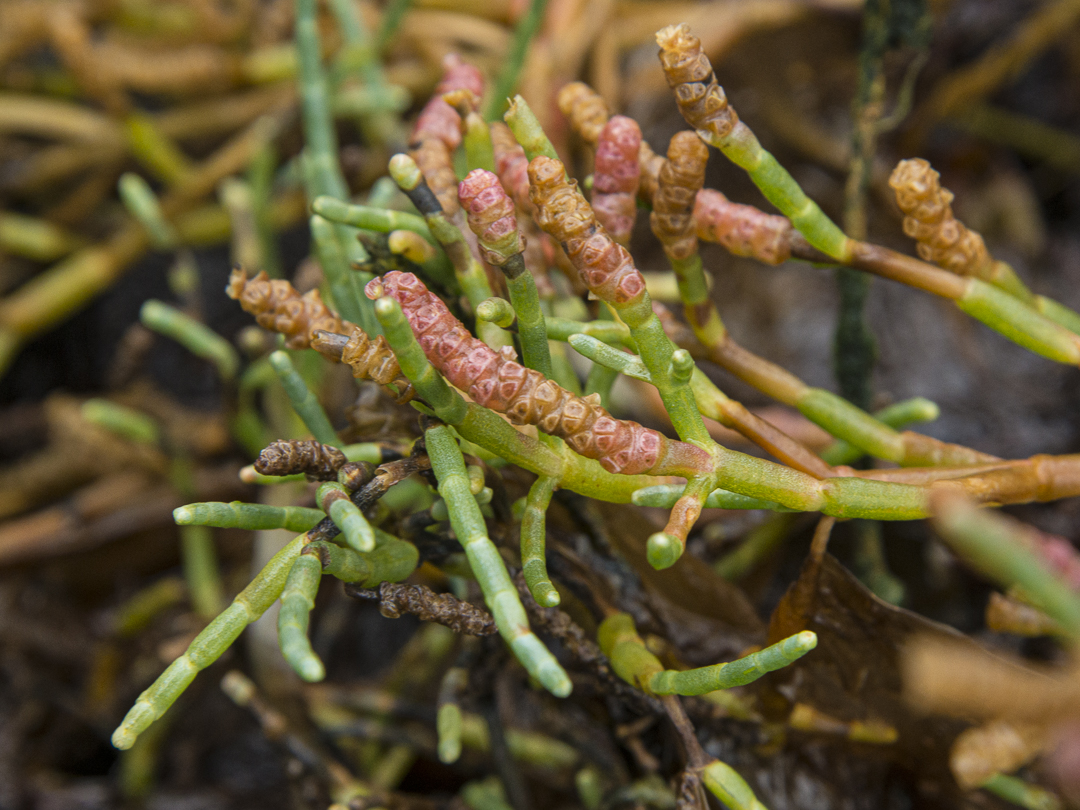
Photo by John F. Williams
Salt grass has beautifully arranged branched blades and if you spread the plants away from the damp soil, you will probably find tiny snails. These are Newcomb’s littorine snails (also knows as Newcomb’s periwinkle), once thought to be rare but more recent studies have shown them to be relatively common.
Thorndyke remains a beautiful marsh and one worth visiting even if it takes a bit of effort to reach. If you visit in August or September you will be greeted by flocks of shorebirds and hundreds of wigeon, a few pintails, and an occasional mallard, plus some green winged teal and bufflehead ducks.
Saltgrass: Distichlis spicata
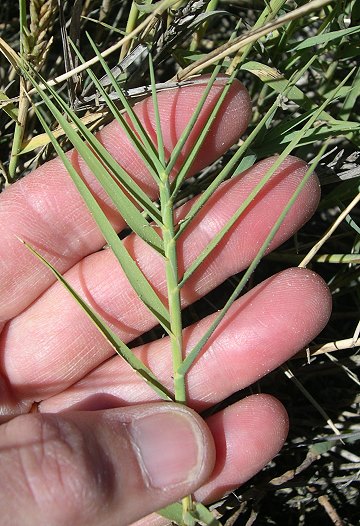
Photo courtesy of Mary Jo Adams
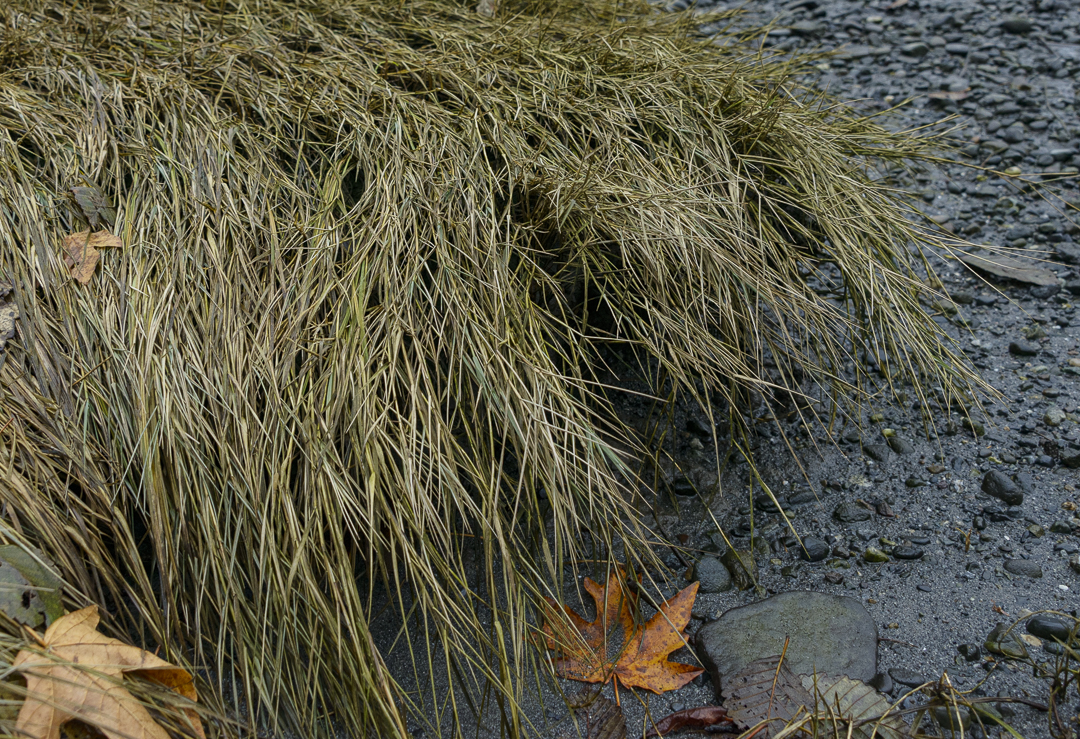
Photo by John F. Williams
foulweather bluff
A similar marsh, and easier to reach, is the Foulweather Bluff marsh in Hansville, in North Kitsap County. Drive into Hansville and then turn west on Twin Spits Road and follow it until it ends at the beach. Park at the road end and walk to the north. Best at low tide, you can trace the edge of the beach until you come to a shallow and easily forded channel. This narrow bit of water drains a blind lagoon, where no stream enters the lagoon, just tidal flow.
You will be in for a real treat if you visit here in April or May. For some reason juvenile chum and pink salmon flood into the lagoon through this narrow opening to feed for a while. Hundreds of baby salmon do this each year, and though not easy to see, you can spot them.

keep your eyes open for surprises
Be aware of the edges of the salt marsh when you are walking beaches. As an example, I was recently leading a group of S’Klallam youth on a field trip to places their ancestors had lived. We walked out across a marshy area and were returning to our vehicles, when I stopped the kids and pointed down at the edge of the marsh and said, “This is the kind of place you will find…” As if I had placed it there, an ancient adze blade appeared, poking out of the edge of the marshy mud. The blade is now with the tribe and now in a position of helping you learn about such things.
So, please look and tread carefully on marshy ground. Waves wash over and sometimes reveal pieces of the past, sometimes revealing ancient places and artifacts.
For further information about PNW tribal adzes, check out this link to the Burke Museum! https://www.burkemuseum.org/news/story-told-stone-and-wood-coast-salish-and-historic-seattle
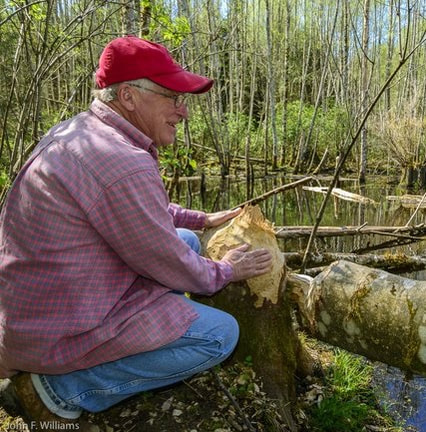
Ron Hirschi is a fish habitat biologist who turned his passion for the future world into working with kids. His more than 50 nature books for young readers have opened many doors to create projects with caring teachers and parents. Locally, he helped create the Suquamish Basket Marsh and was instrumental in the creation of the Nick’s Lagoon park and salmon sanctuary. His work in Ohio has spanned many years and includes restoration of wetlands and creation of a life size humpback whale that dives into the earth where it has inspired hundreds of kids to think ocean. His writing continues with a new book all about the many endangered species in Hawaii. He most favors his time spent at his alma mater, Wolfle Elementary where, each year, he and others take kids out into Hood Canal to see who lives there and who we might protect.
Table of Contents, Issue #9, Autumn 2020

From Swamps and Bogs …
by Sara & Thomas Noland, Autumn 2020 Photos by Thomas Noland except as notedby Sara & Thomas Noland, Summer 2020 Photos by Thomas Noland except as notedWetlands are part of our landscape here in the lowlands near the Salish Sea. Anyone who’s walked around in a...
Issue 9 Art Poetry
Autumn 2020Juan de Fuca painting by Melissa McCannaJuan de Fuca painting by Melissa McCannaSummer 2020Going Home, painting by Julia MillerComing Home by Dawn Henthorn Salmon come home home to the Elwha. Bit by bit of rubble two feet at a time, the dams were removed,...
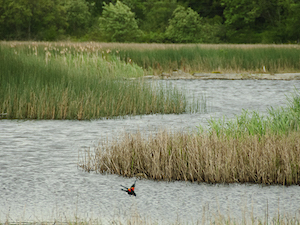
Importance of Wetlands
by Josh Wozniak, Autumn 2020 Photographs by John F. Williamsby Josh Wozniak, Summer 2020 Photographs by John F. WilliamsTaking many forms, wetlands are natural features of the landscape that provide crucial functions for both nature and humankind. We benefit directly...
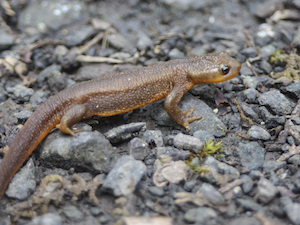
Newts: Wetland Magicians
by Sharon & Paul Pegany, Autumn 2020 Photos by Sharon Pegany except as notedby Sharon & Paul Pegany, Summer 2020 Photos by Sharon Pegany, except as noted. Did I just see what I think I saw? I had to do a double take while exploring the edge of a local pond...
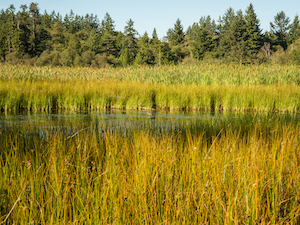
Healthy Wetlands
by Curt Hart and Marcus Humberg, Autumn 2020Wetland at Point No Point, photo by John F. WilliamsWetland at Point No Point, photo by John F. Williamsby Curt Hart and Marcus Humberg, Summer 2020For the 4.2 million residents in and around Puget Sound, there is a good...
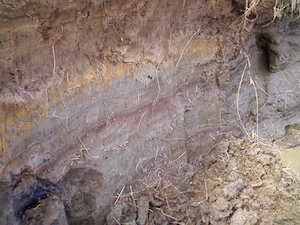
Earthquakes and Tsunamis
by Carrie Garrison-Laney and Ian Miller Autumn 2020 A photo of sediments in the coastal marsh near the mouth of Salt Creek on the Strait of Juan de Fuca, showing distinct bands of different colors and textures. Photo by Ian Miller.A photo of sediments in the coastal...
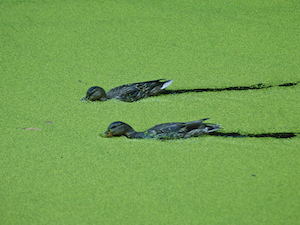
10 Things About Duckweed
by Adelia Ritchie, Autumn 2020 Photos by John F. Williams, except as notedby Adelia Ritchie, Summer 2020 Photos by John F. Williams, except as noted 1. Duckweed grows in dense colonies in quiet water that is undisturbed by wave action. We try to avoid insulting still...
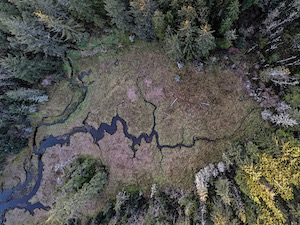
Carpenter Creek Salt Marsh
by Melissa Fleming & Terry Pereida, Autumn 2020 Photos by Terry Pereida, except as notedSalt marsh with the main channel running down the middle. Photo by Tom TwiggSalt marsh with the main channel running down the middle. Photo by Tom Twiggby Melissa Fleming &...
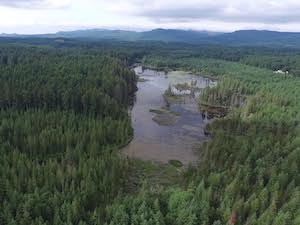
Wetland Basics
Frank Stricklin, Autumn 2020 Photos by John F. Williams except as notedThis large wetland in Newberry Hill Heritage Park is listed by the State of Washington as a “wetland of significant conservation value.” It contains many species of aquatic plants, and some...
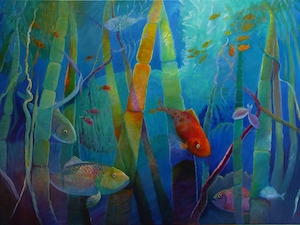
Blue Carbon
by Adelia Ritchie, Autumn 2020Underwater Rainbow, painting by Julia MillerUnderwater Rainbow, painting by Julia Millerby Adelia Ritchie, Summer 2020As you’ll see everywhere else in this issue, a wetland system isn’t just another lovely place for a nature walk. Wetland...
COPYRIGHT
Copyright SEA-Media
All rights reserved. Reproduction or distribution, in whole or in part. without consent of copyright owner is strictly prohibited — except for brief quotations in critical reviews and other noncommercial uses permitted by copyright laws.
SEA-Media is a 501(c)(3) nonprofit corporation
PLEASE HELP SUPPORT
SALISH MAGAZINE
DONATE
Salish Magazine contains no advertising and is free. Your donation is one big way you can help us inspire people with stories about things that they can see outdoors in our Salish Sea region.
We also don't advertise Salish Magazine, so please spread the word of this online resource to your friends and colleagues.
Thanks so much for your interest and your support.